RA FOR ALL...THE ROAD SHOW!

I can come to your library, book club meeting, or conference to talk about how to help your readers find their next good read. Click here for more information including RA for All's EDI Statement and info about WHY I LOVE HORROR.
Showing posts with label obituary. Show all posts

Friday, August 8, 2025

The Power of the Local Public Library: What Dan Read

Below I am finally getting to amplifying a story I have had a note to cover in my drafts folder for a few weeks. Many of you have probably already seen it, but it is too important to not promote.

It is the story of Dan Pelzer. I first read about Mr Pelzer on July 26th in this NYT article (gift link). He read 3,599 books and kept a list with comments. AND he got the majority of them from the public library. His kids uploaded his list so everyone could see "What Dan Read." The site is a tribute to their father, his love of reading, and the Whitehall branch of the Columbus Metropolitan Library.

What I love about this story is not only how important the library was to Mr Pelzer, but how much the library is embracing him back. 

We really cannot fathom how much we are impacting our patrons' lives by helping their find leisure reads. Too often we think our value is tied to how we help them access information that they need, but in reality, it is the work we do for their wants, the little things we do to make people's lives more enjoyable, that really matter.

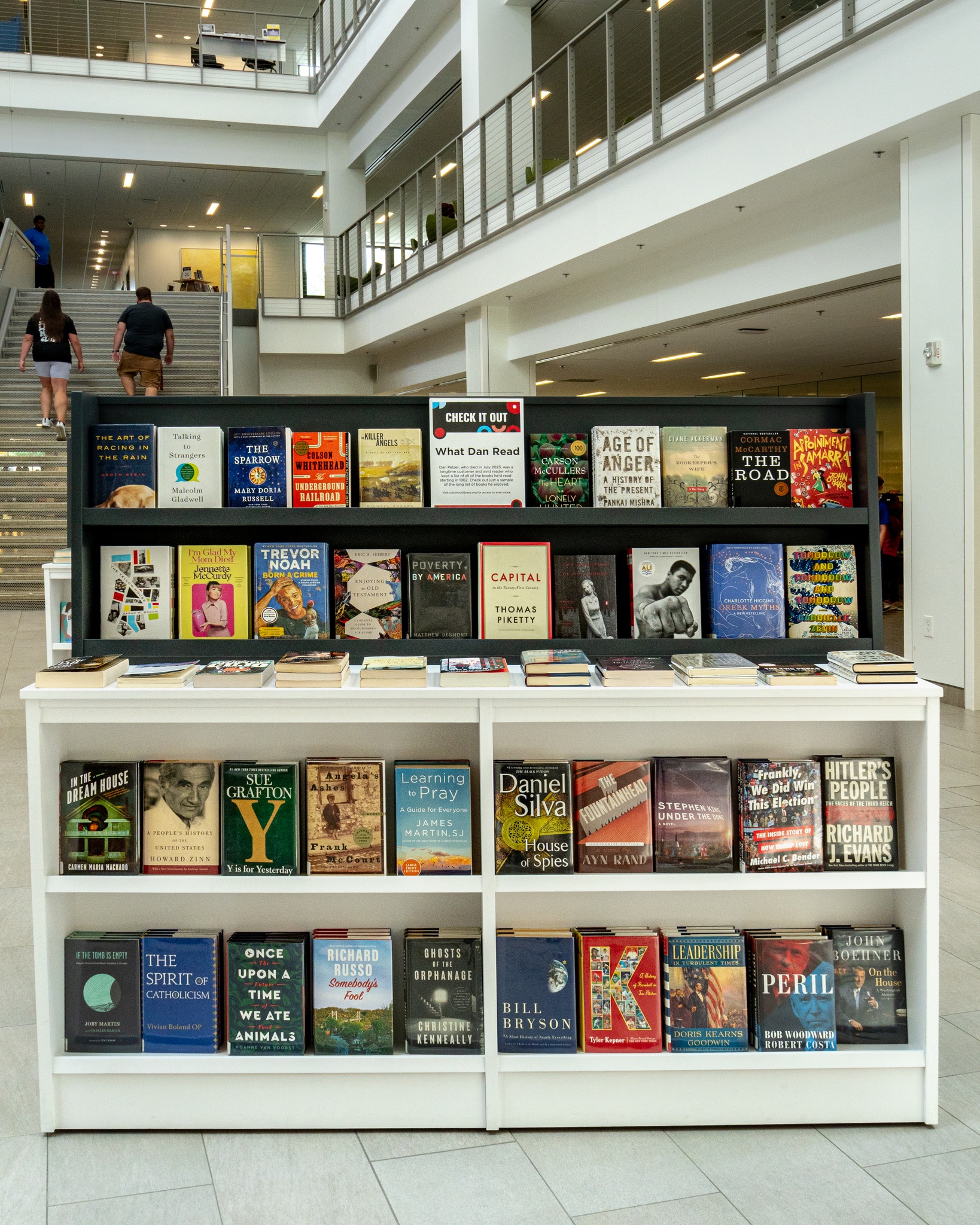
Below is a recent story from Shelf Awareness all about Mr Pelzer with links and pictures of the display the library made in his honor. Everyone can get in on the fun though. The What Dan Read website has gone viral. You can join in on the fun as well. 

Robert Gray: Keeping Up with 'What Dan Read'

I've always felt like an underachiever as a reader when measured by volume. Twenty years ago, I confessed my slow reading habits in a blog post about ARCs ("I'm Reading as Fast as I Can!!"), noting that although I had increased my reading speed somewhat--out of professional necessity--during the first 13 years I'd been a frontline bookseller, I still felt like a biblio-laggard.

Strangely, though, "my customers think I'm a reading machine," I wrote then. "They will sometimes ask, with unmasked awe, 'How many books do you read per week?' It's as if they think I've become some kind of Electrolux, devouring pages as fast as they come off the printing press. The truth is more mundane.... 

"Often I have three, four, or five books going at once, and continue to cast my eyes with hunger and longing at the endless stream of new and tempting titles that come across my desk. And I often just graze, reading 50 pages and bailing if I'm not fully engaged. Nevertheless, the stack on my desk continues to grow at a pace that outstrips my ability to keep up. I seem to look for reasons not to continue reading, reasons to give myself a break and move on to the next title."

I've never been one of those readers who sets yearly goals or meticulously catalogues the books I've read. Before I became a bookseller, I was practically monogamous when I read. I could spend a month with a book, six months with a particular author. The pages of my books were covered with marginalia. I lived in them for long periods, then moved on, as if walking a long, narrow path rather than driving an interstate highway."

So it was with a long-gestating mixture of awe and humility that I recently learned about the extraordinary reading life of Dan Pelzer, who died at the age of 92 on July 1. He logged all 3,599 of the books he had read since 1962, when "he first began jotting his reads down on his language class work sheets while stationed in Nepal with the Peace Corps, to 2023, when his eyesight failed him and he could no longer read," the New York Times reported. 

Most of his books came from the Whitehall Branch of the Columbus, Ohio, Metropolitan Library, which posted on Facebook a message from his daughter, Marci Pelzer, who noted, in part: "Nobody loved the library more than Dan. When we were little, he took us to the downtown library every Saturday morning and enrolled us in every summer reading program. He was a regular at the Livingston and then Whitehall branches until he could no longer read. I'm sure he would be among your highest circulation and longest term borrowers."

She had considered printing his reading list to distribute at the funeral, but it was too long and ultimately she asked her godson create a website featuring What Dan Read, a digitiized version of the handwritten list that guests could access through a QR code on the back of the funeral program. 

The library has since created book displays in his honor at the Whitehall Branch and at Main Library. Lauren Hagan, CEO of the Columbus Metropolitan Library, said a team of about six people at the library were re-creating Pelzer's list online so that it could be used by other patrons.

What Dan Read has since gone viral. Recently, Marci Pelzer told WBNS: "You know, I just keep thinking about how crazy it is that we've spread the list to so many people. Our intention was to hand it out at his funeral. Then, we got the idea to have a QR code. Then, I put it on LinkedIn and it kind of took off and then when the library got a hold of it, it just went crazy.... It's amazing. It's like the dialogue with him about books can continue indefinitely and spread around the globe."

At the Columbus Library

In 2006, a Columbus Dispatch feature explored Dan Pelzer's devotion to reading, noting that he "was making his way through roughly 80 books a year. He had recently read James Joyce's Ulysses, and he wasn't afraid to tell the journalist what he really thought. 'The worst,' he said. 'Pure torture.' " Still, Pelzer finished reading the classic novel because he finished reading every book he started. "Even the books that were dogs, he would slog through to the final page," the Dispatch noted.

When I wrote that blog post mentioned above in 2005, I had just returned home from BookExpo, where I had once again been showered with gifts in the form of ARCs and "now, a new mound of guilt towers above me at this desk. I did not grab them off stacks on a mad locust tour of the show floor. These were nearly all given to me personally by publishers, editors, or authors, who each time handed me the most precious gift they had to give: their work, their life, their hope. I do not have a vested interest in any of the titles that come my way until I read and love them."

I asked myself then: "When will I read all these galleys? Can I read them all? Will I read yours? Maybe, maybe not. But, rest assured that, within the considerable limitations of my ability, time, and attention span, I'll be reading as fast as I can."

I'm no Dan Pelzer though.

--Robert Gray, contributing editor
Tuesday, August 6, 2019

RIP Toni Morrison

Like many of you, I am saddened to hear of the passing of the great Toni Morrison. There are many remembrances and profiles being posted. Here is a link to one of my favorite recent profiles of her [2015] from the New York Times Magazine by Rachel Kaadzi Ghansah.

Obviously, you are all going to put up displays in your libraries of her books to honor her and you really don't need my help to do that. So today, I am just going to post about what Ms. Morrison meant to me, personally.

I am not exaggerating, but I can trace back my career as someone who is paid to write about books to her book The Bluest Eye. I talked about this in greater detail on Episode 13 of the Ladies of the Fright podcast. The discussion of this begins at the 26 minute mark.

In 10th grade American Lit we were assigned this title and had to write an essay. This book affected me deeply. Not only did it give me a window into another world, but it touched me at my core. I can't remember exact details, but I wrote an essay about how the main character would never be okay if she could not learn to love herself. This book was the first time I truly understood how everyone in the world was struggling with something inside of themselves that they all had to work through. It gave 15 year old me the empathy I needed in order to grown into an adult.

But most importantly, I can still, to this day, remember the satisfaction I got from writing this essay, from breaking down the language, metaphors, and characters, from analyzing the technical expertise of Morrison. Looking back, that essay meant a whole lot more than I could have imagined. It was the first time I realized that writing about books was not only something I was good at, but it was also something I also enjoyed doing.

I also did all of this just a handful of miles up Route 206 from where Ms Morrison worked [Princeton University]. That proximity in geography but distance in perspective did not escape me at the time.

And here I am almost 30 years later, still doing the same thing, and asking myself if I would be here without her. I can never know, but I am so grateful to her for all that I am now.

A year later, I read Beloved, which is often cited as one of the best horror novels of the 20th Century. Back then I didn't know horror would also become part of my professional life. It is a story that stays with me to this day; in fact, a few weeks ago I turned in a list with readalikes for my October Library Journal column and Beloved was one of the readalikes I listed [for what you will have to wait and see].

I have paid my respects to Ms Morrison and what she has meant to me and so many others, especially African Americans, by visiting her "Bench on the Side of the Road" at Sullivan's Island in South Carolina. You can read more about this amazing memorial to all of those who gave their life to slavery in this NYT article from when the bench was unveiled in 2008, with Ms Morrison in attendance.

Click here for the original Tweet
These are my personal stories about how Ms. Morrison influenced my life and left her mark. I am not alone, however. She was our greatest living American author. She also unapologetically wrote for an African American audience. She was glad others read her novels and connected with them, but she wrote her book for other black folks first and foremost. She never tried to appeal to white people; she was authentic and true to herself....always. While she also had immense talent as a writer, I would argue that her unwillingness to cater to "the mainstream" is what made her one of the best ever.

If there was only one argument for the power of reading "own voices" books, it is Morrison. [Of course there are thousands.] Many of us talk about the importance of equity, diversity, and inclusion and how we all need to read books by all types of people. And unfortunately there are those who make excuses as to why they default to books by white people. But Ms Morrison proves EDI values matter.

She was America's voice, our literary giant. She influenced writers of all races, sexes, and nationalities here and around the globe. She may be gone but her words will continue to live on an inspire. And we are all better humans for having read those words. RIP.

Monday, October 5, 2015

RIP Henning Mankell-- Reviews and Links in Memoriam

I had heard Mankell was sick, but I was still saddened to hear of his death especially because I was just talking about the beauty of his non-crime novel, Italian Shoes, and how it is one of my all time favorite hidden gem book discussion choices.  Click here for a full report of when I led a discussion of this book back in 2011; it's a discussion and a book I still remember vividly.

While I really appreciated Mankell's place as the father of Nordic Noir, I also know he was a complicated person.  I think the New York Times did a great job reconciling the man as a person and an author of great import in their obituary this morning. The obituary lists many of the authors who became readalikes for Mankell too.

To honor his contribution to world of popular literature, here are some of my favorite links from RA for All where Mankell and his influence are mentioned [you can click here for every single one]:

  • Without Mankell, I never would have read Jo Nesbo.  Here is a link to my review of The Snowman and The Leopard.
  • Here is post I did about the Greatest European Crime Writers via The Guardian
  • Here is every time I have mentioned "Nordic Noir" on the blog including the Nordic Bookblog site, which is full of excellent information to help the influx of readers who will be coming in for these books to honor Mankell.

And finally, I again implore you to read Italian Shoes no matter what you think of Mankell. It is a haunting story of a man confronting his past mistakes and attempting to redeem himself as he is also coming to terms with his own mortality. [And, it is short....]

Thursday, March 12, 2015

Thoughts On Terry Pratchett and His Legacy

Although we all knew he was battling Alzheimer's, it was still shocking to hear of Terry Pratchett's passing today.


Way back in the early days of RA for All, I had this review of The Truth:

Fantasy author, Terry Pratchett has been working on his Discworld series for over 25 years. The world he has created is too complex for me to reiterate, but click here for a great overview and background. 
What I love about these books as a librarian is that they do not have to be read in order, and most certainly, there is no need to read every book to enjoy a few in the series. What I love about these books as a reader is the humor and satire. This month I read The Truth. This installment of the series is both a dig at the changing Millennium (it came out in 2000) and a satire on the role of the press. A rag-tag group of humans and dwarfs start printing The Ankh-Morpork Times. Their pursuit of the truth, ends up uncovering a political conspiracy and puts them all in mortal danger. Along the way we meet a zombie lawyer, werewolf police, a vampire photographer, talking dogs, and a fine art loving hitman. just to name a few of the outrageous characters. In true British humor style, the satire is thick and the jokes are dry, but you will be cheering for the newspaper, its publishers, and the truth for all 350+ pages. 
There are many authors who have the same sense of humor, use of satire, and other-world settings as Pratchett. The most popular are Jasper FfordeDouglas AdamsEric Flint, and Tom Holt. Pratchett has also written a book with Neil Gaiman.

But this was written back in 2008, what do you need to know about Pratchett today, as people come in to ask about him and his books?

Don't fret, I am here to help.

Pratchett wrote for all ages of readers. He has books for audience from age nine up to adult, but he is best known for his Discworld series, which I mention in the review above.

This series is often noted for its humor. And yes, I agree these are funny, satirical, snarky fantasy stories that make you laugh and think, but the Discworld is also one of the absolute BEST EVER examples of world building in a fantasy series. In fact, the world building is so strong and compelling it allows for the books to be read in any order, as well as allowing for him to write many side series. [Click here for more.]

I often suggest a specific title for new readers of the series based on their personal interests, as each book takes the world and the thousands of characters who populate it, and creates a story that speaks loudly about us and the times we live in now with only the thin veil of a fake world and magic to lessen the sting of Pratchett's critical eye.

In terms of carrying on Pratchett's mantle for future generations, I think the full body of work of Jasper Fforde, his various series, his sense of humor, his ability to make us laugh and think at the same time, and the fun he has with fans are all as close as we will now have to the genius of Terry Pratchett. [Please explore the different links in this paragraph for more about Fforde.]

So pull out those Discworld books this week and put them on display to pay homage to Pratchett.  Thankfully they have awesome covers that sell themselves.  But also use Pratchett's passing to talk about his legacy and other similar books.  Use his death to talk about books and reading in general.  That's what Sir Terry Pratchett would want us to do.

Friday, August 30, 2013

RIP Seamus Heaney

 Beowulf: A New Verse Translation
I do not normally post when authors die mostly because it is not particular to the mission of my blog, but today I feel compelled.  One of the greatest poets ever, Seamus Heaney, died early this morning. Click here for an obituary.

But here is why I want to mention his passing on this blog.  Heaney took one of Western Literature's first, and I think, greatest stories-- Beowulf-- and made it relevant to a 21st Century audience.

His new translation was printed in a dual language format with the original Old English on the left and a newly updated modern English translation on the right.  This new translation honored the meter and cadence of the original while making the language more accessible. I am not alone in liking this work, it became an huge International Bestseller!

Beowulf is an exciting tale of a heroic quest with many parallels for readers of any age, but clunkier translations had always turned people off.  This is a book I own, and regularly re-read.  Personally, I am thankful to Heaney for his work on Beowulf  both for my own enjoyment and for the generations to come.

But most importantly, he reminded us all that storytelling is part of who we are as humans. It unites us, despite our differences. Thank you Mr. Heaney and rest in peace.

Please see the information I have re-posted below from Goodreads which was supplied by the publisher of Beowulf for more information about Heaney's motivation and process in working on this new translation.

Who's Afraid of Beowulf?
 
Seamus Heaney, recipient of the Nobel Prize in Literature and considered by many to be the greatest living poet writing in English, has produced a new work that will be one of the most significant literary events of the year. This meditation on fame, blood feuds, and the culture of war, already awarded the Whitbread Prize for poetry and named the Whitbread Book of the Year, addresses some of the most important issues of our world at the turn of the millennium. The trouble is, it was written in the first millennium, more than a thousand years ago: Heaney's latest offering is not a collection of original poems or essays, but a modern English verse translation of that greatest of heroic epics, Beowulf.

Heaney's project is to save Beowulf and what he calls its status as a work of "the greatest imaginative vitality" from the tedium of required English courses in high schools and universities. Because of its arcane language, this gripping and beautifully wrought story is largely impenetrable to modern audiences. What's more, just as Beowulf's language and structure paved the way for modern English and its literary devices, its themes of fame and warrior cultures can tell us a lot about the world we now inhabit, where fame is viewed as perhaps the only thing worth achieving, and intractable ethnic conflicts wreak havoc on humankind. Some things never change -- or, as Heaney puts it, BEOWULF "lives in its own continuous present, equal to our knowledge of reality in the present time."

The tale is simple, and yet complex in its telling. It is composed of three main sections that center on a mortal battle: Beowulf's fight with Grendel the monster in the hall of a Danish king; his underwater battle with Grendel's mother, who is bent on revenge; and, finally, 50 years later, Beowulf's death at the hands of a third monster, a dragon accidentally awakened in Beowulf's own kingdom. Each sequence, narrated by an anonymous speaker who is familiar with the customs and laws of the Scandinavian people who make up the epic's characters, follows a similar pattern. First, there is a suspense-producing buildup in which the monster makes its presence known and begins its rampage; then, Beowulf's arrival on the scene and the ensuing battle to the death; and lastly a taking of stock -- in the first two cases, a celebration of the monster's defeat, and in the final sequence, in which the dragon is killed at the cost of Beowulf's life, a period of mourning. Interwoven with these main tales are many diversionary stories, and a series of pronouncements that define the role of the hero and the ethics of war, friendship, and death.

As in Homer, certain powerful phrases and titles, such as "Hrothgar the ring-giver," recur throughout the epic, lending it a comforting and rhythmic certainty. Heaney has divined an odd and mannered lyricism in the Old English and reproduced it in a fresh and compelling way in our own familiar tongue. In his introduction, Heaney speaks of the respect he had as a child for the plain and solemn voices of his father's Northern Irish relatives and how he wanted his translation "to be speakable by one of those relatives." It is filled with simple and direct turns of phrase, such as the final sentence of a list of the virtues of Shield Sheafson, a Danish warrior-king: "That was one good king."

Heaney's next accomplishment is that he remains faithful to Beowulf's confusing structure without losing the thread of the story. The main narrator often gives way to speeches by his characters, who will tell similar (but unrelated) stories of other great warriors. Through these digressions the setting develops, as do its surrounding ethical framework and dramatizing rituals, lending a deeper symbolic meaning to the archetypal actions of its great hero. Poets and bards occasionally appear to sing of more heroic deeds, and, in another instance of this ancient tale's surprising relevance for modern readers, the speaker argues for the descriptive powers of these poets in a self-referential manner that seems positively postmodern.

Heaney has provided a rich and original translation of Beowulf that should dispel once and for all the "rumor" that it is a boring, repetitive tale filled with unpronounceable names. His new offering is vivid and at times breathtaking; it renews the timeless drama of an often-misunderstood epic.

Thursday, June 7, 2012

RIP Ray Bradbury

Of course it was inevitable.  The great science fiction writer, Bradbury was in his 90s, so while I was not surprised that he passed away on Tuesday, I was saddened.

Bradbury is a writer I have always admired.  He wrote fantastical but accessible stories.  I felt a kinship with his world view.  And I adored how he loved the public library with all of his heart.

Fahrenheit 451 is one of my all time favorite books.  I have read it at least 10 times, but I refuse to own a copy.  Bradbury wrote the book by feeding dimes in the pay typewriters at the LA Public Library.  As a book all about the importance of books and reading, I feel like I show solidarity with his message by reading public library copies of this book.

Also, back in April, I wrote this "Back List Not to Miss" post about Something Wicked This Way Comes.

Many people have argued that Bradbury is responsible for moving science fiction into the mainstream. He was one of the first genre writers who transcended genre and was simply considered...a writer.  Current authors like Neil Gaiman, China Mieville, and Michael Chabon would not be held up as writers of great literary fiction without Bradbury first paving the way.  They might still be confined to the fringes as "genre writers."

As readers, lovers of great story telling, and, for me at least, librarians, we all owe so much to Bradbury, his vision, his imagination, and his talent. All I want to say is "Thank You."

Already planned before his death, a new collection of stories inspired by Bradbury entitled, Shadow Show, featuring new stories by authors as varied as Margaret Atwood, Joe Hill, and Jacquelyn Mitchard, is coming out in July.  What a fitting tribute to such an amazingly talented man.

Click here for Bradbury's official website.

Tuesday, May 8, 2012

RIP Maurice Sendak

I have been away from my computer all day, but with an hour commute to my presentation today, I was lucky enough to get to hear Fresh Air's tribute to Maurice Sendak.

Quite often Terry Gross annoys me, but not when she would talk to Sendak.  He had an obvious affection for her and it came through in the many times they spoke.

Today, Fresh Air ran excerpts from many of these interviews ranging over decades.

A better tribute you will not see or hear.  Click here for access.