RA FOR ALL...THE ROAD SHOW!

I can come to your library, book club meeting, or conference to talk about how to help your readers find their next good read. Click here for more information including RA for All's EDI Statement and info about WHY I LOVE HORROR.
Showing posts sorted by relevance for query richard russo. Sort by date Show all posts

Tuesday, September 8, 2009

What I'm Reading: That Old Cape Magic

That Old Cape Magic

I read the newest Richard Russo, That Old Cape Magic, on the beach; it wasn't the Cape Cod or Maine beaches mentioned in the novel, but rather, my homeland, the Jersey Shore, specifically Wildwood Crest.

Here's the basics on plot. Griffin is a college professor of screen-writing at a MA college where his wife works in admissions. Griffin is on his way to his daughter's, best friend's wedding on Cape Cod. He has been driving with the ashes of his dead father in his trunk for about 9 months. He tells himself he was waiting to deposit the ashes in the waters off of Cape Cod, where his parents took him every summer for vacation.

Griffin cannot get himself to dispose of the ashes. He is also haunted by the memories of his childhood. To put it mildly, his parents were very messed up, and he has spent his entire adult life trying to not be like them. However, his marriage is currently suffering due to his inability to see he has actually become them.

After the first wedding, the story fast-forwards a year to another wedding. This time it is Griffin's own daughter and it is in Maine. Over that year, Griffin and his wife have lived on opposite coasts and are considering divorce. Also, Griffin's mother has now passed on, so he is riding around with both of his parents' ashes in his trunk.

In true Russo protagonist style, Griffin is extremely ineffectual, to the point of self destructive; however, despite the chaos, after this second wedding, Griffin is able to see his life clearly, possibly for the first time, and he manages to make steps toward fixing his life.

That Old Cape Magic is a story like most Russo tales in that it involves a middle aged man going through some kind of mid-life crisis. I don't mean to belittle Russo's work; in fact, I am a huge fan of his. Russo is able to capture the relationships between people in such a realistic way that I feel it is, at times, clearer than reality. What I mean by this is that Russo is able to inhabit his narrators and tell us what they are thinking; explaining their inner thoughts so well that the reader can understand why they act so stupidly. We root for them to figure it out, even as we cringe at their choices along the way.

The other thing this talented Pulitzer Prize winning author is so well known for is his descriptions of the demise of working class towns in the upper North East. He describes what happens to once prosperous middle class communities and their citizen once the mill or factory in said community is shut down. Click here to see an example when I read Bridge of Sighs.

That Old Cape Magic has been getting mixed reviews though, and I think I understand why. It is missing that working class motif. In fact, it is only about privileged and well connected people which made for a different, yet still entertaining novel.

Readalikes: I enjoy Russo quite a bit, as a result, I have considered his readalike options frequently. I would suggest Richard Ford (specifically the Bascombe Triliogy), Tom Perrotta, Pete Hamill, Anne Tyler, Barbara Kingsolver and Michael Chabon.

The Corrections by Jonathan Franzen and Olive Kittridge by Elizabeth Strout are also readalikes for That Old Cape Magic specifically.

Readers may also be interested in books about Cape Cod after reading this novel.

Saturday, January 31, 2009

What I'm Reading: January 2009

This month I read a horror graphic novel, a title by a favorite literary fiction author, and a novel that disappointed me a bit.

I will begin with Joe Hill's newest work, Locke & Key: Welcome to Love Craft a horror graphic novel, illustrated by Gabriel Rodriguez. This is the first of a planned series following the Locke family's return to their ancestral home in New England after the murder of their father. This is no ordinary home, however. There are doors that when opened have you drop dead and turn into a ghost (you don't stay dead) and a demon itching to be set free in an abandoned well. The illustrations are beautiful, but graphic. Hill's story mostly follows the 3 Locke children (a grade school boy and teen aged boy and girl). Thus, the story is both about the children's grief, coming-of-age issues and the evil force stalking the entire family. In true horror fashion, the conflict is resolved, but the evil lives on, in this case taking the form of a teenage boy who has befriended the Locke kids. This is a satisfyingly creepy read.

For readalikes, you could try the graphic novel versions of Hill's Dad's (Stephen King) Dark Tower series. Neil Gaiman's Sandman series of graphic novels would also be a good choice here. In terms of novels, Gaiman's The Graveyard Book or Neverwhere, both combine the supernatural evil element with a coming-of-age story much like Locke & Key. The works of Bentley Little are also a good bet for those who enjoy the popular "small town horror" subgenre. For those interested in horror in general, here is a link to my previous posts on what is new in the world of horror.

I have had Richard Russo's Bridge of Sighs loaded on my computer awaiting listening for about a year now, but I was daunted by its length. However, once I started listening, I was hooked. I should warn you that Russo is one of my favorite authors to begin with though. Bridge of Sighs recounts the life of Lou C. Lynch (known as "Lucy") in Thomaston, NY. Thomaston, like many Russo settings, is a former manufacturing town, looking at hard times, in upstate NY. The novel follows the stories of Lucy, his wife Sarah, and his best friend Bobby beginning in the present and weaving in and out of the past, recounting their stories from childhood to middle age. It is the story of a town, of family, of friendship, of art (Sarah and Bobby both become artists, although with completely different trajectories) and the meaning of each of these things. Like all Russo novels, Bridge of Sighs seems like a simple novel recounting the life of a few characters, but when it is all said and done, you have learned a lot about all people and yourself throughout the course of the novel.

Authors who are similar to the award winning Russo are Richard Ford, especially his Frank Bascombe trilogy, Anne Tyler, and Michael Chabon (try Wonder Boys). Each of these authors uses their novels to examine the human condition and a specific town much like Russo. Those also interested in Venice (where Bobby lives as an adult and where the Bridge of Sighs is) can click on the link for reading suggestions.

Finally, I want to share a more disappointing reading experience. For a few months I have had Beginners Greek by James Collins on my to-read list based on its glowing reviews. It was touted as using all of the chick-lit conventions only in a "unique" way. Well, I finally read it, and I disagree. I think this book was seen as "unique" only because a man wrote what is normally seen as a women's book. The whole story revolves around a couple that keeps missing each other; every time they should get together, something else stands in their way. There are many side plots about the other characters and their love lives. Everything ties up way too neatly and the foreshadowing is too blatant.


If you want to read some good chick-lit, try The Time of My Life (scroll down the post to read about what I thought about it) by Allison Winn Scotch, the novels of Jennifer Weiner or Sarah Bird. Also, Kristin Gore's political, chick-lit is unique and well written. I wish some of these good female writers of stories of women's lives and relationships would get as good reviews as this weak offering by a man.

Enough ranting, that's the month that was.

Monday, October 22, 2007

Too Many New Books!

I never thought I could have too big a pile of books to read. My list of books is always longer than I will ever get to in my life and I have long ago come to terms with this fact, but a few circumstances have led to my physical pile of books beginnning to literally loom over me.

First, 2 of my favorite authors, Tom Perrotta and Richard Russo have new books. Next, my name came up for Thousand Splendid Suns. And the biggest culprit, my local library's move into its brand new building. When the temporary library closed down for the move into the new $10 million facility, they were encouraging patrons to take out as many books as they wanted with 8 week loan periods. I took advantage and grabbed a ton of books, mostly from the new book shelf. Some will make it in my end of the month reading post. Others that I may or may not get to include William's Gibson's Spook Country and and Angelica by Arthur Phillips.

At first I was happy to have access to these newer titles for so long; however, now that I have finished a few, I am struggling with what to do with them. The library is still not open and they would prefer we wait to return them until the end of this month. And being a good Library Trustee, I am trying to follow their wishes. I feel like a kid on Halloween after pigging out on to much candy. You can have too much of a good thing.

The good news for you. In a few days I will have some interesting books to recount; books I would not have read this month if not for these unique circumstances.

But now to dive into the thickest Richard Russo book I have ever seen.

Tuesday, May 4, 2010

What I'm Reading: Aloft

AloftRecently, I finished listening to Chang-rae Lee's Aloft. Lee, known for his depictions of Korean Americans, has an interesting protagonist here, an Italian-American, retired landscape company owning, Long Islander named Jerry Battle. Jerry is the patriarch of a family that includes his elderly father and his children from his marriage to a Korean woman (now deceased) named Daisy, Jack, who is slowly running the family business into the ground and Theresa, a graduate student about to marry an Asian American writer. Also playing a big role in the family is Jerry's long-time girlfriend, Rita a Puerto Rican nurse.

Jerry is retired from Battle Brothers landscaping and spends his time working part-time at the local travel agency and flying in his private plane. But Jerry is not a model father, husband, or boyfriend. He is not terrible either. Actually, this is the main problem in Jerry's life and the source of all of the problems plaguing his relationships with family and friends. Jerry has always avoided confrontations and hides his true feelings. At 59 he is in danger of drifting away from everyone and everything that has meaning in his life.

And then, tough circumstances bring his daughter and her fiance back East to live at home. And so the catalyst is introduced to this equation and Jerry's life begins to move forward for the first time in years, but not without problems, setbacks, and heartache. Jerry is forced to deal with life and all of its problems head on, but he is also able to reap the rewards of a life fully lived with feet firmly on the ground.

The appeal of this book lies in a few distinct area. First, there is no question that Lee is a fantastic writer. This book moves fluidly along. It has graceful and moving passages, it has times of reflection, it has action scenes, and Lee easily holds it all together in a moving and steadily building story. Just when the plot could drag, Lee introduces enough drama to keep you turning the pages, or in my case, listening to a few more tracks.

This is also a book for people who like a domestic-centered, character driven story. Here our main character is a complex, middle aged man sandwiched between his elderly father and his grown kids. He is having a minor mid-life crisis, but handling everything as it comes at him. Although he has made his share of missteps and his life is not without tragedy, he comes out the other side of the novel on the upswing; which in and of itself is refreshing for serious literary fiction.   The ending is not all happy, I should warn you though, but it is a classic example of bittersweet.

There are also some great secondary characters like Jerry's powerful lawyer friend, the elderly Battle Brothers accountant, Jerry's cranky dad, Jerry's travel agent office mates, and Paul, Theresa's fiance, to name only a few.

Finally, you cannot overlook the appeal of the main theme of Aloft, which is interracial families and the multicultural blending of modern Americans. Jerry is the patriarch of an Italian-Korean-American family with a Puerto Rican girlfriend. Lee has Jerry ponder how he got to be the head of such a blended family and what it all means, if anything at all.

Three Words That Describe This Book: character-driven, compelling, interracial families

Readalikes: Showing its age, the reviews of this 2004 novel mention it as a readalike to the then popular, but now not so much, About Schmidt by Louis Begley.  Begley's novel is worth a look for fans of Aloft who missed About Schmidt the first time around (or vice versa). John Updike's Rabbit novels were also mentioned by reviewers. Although I agree, I kept thinking more of Richard Ford's Bascombe trilogy and the novels of Richard Russo.

Specifically for Russo, I found Aloft very similar to Bridge of Sighs on many different levels. Click here to see what I said about Bridge of Sighs when I read it. I also listened to both novels and am pretty sure that they share the same reader, which may be influencing my suggestion here.

For a book with very similar themes but with younger protagonists, try The Corrections by Jonathan Franzen

Nonfiction about suburban sprawl (there is a lot about the history of the migration to the LI suburbs here), aviation, and interracial families (use the link to see suggestions of other titles too) could all be of interest to fans of Aloft.

Wednesday, October 3, 2012

What I'm Reading: Canada

Still playing catch up on reviews.  According to my Shelfari account, I finished Canada by Richard Ford on June 20th.  Better late than never.  And, at least now, the holds are done on this excellent novel, so if you like what I have to say below, you may be able to go to the library today and check it out for yourself.

But I digress...

Richard Ford is one of my favorite novelists. He is master at telling a story beautifully, clearly, and in a way that I can experience it with all of my senses, but without being too wordy.  His books read easily. You sit down, open the pages, and fall into the lives of the protagonists.  It should be said however, that his protagonists are always seriously flawed.  Not flawed so badly that they are unreliable or unsympathetic, but these people do not always make the best choices.  Readers will squirm knowing that their choices are bad, but at the same time, we cannot look away, and we root for things to turn out okay in the end.  And, they normally do turn out okay; not necessarily happily ever after, but okay.

You can click here to see other posts where I reviewed or recommended books by Richard Ford.

These general statements above hold true in Canada.  This novel is Dell Parsons life story, but the first half of the novel recounts a summer in the 1950s when he was 15 and everything changed.  Living in rural Montana with his twin sister Berner and his parents, Dell and Berner's life is thrown into chaos when their parents rob a North Dakota bank.

This first half of the book moves back in forth in time as the entire book is framed as coming from a grown Dell's point of view.  So we see things through Dell's eyes as they happen, but adult Dell is able to occasionally add more detail of things he realized later in life.

This first half of the novel is an intense character study.  We learn about the four members of the family.  Dell's descriptions of his parents, their relationship, and their motivations are engrossing.  The details about his Dad and his shady business dealings are also interesting coming from the child's eye view.  His relationship with his sister and his awkwardness at growing up are also probed.  Since we know from the first lines of the book that the robbery is coming, this half of the book is not about the plot as it is about the characters.

In fact, I should mention that in the first line of the novel we know that there is a bank robbery and some murders.  This sets a menacing tone from the start.  And then the setting-- desolate, dirty, hot-- underscores it.  This is a family on the edge, with nowhere left to go, much like the town they are in.

Also, I have to say one of the most heartbreaking scenes in the book is when the State Fair is in town and Dell, so longing to go, never gets there.  Ford takes you with Dell to the edge of anticipation, he almost gets there, but then, alas, it is not to be.  This scene stands as a clear example of how Ford tells a story, and presents the overall tone of this novel.  While Dell does not get to the fair, we know he will turn out okay in the end, because he is narrating from an adulthood which he hints throughout this first half, is going just fine.

Part 2 is after his parents are caught up and sent to jail.  Dell's mom has made arrangements for the twins to be sent to the open prairies of Saskatchewan to work for a family member of a friend.  Berner runs off with her boyfriend, leaving Dell to make the long, illegal trip alone.  Dell is a minor who is about to become a ward of the state with both parents in jail. Crossing into Canada is a delicate operation fraught with peril.

Once in Saskatchewan, Dell works for Arthur, an American, charismatic property owner and shady business man.  Arthur feels a kinship to Dell because they are both on the run from their pasts, living in a foreign country.

This second half of the novel is Dell's true coming of age.  He is sent to an even more remote, more desolate place, but here he finds hope.  Again, not much happens in terms of action until there is a flurry of it at the end, but Dell grows and learns to understand people better.  Working in the hotel he sees all types of people and learns the truth about Arthur, and people in general.

The country of Canada leads to Dell's redemption.  It is here, on his own, without any family, that he can finally become the adult he was meant to be.

Canada (the novel) presents a harsh world view, but it is an ultimately uplifting one.  Dell has a tough first 16 years of his life, but in the end, those tough years are what made him into a happy and successful adult-- a happily married teacher.  Dell loses his innocence but gains a good life in return. He learns how to judge the character of a person and how to negotiate the world of adults.

One of the themes of the novel is what it means to cross borders.  Literally, Dell crosses into Canada and his parents face stiffer jail time because they cross into ND to rob a bank.  There is always talk about moving somewhere else, crossing a border to make things better.  But figuratively, when Dell crosses into Canada he begins his adult life.  Though he must go through some hardship to get there, he will have a much better life than was ever possible back with his family all because he crossed that international line.

Overall,  this is a story where character and setting reign supreme.  Many of the secondary characters are more fully developed than some protagonists I have found in other books.  And the sparse but elegant prose Ford uses to describe Montana and Canada made me feel like I was there with Dell.  That being said, there is still enough suspense and story here to draw in more readers than Ford's Bascombe novels (which many readers find too "navel gazing" without enough action).  With those first lines about robbery and murder, what should be a leisurely paced book, speeds up because of the suspense of wanting to know who gets murdered and by whom.

Finally, the novel makes a statement about the bonds of family.  I don't want to give away details, but Ford presents the truly complicated nature of familial bonds in a believable way.  Again, with sparse but elegant prose, he speaks volumes about the pull of family.

This is a a novel that will be on many of the 2012 end of the year best lists.  If you want to read an award winning novelist who is still at the top of his game, check out Canada.

Three Words That Describe This Book: character centered, sparse but elegant prose, coming of age

Readalikes: Richard Russo and Tom Perrotta are authors who like Ford write about flawed but lovable men and their choices and relationships with dark humor and a dash of grittiness.  They all are excellent wordsmiths who focus on character while still providing an engaging story.  If you are a fan of any of these three writers, I would suggest trying the others.

A younger author who may be the Generation X version of Richard Ford is Jonathan Tropper.  He uses flawed protagonists, black humor, and engaging character development to move his internally motivated stories along.  Click here and scroll down to see my review of How to Talk to a Widower, which is also about the complicated bonds of family with a protagonist who has a twin sister.  He also is faced with a life altering event that forces hime to "grow up."

If readers are looking for a similar writing style, tone, and theme to Ford, but also want that wide open, Western setting, I would suggest the novels of Brady Udall.  Click here for my detailed review of The Lonely Polygamist, an excellent title readalike suggestion for Canada.

Finally, if you are looking for more western landscape and complex family tales Peace Like a River by Leif Enger is another suggestion.  It is a bit more lyrical and spiritual than Canada, but it has an engaging teenaged narrator and a family on the run storyline.

Looking back at my past reading, I also found this post reviewing two narrative nonfiction suggestions that are also good options: American Buffalo by Steven Rinella and The Big Burn by Timothy Egan.

Tuesday, December 27, 2011

Monday Discussion: Looking Forward to 2012

It's a bit crazy at the BPL today.  We were closed for 4 consecutive days for the Christmas holiday and everyone has a new ebook reader they need help with.  Thankfully, our fearless leader, Kathy, trained the entire staff during the month of December on how to help people so Sharon and I are holding our own this morning.  Although the lady who got a Kindle and doesn't have a computer, email address, or an Amazon account did throw us for a bit of a loop. But I digress.

Today's Monday Discussion is also a bit wonky since it is Tuesday, but pretty much everyone in the world was off work yesterday, so today is a default Monday.

This is also the last Monday of the year so it is time to look forward into 2012 in the world of books.

Personally, there is no bigger event for me than the impending publication of The Twleve by Justin Cronin in August.  This novel will continue the story from my favorite book of 2010, The Passage.

I am also excited for new books by some of my favorite authors in 2012:
But now it is your turn.  For today's Monday Discussion: what are you most anticipating from the world of books in 2012?  It can be a book or maybe you are taking the eReader plunge in 2012.  Maybe there is a reading centered event coming in 2012 that you are excited about.

Whatever you are most looking forward to in the world of books and reading in 2012, here and now is the place to share it.

To follow past Monday Discussions, click here.

Monday, July 31, 2017

RA for All Vacation Edition: Day 8- Backlist Gems from the Archives

And finally, as my vacation comes to a close, the 10th anniversary of RA for All is also on the horizon-- actually, it's 1 week from yesterday.

More on that next week, but to end this vacation week of backlist reading suggestions, I thought it would be fitting the post my very first "What I'm Reading" report. Back then I only did 1 a month.

Back tomorrow with new content. Thanks for reading even while I was away. I hope one of these backlist options helped you to help a reader, or at the very least, inspired you to look to the backlist for a great suggestion.

WEDNESDAY, AUGUST 29, 2007

What I'm Reading August 2007

During the last week of each month I will give a run down of some of the books I read that month. I will try to include at least 3 titles, a brief annotation, and one readalike. So here's the first month's run down.

Kristin Gore, daughter of former Vice-President Al Gore, published her second novel in July, Sammy's HouseIn this sequel to Sammy's Hill, Samantha James is now the health care policy adviser to the Vice President of the United States. She is also involved in her first serious relationship and trying to navigate her career and a long distance boyfriend. The insider information that only those who have worked in the White House could provide adds a unique angle to the story. WhileSammy's Hill was pure Chick Lit, Sammy' House is moving into Women's Lives and Relationships territory. Anyone who enjoys Marian Keyes' novels of women dealing with life, love, and career will enjoy this book. Also any fans of politics and how the American government works (who also don't mind the relationship issues) should give this one a try.

I also finished listening to Richard Ford's The Lay of the Land this month. At 20+ discs, it took awhile. This is the third in Ford's Frank Bascombe trilogy, the second of which won the Pulitzer Prize. This was a satisfying read and as usual, Ford captured the NJ setting perfectly. As a "Jersey Girl" I appreciate this very much. Each of the three books revolves around a holiday, and they always involve some kind of catastrophe, that gets satisfactorily resolved. Here it is Thanksgiving, 2000 and the election is still up in the air, although Frank has conceded that his guy (Gore) is done. Frank himself is undergoing treatment for Prostate Cancer, having problems with his second wife, and as usual, is perplexed by his son. This is a long book, and Ford takes his time with the story. His writing is exquisite and I loved every detail. Bascombe is an everyman and the reader roots for him, even as we cringe watching him make poor decisions. Bascombe is very similar to the middle aged men in Richard Russo's books. If you liked Empire Falls or Straight Man, the Bascombe Trilogy is for you.

Another book I listened to this month is Ian McEwan's new novella On Chesil Beach. Check the Amazon link for a basic summary. I do not want to give too much away about the plot since it is so short, but this is classic McEwan. Here we have the familial dysfunctionclaustrophobic setting, and sexual problems found in most McEwanbooks. I might even start suggesting this book to those who have never read McEwan as the new first place to start since this novella provides everything a McEwan novel is, only in a smaller package. Note to new readers of McEwan, his endings in general are resolved but not necessarily happy. His works also require work from the reader to look between the printed lines. Here I also highly recommend getting your hands on the audio. Included at the end is one of the best author interviews I have ever heard. If you like Paul Auster, Martin Amis, Margaret Atwood, or Philip Roth, try McEwan.

This is a good first month's report. It should help get you started on some reading ideas for yourself. Each title has a link to the Amazon record where you can read other actual readers' thoughts on these titles. I encourage you to browse them. You may find more titles to add to your to read list.

Finally, don't forget to check the posts tagged "book discussion books." These are also books I read in any given month. The reports posted there go over the main topics of discussion and contain readalikes. Eventually, the other librarian who runs the book groups at our library will also post comments once her group has discussed the title.

Wednesday, August 29, 2007

What I'm Reading August 2007

During the last week of each month I will give a run down of some of the books I read that month. I will try to include at least 3 titles, a brief annotation, and one readalike. So here's the first month's run down.

Kristin Gore, daughter of former Vice-President Al Gore, published her second novel in July, Sammy's House. In this sequel to Sammy's Hill, Samantha James is now the health care policy adviser to the Vice President of the United States. She is also involved in her first serious relationship and trying to navigate her career and a long distance boyfriend. The insider information that only those who have worked in the White House could provide adds a unique angle to the story. While Sammy's Hill was pure Chick Lit, Sammy' House is moving into Women's Lives and Relationships territory. Anyone who enjoys Marian Keyes' novels of women dealing with life, love, and career will enjoy this book. Also any fans of politics and how the American government works (who also don't mind the relationship issues) should give this one a try.

I also finished listening to Richard Ford's The Lay of the Land this month. At 20+ discs, it took awhile. This is the third in Ford's Frank Bascombe trilogy, the second of which won the Pulitzer Prize. This was a satisfying read and as usual, Ford captured the NJ setting perfectly. As a "Jersey Girl" I appreciate this very much. Each of the three books revolves around a holiday, and they always involve some kind of catastrophe, that gets satisfactorily resolved. Here it is Thanksgiving, 2000 and the election is still up in the air, although Frank has conceded that his guy (Gore) is done. Frank himself is undergoing treatment for Prostate Cancer, having problems with his second wife, and as usual, is perplexed by his son. This is a long book, and Ford takes his time with the story. His writing is exquisite and I loved every detail. Bascombe is an everyman and the reader roots for him, even as we cringe watching him make poor decisions. Bascombe is very similar to the middle aged men in Richard Russo's books. If you liked Empire Falls or Straight Man, the Bascombe Trilogy is for you.

Another book I listened to this month is Ian McEwan's new novella On Chesil Beach. Check the Amazon link for a basic summary. I do not want to give too much away about the plot since it is so short, but this is classic McEwan. Here we have the familial dysfunction, claustrophobic setting, and sexual problems found in most McEwan books. I might even start suggesting this book to those who have never read McEwan as the new first place to start since this novella provides everything a McEwan novel is, only in a smaller package. Note to new readers of McEwan, his endings in general are resolved but not necessarily happy. His works also require work from the reader to look between the printed lines. Here I also highly recommend getting your hands on the audio. Included at the end is one of the best author interviews I have ever heard. If you like Paul Auster, Martin Amis, Margaret Atwood, or Philip Roth, try McEwan.

This is a good first month's report. It should help get you started on some reading ideas for yourself. Each title has a link to the Amazon record where you can read other actual readers' thoughts on these titles. I encourage you to browse them. You may find more titles to add to your to read list.

Finally, don't forget to check the posts tagged "book discussion books." These are also books I read in any given month. The reports posted there go over the main topics of discussion and contain readalikes. Eventually, the other librarian who runs the book groups at our library will also post comments once her group has discussed the title.

Tuesday, January 1, 2008

What I'm Reading: December 2007

This month I read 3 different books which all came out (at least in America) over the last half of 2007. I don't always read only "new" books, but these were books that couldn't wait.

After loading it on my computer back in July, I finally listened to Lisa See's Peony in Love. Much like her best selling Snow Flower and the Secret Fan, Peony in Love tells the story of the experiences of young girls in China, this time in the 17th-century. Along with the details of how women lived at this time and place, See also introduces a famous Chinese opera, its effect on young women, the study of literature, and a ghost story into her seemingly traditional historical family saga. I was pleasantly surprised and very much enjoyed the supernatural aspects.

Readers who enjoyed the use of opera in the storyline would also like Bel Canto by Ann Patchett. Those who are interested in historical women's lives should try A Thousand Splendid Suns by Khaled Hosseini or The Red Tent by Anita Diamant. However, I would also highly recommend See's own memoir of her racially mixed family, On Gold Mountain to any reader who has enjoyed any of her novels or those by Amy Tan.

You may have noticed in my Favorite books I Read This Year post that Joe Hill's 20th Century Ghosts made the cut. I finished this collection of short stories by 2007's it boy (and Stephen King's son) and was blown away. Granted, I like my stories to be a bit off, so I was probably going to enjoy this read, but what I really appreciated was how creative the stories were. Even a reader such as myself who has been there, and done that with "horror" stories was able to be surprised. The stories range from out right horror, to genre spoofs, to suspense, all the way to even a bit sweet. This collection was originally published in England, but with the success of Heart-Shaped Box, it was finally published in the US late in 2007.

Similar authors who also write short stories and novels with the same feel and depth of imagination as Joe Hill are Stephen Millhauser and Kevin Brockmeier.

Right at the close of 2007, I also finished Tom Perrotta's The Abstinence Teacher. I have been a Perrotta fan way back to the early days of The Wishbones and although I did enjoy his newest offering, it was not my favorite. The basic plot revolves around the lives of a female Sex Ed teacher being forced to teach an abstinence curriculum and a male former drug-addict turned evangelical. The two are both missing something in their lives and are drawn to each other in their quest to fulfill themselves. The novel is told from their alternating points of view, and sometimes, we see the same scene from each character's pov.

I appreciated Perrotta's even handed look at both perspectives. He also did a great job, as usual, of not simplifying complex issues and feelings. And, the book has a realistically open ending, which I loved but may drive some readers crazy. However, with his last two books, I feel Perrotta may have lost a bit of his sense of humor. Maybe it is just part of his personal "growing-up" process. No matter, he is still the best at capturing authentic suburbia. right now.

There are many readalikes for Perrotta and this novel in particular. Richard Russo's Empire Falls works here, as do all of the books in Richard Ford's Frank Bascombe trilogy. For a female perspective on modern family and how abstinence may or may not work, try Julia Glass' Three Junes

Here's to Happy Reading in 2008.

Friday, February 17, 2012

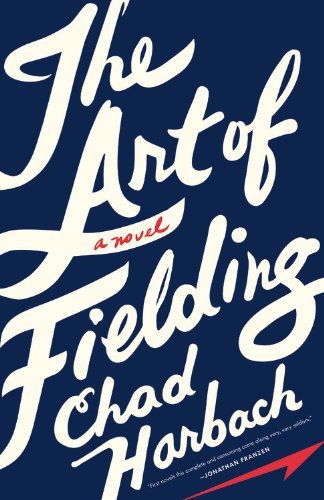
What I'm Reading: The Art of Fielding

Well, while I am making good progress on my New Year's resolution to read 2 new romance authors this year, I am quite far behind on my resolution to keep up on my reviews.  Of the 6 books I have finished reading in 2012 (with 2 more that I have to finish in the next week for work), I have only written 2 reviews so far.  So I am 4 (about to be 6) behind already!!

I will only be getting further behind, so today I am going to buck up and get going.  Also, I have a bunch of boring paperwork to complete today, so writing a review will be a nice procrastination option.

As I mentioned at the end of this post, I saved the consensus best book of 2011 to read to start 2012.  I really did enjoy The Art of Fielding by Chad Harbach, but I feel like it is cheating for me to read and review.  Why?  It had so many elements that I like if only one of them appears in a book, but this one literally had everything but a circus (one of my other favorite frames; click here to see more on that) and if it had been set in NJ instead of WI, I might have exploded with happiness.

Seriously, here is a cross-referenced list of the things I love to see in any book which are all in play in The Art of Fielding:
  • Baseball
  • Liberal Arts College Setting
  • Moby Dick references
  • Ralph Waldo Emerson references (this one is even key to the final dramatic moments)
  • My actual alma matter shows up and is made fun of, but in a fair way.  It made me laugh.
  • Book within a book frame. (The Art of Fielding is a book that the characters in the book refer to often.)
The Art of Fielding also features some of my favorite story telling techniques:
  • Told as a "slice of life"-- The novel is one year in the life of 5 characters. You learn a bit about their life before this pivotal year and nothing about what happens after, but you are wrapped up in every detail of the year in which the book takes place.
  • Told from multiple charcaters points of view.  The story bounces back and forth between 5 protagonists.
  • Interesting but extremely flawed characters.  Each of the 5 protagonists is a good person deep down, but they all have a serious flaw that propels the story along.  In the end they mostly redeem themselves and come to terms with their flaws, but as a reader you are not sure that these flaws are completely overcome.
So all of this being said, I am a bit freaked out by Harbach.  Does he know me? Are we similar people? I don't know the answers here, but I am not going to complain.  That being said, I will again say I might not be the best person to take advice from on this book.  I was predisposed to love it.


Now more general appeal comments.  This is subtle storytelling.  You are meant to dive in and experience this novel.  You live with the characters, get wrapped up in their problems, and come to feel like they are your friends.  They all hit some pretty low points during the course of the book, but manage to pull themselves out (for the most part).

As a result of these low points, there are some darker moments in this novel.  There is one particualrly darkly humorous scene towards the end, but overall, the novel was realistic, thought provoking, bittersweet, and hopeful.

This is not the best book I ever read, but it was extremely well executed (it is hard to believe this is a first novel) and compelling. I was happy to spend a few days immersed in the world of Westish College.  I was sad to finish the book because I so enjoyed my time reading it, but I felt like the ending while open, was satisfying.  All things do not turn out well, nor do all turn out badly.  I will definitely read Harbach's next book.

Notice I  haven't said much about the plot here.  This is on purpose.  The plot itself is not the issue.  How the story is told will determine whether you like it or not.  Plus, this book has been reviewed to death in the last few months, so if you just want a basic plot, go here.

Three Words That Describe This Book: slice of life, multiple points of view, character driven

Readalikes:  The first book I thought of was another one of 2011's best, Swamplandia! because it shares all three of the story telling techniques I mentioned above. Click here for my full review of Swamplandia!.

Many reviewers have called The Art of Fielding Franzen-lite.  I agree completely.  In Harbach's novel the characters are more likable, less annoying, and the story more nuanced. Click here for my review of Freedom by Franzen for more.

The backlist title I most thought of while reading The Art of Fielding was Richard Russo's Straight Man.  The protagonist here is the Chairperson of the English Department at a liberal arts college.  He reminded me so much of the Westish College President who is one of the 5 narrators of The Art of Fielding.  Another good campus life/politics novel is Moo by Jane Smiley.  I have read both the Russo and Smiley, but years before I started this blog. Both are worth a trip to your local library to check out.  Interestingly, both authors are masters at writing quintessentially "American" novels that are critically acclaimed yet accessible. I think Harbach can be placed in their cannon for now.  I hope he stays there and becomes as reliable as these 2 have been over their long careers.

Underworld by Don DeLillo is another suggestion.  It too uses baseball as a frame without being a "baseball novel."  There is a fluctuating point of view in Underworld, but the story is much broader in scope.  In Underwold, the story is that of the last 50 years of the 20th century, while in The Art of Fielding, we are following one academic year.

Monsters of Templeton by Laura Groff could be another suggestion.  From my original review:
Willie Upton returns to her home town of Templeton to recover from a disastrous relationship with her graduate professor. Willie, is a direct descendant (on both sides!?!) of the town's founder. Here Templeton is a stand-in for Cooperstown, NY complete with a James Fenimore Cooper stand-in and a "baseball history museum." But Templeton has something the real Cooperstown does not, a sea-monster, long a part of town folklore, rising to the surface of the lake, dead, in the opening pages of the novel. What follows is a complex novel in which Willie searches through the town's historical documents for the identity of her father. Goff has the dead speak, giving them entire chapters of monologue, and she incorporates some of Cooper's more famous characters into the story.
I think if you are okay with the speculative elements here, the tone, characterizations, and style are very similar.

I mentioned Moby Dick above.  If you feel you did not get the Moby Dick references, a quick look at Nathaniel Phlibrick's compelling and fun Why Read Moby Dick? will clear it all up for you.

Tuesday, May 15, 2012

Arty Fiction

Later today, my husband and I are going to our son's first grade class room for art appreciation.  We are going to teach the kids about Norman Rockwell (pre-chosen topic).  So I have had artists on the brain.

It got me thinking about all of the great novels which feature art and artists prominently.  Two of the most obvious are the literary and often historical novels of Tracy Chevalier and Susan Vreeland.  Both women tell stories about artists, the creation of art, and how art affects people generally from the female perspective.

But there are also men out there who regularly incorporate art into their stories.  Take bestseller espionage thriller writer Daniel Silva.  His hero, Gabriel Allon is a Mossad agent and art restorer.  These action packed spy novels are filled with danger, terrorists, and lots of details about art.

Here are a few art focused titles by other authors that I would highly suggest:

  • The Flanders Panel by Arturo Perez-Reverte: this novel has 2 story lines, both revolving around the aforementioned panel, one in the present and one in the past.  Expect romance, intrigue and murder.
  • Bridge of Sighs by Richard Russo features an artist.  Read more here.
  • The Amazing Adventures of Kavalier and Clay by Michael Chabon is one of my favorite books ever and it is about comics; therefore it is all about art, artists, and the creative process.  But it is also about mid-20th Century America.
  • Nora Roberts is an amazing storyteller.  Look, I don't like Romance much and even I can admit that that woman can tell a great story.  I have men and women coming in to read her books.  One of the reasons Roberts is so popular is the details she adds to her stpries.  It is not uncommon for either her hero or heroine to be involved in an art form.  A good example is Chesapeake Blue.
  • We read The Samurai's Garden by Gail Tsukiyama in book club last year.  The narrator is a young painter who encounters a Japanese gardener whose work with plants is also a form of art.  This is a novel which has stayed with me, and I often find myself thinking about it 13 months later.
This is just a sampling of the numerous offering out there.  Art and artists have obviously been quite an inspiration to their prose creating cousins the fiction writers.  For more ideas, check out this list from 2008 compiled by the contributors to Fiction-L a RA list serv.  Feel free to leave your own suggestion in the comments.

Tuesday, May 10, 2016

Attention Book Discussion Leaders: Picking Better Books for Your Group

Reading Group Choices is one of my favorite resources as a book discussion leader.

They just released the results of the 2015 Annual Survey of the most popular book discussion books according to their readers.  You can also click here to access the page with the results from every year's survey from 2002 to the present!

First a word about each annual survey. Take the current 2015 survey results as an example. Since they ask all of their readers to contribute their favorites the results are as varied as the book discussion groups themselves.  We have titles from middle grade chapter books (Wonder which does lead to an excellent discussion for any age group) to YA to adult fiction, nonfiction, and even graphic novels!

And the titles for 2015 are not all the brand new and shiny titles that you see recommended by the publishers.  There are some titles that go back a few years on this 2015 list.

Which leads me to....

Second, a word about the BACKLIST goodness of the page with all of the annual favorite results. Many of the titles on the 2105 list were on the 2014 list and some were on the year before that too [and so on]. Comparing the backlist of survey results at one time gives you a sense of the books that have endured over time and resonated with many book groups.

Enduring favorites are a great choice for any group because they are proven winners, year after year.

But an even more fun way to use this backlist is to click on a really old list, like this 2002 one:
  1. The Girl With a Pearl Earring by Tracy Chevalier (Plume)
  2. The Red Tent by Anita Diamant (Picador USA)
  3. The Lovely Bones by Alice Sebold (Little Brown)
  4. Empire Falls by Richard Russo (Vintage)
  5. Peace Like a River by Leif Enger (Grove)
  6. Seabiscuit by Laura Hillenbrand (Ballantine)
  7. Bel Canto by Ann Patchett (HarperPerennial)
  8. John Adams by David McCullough (Simon & Schuster)
  9. Girl in Hyacinth Blue by Susan Vreeland (Penguin)
  10. The Poisonwood Bible by Barbara Kingsolver (HarperPerennial)
  11. Pope Joan by Donna Woolfolk Cross (Ballantine)
  12. To Kill a Mockingbird by Harper Lee (Warner & HarperCollins)
  13. Big Stone Gap by Adriana Trigiani (Ballantine)
  14. The Bonesetter’s Daughter by Amy Tan (Ballantine)
  15. Jim the Boy by Tony Earley (Back Bay)
  16. The Jew Store by Stella Suberman (Algonquin)
  17. Ahab’s Wife by Sena Jeter Naslund (HarperPerennial)
  18. The Secret Life of Bees by Sue Monk Kidd (Penguin)
  19. A Fine Balance by Rohinton Mistry (Vintage)
  20. Hanna’s Daughters by Marianne Fredriksson (Ballantine)
What makes something a good book for discussion has nothing to do with its publication date. In fact, I would argue that the older the title, the more there might be to discuss. Does it still ring true? Can it be read differently as time passes? Why is this book still worth reading? Why was it so popular in 2002?

These are all great questions for a group to consider before you even get to talk about the book itself. I would highly recommend giving one of these older favorites a try.


Monday, June 30, 2008

What I'm Reading: June 2008

As a Readers' Advisor I try to read at least one book from each major genre each year. To aid me in my quest for well-roundedness, we have a reading standards form for our department at the BPL which gives me handy spaces into which I can type the titles and mark my progress. Why tell you all of this? Because this month I read my Western as well as a cozy Mystery, and a Literary Fiction.

I found Ryder of the Hills by Robert J. Horton while reading reviews in Booklist. Turns out that Horton was quite prolific back in the early years of the twentieth century, earning 5 cents a word for his works (just like Max Brand). This specific story was originally serialized in a western magazine back in 1927, and was just re-released by Five Star this year. This novel begins as the story of Jess Sneed, a rancher, gunslinger, and just generally feared, but principled outlaw. While visiting town, Sneed is present when a miner dies in an accidental fall. Sneed takes the rancher's teenage son, Ted Ryder, into his home. Sneed and his ranch partner, Lucy Ware, raise Ryder as a rancher, not letting him know of Sneed's bad side. The plot ultimately shifts to become Ryder's story. It is a story about Ted's coming-of-age, as well as a story of the taming of the West. It is a Western in the mode of the popular HBO series, Deadwood.

Readers who like traditional westerns should definitely give Horton a try. Five Star will be re-issuing a few more of his books in the coming months. Those new to Westerns should also try Max Brand, Zane Grey and especially the all time best Western (IMO) Louis L'Amour's Hondo. Elmer Kelton is also another good bet for those who are looking for an author who is still writing.

After many years of having Pete Hamil on my to-read list, I finally listened to North River. Hamil tends to write literary fiction, with a historical nod, that capture the people and character of New York City. North River follows Dr. Delaney, the local doctor in Greenwhich Village during the Depression. He is an injured WWII vet, serving the poor and dealing with the disappearance of his wife. Delaney has been limping through life, not fully living, until his only child, Grace, abandons her almost 3 year old son Carlito on his doorstep. Delaney also saves the life of his WWII buddy, turned Italian mobster friend and gets himself mixed up in a mob war. Into this chaos enters Rose, an illegal, Sicilian immigrant, who is hired to care for Carlito and keep house. Her solidity and love of life, help to change the Delaney home forever.

This is a slice of life story about the growth of Delaney. As a Jersey girl myself, I loved the 1930s, NYC setting, and found the happy (but let me say, very open) ending refreshing in a work of literary fiction. Don't get me wrong, there are some dark issues like mafia, suicide, prostitution, poverty, and domestic abuse, which are all explored in this novel. However, overall, Delaney's story is positive and refreshing.

Those who liked North River and its local politics may want to try William Kennedy's novels of Albany politics. Ironweed is the best of the lot and takes place in a similar time frame. Richard Russo also writes about the evolution of mature men very well. Try Straight Man which follows a middle aged college professor who is humorously stumbling through absurd situations. Although is has more blatant humor than North River, at its heart, Straight Man is about its main character's growth. Finally, the "Five Points" history of NYC plays a big role in creating the mood and setting for this novel. Those who want to know more about the history of that era should either check out the book The Gangs of New York : an Informal History of the Underworld by Herbert Ashbury or view the Martin Scorsese film The Gangs of New York (2002).

I also read the funny and cozy British mystery, The Case of the Missing Books by Ian Sansom. This is the first in Sansom's Mobile Library Mysteries. The reader is introduced to British Librarian, Israel Armstrong who is chubby, clumsy, Jewish (remember we are in Ireland) and a vegetarian. Israel accepts a job in Tumdrum, Northern Ireland to be the head Librarian. When he arrives, the library building is closed and he has been reassigned to drive a bookmobile. Next problem...there are no books. They are all missing and no one seems to want to help him locate them.

The Case of the Missing Books is more a novel in the Garrison Keillor style of Lake Wobegon Days than a mystery. Israel is a lovable character and a champion of the public library system. He is an outsider in a tight knit community, who by the novel's conclusion finds the books and, more importantly, earns the locals' respect.

Besides Keillor, Sansom's novel reminded me of some of Roddy Doyle's less serious works, such as The Commitments, The Snapper, and The Van. Alan Bennett's The Uncommon Reader (discussed on this blog) and The Camel Bookmobile by Masha Hamilton are also good bets for fans of Israel.

Wednesday, June 17, 2009

BPL Book Discussion: North River

This week at BPL we discussed Pete Hamill's North River. I also wrote about reading this novel in June of 2008 here.

Pete Hamill is an accomplished, if not quite bestselling author, who tends to write literary fiction that captures the people and character of New York City.

North River follows Dr. Delaney, the local doctor in Greenwich Village during the Depression. He is an injured WWII vet, serving the poor and dealing with the disappearance of his wife. Delaney has been limping through life, not fully living, until his only child, Grace, abandons her almost 3 year old son Carlito on his doorstep. Delaney also saves the life of his WWII buddy, turned Italian mobster friend and gets himself mixed up in a mob war. Into this chaos enters Rose, an illegal, Sicilian immigrant, who is hired to care for Carlito and keep house. Her solidity and love of life, help to change the Delaney home forever.

This is a slice of life story about the growth of Delaney. As a Jersey girl myself, I loved the 1930s, NYC setting, and found the happy (but let me say, very open) ending refreshing in a work of literary fiction. Don't get me wrong, there are some dark issues like mafia, suicide, prostitution, poverty, and domestic abuse, which are all explored in this novel. However, overall, Delaney's story is life affirming.

And it is with this point that our discussion began. The entire group loved how this book felt "old fashioned," not just because it was about a simpler time, but also because it was a novel with substance that was "easy to read," "fluid," and "straightforward." (The quoted terms were all used by the participants to describe this novel.)
We also talked a great deal about Hamill's use of words. People read out passages with descriptions they enjoyed. We talked about how well Hamill captured Carlito's 3 year-old voice. He is young and did not know English. Delaney's observations of how he learns to build sentences (noting his first uses of adjectives and verbs) as well as Hamill's dialog for the boy, were striking to us. Hamill is known for his ability to capture people and describe places evoking all five of the readers senses, and our group noticed this right away.

Despite the fact that this novel was written by a man, the participants were quite impressed with how Hamill described Rose. One participant thought he did such a great job describing the food and cooking smells that she had to double check the author's name to make sure it wasn't a female writer. This led another group member to comment on Delaney's dreams. She also felt that including dreams was a bit more feminine. We were in agreement that this novel would be a great choice for groups that tend to only read women writers but want to try a male author.

North River also centers around the grandfather/grandson relationship which my group enjoyed, although here they thought Hamill's maleness shone through. As mothers and grandmothers, the participants felt that Carlito adjusted a little too fast for their taste. Others were appalled that Delaney agrees to give custody of Carilto back to his daughter, the mother who abandoned him, so easily. And a few others though Delaney himself made the transistion from being "numb" to having a full household a bit too smoothly. However, these were all minor complaints. No one thought that any of this took away from the novel as a whole.

There is some moral ambiguity in this novel too. Delaney tends to injured people in the neighborhood who are victims of domestic abuse and severely injured Chinese prostitutes, but never reports any crimes to the police. The largest issue, however, is Delaney's involvement in a mob war. First he saves his war buddy, who is one of the local mob bosses, after a botched assassination attempt. For his work, Delaney accepts $5,000 in cash from the mobster. He then is targeted by the rival mob boss, Frankie Botts. After caring for Frankie's sick mother, Delaney is no longer in mortal danger. Yet, when his war buddy returns and makes it clear that Frankie will be dead shortly, Delaney does not alert the police or Botts. He questions himself when a mob war breaks out all over the city. He could have stopped it, but chose not to.

We discussed these moral ambiguities. However, we agreed that Hamill built up Delaney as the caregiver to the community; the only doctor they had. He needed to take care of these forgotten people, and since no one could really pay him, taking the $5,000 from a mobster was a no-brainer. He had a kid to take care of now. And, for the same reasons he could not get involved in their mob issues.

The only other mild criticism our group had was that the ending was a bit too neat. Things seemed to wrap-up perfectly. Although, again, the characters and setting we so richly described that we all were okay with the happy, if still slightly open, ending.

One last amusing anecdote from our group. I used these Reading Group Guides discussion questions to lead the group. Question 12 states:

One presence in this novel has in fact vanished: the big city political machine. Such machines were often corrupt but did play important roles in urban life --- for example, in handling the arrival of immigrants in large numbers. Are there any lessons here for today’s world?
Okay, note to the writers of these questions....we live in Chicagoland and the big political machine is still HUGE here. Those people need to see Mayor Daley in action some time. I mean the guy wanted to close an airport, and when no one would let him, he brought in some bulldozers in the middle of the night to dig up the runway. And he will get us the Olympics, I am sure of it. Without his political machine, we would have no chance.


Readalikes:
During the discussion, participants mentioned that this book reminded them of A Tree Grows in Brooklyn by Betty Smith and The Godfather by Mario Puzo.
Those who liked North River for its historical description of local politics may also want to try William Kennedy's novels of Albany politics. Ironweed is the best of the lot and takes place in a similar time frame.

Richard Russo also writes about the evolution of mature men very well. Try Straight Man which follows a middle aged college professor who is humorously stumbling through absurd situations. Although it has more blatant humor than North River, at its heart, Straight Man is about its main character's growth.

The "Five Points" history of NYC plays a big role in creating the mood and setting for this novel. Those who want to know more about the history of that era should either check out the book The Gangs of New York : an Informal History of the Underworld by Herbert Ashbury or view the Martin Scorsese film The Gangs of New York (2002).

For those who liked the New York City setting I would suggest the novel, Empire Rising by Thomas Kelly or these books about the history of NYC.

The next meeting of our group is on Monday, July 20th at 2pm when we will be discussing Joan Didion's memoir, The Year of Magical Thinking.