Irish novelist John Banville has written many critically acclaimed literary fiction novels, including the Booker Prize winner, The Sea. However, he is experiencing the largest readership of his career with his noir suspense novels written under the pen name, Benjamin Black.
Here is a link to an audio interview with Banville from NPR's Morning Edition where Banville discusses the pros and cons of genre labels.
I found his discussing of how long it takes him to write a "Banville" novel, versus the speed at which he puts out a "Black" novel quite interesting.
Showing posts sorted by relevance for query Benjamin Black. Sort by date Show all posts
Showing posts sorted by relevance for query Benjamin Black. Sort by date Show all posts
Wednesday, April 9, 2008


Monday, March 17, 2014
Monday Discussion: Who's Your Favorite Irish Author?
Happy St. Patrick's Day! Today is an obvious discussion. Name your favorite Irish Author. Look, I didn't want to make it too hard on all of you who over did it this weekend.
I'll go first. There is no question in my mind here. My favorite Irish Author is Roddy Doyle.
A distance second is John Banville writing as Benjamin Black.
Now it's your turn.
Let me know your favorite Irish Author. Together we can make a nice list of options. It's that easy today.
For past Monday Discussions, click here.
I'll go first. There is no question in my mind here. My favorite Irish Author is Roddy Doyle.
A distance second is John Banville writing as Benjamin Black.
Now it's your turn.
Let me know your favorite Irish Author. Together we can make a nice list of options. It's that easy today.
For past Monday Discussions, click here.
Monday, July 15, 2013
Monday Discussion: Pseudonyms

The author of The Cuckoo's Calling, published by Mulholland Books on April 30, turns out to be J.K. Rowling, who used the pseudonym Robert Galbraith for the book, revealed yesterday by the Sunday Times in London.
Little, Brown confirmed that Rowling is Galbraith--which was supposedly a pseudonym for a retired British military investigator. A reprint of the book that is underway will add this phrase in the author biography: "Robert Galbraith is a pseudonym for J.K. Rowling."I am also happy to report that here at the BPL we had ordered the book back in late April when it came out based on its positive reviews. It has already circulated 4 times before this news too!
So since this is all anyone can talk about, it got me thinking how I could turn this discussion into a Monday Discussion, and it hit me right away. Let's talk about other famous pseudonyms.
Rowling is not the only famous author who wanted to try something new without people judging it by what he or she wrote previously. Another famous example is Stephen King writing as Richard Bachman.
But from recent times I have two favorites, not because I loved the books (I did like them though as you will see when I link the titles to my reviews), but because they did it for just Rowling's reasons. They were well known in one genre and wanted to write in another. I applaud them for wanting to do something different.
- Psychological Suspense author Peter Abrahams wanted to write a lighter mystery from a dog's point of view. He did, but with the pen name Spencer Quinn. No one knew it was Abrahams and he got fabulous reviews with Dog Gone It. Here's my review.
- Literary Fiction writer John Banville also wanted to try his hand at mysteries, but his were of the historic noir Irish mold under the name Benjamin Black. Here is my review
For past Monday Discussions, click here.
Thursday, June 5, 2008
What I'm Reading: May 2008
This month I read many award winners and a YA title suggested by one of my students.
I began the month by finishing the audio of Geraldine Brooks' latest People of the Book. This title goes well with April's book discussion offering The Lemon Tree. This novel is a mixture of historical fiction and more contemporary events (the 1990s conflict in Sarajevo). The plot begins with the story of Hanna Heath, a rare Hebrew manuscripts restorer and her encounter with a one of a kind Haggadah. As she is restoring the work, Hanna finds clues to the book's past. A past which she never can fully uncover, but which Brooks treats the reader to with her imagination. What follows is a novel which explores European Jewish history back to 1480, with an emphasis on Jewish-Muslim relations.
I began the month by finishing the audio of Geraldine Brooks' latest People of the Book. This title goes well with April's book discussion offering The Lemon Tree. This novel is a mixture of historical fiction and more contemporary events (the 1990s conflict in Sarajevo). The plot begins with the story of Hanna Heath, a rare Hebrew manuscripts restorer and her encounter with a one of a kind Haggadah. As she is restoring the work, Hanna finds clues to the book's past. A past which she never can fully uncover, but which Brooks treats the reader to with her imagination. What follows is a novel which explores European Jewish history back to 1480, with an emphasis on Jewish-Muslim relations.
I felt the book was at its best when the reader was brought into the past. Hanna's story got a bit old to me, and the suspense elements introduced in the last third were a bit contrived. However, I loved being lost in the story of the actual book and its journey backward through time. Also, the overall message about how historically Muslims and Jews have worked together was uplifting. I also happened to be listening to this novel near Passover, and since a Haggadah is used during the Passover Seder, it added to my enjoyment of the work.
In terms of readalike, those listed here on my post about The Lemon Tree would all be a good place to start. Another book I have written about, Gentlemen of the Road, would be good for readers who liked the historical aspects of Jewish-Muslim relations. My People's Passover Haggadah by Lawrence Hoffman, a 2 volume set, has both the text of the Haggadah and well respected commentary on its history and the holiday of Passover; it should satisfy those who want more information on this aspect of the book.
There may also be readers of this book who are interested in book preservation or any of the specific historical time periods discussed in this novel. You could go on forever finding readalikes for this novel. With all of the different periods, peoples, and issues in this book, it is a great example for practicing Whole Collection RA.
Recently, I mentioned John Banville's alter ego, Benjamin Black, in this post, which led me to finally reading his award winning suspense novel Christine Falls . It is the 1950s in Ireland. Our "hero" is Quirke, the pathologist at the local hospital. Without giving too much away, this a a classic noir tale, told at the time of the all powerful Catholic Church. Quirke, a depressed borderline alcoholic, finds his brother, an obstetrician, trying to change an autopsy report, which leads Quirke into a tangled mystery which ultimately puts him in danger. Obviously, he survives since the sequel, Silver Swan just came out.
Recently, I mentioned John Banville's alter ego, Benjamin Black, in this post, which led me to finally reading his award winning suspense novel Christine Falls . It is the 1950s in Ireland. Our "hero" is Quirke, the pathologist at the local hospital. Without giving too much away, this a a classic noir tale, told at the time of the all powerful Catholic Church. Quirke, a depressed borderline alcoholic, finds his brother, an obstetrician, trying to change an autopsy report, which leads Quirke into a tangled mystery which ultimately puts him in danger. Obviously, he survives since the sequel, Silver Swan just came out.
This was better than average noir in my estimation. For readalikes, I would suggest anything by P.D. James and the new Elizabeth George Careless in Red (which is not only has a darker tone, but also deals with a main character who has lost his wife, like Quirke). For an American twist try the Michael Connelly Harry Bosch mysteries.
Again, there are many ways to identify readalikes here. First, even though the novel makes fun of it, In the Time of Butterflies by Julia Alvarez, would be a great read for those wanting to know more about the reign of Trujillo. But really the book most like Diaz's novel is Jonathan Lethem's Fortress of Solitude. It has the same coming-of-age themes, a New York area setting, multicultural issues, and artists. The writing is also similarly non-traditional, yet accessible. Of course, I would also be remiss if I did not mention the numerous references to The Lord of the Rings Trilogy throughout Oscar Wao.
Finally, a book Oscar might have liked, Hero by Perry Moore. This book is easy to describe. It is a YA, gay coming out story, where the protagonist is also a superhero. It is YA, so it has a happy ending. In fact, the hero saves the world and gets the boy. It is fun and thought provoking.
Since Hero is a YA book, most of the readalikes are also YA novels. I would like to suggest some adult options. The Amazing Adventures of Kavalier and Clay by Michael Chabon shares the superhero and gay issues appeals, while many of the novels by David Leavitt deal with artists and coming out themes.
Thursday, August 25, 2011
What I'm Reading: Sharp Objects

 When Karen Slaughter came to the BPL earlier this summer, she sang the praises of Gillian Flynn
 , who was in attendance. Flynn was one of those authors I was a fan of without ever having read her. Let me explain.
In my line of work, I am expected to suggest books and authors which I have never read myself. Oh, now you know the RAs dark, dirty secret. We cannot possibly read every book, but we can know a lot about a wide range of books. Flynn fits into that second category. She is an author who style and tone I knew, thus leading me to steer certain readers to her novels, but I had never actually read more than an excerpt. Often that is enough though for us to do our job-- matching readers with the perfect book.
Flynn has been such a solid standby for the "not quite horror" fan: those who want the tension, macabre happenings, and creepy atmosphere, but do not want supernatural monsters. In fact, Flynn will be featured in my new book as a sure bet psychological suspense author for horror fans.
I have handed out the two books
(soon to be three) of this Chicago author to patrons many times, and each time I have gotten positive feedback about her stories and style. After exchanging emails with her before the Slaughter event and then meeting her (she is super nice and down to earth by the way), I figured I no longer had an excuse not to read her for myself. So I got both Sharp Objects and Dark Places
 on audio. I began with her debut novel, Sharp Objects and I am happy to report it was as good as I had advertised.
Sharp Objects is narrated by a very troubled young woman in her early thirties, Camille. She is still recovering from a very serious self mutilation mental illness. She is currently a reporter for a 3rd tier newspaper in Chicago. She also happens to be from a small, rural Missouri town (Wind Gap) where a serial killer is targeting adolescent girls. Camille's father-figure editor sends her home to cover the story. However, Camille is completely out of touch with her family, especially her mother, and her homecoming is not positive for her recovery.
Appeal: What follows is a haunting story. The reader is privy both to Camille's mental unravelling and the slow discovery of who is responsible for the murders. Readers who want a fast paced suspense tale will be disappointed. But readers (like myself) who want a complicated, psychological, tense story with an extremely flawed narrator and one messed up family will love this novel. The book is intense from page one. The sense of unease literally permeates and fills every crack in the book.
While there are a few graphic descriptions of the murderer's MO (he/she removes all of the victim's teeth), the real troubling issues in this book come from Camille's own illness and what she finds out about her family. The long drawn out investigation also adds to the dark, tense atmosphere of the story. This is as close as you can get to a horror novel without the monsters.
Although I suspected the killer from about the halfway point, Flynn expertly folded the plot over on itself so many times that I was beginning to spiral with Camille and starting thinking like her. So, when the end came, I was almost as devastated as Camille. I need to emphasize this point more. Camille is a great character. We know she is flawed from the start. We know we shouldn't trust her. We see her make terrible decisions. But Flynn slowly builds our sympathy for her, so that by the novel's end, I was in her head, agreeing with her reasoning. Not a good move because Flynn knew she does this to the reader and then, she drops the ending on us and we are reminded just how flawed Camille and her reasoning really are. The end was shocking, but not out of left field. Very satisfying.
I should say again, this is a twisted book. Even though there are bloodier books, the psychological aspects play with the reader and many may find it too disturbing.
Three Words That Describe This Book: unease, psychological, family dysfunction
Readalikes: As I have said already, this is a great example of psychological suspense for anyone whose tastes lead toward horror. The emotional pull of the story is its key. Readers need to be okay with suspense stories that have a flawed narrator, and situations in which bad things will and do happen.
Authors I would suggest who fit this bill are: Tana French, Jennifer Egan
, Chelsea Cain, Sarah Waters, Benjamin Black, Peter Abrahams. For the authors I have written about on my blogs, the link will lead to a longer discussion.NoveList had a bunch of Mary Higgins Clark
books as readalike suggestions, but I would NOT suggest those. This is a much darker book than Higgins Clark writes.Some readers may also want to know more about self mutilation
or Muchausen Syndrome by Proxy after reading Sharp Objects.
Wednesday, August 3, 2011
What I'm Reading: A Fatal Grace

 Recently I finished listening to second book in Louise Penny's Chief Inspector Armand Gamache series, A Fatal Grace
 .
.I wrote the author statement on Penny for NoveList, subscribers can find the full one there, but here is some paraphrasing of what I said about Penny's overall appeal:
Chief Inspector Armand Gamache works in the of the Sûreté du Québec. He is a man of moral integrity, who is very intelligent, loves to eat, and has the loyalty of his colleagues. While Gamache is the main attraction here, readers also enjoy her cast of secondary characters, especially the residents of Three Pines, a town near the American border. These books have a timeless feel, and the tone is one of hope and resilience despite adversity. The mysteries themselves are intricate and quirky, while their pacing reflects the thoughtful pace of Gamache himself.Every single one of the books in the series has been highly praised. The series is also one of my go-to suggestions when I am having trouble finding a reader something "good." It works for those who want a gentler story (read: murders without much blood) but it is also complex enough for readers who want a mystery with meat. These are nuanced tales which not only explore the psychological affects of crime on those in a community, but also look at the moral ambiguity of all people. These books remind us that no one is all good or all bad.
Also, most readers find the setting, French Canada just exotic enough without being too foreign. The setting 's details are fabulous too. I feel like I have been to Three Pines myself.
In terms of the murder here, again someone in Three Pines has died; this time of what appears to be a deliberate and elaborately staged electrocution. Gamache returns to his favorite little town to solve the case. The murdered woman it turns out, was not well liked in town. I was not shocked by who committed the murder, but the secrets Gamache uncovers about many of the characters kept me reading.
My favorite parts though are the descriptions of the town and the people. I love how Penny talks about all of the layers of clothing needed in the coldest days of winter and how people know each other by their hats. Her details about the way food smells, the winter landscape looks, and the people move about keep me reading.
If you want to start at the beginning, try Still Life, and if you are already a fan, get on the list for A Trick of the Light
 , coming out on 8/30/11.
Where This Book Took Me (Summer Reading Feature): Three Pines, Canada in the dead of winter. Brrrrr.
Three Words That Describe This Book: character-centered, detailed, nuanced
More Appeal and Readalikes: Here is some of what I said when I read Still Life last year:
This book is for fans of smart cozies: fairly bloodless mysteries which are character centered, with interesting settings, that still contemplate larger issues. The overall tone here is fun, but can move to serious and thoughtful at times. Gamache is a complex lead investigator who is always thinking, teaching, and observing.
The point of view is interesting. It is 3rd person omniscient, which allows us to see what just about everyone is thinking at any and all times. Penny moves between people and their thoughts very fluidly. People will either love this pov or hate it.
The setting is detailed with lots of information about the issues between the "French" and the "English" in Quebec. Three Pines feels like a place you want to go visit, sit in the cafe, walk in the woods, and chat with the characters. This is a huge appeal that cannot be overlooked. Even cosmopolitan Montreal resident Gamache cannot seem to get enough of this charming small town, despite one resident's murderous impulses.
Penny's series is also for people who like series because once you read Still Life, you will be compelled to keep going with the series. These are people and a town you will want to visit again and again.
Other mystery authors who share this overall appeal and are good matches for fans of Penny are Alan Bradley
Nonfiction options would include books about QuebecTo these suggestions, I would also add:, a nonfiction account of a small town in MA.
- PD James (police procedural, character driven, explore the psychological affects of crime, strong settings, middle aged inspectors)
- Charles Todd (character driven, psychological affects, strong setting, layered plots)
- Julia Spencer-Fleming (strong setting, character driven, compelling)
- Donna Leon (police procedural, character driven, moral issues, great secondary characters, strong setting)
- Benjamin Black (a bit darker, but psychological aspects, strong setting, complex, nuanced)
Tuesday, July 2, 2019
Using Awards List as a RA Tool: Locus Awards Edition
Over the weekend, one of my favorite awards was given out, The Locus Awards. Because these awards cover all of the speculative genres, they are a great example of one of my most popular blog mantras-- Awards lists are one of your best RA and Collection Development tools.
Click here to see every time I have talked about this and here for the first time.
In fact, it has been a while since I posted those initial reasons and I don't trust you all to click [I was a grad school teacher for 8 years, so I know a thing or two about how to make people learn], so here is a reprint from 2011:
As the book award season heats up with the Nobel Prize in Literature being announced yesterday (disappointing from an RA perspective again) and the National Book Award coming early next month, the National Book Foundation got in the spirit by releasing their "5 under 35" list of authors to keep an eye on.
And I put my money where my mouth is on this issue, as I am currently in the final stages as the "captain" of the Speculative Fiction section of the new edition of the ARRT Popular Fiction Reading List, a product we sell to NoveList. We used the last three years of the Locus Reading List as one of our major resources to make sure we did not leave out the best and most important authors in these genres today.
Even if you are not a fan of speculative fiction yourself, and especially if you have a small library and a modest collections budget, take a look at these nominees and winners. What you will realize is that many of these titles [nominees and winners] you own already; seriously, check right now. Many of these titles are popular with your readers already. Therefore, adding a few more is probably a good idea. These are sure bet speculative titles for your collections.
Now go forth and make displays, order a few more titles, hand sell the Locus Award books and stories to readers today.
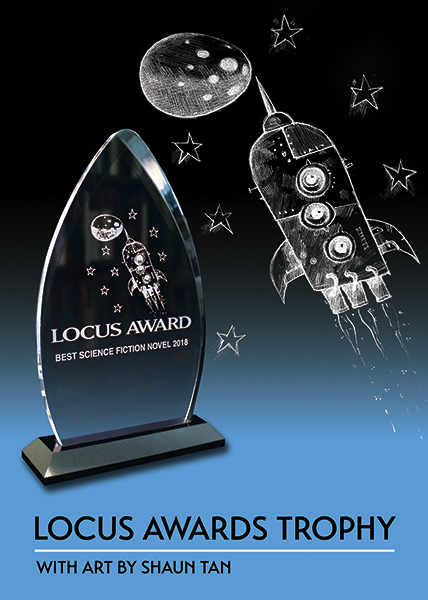 The Locus Science Fiction Foundation announced the winners of the 2019 Locus Awards during the Locus Awards Weekend in Seattle WA, June 29, 2019.
Click here to see every time I have talked about this and here for the first time.
In fact, it has been a while since I posted those initial reasons and I don't trust you all to click [I was a grad school teacher for 8 years, so I know a thing or two about how to make people learn], so here is a reprint from 2011:
As the book award season heats up with the Nobel Prize in Literature being announced yesterday (disappointing from an RA perspective again) and the National Book Award coming early next month, the National Book Foundation got in the spirit by releasing their "5 under 35" list of authors to keep an eye on.
From the RA standpoint, this list of young authors can serve you in multiple spheres of your work:
- Collection Development: these are authors you need to be purchasing for your collections. Go check your catalogs, and order copies where necessary. Also, keep an eye out for their new titles in the future.
- Readalikes: these authors make a great readalike suggestion for your readers who are interested in the newest literary fiction. So while the waiting list for The Night Circus, The Art of Fielding, and State of Wonder may be long right now, these 5 authors under 35 are a great while you wait readalike suggestion.
- Displays: going back and checking past 5 under 35 designees (scroll a bit; all of the lists are in the right gutter) and the also popular New Yorker 20 Under 40 annual list, makes for a unique and fun display idea. These lists contain a nice mix of authors who made it big and those who never quite broke through, but all are quality options which your library probably already owns. Highlight that backlist by drawing a connection to the release of this new list.
- Resources: just being aware of designations such as this one provides you with a new resource for helping readers. Don't forget about any and all award lists as a potential tool to help you as you match readers with their next good read. If an author your reader likes has been singled out for an award in the past, there is a good chance he or she might enjoy the work of another author who also received this recognition. I speak from personal experience here as I have noticed my own personal predilection for Booker nominees.
I hope this gets you to look at all award announcements in a different light. Yes, it is good to know who the current award winners are, but do not forget to use this information as another tool in your work as the matchmaker creating connections between your readers and the stacks of books at your library.Okay back to the awards at hand. Nowhere, and I mean nowhere, will you find a better list of all of the the best titles in SF, Fantasy and Horror, including short fiction and nonfiction, than Locus. From their Annual Recommened Reading List to these awards [which are based off of that previous list], this is the very best of speculative fiction for the general reader. Or, as I like to say, all of the titles and authors you need to have for your general library collections.
And I put my money where my mouth is on this issue, as I am currently in the final stages as the "captain" of the Speculative Fiction section of the new edition of the ARRT Popular Fiction Reading List, a product we sell to NoveList. We used the last three years of the Locus Reading List as one of our major resources to make sure we did not leave out the best and most important authors in these genres today.
Even if you are not a fan of speculative fiction yourself, and especially if you have a small library and a modest collections budget, take a look at these nominees and winners. What you will realize is that many of these titles [nominees and winners] you own already; seriously, check right now. Many of these titles are popular with your readers already. Therefore, adding a few more is probably a good idea. These are sure bet speculative titles for your collections.
Now go forth and make displays, order a few more titles, hand sell the Locus Award books and stories to readers today.
**********************************************
The Locus Science Fiction Foundation announced the winners of the 2019 Locus Awards during the Locus Awards Weekend in Seattle WA, June 29, 2019.
SCIENCE FICTION NOVEL
- WINNER: The Calculating Stars, Mary Robinette Kowal (Tor)
- Record of a Spaceborn Few, Becky Chambers (Harper Voyager US; Hodder & Stoughton)
- If Tomorrow Comes, Nancy Kress (Tor)
- Revenant Gun, Yoon Ha Lee (Solaris US; Solaris UK)
- Blackfish City, Sam J. Miller (Ecco; Orbit UK)
- Embers of War, Gareth L. Powell (Titan US; Titan UK)
- Elysium Fire, Alastair Reynolds (Gollancz; Orbit US)
- Red Moon, Kim Stanley Robinson (Orbit US; Orbit UK)
- Unholy Land, Lavie Tidhar (Tachyon)
- Space Opera, Catherynne M. Valente (Saga)
FANTASY NOVEL
- WINNER: Spinning Silver, Naomi Novik (Del Rey; Macmillan)
- Lies Sleeping, Ben Aaronovitch (DAW; Gollancz)
- Foundryside, Robert Jackson Bennett (Crown; Jo Fletcher)
- The Monster Baru Cormorant, Seth Dickinson (Tor)
- Deep Roots, Ruthanna Emrys (Tor.com Publishing)
- Ahab’s Return, Jeffrey Ford (Morrow)
- European Travel for the Monstrous Gentlewoman, Theodora Goss (Saga)
- The Mere Wife, Maria Dahvana Headley (MCD)
- The Wonder Engine, T. Kingfisher (Argyll Productions)
- Creatures of Want and Ruin, Molly Tanzer (John Joseph Adams)
HORROR NOVEL
- WINNER: The Cabin at the End of the World, Paul Tremblay (Morrow; Titan UK)
- In the Night Wood, Dale Bailey (John Joseph Adams)
- Unlanguage, Michael Cisco (Eraserhead)
- We Sold Our Souls, Grady Hendrix (Quirk)
- Coyote Songs, Gabino Iglesias (Broken River)
- The Hunger, Alma Katsu (Putnam; Bantam Press UK)
- The Outsider, Stephen King (Scribner; Hodder & Stoughton)
- The Listener, Robert McCammon (Cemetery Dance)
- Cross Her Heart, Sarah Pinborough (HarperCollins UK/Morrow)
- Tide of Stone, Kaaron Warren (Omnium Gatherum)
YOUNG ADULT NOVEL
- WINNER: Dread Nation, Justina Ireland (Balzer + Bray)
- The Gone Away Place, Christopher Barzak (Knopf)
- The Cruel Prince, Holly Black (Little, Brown; Hot Key)
- The Belles, Dhonielle Clayton (Freeform; Gollancz)
- Tess of the Road, Rachel Hartman (Random House)
- Cross Fire, Fonda Lee (Scholastic)
- The Agony House, Cherie Priest & Tara O’Connor (Levine)
- Half-Witch, John Schoffstall (Big Mouth House)
- Impostors, Scott Westerfeld (Scholastic US; Scholastic UK)
- Mapping the Bones, Jane Yolen (Philomel)
FIRST NOVEL
- WINNER: Trail of Lightning, Rebecca Roanhorse (Saga)
- Children of Blood and Bone, Tomi Adeyemi (Henry Holt; Macmillan)
- Semiosis, Sue Burke (Tor)
- Armed in Her Fashion, Kate Heartfield (ChiZine)
- The Poppy War, R.F. Kuang (Harper Voyager US; Harper Voyager UK)
- The Quantum Magician, Derek Künsken (Solaris US; Solaris UK)
- Annex, Rich Larson (Orbit US)
- Severance, Ling Ma (Farrar, Straus, Giroux)
- Witchmark, C.L. Polk (Tor.com Publishing)
- Empire of Sand, Tasha Suri (Orbit US; Orbit UK)
NOVELLA
- WINNER: Artificial Condition, Martha Wells (Tor.com Publishing)
- The Black God’s Drums, P. Djèlí Clark (Tor.com Publishing)
- The Tea Master and the Detective, Aliette de Bodard (Subterranean)
- “Umbernight“, Carolyn Ives Gilman (Clarkesworld 2/18)
- Black Helicopters, Caitlín R. Kiernan (Tor.com Publishing)
- Time Was, Ian McDonald (Tor.com Publishing)
- Gods, Monsters, and the Lucky Peach, Kelly Robson (Tor.com Publishing)
- The Freeze-Frame Revolution, Peter Watts (Tachyon)
- Rogue Protocol, Martha Wells (Tor.com Publishing)
- The Descent of Monsters, JY Yang (Tor.com Publishing)
NOVELETTE
- WINNER: The Only Harmless Great Thing, Brooke Bolander (Tor.com Publishing)
- “The Donner Party”, Dale Bailey (F&SF 1–2/18)
- “Okay, Glory”, Elizabeth Bear (Twelve Tomorrows)
- “No Flight Without the Shatter“, Brooke Bolander (Tor.com 8/15/18)
- “The Last Banquet of Temporal Confections“, Tina Connolly (Tor.com 7/11/18)
- “An Agent of Utopia”, Andy Duncan (An Agent of Utopia)
- “Queen Lily“, Theodora Goss (Lightspeed 11/18)
- “Nine Last Days on Planet Earth“, Daryl Gregory (Tor.com 9/19/18)
- “Quality Time”, Ken Liu (Robots vs Fairies)
- “How to Swallow the Moon“, Isabel Yap (Uncanny 11–12/18)
SHORT STORY
- WINNER: “The Secret Lives of the Nine Negro Teeth of George Washington“, Phenderson Djèlí Clark (Fireside 2/18)
- “The Bookcase Expedition”, Jeffrey Ford (Robots vs Fairies)
- “STET“, Sarah Gailey (Fireside 10/18)
- “A Witch’s Guide to Escape: A Practical Compendium of Portal Fantasies“, Alix E. Harrow (Apex 2/6/18)
- “Cuisine des Mémoires”, N.K. Jemisin (How Long ’til Black Future Month?)
- “The Storyteller’s Replacement”, N.K. Jemisin (How Long ’til Black Future Month?)
- “Firelight“, Ursula K. Le Guin (Paris Review Summer ’18; The Books of Earthsea: The Complete Illustrated Edition)
- “The Starship and the Temple Cat“, Yoon Ha Lee (Beneath Ceaseless Skies 2/1/18)
- “Mother of Invention“, Nnedi Okorafor (Future Tense)
- “The Court Magician“, Sarah Pinsker (Lightspeed 1/18)
ANTHOLOGY
- WINNER: The Book of Magic, Gardner Dozois, ed. (Bantam; Harper Voyager UK)
- The Best Horror of the Year Volume Ten, Ellen Datlow, ed. (Night Shade)
- The Year’s Best Science Fiction: Thirty-fifth Annual Collection, Gardner Dozois, ed. (St. Martin’s Griffin)
- Worlds Seen in Passing, Irene Gallo, ed. (Tor.com Publishing)
- The Best American Science Fiction and Fantasy 2018, N.K. Jemisin & John Joseph Adams, eds. (Mariner)
- Robots vs Fairies, Dominik Parisien & Navah Wolfe, eds. (Saga)
- The Best Science Fiction & Fantasy of the Year, Volume Twelve, Jonathan Strahan, ed. (Solaris US; Solaris UK)
- Infinity’s End, Jonathan Strahan, ed. (Solaris US; Solaris UK)
- The Underwater Ballroom Society, Tiffany Trent & Stephanie Burgis, eds. (Five Fathoms)
- The Future Is Female!, Lisa Yaszek, ed. (Library of America)
COLLECTION
- WINNER: How Long ’til Black Future Month?, N.K. Jemisin (Orbit US; Orbit UK)
- The Tangled Lands, Paolo Bacigalupi & Tobias S. Buckell (Saga)
- Brief Cases, Jim Butcher (Ace; Orbit UK)
- An Agent of Utopia, Andy Duncan (Small Beer)
- The Dinosaur Tourist, Caitlín R. Kiernan (Subterranean)
- Fire & Blood, George R.R. Martin (Bantam; Harper Voyager UK)
- All the Fabulous Beasts, Priya Sharma (Undertow)
- The Future Is Blue, Catherynne M. Valente (Subterranean)
- Starlings, Jo Walton (Tachyon)
- How to Fracture a Fairy Tale, Jane Yolen (Tachyon)
MAGAZINE
- WINNER: Tor.com
- Analog
- Asimov’s
- Beneath Ceaseless Skies
- Clarkesworld
- F&SF
- Fireside
- Lightspeed
- Strange Horizons
- Uncanny
PUBLISHER
- WINNER: Tor
- Angry Robot
- Baen
- DAW
- Gollancz
- Orbit
- Saga
- Small Beer
- Subterranean
- Tachyon
EDITOR
- WINNER: Gardner Dozois
- John Joseph Adams
- Neil Clarke
- Ellen Datlow
- C.C. Finlay
- Jonathan Strahan
- Lynne M. Thomas & Michael Damian Thomas
- Ann & Jeff VanderMeer
- Sheila Williams
- Navah Wolfe
ARTIST
- WINNER: Charles Vess
- Kinuko Y. Craft
- Galen Dara
- Julie Dillon
- Leo & Diane Dillon
- Bob Eggleton
- Victo Ngai
- John Picacio
- Shaun Tan
- Michael Whelan
NON-FICTION
- WINNER: Ursula K. Le Guin: Conversations on Writing, Ursula K. Le Guin & David Naimon (Tin House)
- Space Odyssey: Stanley Kubrick, Arthur C. Clarke, and the Making of a Masterpiece, Michael Benson (Simon & Schuster)
- Sense of Wonder: Short Fiction Reviews (2009-2017), Gardner Dozois (ReAnimus)
- Strange Stars, Jason Heller (Melville House)
- Dreams Must Explain Themselves: The Selected Non-Fiction of Ursula K. Le Guin, Ursula K. Le Guin (Gollancz)
- Old Futures: Speculative Fiction and Queer Possibility, Alexis Lothian (NYU Press)
- Tolkien: Maker of Middle-earth, Catherine McIlwaine, ed. (Bodleian Library)
- Astounding: John W. Campbell, Isaac Asimov, Robert A. Heinlein, L. Ron Hubbard, and the Golden Age of Science Fiction, Alec Nevala-Lee (Dey Street)
- None of This Is Normal: The Fiction of Jeff VanderMeer, Benjamin J. Robertson (University of Minnesota Press)
- An Informal History of the Hugos: A Personal Look Back at the Hugo Awards, 1953-2000, Jo Walton (Tor)
ART BOOK
- WINNER: Charles Vess, The Books of Earthsea: The Complete Illustrated Edition, Ursula K. Le Guin (Saga)
- Yoshitaka Amano, Yoshitaka Amano: The Illustrated Biography – Beyond the Fantasy, Florent Gorges (Les Éditions Pix’n Love 2015; Dark Horse)
- Spectrum 25: The Best in Contemporary Fantastic Art, John Fleskes, ed. (Flesk)
- John Howe, A Middle-earth Traveler: Sketches from Bag End to Mordor (Houghton Mifflin Harcourt; HarperCollins UK)
- Jeffrey Alan Love, The Thousand Demon Tree (Flesk)
- Simon Stålenhag, The Electric State (Fria Ligan ’17; Skybound)
- Shaun Tan, Cicada (Lothian; Levine ’19)
- Michael Whelan, Beyond Science Fiction: The Alternative Realism of Michael Whelan (Baby Tattoo)
- Dungeons & Dragons Art and Arcana: A Visual History, Michael Witwer, Kyle Newman, Jon Peterson & Sam Witwer (Ten Speed)
- Lisbeth Zwerger, The Tales of Beedle the Bard, J.K. Rowling (Levine)
SPECIAL AWARD 2019: COMMUNITY OUTREACH & DEVELOPMENT
- WINNER: Mary Anne Mohanraj
The Locus Awards, except for the Special Award, are chosen by a survey of readers in an open online poll.
Subscribe to:
Posts (Atom)