RA FOR ALL...THE ROAD SHOW!

I can come to your library, book club meeting, or conference to talk about how to help your readers find their next good read. Click here for more information including RA for All's EDI Statement and info about WHY I LOVE HORROR.
Showing posts sorted by relevance for query Candice Millard. Sort by date Show all posts

Thursday, January 26, 2012

What I'm Reading: Destiny of the Republic

Last week, I finished one of 2011's best picks for Nonfiction, Destiny of the Republic: A Tale of Madness, Medicine, and the Murder of a President by Candice Millard.  Previously, my book group read Millard's other critically acclaimed book, River of Doubt: Theodore Roosevelt's Darkest Journey.  You can use the link to read all about that one and to see readalikes.

This book is a detailed recounting of James A. Garfield's unexpected rise to the Presidency and the story of his assassin, Charles Guiteau.  I will not give away the interesting details of how these two men's stories were set on a trajectory towards a violent collision because allowing Millard to reveal them to me as I read was one of the joys of the book.  There were times I literally gasped with shock at this book. Personally, I love it when history can still shock me.

She also recounts a brief biography of Alexander Graham Bell because Bell created a metal detector specifically to try to find the bullet lodged in Garfield.  It goes into some detail about his background and personal life, specifically his family and his great frustration with all the grief the invention of the telephone brought him.

But it is the information on the radical differences of opinions in medical science at this time where this book shines.  Millard slowly introduces the vehement fight between doctors at the time with the new idea of trying to keep things sterile led by Dr. Lister against the old way of the grubbier the better.  Literally she describes doctors wearing dirty coats into surgery like a badge of honor; wiping instruments on their bloodied shirts from one surgery to the next, without washing a thing!

The crazy thing is, Lister was seen as wrong for wanting to keep things sterile.  Millard uses the case of Garfield to show how the world was soon going to fall in line with Lister.  Garfield's doctors, led by Dr. Bliss, are what killed him, not the bullet.  In fact, as Millard tells us, the shot Garfield sustained then, would barely keep him in the hospital 24 hours today.  To see how he suffered all summer waiting to die of an infection is quite horrific, but unfortunately 100% accurate.

While I enjoyed the medical parts, this book works because of Millard's obvious affection for Garfield.  In a letter posted on Amazon here, Millard wrote,  "This book is my attempt to step back in time, to understand these men and this moment in history, and to tell a story that should never have been forgotten."  Her compassion and personal interest in this forgotten history comes through in her prose. She tells a specific story about particular men, but it is also our American story.

Sadly, Garfield knew he would be forgotten.  I think that is what I take away most from this book.  For the first time, I am thinking about how different America would have been if Garfield had lived, instead of viewing him as a footnote in our history.  He was staunchly for the equal rights of blacks at a time when that was an uncommon political stance. Could he have helped to bring about Civil Rights sooner?  If I go by Millard's overall argument, probably not.  It was in how his death united the country that Garfield made the biggest strides of any post-Civil War President to bring the country back together.

I was so mad at Guiteau by the end of the book.  Millard made me go from never thinking about Garfield to being in awe of his intelligence, fairness, and statesmanship to then mourning him, all in 350 pages.  That is a good book.

The combination of Millard's engaging voice, her ability to cram in lots of details without overwhelming the reader, and her research which allowed her to link independent events of the era and show how they all played out through Garfield's shooting, long suffering, and eventual death, is a joy to watch unfold.  This book may be about Garfield's assassination on the surface, but at its heart it is a story about an adolescent America going through some real growing pains, trying to move into adulthood.

Any readers who like smart, interesting, and entertaining narrative nonfiction should read this book.

Three Words That Describe This Book:  engaging, compelling, richly detailed

Readalikes:  Although the tone is completely different, I kept thinking of Assassination Vacation by Sarah Vowell. In this book, Vowell uses her trademark geeky humor to delve further into the ways in which the assassination of Lincoln, Garfield, and McKinley were played out in a cultural context.  In the process of reading Vowell's book I learned quite a bit about Guiteau, and I knew the weirdness of Robert Todd Lincoln's presence at the assassination (and McKinley's later), but Vowell's book did not have any of the details about Lister, Bell and/or Bliss that I found so interesting.  Together these books make a nice pair.

A search on NoveList revealed a few good nonfiction readalikes: Ira Rutkow's James A. Garfield (a biography), Kenneth Ackerman's Dark Horse: The Surprise Election and Political Murder of President James A. Garfield (as much about the era as the assassination), and Midnight Rising by Tony Horwitz (similar writing style; about the post-Civil War era).

For those interested in the subsequent McKinley assassination (which finally got the President some armed guards wherever he went), Scott Miller's The President and the Assassin: McKinley, Terror and Empire at the Dawn of the American Century is widely considered to best the best narrative nonfiction on the topic.

As an author, Millard's richly detailed, yet not bogged down style, her engaging voice, and compelling plotting remind me of a few other authors:
If you have a reader who liked Destiny of the Republic but wants a fiction suggestion, I would try The March by E.L. Doctorow for its American History, multiple points of view, engaging voice and compelling plot.  Just like Destiny of the Republic, we know what is going to happen but we are still compelled to see how it turns out.

Monday, May 22, 2017

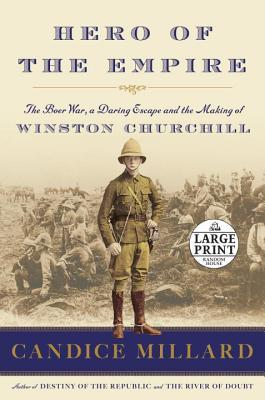
What I’m Reading: Hero of the Empire

Hero of the Empire: The Boer War, a Daring Escape, and the Making of Winston Churchill
It’s Monday, but until I catch up on my personal reading reviews, there is no Call to Action for anyone! You can read past ones here though.

I know I also promised to pair all of my upcoming reviews and this is a review of only 1 book, but that is because I want to pair this review of Candice Millard's Hero of the Empire: The Boer War, a Daring Escape, and the Making of Winston Churchill with her other 2 books. Why? Because her body of work, taken together illustrates on of the principles of RA service that I am constantly hitting home-- people are looking to match books based on their particular feel, not based on the plot, or to but it another way, we need to make our matches based on appeal NOT subject heading. With Nonfiction this becomes more tricky so I am using this review to hammer that point home. I will explain more below, but first here is the summary:
At age twenty-four, Winston Churchill was utterly convinced it was his destiny to become prime minister of England one day, despite the fact he had just lost his first election campaign for Parliament. He believed that to achieve his goal he must do something spectacular on the battlefield. Despite deliberately putting himself in extreme danger as a British Army officer in colonial wars in India and Sudan, and as a journalist covering a Cuban uprising against the Spanish, glory and fame had eluded him.  
Churchill arrived in South Africa in 1899, valet and crates of vintage wine in tow, there to cover the brutal colonial war the British were fighting with Boer rebels. But just two weeks after his arrival, the soldiers he was accompanying on an armored train were ambushed, and Churchill was taken prisoner. Remarkably, he pulled off a daring escape--but then had to traverse hundreds of miles of enemy territory, alone, with nothing but a crumpled wad of cash, four slabs of chocolate, and his wits to guide him.  
The story of his escape is incredible enough, but then Churchill enlisted, returned to South Africa, fought in several battles, and ultimately liberated the men with whom he had been imprisoned.  
Churchill would later remark that this period, -could I have seen my future, was to lay the foundations of my later life.- Millard spins an epic story of bravery, savagery, and chance encounters with a cast of historical characters--including Rudyard Kipling, Lord Kitchener, and Mohandas Gandhi--with whom he would later share the world stage. But Hero of the Empire is more than an adventure story, for the lessons Churchill took from the Boer War would profoundly affect 20th century history.
Appeal: Let’s start with the appeal of Winston Churchill before we move into Millard’s own appeal as a writer. I will admit to being both a Millard fan, and after my New Year's trip to London and visiting the Churchill War Rooms [by the way one of the best museums I have ever been to, and I have been to hundreds at this point], a Churchill fan. [In my 14 year old daughter's word, "He was a savage."] However even if you were not a fan of either before reading this book, you will be after.

Churchill was a dynamic man from the start of his life. Yes we know of his bravery and leadership during WWII, but the picture of this man who was arrogant and egotistical but also kind; who was brilliant, rich and privileged, but also brave; a man who always put service to his country first. To see all of these complications in one short volume was not only informative, but it was fun to read. 

We saw the man who became the legend here. That was fun in and of itself.

But as you cab see I am already moving beyond the subject of the story and am hinting at the biggest appeal, how Millard writes her books. 

Here is a comment about Millard's writing style from notes on my book group's discussion of River of Doubt in 2008.
Everyone agreed that Millard's writing style was excellent. One member mentioned how much she liked the "slice of life" narrative device. Too many times, she explained, great people's lives are "shoe-horned" into a book; here, she enjoyed how much we learned about Roosevelt through this one event in his life. The shorter time frame allowed for more depth into the character of the man himself.
This is why I enjoy all of her books but this is also why she it takes her so long to write each one. She takes a moment in time surrounding a seminal event in a “great man’s” life and tells the complete story around that moment. She gives you the context from every possible angle, pulling in side stories that you think might not mean anything, but with her 360 degree approach to historical research-- they most certainly do matter. But through all of this detail, Millard still manages to create a book that moves briskly. The story and it’s “characters” take over. Her hand in the story disappears. Of course I know she is writing it, but she does so in a way where the action and the actors take control and lead us, the reader through the book. We have fun and learn quite a bit but without any artifice of the author putting herself in the way. She stops back and lets history both teach and entertain on its own.

In this specific case, pairing this great man with a writing style that looked at just a moment in his life AND add to it all of the other things I learned about while being treated to an exciting adventure story, was highly satisfying. You cannot deny the adventure here. Look we know Churchill will not die. We know he makes it, but it is still an exciting tale of war, daring escape, and dangerous travels to freedom. You are on the edge of your seat waiting to see him get to safety.

Millard also taught me about the Boer War, the diamond industry, British colonial politics at the turn of the 20th Century, and the roots of modern South African. In the process, I now see some of the major world events of the 20th Century in a more nuanced and informed light. Yes I had fun reading this book and I learned quite a bit about a lot of things, things that actually have relevance to my life. Millard did that with the way she writes. That bolded line, that’s how you hand sell any Millard book. It is the soundbite review you say to a potential reader before going further. For many patrons, that one sentence might be all it takes.

For more about Millard's other books, click here for more by me on The River of Doubt and here for my review of Destiny of the Republic and here for the book discussion report on that title too. 

The overall point I want to make here is that while Churchill will be a draw for some readers, many who didn’t know much about him, will still love this book for the way it makes history come alive, the way it connects things you didn’t think mattered to your own life, and the way Millard captures you and happily takes you on a historical journal with her. 

Note on the Audio Narration: Hero of the Empire was narrated by the incomparable Simon Vance. For many that will be enough for them to listen; however, here is the AudioFile review [via NoveList] with a bit more appeal detail: 
Simon Vance's full-throttle narration is one of the many delights in this rousing biography of Winston Churchill's youthful escapades in the Boer War. Yes, the future statesman WAS a colossal egoist blessed with complete self-confidence, but, trust me, he was also funny, smart, talented, brave, good-hearted, and an all-together boon companion. He's also lucky in Vance, who reads the future statesman's boastful letters home with a straight face, which allows the audience to laugh, and with just the right hint of the Churchillian timbre. His interpretations of others, including Boer soldiers, Brits of all classes, and the odd American are equally well shaded. And when the adventure breaks out, as it often does, he breathlessly dodges bullets with the best of them. A.C.S. Winner of AudioFile Earphones Award  AudioFile 2016, Portland, Maine

Three Words That Describe This Book: Slice of Life biography, Compelling, Richly Detailed

Readalikes: In my previous mentions of Millard, I made these suggestions of other writers who take a similar approach to history as she does:


But with this title in particular, I couldn’t stop thinking about Susan Orlean. Any of her books really, but in particular The Orchid Thief. The way both women capture something I didn’t think I cared about and write what is a compelling adventure story filled with danger, drama, and lots of history and facts, it’s all just fascinating and fun. I feel like a more informed human citizen after reading these authors, but I also feel little guilty that I had so much fun while I learned.

Of course some may want to also read more about the Boer War or Churchill and for those I have left a link to a book on Goodreads to get your started. But I would venture that most who read and enjoy Millard, will want to read all of her books and others who write like her, regardless of the subject matter.

Monday, November 17, 2008

BPL Book Discussion: River of Doubt

This month my book group tackled The River of Doubt: Theodore Roosevelt's Darkest Journey by Candice Millard. This New York Times notable book follows Roosevelt after his failed bid for a third term as President. To take his mind off of his political failures, Roosevelt accepted a speaking tour of South America in 1913. Roosevelt's son Kermit was already on the continent, and the chance to see the Amazon River was just what the ex-President and famous outdoors man needed to get over his defeat.

However, the planning for the trip was shoddy and once in Brazil, Roosevelt changed the group's plans. Instead of traveling down a well mapped river, Roosevelt and his team decided to explore "The River of Doubt," a completely uncharted 1,000 mile tributary of the Amazon. As you can imagine from this set-up, things do not go well. The group loses boats in the rapids, 3 men die, food stores all but run out, and Roosevelt himself barely survives the trip. As you can see, The River of Doubt is not your run-of-the-mill Presidential narrative.

On to our discussion: All but 2 people loved the book. The two who felt so-so about it commented on the unrelenting suffering and the descriptions of all of the terrible things the group went though. One commented that she felt their pain too intensely. I did remind her that if it were fiction, we could say the author was laying it on too thick, but she was not because this was real!!

Others loved it because of the suffering. One participants comments that she was in awe of their adventurous spirit and all they went through. She was astounded.

Everyone agreed that Millard's writing style was excellent. One member mentioned how much she liked the "slice of life" narrative device. Too many times, she explained, great people's lives are "shoe-horned" into a book; here, she enjoyed how much we learned about Roosevelt through this one event in his life. The shorter time frame allowed for more depth into the character of the man himself.

Since Millard used a lot of diaries and first person accounts, this nonfiction book had a lot of well rounded characters. We got insight into Roosevelt and his crew as men, not just as famous people.

We also talked about how much we learned about the ecology, evolution, and topography of Brazil and the rain forest. One participant read a few facts out loud, such as that the mouth of the Amazon is so large, there is an island in it, almost as big as Switzerland!

We also spent some time discussing the indigenous population and what it means to be "civilized." Who is more civilized, the modern explorers or those who had lived in the rain forest for thousands of years?

We ended our discussion by talking about survival. I asked the group what would you do in a situation like Roosevelt's where you literally were fighting to survive in a hostile and unknown environment with not hope of rescue. People talked about how they thought they would react. Each had something slightly different to say, but overall, we decided that your real self comes out in those situations. We also thought that at some point you would have to confront death and come to terms with its inevitability. We also talked about how Rondon's adherence to a schedule and his strict regimentation saved them all. You had no choice but to go forward with Rondon in the lead. You may be upset, uncomfortable, unwell, and dejected, but you just kept moving toward your goal.

As you can see, we enjoyed the discussion and loved that the book allowed for so many different paths of exploration. This also leads to many readalike possibilities. One of the participants mentioned that this book reminded her of when we read The Orchid Thief by Susan Orlean. Another brought up our discussion of Ines of My Soul by Isabel Allende. I would add to this list, 2 other narrative nonfiction titles of people persevering through tough times although not in the Brazilian rain forest, The Worst Hard Time: The Untold Story of Those Who Survived the Great American Dustbowl by Timothy Egan and Mayflower: A Story of Courage Community and War by Nathaniel Philbrick. Finally, other famous explorers were mentioned in this work, one of which was Ernest Shackleton. Endurance: Shackleton's Incredible Voyage by Alfred Lansing is one of the best accounts of his Antarctic exploration.

There is an extensive bibliography in the back of The River of Doubt to turn to for reading about this adventure specifically, but I would like to point out Roosevelt's own account of his trip, Through the Brazilian Wilderness which is still available at many public libraries. If you want to learn more about Roosevelt, I would also suggest trying Theodore Rex by Edmund Morris or Mornings on Horseback: The Story of an Extraordinary Family, a Vanished Way of Life and the Unique Child Who Became Theodore Roosevelt by David McCullough.

In terms of fiction, there are many ways to go. I mentioned Ines of My Soul above, but there is also Kathy's suggestion of Fordlandia by Edwardo Sguiglia which is a fictionalization of Henry Ford's attempt to have his own rubber plantation in the Amazon. Another patron also mentioned thinking of the Jean Auel Clan of the Cave Bear books when reading this.

Obviously there is lots to draw on here. Enjoy.

Tuesday, March 4, 2014

BPL Book Discussion: Destiny of the Republic


Last Monday, my book group met to discuss Candice Millard's Destiny of the Republic: A Tale of Madness, Medicine, and the Murder of a President.  I originally read, reviewed, and loved this nonfiction title back in January of 2012.  You can click here for that full review by me, but in the interest of keeping all of my book discussion reports as similar in structure as possible, here is the publisher review courtesy of Lit Lovers:

James A. Garfield was one of the most extraordinary men ever elected president. Born into abject poverty, he rose to become a wunderkind scholar, a Civil War hero, and a renowned and admired reformist congressman. Nominated for president against his will, he engaged in a fierce battle with the corrupt political establishment. But four months after his inauguration, a deranged office seeker tracked Garfield down and shot him in the back.
But the shot didn’t kill Garfield. The drama of what hap­pened subsequently is a powerful story of a nation in tur­moil. The unhinged assassin’s half-delivered strike shattered the fragile national mood of a country so recently fractured by civil war, and left the wounded president as the object of a bitter behind-the-scenes struggle for power—over his administration, over the nation’s future, and, hauntingly, over his medical care. A team of physicians administered shockingly archaic treatments, to disastrous effect. As his con­dition worsened, Garfield received help: Alexander Graham Bell, the inventor of the telephone, worked around the clock to invent a new device capable of finding the bullet. 
Meticulously researched, epic in scope, and pulsating with an intimate human focus and high-velocity narrative drive, The Destiny of the Republic will stand alongside The Devil in the White City and The Professor and the Madman as a classic of narrative history.
Lit Lovers also has original questions posted here which I used as a guide to our discussion. Speaking of, here are the notes of what we talked about:
  • Well the votes went down unanimously this time.  I had a smaller crowd of 12 but all voted for Liked It!  One even said WOW!  People who couldn’t make it called or emailed in that they loved it too.  I get worried when this happens because book discussions go better when there is dissension, but the good news for our discussion was that people liked different aspects of the book, so that made for a varied discussion.  Here are some of the initial comments from the start of the discussion:
    • Who knew how interesting Garfield was?  Not me.
    • I knew it would be sad since it is no shock that he dies, but I didn’t expect to be heartbroken for what our country lost when he died.
    • I suggested it to a friend for his book club
    • I found it crazy that after Lincoln there was still no Secret Service
    • Millard is a good historian but she also writes in a way that is fun to read.  This is how to write Nonfiction!
    • I too was impressed with the scholarship here.  I also really liked her acknowledgements.
    • My favorite part was all of the medical history I learned.
    • That part infuriated me. So frustrating that there was a time when Lister’s idea of a sterile environment for surgery was NOT considered correct.
    • I found hopefulness in this book.  The country was so divisive, yet Garfield brought us together in his death.  It also gave me perspective that although things are VERY divisive now, it was much worse then and we got through that.
    • As surprised as I was about what a great leader Garfield was, I was equally impressed and gained new respect for Chester Arthur.  His change in response to Garfield’s death was impressive. That too was lost to history.
  • Question: Before you started this book, how much did you know about Garfield? Is her case for his potential and forgotten greatness convincing?
    • I never knew he was such a great guy.
    • At first, I was worried because I felt like Millard was too pro-Grafield.  She was not impartial enough.  But I liked the book even if it was not balanced.
    • As a “recovering academic” (this got giggles), I questioned how little Millard went into Lucretia and Garfield’s student-teacher relationship as they started courting.  I sought out more on that on my own. [See the very end of this post for a link to a CSPAN video on Lucretia.]
    • We read Millard before in book club, she seems to take the underdogs in history and elevates them.  So yes, she does write from a biased perspective of the protagonist (underdog) as good with clear bad guys in opposition.
  • Question: What was with the crazy Republican Convention where Garfield somehow went from nominator to nominee? Let’s make comparisons to the political process today.
    • First of all, Garfield didn’t want to be President.  He almost turned the nomination down.  I can't even imagine someone so involved in politics today NOT wanting to be President.
    • That convention had drama.  It is nothing like the controlled, staged event that happens now.
    • It would have been like that year Obama was just a speaker, and he wowed the crowd, trumping the actual nominee and being nominated 4 years earlier than he was.
    • Maybe it was good that it was so divisive and crazy because as a result, the civil service system was established and it helped to stop some of the madness of political appointments.
    • Patronage systems that fueled those problems are now illegal.  They still happen, but not as practice since they are technically illegal.
    • The patronage system egged on a single sicko-- Guiteau-- to assassinate the President.
    • Today’s professionalized Civil Service and more national and global awareness work together to keep politicians in-line.
    • Leaders Note: This line of questioning started off slowly but began to build very nicely.  If you discuss this book, give this question time to build. I was patient and it paid off.
  • Question: Guiteau.  I feel like he doesn’t deserve our respect to spend time talking about him, but how can we not even bring it up a little. Let’s just say what we want about him and then move on.
    • psychotic
    • I was so mad that he survives the boat accident that Millard opens her book with.  I know she manipulated my emotions on purpose, but still so mad.  He should have been one of the people who died!  Even worse than the fact that he survived, he thought his survival was a sign from God that he was meant for great things. Yuck.
    • He had to be executed because the country needed to see him die in order to heal over the national tragedy that was Garfield’s death, but at the same time, it was tragic because he really was mentally ill and needed help.
    • I don’t think anyone at that time could have helped him.  Medicine was not advanced enough to not kill Garfield.  Guiteau’s mental illness was too biologically complicated to be treated at the time too.
    • I liked how she explained that around this time (end of 19th Century) the insanity defense was still new.  Many people at the time still thought it was a way for murderers to lie.  I think they were right to try NOT to allow it to be used in his defense.
    • One participant shared a personal story about a co-worker whose husband was killed by an insane person.  This widow actively fought for him NOT to use the insanity defense because if he were convicted that way, there was a chance he could one day be released.  She knew he was insane, but couldn’t bare to know he would be out of jail one day.
    • Back to Guiteau.  We appreciated that they government worked very hard to keep Guiteau alive for his day in court so he could tell his (crazy) story, be convicted, and be publicly executed.  This made us think about all of the pain and conspiracy theories we still have over JFK because Oswald was killed before he had his day in court.
    • This book also made me think about how much we still need to learn about mental illness.
    • I was struck by Millard pointing out that both men were involved in a serious boating accident and how different the outcomes were because of this accident.  Guiteau thought it meant he was chosen by God and Garfield’s made him redirect himself to family and scholarship.  Excellent job by her as a historian to find that connection and as a writer to work it into the book subtly.
  • Question: What did you think about the descriptions and information about the medical establishment at the time, and Dr. Bliss’ fault in Garfield’s death?
    • I was so frustrated to learnt hat Dr. Lister’s methods of a sterile environment was already accepted and used in much of Europe but not accepted here.  Sometimes Americans have the mentality that we always know best, when it is obvious that this is not true.
    • Bliss had ambition and wanted to create a name for himself, maybe more than he cared about his patient. This ambition hurt Garfield’s chances at survival.
    • I thought it was interesting that while they knew some Civil War Vets had been living just fine with bullets still lodged inside of them, since they didn’t know how or why this was the case, and this was the President, they wanted to do everything they could to save him.  To them it made sense to remove the bullet at all costs, except, this insistence is probably what killed him.
    • What happened to Garfield after he was shot was BARBAROUS (her emphasis).
    • We decided that Bliss was not all bad. He did truly want to save Garfield, he just cared about his career more than Garfield’s health.
    • Interestingly, Millard included (for comparison) a description of the female doctor who cured Lucretia, actually nursed her back from the brink of death, with much less invasive procedures.
    • The diet Garfield was given to cure him actually made hime sicker.  He had known dietary problems and was very careful to only eat things that agreed with him.  Why did they force him to eat things that were established as upsetting to his body as part of his treatment? Again, they did not understand food intolerances then.
    • All of this medical stuff was very frustrating to me because it seemed like common sense.
    • Ahhh, but it is 21st Century common sense.  This was the late 19th Century.
    • The expression, “Ignorance is Bliss” came from an older poem but this shortened version of the statement became popularized by the media after Garfield’s death.  The fact that it has hung around as a colloquial expression is because of Dr. Bliss and his bad treatment of Garfield.
    • This reminded us of when we read Manhunt by James Swanson and we learned that saying someone’s “ name is Mud,” comes from a figure in the chase to capture James Wilkes Booth.  That also made me comment  that we might have an assassination fetish as  a group because we also read Assassination Vacation as a group too [see readalike info below for details].
  • Question: Let’s discuss the entire plot arc with Alexander Graham Bell.
    • I knew Bell was important, but now I think of him as AMAZING (her emphasis)
    • He was a true scientists and obsessed inventor.
    • His mind was so active and creative.
    • He was like a Leonardo da Vinci Renaissance man.
    • I really liked how his commitment to the deaf was woven into the narrative by Millard.  This was interesting, informative, and completely new to me. It increased my enjoyment of the book as a reader.
    • I never knew the extent of how much Bell invented.  We hear about Edison more, but Bell was less of a self promoter.
    • This book made me want to read more about Bell. [Click here for an award winning option]
    • It’s amazing how much 1 person can change our entire world--this is what the info on Bell made me think about him.
  • Question: Now that we have read both of Millard’s books, even though they are different, what do you think of her as a writer?
    • I love how she captures history.
    • I like that she gives the longview approach.  She looks at different areas surrounding the situation at the center and puts what happened into a larger context.
    • 20 years later, she tells us, Garfield would have lived, but it had to end with his death in order to force the medical community in America to change.
    • How she connects all of these disparate details seems effortless.  I know it is hard to do though.
    • Yes, like how she introduces us to Garfield as he walks through the Worlds Fair when he was a Congressman.  He is looking at Bell’s inventions.  To the reader it seems like a weird place to start, yet as the book continues, it makes sense, and even more so, it seems brilliant in retrospect. Since Bell was introduce in a seemingly random way at the start, it is less jarring when he shows up later.
    • I also loved how she included Garfield’s own words from his journals throughout. She even included longer excerpts in the notes (which are also very entertaining and readable on their own). She laid the foundation of  Garfield’s story with his own words, but it did make me want to read even more of his journals.
    • The same facts laid out in a different way would have made a boring book.
    • This made me ask a question follow up: Does history have to made more interesting to be worth reading?
      • It doesn’t hurt
      • I think this is like when you have a great teacher. He or she may teach you the same things as another teacher would, but they can also make it all better and more memorable by their style.
      • A book like this gives you a way of looking at history and ask what the stories are.  And that is what makes history, all of the stories woven together.
      • Yes, but this is harder to do with recent history as we are too close to it.
  • Question: What else do you want to say before we wrap up? [Leader Note: this is always a good idea so everyone leaves feeling like they got to say everything they wanted to say.]
    • Garfield was ahead of his times.
    • His death united a country, much as he foretold when he said, at the Republican Convention when nominating someone else for President, that this election held the "Destiny of the Republic” in the country’s hands.
    • I liked learning about his secretary, Brown, and what a hero he was.
    • Yuck, the awful shape of the White House.  Rats, smells, swamp!
    • The pictures were a nice edition
  • Ending as usually with words or phrases to sum it all up:
    • heartbreaking
    • united
    • eye-opening
    • history’s stories
    • riveting
    • the longview
    • interconnected details
    • consequences of actions
    • humility over hubris
    • critical thinking over “being right”
    • triumph of the thinking man
Readalikes: Here is what I suggested in January 2012:
Although the tone is completely different, I kept thinking of Assassination Vacation by Sarah Vowell. In this book, Vowell uses her trademark geeky humor to delve further into the ways in which the assassination of Lincoln, Garfield, and McKinley were played out in a cultural context.  In the process of reading Vowell's book I learned quite a bit about Guiteau, and I knew the weirdness of Robert Todd Lincoln's presence at the assassination (and McKinley's later), but Vowell's book did not have any of the details about Lister, Bell and/or Bliss that I found so interesting.  Together these books make a nice pair.
A search on NoveList revealed a few good nonfiction readalikes: Ira Rutkow's James A. Garfield (a biography), Kenneth Ackerman'sDark Horse: The Surprise Election and Political Murder of President James A. Garfield (as much about the era as the assassination), and Midnight Rising by Tony Horwitz (similar writing style; about the post-Civil War era).
For those interested in the subsequent McKinley assassination (which finally got the President some armed guards wherever he went), Scott Miller's The President and the Assassin: McKinley, Terror and Empire at the Dawn of the American Century is widely considered to best the best narrative nonfiction on the topic.
As an author, Millard's richly detailed, yet not bogged down style, her engaging voice, and compelling plotting remind me of a few other authors:
If you have a reader who liked Destiny of the Republic but wants a fiction suggestion, I would try The March by E.L. Doctorow for its American History, multiple points of view, engaging voice and compelling plot.  Just like Destiny of the Republic, we know what is going to happen but we are still compelled to see how it turns out.
To this extensive list I would add Carol J. Baxter's The Peculiar Case of the Electric Constable: A True Tale of Passion, Poison, and Pursuit. Both are histories that read like novels filled with memorable characters, suspense, and lots of research.

Finally, a participant highly suggested this video about Lucretia Garfield on CSPAN from their series on first ladies.  You can watch it for free online.  She said it provided another perspective on Garfield, and added in many details of interest to those who want to know more. It is free to view online.

Thursday, February 6, 2020

The ARRT Nonfiction Genre Study Begins


Later today I will attend the first meeting of the 2 year, ARRT Narrative Nonfiction Genre Study. While the notes of every discussion will be made available to all, I wanted to share today's introductory assignment and some of my preparation today.

Before we begin with the newest study, a quick reminder that the main page for all of ARRT's genre studies, current and past, goes back to 2011-12. The most recent Genre Study on Romance just finished up in December of 2019 and is an excellent, up to date resource for that genre. You an use ARRT's current or former Genre Studies as a guide to organize your own.

Now on to Narrative Nonfiction. Click here to access the full schedule with dates and locations. Assignments and notes are added as they become available. 

Here is how the organizer have divide up the huge collection of genres that Narrative Nonfiction encompasses. Note, biographies and memoirs are not a category because they will be specifically considered within each category:
  • Welcome Meeting 
  • Social Issues 
  • Let’s Make Something: Food, Crafts, Arts, Decorating 
  • Pop Culture, Sports, Entertainment 
  • Global Issues: Beyond America 
  • Travel and Adventure 
  • Crime 
  • History, War, Politics 
  • Improvement: Personal or Professional 
  • Nature, Science, Health 
  • Current Events/Trending Topics 
  • Wrap-Up
And it all begins today with this assignment:
Welcome Meeting
February 6, 2020, 2-4 PM
Lisle Library District
Here is the assignment:
For our first meeting we’ll discuss the outline of the genre study and how we will tackle narrative nonfiction. For your assignment:
  • Bring one “Sure Bet” nonfiction book. When you have someone who says they have to read a nonfiction book (against their will), what book do you find they end up enjoying? Be prepared to discuss why you think this book appeals broadly to many readers.
  • Please read a narrative nonfiction book that appeals to your sense of humor. Since humor is so hard to define, you are just looking for a book that makes you laugh. If you can’t find one, bring an example of a book that failed and why it failed to make you laugh.
I have my notes ready to answer both questions, but I am more excited to see what everyone else in attendance has to say because that is the best part of any Genre Study. It is through the group discussion of the topic, the sharing of different opinions, the crowd sourced lists and notes we create [and share here, for free, after every meeting for all to use to improve their service] where the real learning happens.

So bookmark the Narrative Nonfiction Genre Study homepage, use it to train yourself, or to organize your own genre study. Follow along. I will be alerting my readers when new notes are available.

Finally, here is a quick teaser of the authors and titles [with links] that I will be mentioning for each bullet point above:

Monday, March 5, 2012

Monday Discussion: Women's History Month Edition

So, it is the first Monday in March, which means it is time for Women's History Month.

I thought today we could talk about some of our favorite female authors.  I decided to focus on current female authors who I really enjoy.  I have linked to my reviews of their works for you to see why.  These links are to any time I have mentioned them.
But, I have already written quite a bit about these women here on RA for All.  Now it is your turn.  What female writers now or in the past are among your favorites?  Now is your chance to talk them up and get us to read them.

For past Monday Discussions, click here.

Monday, April 11, 2011

BPL Book Group In the Tribune

Becky Spratford and Berwyn Public Library Monday Afternoon Book Club.
Picture from April 2010 Meeting
 
Finally, after being in the cue for almost an entire year, there we were on Saturday, me and my ladies.  Aren't we lovely?

I am so proud to be a part of this wonderful group.  I am also so happy for them that we made it into the paper.  This was totally their doing.  They told me that our group was better than all of the others the Tribune featured and asked how we could get in.  Without their pushing, I would have never submitted our group information.  So ladies, this is for you.

Here is the direct link to the article and below is the text.

Berwyn Public Library Monday Afternoon Book Club

We are: about 15 bright, eclectic, mature woman and a 30-something librarian who has been leader for nine years.

We reserve a room at the library for the discussion from 2-4 p.m. We spend about 80 of those minutes discussing the book.

Five books we loved: "Manhunt: The 12-Day Chase for Lincoln's Killer" by James Swanson, "Devil in the White City" by Erik Larson, "The Zookeeper's Wife" by Diane Ackerman, "The River of Doubt" by Candice Millard, and "Loving Frank" by Nancy Horan.

About "Manhunt": What we loved about this book was how it took a historical event we were all familiar with, but told it from the other side — from the point of view of John Wilkes Booth and his conspirators. We were surprised by how much we were drawn to Booth. We agreed that Swanson manipulated our emotions by using Booth's own personal diaries and playing off the fact that we know in the back of our heads that he will not get away with what he did. Two years later we still talk about this book.

We would love to meet: Bill Bryson because we love his sense of humor and how he is able to cover so many areas and issues in his books without making it feel like he is trying too hard.

Sometimes a book that people didn't like leads to a great discussion.

We begin every discussion with a poll as to who liked, disliked, or was in the middle about the book. Quite often, the reason one person loved the book is the exact reason why another disliked it. This gets the discussion off to a running start every time.

Up next: "Italian Shoes" by Henning Mankell, and "Wait Till Next Year" by Doris Kearns Goodwin

Monday, February 15, 2016

Happy Presidents' Day: A RA for All Reading List


Since I hold a BA in American Studies, this is a topic I greatly enjoy. I even took a class in college called, "The American Presidency" during a Presidential election year which was also the first year I could vote ['96].

But I am not alone in enjoying books on Presidents. As the current Presidential race moves forward, you will have many patrons looking for Presidential reading options. So while we shine a spotlight on past American Presidents today, keep this link saved for the several months, as it will make for a good suggestion list for the foreseeable future.

Here are some of my favorite books about American Presidents.  Most of the links go to reviews or book discussion reports here on RA for All. And each post has plenty of readalike options too. But please note, these are not your typical Presidential biography suggestions; those you can find pretty easily using traditional reference techniques. RA for All is about taking the leisure reading suggestions beyond the most basic steps.

  • Candice Millard is THE BEST. I wish she could write faster.  Here is a link to the book discussion I led on River of Doubt: Theodore Roosevelt's Darkest Journey. And here is the link to the book discussion report for Destiny of the Republic which also includes a link to the review I wrote the first time I read this book.  Her new book is coming out in September, but she is moving her focus across the Atlantic as it will be about Winston Churchill.
  • Assassination Vacation by Sarah Vowell may have a witty tone, but it takes a very serious look at the factors and events that led up to the first three American Presidential Assassinations.
  • James Swanson's Manhunt: the 12-day Chase for Lincoln's Killer was my book club's all time favorite book. They even proclaimed their love for it publicly when they were featured in the Chicago Tribune.
  • Stephen King's 11/22/63 is one of my all time favorite books.  Plus, it is a TV miniseries now, so there is interest.  It is especially great on audio.
  • Erik Larson's Dead Wake from last year had a very interesting side plot about President Wilson. I learned quite a bit more about him than I was anticipating [in a good way].
  • One of my favorite novels about the life of an American President, one that I read pre-blog and still hand out regularly is Sally Hemmings by Barbara Chase-Riboud. It is an older title, and most strikingly, it was written before it was an accepted fact that Thomas Jefferson had children with Hemmings. Chase-Riboud took a lot of flack for writing this book. It is historically accurate AND a moving read. Here is an annotation I wrote back in 2007 promoting this book during Women's History Month:
    • Sally Hemings was Martha Jefferson’s half sister and eventually the mistress of Martha’s husband, Thomas Jefferson.  This novel recreates life in 19th century Virginia and depicts its slavery, miscegenation, denial, and hypocrisy, by recreating the life of Hemings and her children by Jefferson.  Chase-Ribould’s narrative shows Hemings as a complicated woman in a loving relationship, at a tumultuous time in America.

Monday, December 19, 2011

Monday Discussion: What I Have Learned About My Reading Tatses This Year

Before we get to today's Monday Discussion, I want to recap the favorite books of 2011 that people shared last week.  All have a 2011 copyright:
What I love about this list is the range of titles you can find here. There are kids books, nonfiction, literary fiction, romance, crafting books.  Just about something for everyone.  You can use this link to see all the wonderful comments by everyone who shared their best books of 2011.

Now on to today's discussion.  I have been compiling my personal list of the best books I read this year, and in the process, I figured out a few new things about myself and my personal reading tastes.


For example, this year I learned that I love to read travel guides.  Click here to read my full review and reasoning, but it was a pleasant surprise to find that there is a who new type of book for me to enjoy.

It reminded me that even people like me who are extremely self aware of what we like to read and why, can be surprised by something new.  We should all keep our minds and options open to new types of books, new authors, new genres, and new formats.

When we, the professionals, keep our options open, it is easier to counsel our patrons to do the same.  How can we expect them to try something new if we won't do it ourselves.

So in that spirit, think back on your last year of reading.  What new authors, genres, formats, or themes emerged as new likes for you this year?

Click here to follow past Monday Discussions.

Also a programming note: due to the fact that the government, post office, and libraries are all observing Monday 12/26 as the day off for Christmas, the library will be closed and I will not be working.  The Monday Discussion will make a rare Tuesday appearance on 12/27.

Wednesday, January 21, 2015

Book Discussion Questions for The Secret Rescue

On Monday, my group met to discuss The Secret Rescue: An Untold Story of American Nurses and Medics Behind Nazi Lines by Cate Lineberry. I am working on the book discussion report post, but I wanted to let people know that I could not locate prepared questions for this book.

So, I created my own questions, but I wanted to get them up in a separate post so that they will be picked up by search engines more easily than if I embedded them in the post on the discussion itself.

They are posted below. Feel free to use them, but please cite RA for All and this permalink if you do.
________________________________________

The Secret Rescue: An Untold Story of American Nurses and Medics Behind Nazi Lines by Cate Lineberry

(Questions by Becky Spratford with some guidance from LitLovers)

  1. We have read many books about WWII and others about “survival.” How does The Secret Rescue compare to those books? Is it a WWII book or a survival book? If you had to describe this book to someone, which subject heading would you pick out as the primary one for this story?

  1. Albania in 1943-44 was an unknown political and cultural landscape to the Allies. What did you learn about this country, its customs, politics, and traditions by reading this book? What does Lineberry think about the Albanian people themselves and/or our interaction with them? How does she feel about the Partisans and the BK, and how do her feelings influence how she tells the story? Do you feel like you know anything about Albania today? Does this book help you understand that region of the world better?

  1. Lineberry employed a comprehensive research strategy to write this book using government documents, personal recollections of those involved, interviews of survivors and their family members, trips overseas, etc…  Her research choices influence the style in which she chooses to tell the story of these events. Did you enjoy reading this as a narrative story or did you enjoy the learning aspects more?

  1. How did you experience this story? Were you engaged immediately, or did it take you a while to “get into it.” Compare Linberry’s style with Candice Millard who we have read twice. Both teach us about history we did not know, but write with different styles.

  1. How did you feel while reading this story? Were you able to experience the parties’ struggle and feel their hunger, pain discomfort, despair, etc..  Were you able to experience the struggle of those who helped them-- the partisans, the British, the OSS officers? Was Lineberry more successful at articulating some points of view and feelings more than others?

  1. What did you know about medics and Army nurses before this? What did you learn about how their mixed sex squadron functioned? How did the officers, nurses, and enlisted men interact? Were you surprised to find female nurses on front lines at this time? Were you surprised at how strictly they kept rank throughout their ordeal?

  1. What does Lineberry want us to take away from this story? Is she doing more than simply asking us to learn about “lost” history?

  1. Let’s talk “characters.” There are many people here-- the 30 stranded service people plus the dozens who helped them.  Were their any who you would like to discuss [for better or worse]? Or, were there so many people here that you felt you did not have the time to get to know anyone well enough?

  1. Were you surprised that all 30 made it out alive? Why do you think that is? But not everyone involved survived the ordeal? Who made the biggest sacrifice so that these 30 could make it home alive?

  1. Did you feel like you now have the “whole story?” Did this book make you question how much we truly know about recent history? Current conflicts and situation?