RA FOR ALL...THE ROAD SHOW!

I can come to your library, book club meeting, or conference to talk about how to help your readers find their next good read. Click here for more information including RA for All's EDI Statement and info about WHY I LOVE HORROR.
Showing posts sorted by relevance for query junot diaz. Sort by date Show all posts

Thursday, January 25, 2018

Junot Diaz’s Personal Plea to “Decolonize” the Shelves and Becky’s Demand That You Start NOW!

Thanks to my daily reading of Shelf Awareness, I was altered to an amazing and heartfelt speech by Pulitzer Prize winning author, Junot Diaz.

Below is the summary of what he said via Shel Awareness with the link to watch the entire speech, but after that I have some comments that are specific to you as you work at your library.
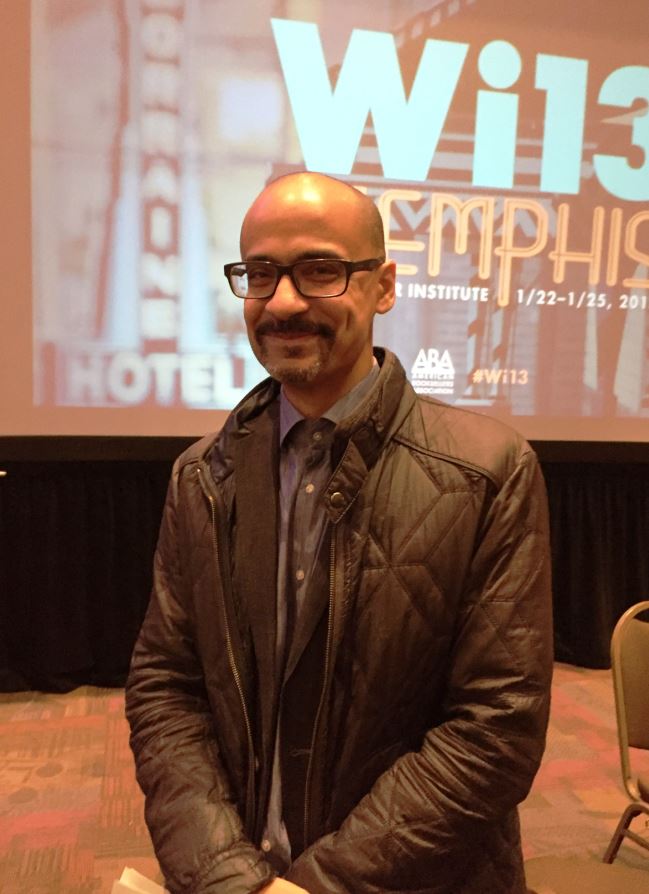
#Wi13: Junot Díaz on 'Decolonizing the Shelves'

Junot Díaz
Valerie Koehler of Blue Willow Bookshop, Houston, Tex., introduced Wednesday's Wi13 Breakfast Keynote speaker, "beloved novelist" and Pulitzer Prize winner Junot Díaz. Islandborn (illustrated by Leo Espinosa, available from Penguin March 13), his debut picture book, is, in her words, "a celebration of creativity, diversity and our imagination's boundless ability to connect us."
The breakfast of nearly 1,000 booksellers and publishing representatives marked Díaz's first time speaking at the Winter Institute. "It's a great honor," he said, "to meet the people who made me possible." He began by giving a quick "genre of gratitudes" to the booksellers both present and not, to his publisher and to the bookstores he referred to as his own: Bunch of Grapes and Edgartown Books on Martha's Vineyard in Mass.; Harvard Book Store, Cambridge, Mass.; New York City's Word Up Community Bookshop/Librería Comunitaria; and Singapore's BooksActually. "If it hadn't been for the curatorial devotion of independent bookstore sellers, my art would perish."
After expressing his gratitude, Díaz read prepared remarks. His speech was a deeply personal account of his childhood relationship with books and his inability to find himself in them. His family emigrated from the Dominican Republic to the United States in 1974, settling in Parlin, N.J., "on the bleeding edge of Bon Jovi-level whiteness." He explained that his family were the first Dominican people in the neighborhood and not welcomed: "The white supremacy... was all day every day for us immigrants of color where white folks could say anything to us without any kind of repercussion."
Having "arrived in the United States completely illiterate," Díaz said that, "if it hadn't been for the kindness of librarians," he probably wouldn't have found books. But he did. "Books became my shelter against the white world that sometimes felt like it was trying to destroy me." Yet, while the books saved, they also alienated him. As the world in which he lived told him his very existence was weird or wrong, his books either agreed with the greater world or acted as if he didn't exist at all: "what really killed, was the erasure. God almighty, the complete and utter erasure. How thoroughly kids like me did not exist in our books."
This desperate desire for representation in children's literature is what drew Díaz to writing for a young audience: children of color still "live out milder versions of what I endured in my childhood." He is working to "decolonize the shelves" and asked the audience to do the same. "Bookstore owners and librarians are on the front line. It's the smallest intervention that can sometimes create the most important, lasting change." He finished his speech to a standing ovation: "I wrote my children's book, Islandborn, because I believe there are things immigrants can teach that we all need to hear without which we will never understand this stolen land we inhabit."
You can watch his keynote here. --Siân Gaetano
On a personal note, I love Diaz’s writing. You can click here to see everything I have had to say about him.  The Brief Wondrous Life of Oscar Wao is one of the only books I have read three times-- for fun. I love how he captures the immigrant experience in general, his personal Dominican heritage, and nails what it mean to be from Jersey better than anyone.

He is one of the best writers I have ever read. He can take letters and craft them into words [in 2 languages] that can portray every emotion and at the same time, tell a story that is a pleasure to read. His stories can be in equal turns brutal, beautiful, funny, suspenseful, speculative, and above all-- lyrical.

But to hear him speak here, my heart breaks for him, yes, but it also breaks for all of the immigrant kids and all of the kids of color, who have never been reached by great books because they could not find one to speak to them and their experience.

He talks about how the library both saved him AND saddened him. It gave him a place to belong, but the books he read could not save him. Thankfully, he was able to write the books that could save him. And now he is writing to save others-- especially children. In a room full of white booksellers, he is challenging us all to do better.

Listen to Diaz. Don’t think you are not part of the problem...still. Even those of you, myself included, who are trying to do better, who make an effort to check our privilege. Every single one of us-- we all need to listen to Diaz tell us the honest truth from the perspective of that brown kid who became a great “American” writer.

Look, it is fine to say you are making sure that you are providing diverse reading options to all of your patrons. Everyone grows, learns, and is a better human on this planet by reading diversely. [Please use my diversity tag for more information, essays, and presentations on this topic.] But there is more to this speech. There is a call to action. We cannot keep paying lip service to the problem without ACTING.

If you get nothing else out of today’s post, please know that one of my mantras for 2018 is that when it comes to diversity, checking yourself is a mandatory, professional responsibility. I will demand that of all of you and of myself. And I am serious. I am working on a committee to re-write an author list and I assigned a person whose sole job is to be the diversity checker-- to make sure we are considering all voices. And I am not sorry that I didn’t even ask for this, I simply demand it happen and in the middle of the meeting asked someone to do it, putting her on the spot [but to be fair, I know her well enough to know she wouldn’t protest].

This is not how committees should work, but I am not ashamed of my behavior even a little.  Seriously people, this is how change happens- when people act. Don't wait for change to come. Act. I don’t care if that behavior described above made anyone upset. It is too important to wait around for change, or bring it up for discussion in 4 consecutive meetings before deciding to maybe do something.

I will continue to check myself, check others, but I will also ACT. I will demand we all do something. The last few years have been focused on talking about the problem. What are you going to do about it?

Thursday, February 14, 2013

What I'm Reading: This is How You Lose Her and A Visit From the Goon Squad

In January, I finished two books which are very different in subject, but very similar in appeal, so I decided to review them together. Both books are also composed of connected short stories and each is by a Pulitzer Prize winning author. So let's begin.

I started 2013 by listening to one of the unanimous best books of 2012, the connected short stories in This is How You Lose Her by Junot Diaz.

Diaz's stories once again bring back the narrator from The Brief Wondrous Life of Oscar Wao, the irascible but brilliant Junior.

While Junior was there to tell us Oscar's life story in The Brief Wondrous..., here in a collection of connected stories, Junior is set free to tell us the story of his own life.  We see his own story of coming from the Dominican Republic to Patterson, New Jersey.  He tells us about the complicated relationship with his older brother, who we know from Oscar Wao will die of cancer, and his mother.  And of course, it all centers around a Dominican man's greatest joy, his love of women.

The stories recount Junior's failed relationships, his love of women, and his desire to do good by them, except for the fact that he is always cheating. As a result the overall tone is moving and bittersweet. We see stories of love and loss, and although the structure of the book is nontraditional, the story still moves in a way that is easy to follow.

I should note that the stories do not go in chronological order per se, but their connection is strong enough that the entire book flows as one unit.  We get glimpses into Junior's life at various times.  Your enjoyment of this book will be dictated by whether or not Diaz sucks you in to loving Junior.

As much as I enjoyed how the stories united to tell Junior's story, I am also enjoying the connection Diaz is creating across all his works by using his alter-ego, Junior, across his oeuvre.  As a reader, I greatly enjoy this.  Also, Junior is my kind of character-- deeply flawed, but complex.  He makes bad choices, but he is not an evil person.  I also love how he talks directly to the reader; this draws me in every time. I have been captivated by Junior and can understand why women fall for him.

Another huge appeal here is the lyrical language.  Diaz works hard to create stories in which the language flows without making you feel stupid.  This is a gift that I treasure each time I read one of his books.

Also, without giving anything away, the last story had great closure.  Quite often, a book of short stories leaves you hanging, but although the book is episodic and we only get peeks into Junior's life at a few points, Diaz is able to wrap it all up perfectly at the end.  We see the point of the entire book in the final pages of the last story. That was extremely satisfying.

Finally, a note on the audio.  Diaz narrates this book.  Sometimes author narration don't work, but here I loved it, except for the one story in the book that has a female narrator [otherwise they are all Junior].  It was jarring to hear Diaz start the story only to realize a few minutes in that his "Junior" voice was a woman.  In fact, with Brief Wondrous... I both read and listened to it.  Now having 2 Diaz listening experiences I think that I prefer his work in audio.  When he is reading them, his amazing, lyrical construction flows more naturally.  My gringo pronunciation is better than average but does not have the "DR" swagger the text needs. I also enjoy how Junior mixes slang and fancy vocabulary, English and Spanish.  This is realistic.  Junior, a product of the Patterson projects who has grown to be a university professor, would talk this way.  It is little details like this which make Diaz's work so enjoyable, and in audio this brilliance shines even more brightly.

Three Words That Describe This Book: Character Driven, Lyrical, Connected Stories

Readalikes: In the past I have posted here about readalikes for Diaz. But in considering a new suggestion for this post, I had one name that kept popping in my head-- Philip Roth.

Okay, now you think I am crazy, but hear me out here.  Both authors write intricate stories set in urban Northern New Jersey (Roth's Newark to Diaz' Patterson).  While they are separated by over a generation, both men contemplate their place as ethnic minorities in their work using the first person narration of an alter ego, often one who is also a writer.  Finally, both authors have frank discussions of sexuality and sexual situations in their work. See, not as different as you first thought.

You can also see the end of this post for more read alike options.

But first, another critically acclaimed episodic novel, A Visit From the Goon Squad by Jennifer Egan.

In this case, I would call this novel more of a novel in stories than a book of connected stories.  Let me explain.  Egan's novel spans from the 1970s until about 2020 and is centered around two characters, Bernie, a record executive, and his long time assistant, Sasha. The novel as a whole tells each of their life stories, but the narrators constantly change; in fact Bernie and Sasha only get 1 chapter each.

The stories move in a conscious way, although I have to admit it took me a few stories to get in the groove.  I thought it was all haphazard at first, but it is not.  Each chapter flows into the next as one character who either appeared in the previous story or was somehow featured, takes over the next one.  The connection get stronger as the book moves on.  It was awesome and fulfilling as a reader.  I felt the crescendo building even though the stories jumped around in space and time.  The result is a novel that is consciously constructed, but not difficult to follow.  It was intricate without being obtuse.

And, in case you didn't get it, the last story takes the guy who appears in the first story (narrated by Sasha) and lets him have his turn years later, only he interacting with Bernie this time. The circle closes, and despite the complex style of the work, you feel like it all resolved. Maybe a circle is the wrong shape, since the story flows, but in a twisted way.  Maybe it is more of a double helix.

Since each story has a different narrator, each also has a different style.  In fact, this is one of the best things about the novel.  Each chapter draws us into the narrator's world view by relating the action of the chapter in their own style.  The words flow differently, the people are described differently, the dialogue changes all depending on who is narrating.  In the biggest stylistic shift, Sasha's daughter tells us her story in power point form. An author less devoted to creating this novel-in-stories would not have the attention to detail here that Egan does.  It really enhanced the experience of reading the work as a whole, as well as increasing my enjoyment of each individual piece.

It should also be noted that there is a psychological darkness in Egan's work that is different from the moving, bittersweet darkness in Diaz. In This Is How You Lose Her, Junior is a good guy who makes bad choices, but in A Visit From the Goon Squad, there is more than just bad choices going on.  There are seriously messed up people sprinkled throughout, including our "protagonists."  But amidst the melancholy, despair, and lying, there are moments of tenderness, joy, and hilarity.  This is an entrancing and compelling novel that looks deep into human nature and comes back with a troublingly, but realistic, verdict.

Three Words That Describe This Book: Novel in Stories, Character Driven, Psychological

Readalikes:  In my updated Haruki Murakami readalike for NoveList published in late 2012, I said this:
For readers looking for a female author who writes like Murakami, try Pulitzer Prize winning novelist Jennifer Egan. Like Murakami, Egan writes character-centered,  complexly layered narratives that shift points of view.  She crafts tales of alienation and lost love that carry a haunting and thoughtful tone.  Murakami fans should try A Visit from the Goon Squad, in which music plays a central role.  In a story that spans from the 1970s until 2020, Egan recounts the lives of a punk rocker turned music executive and his secretary, using interconnected stories that shift points of view and are written in different styles.  One chapter is even in the form of a Power Point presentation.  Readers of Murakami will appreciate the novel’s experimental nature, while being drawn to the larger metaphysical questions it raises.
When I was reading this novel, I was reminded of The Art of Fielding by Chad Harbach. Although this is a more traditional novel, there are multiple points of view that jump around frequently, creating that episodic feel.  And it is a character driven, psychological story. Click here for more from me on The Art of Fielding.

It also reminded me of Building Stories...a lot!  And that was my favorite book I read in 2012!

Readalikes For Both Books:  Although I have pointed out the differences in these two novels created out of smaller stories, these books do both appeal to fans of literary, character driven fiction that is original, and interesting without being too long. In fact, I have heard readers of both of these books tell me that they don't normally like short stories, but these books they liked.

Personally, I always enjoy books of short stories, especially by authors I admire, so this made me think about why these two novels elicit this response from people who don't consider themselves short fiction fans.

Here's what I came up with.

These episodically told yet still intricate stories are very satisfying to literary fiction readers who love the detailed character development and layered stories of larger novels, but don't want to immerse themselves into a huge tome at the moment. The readalike options are also on the darker side of mood, just like the This is How You Lose Her and A Visit From the Goon Squad. One final note, while not all of the books below are all explicitly novels in story, these are collections (and authors) that I feel will appeal to fans of books I am reviewing here.

The following list of suggestions are linked by these appeal factors:

Tuesday, April 13, 2010

Readalikes for The Brief Wondrous Life of Oscar Wao

The Brief and Wondrous Life of Oscar WaoLater today, I will be hosting a book discussion of The Brief Wondrous Life of Oscar Wao by Junot Diaz winner of the 2008 Pulitzer Prize for Fiction. The discussion is part of the work I do for the Adult Reading Round Table.  This quarterly book discussion is a chance for librarians to participate in a discussion rather than only leading them.  We will discuss the book and discuss the discussion. It is a chance for librarians to exchange information about what is working and not working in their groups.

I chose the Diaz book for 2 reasons. The first is that is won the Pulitzer Prize and I knew that the discussion would be right around the time this year's winner would be announced. Also the ARRT membership asked for us to offer "multicultural" titles this year, and this novel with its NJ and Dominican Republic settings and its liberal use of spanglish, fit the bill.  And on a selfish note, I wanted an excuse to read it again.

I will have a short report on what we discussed later this week, but today I wanted to focus on the readalike suggestions.  Since The Brief Wondrous Life of Oscar Wao is such a unique book, there are a lot of places you can go for readalikes.

In an excellent book discussion guide for the novel, NoveList contributor Michael Jenkins suggests the following titles for further reading:
The full article with reasons why these are great matches, as well as detailed questions and answers, is available on NoveList. Berwyn card holders can click here for immediate access. My editor over at NoveList, Katherine, wanted to especially mention Faulkner. She felt Diaz's work had an overwhelming Faulknerian quality that, if you don't mind reading Faulkner, is worth a try.

In the past, I have suggested this:
First, even though the novel makes fun of it, In the Time of Butterflies by Julia Alvarez, would be a great read for those wanting to know more about the reign of Trujillo and the Dominican diaspora. But really the book most like Diaz's novel is Jonathan Lethem's Fortress of Solitude. It has the same coming-of-age themes, a New York area setting, multicultural issues, and artists. The writing is also similarly non-traditional, yet accessible. Of course, I would also be remiss if I did not mention the numerous references to The Lord of the Rings Trilogy throughout Oscar Wao.
To these suggestions I would also add, Edwin Mullhouse by Steven Millhauser. Like Oscar's story, this is a fictional memoir of a writer who died young, told by an acquaintance. Millhauser uses magical realism throughout all of his work just like Diaz. Also The Feast of the Goat by Mario Vargos Llosa is mention in BWLoOW and is a great fictional account of Trujillo's regime.

Oscar himself would have loved io9, the online guide to everything a speculative genre loving nerd could dream of.

After reading this book, many people are interested in learning more about the history of the Dominican Republic in relation to Diaz' book. For those readers, I would suggest the following nonfiction:
Look for my report on what we discussed in a few days.

Wednesday, June 11, 2014

New NoveList Article On Matching Appeal [With a Guest Appearance by Me]

So in my email I got the new issue of NoveList Notes which I always read because it contains tips on how to use NoveList better.

Well, the very first article was by Shauna Griffin and is all about how NoveList's contributors use the complexity of appeal to create individual, handwritten, readalike suggestions.  The example book is The Brief Wondrous Life of Oscar Wao and in the article, they included my example readalike at the very end. Even before I knew I was included in this article, I was enjoying it.  There is a lot of good information about how to personalize a readalike suggestion based on the book and what the person liked most about it.

Click here for the article or see below where I reposted it. [For my suggestion, click on the box at the botom to pull up a readable version of the graphic.]

+++++++++++++++++++++++++++++++++++++++++++

Recommendations: A Labor of Love

Post by Shauna Griffin
Posted June 06, 2014 in Readers' Advisory News


For the last few months, we've been explaining the foundations of good recommendations -- genreappeal, and subject. Now I'd like to describe how we turn those into actual recommendations. We create two distinct kinds of recommendations at NoveList, individual handwritten recommendations and algorithm generated recommendations. My focus is on the first kind. You’ll recognize these in part because you’ll see our names after them, but they also have a more personal touch than do the ones based on the algorithm, which is itself based on our genre, appeals, and subject cataloging.

When we're creating individual handwritten recommendations for NoveList, there’s a lot to consider. Primarily, what is it that readers like about a particular book (or author, or series)? Because different readers like different things about the same book, it's best to try to address multiple aspects -- usually with multiple recommendations. Plot, characters, location, subject matter, themes, time period, writing style, tone, AND genre all come into play when considering what books to recommend for each other.

This multiplicity of appeals is one reason we have multiple people writing recommendations -- give the same title to three different people and ask for similar titles, and they'll likely come up with six different suggestions. Generally, we try to keep tone and genre the same between books that are recommended for each other, but a good recommendation has to draw parallels between at least a few of the different aspects mentioned above. We usually don't suggest other books by the same author, figuring readers will have already gone that route; we never write recommendations for books in the same series.

Our primary goal is to offer a reader some options; we don't expect all of our suggestions to work with all readers.

Let's use a specific example to illustrate this concept. Imagine you have a reader who enjoyed Junot Diaz’s Pulitzer Prize-winning The Brief Wondrous Life of Oscar Wao. It's the story of a Dominican-American and his family members, each of whom looks outside the natural world to understand their lives, but more than that it's a study in multiculturalism and cultural identity, with the language used in the book itself shifting from English to Spanish and back again, and in style from formal to street slang. Adding to the complexity, there are multiple narrative shifts, both in time and location, and several narrators, offering several perspectives on identity. Steeped in generations of change, bad luck, and Dominican history, especially those years of Trujillo's brutal dictatorship, Oscar Wao and his family -- now living in New Jersey -- are a microcosm of the Dominican Republic and its diaspora. Part family saga, part political, passionate and exuberant, there are plenty of directions to go in when considering recommendations. (There are also strong female characters, references to science fiction, fantasy, and literary fiction, and lots of swearing. As with any book, this one's not for everyone!)

First, we've got the colorful backdrop of Dominican history and myth. For readers interested in this aspect, we suggest Mario Vargas Llosa's Feast of the Goat and Julia Alvarez's How the Garcia Girls Lost Their Accents. Though The Brief Wondrous Life of Oscar Wao is more spirited, all three books star families affected by Trujillo's reign, and Dominican history and culture is inextricably linked to the characters' lives in the U.S.

Then there's the immigrant experience, a rich theme in this novel and plenty of others. Though there are many to choose from, we suggest Lysley Tenorio's Monstress and Anzia Yezierska's Bread Givers, even though neither of these is about Dominicans in the US. Monstress is a collection of short stories featuring Filipinos both in the Philippines and the US. It also provides a nice survey of Filipino-American immigrant history. Like Oscar Wao, it offers an imaginative take on the contemporary American experience. Bread Givers is, like Oscar Wao, steeped in tradition -- though in this case, it's Jewish tradition. (For Dominican emigrants, try Jon Michaud's When Tito Loved Clara or Nelly Rosario's Song of the Water Saints. Or, Junot Diaz's other books, though of course you’ve already thought of that!)

We haven't yet addressed writing style -- this is a vivid, complex book, in story and in style. For readers who enjoyed the exuberant writing style, we suggest Martin Amis' Lionel Asbo (though set in England, it also addresses themes of race and class) and David Foster Wallace's Infinite Jest (plenty of suffering here, too). Though radically different in other respects, their inventive storytelling styles make them possibilities for readers of Oscar Wao

Lastly, though The Brief Wondrous Life of Oscar Wao follows the stories of several different people, it revolves around the life of Oscar Wao. In one respect, the novel is the story of a coming of age in a multicultural urban setting. So too is Jonathan Lethem's The Fortress of Solitude (the protagonists in both also share an interest in speculative fiction). And Zadie Smith's NW, with its multiple protagonists linked by childhoods in London public housing, has much to offer fans of Oscar Wao.

When you look for your favorite books, authors, and series in NoveList, you'll come across the many handwritten recommendations created by our staff and contributors. It’s a labor of love -- for all the hours we put into writing recommendations, they're still just a small portion of all the recommendations in NoveList. While we try to focus on the most highly visible titles -- award winners, bestsellers, and other buzzworthy books -- we realize we can't get to everything. In the next installment of this column, we'll tell you how we create recommendations for the rest of the books in NoveList; in the meantime, I hope you find some handwritten ones that serve you well. 


Thursday, June 5, 2008

What I'm Reading: May 2008

This month I read many award winners and a YA title suggested by one of my students.

I began the month by finishing the audio of Geraldine Brooks' latest People of the Book. This title goes well with April's book discussion offering The Lemon Tree. This novel is a mixture of historical fiction and more contemporary events (the 1990s conflict in Sarajevo). The plot begins with the story of Hanna Heath, a rare Hebrew manuscripts restorer and her encounter with a one of a kind Haggadah. As she is restoring the work, Hanna finds clues to the book's past. A past which she never can fully uncover, but which Brooks treats the reader to with her imagination. What follows is a novel which explores European Jewish history back to 1480, with an emphasis on Jewish-Muslim relations.

I felt the book was at its best when the reader was brought into the past. Hanna's story got a bit old to me, and the suspense elements introduced in the last third were a bit contrived. However, I loved being lost in the story of the actual book and its journey backward through time. Also, the overall message about how historically Muslims and Jews have worked together was uplifting. I also happened to be listening to this novel near Passover, and since a Haggadah is used during the Passover Seder, it added to my enjoyment of the work.

In terms of readalike, those listed here on my post about The Lemon Tree would all be a good place to start. Another book I have written about, Gentlemen of the Road, would be good for readers who liked the historical aspects of Jewish-Muslim relations. My People's Passover Haggadah by Lawrence Hoffman, a 2 volume set, has both the text of the Haggadah and well respected commentary on its history and the holiday of Passover; it should satisfy those who want more information on this aspect of the book.

There may also be readers of this book who are interested in book preservation or any of the specific historical time periods discussed in this novel. You could go on forever finding readalikes for this novel. With all of the different periods, peoples, and issues in this book, it is a great example for practicing Whole Collection RA.

Recently, I mentioned John Banville's alter ego, Benjamin Black, in this post, which led me to finally reading his award winning suspense novel Christine Falls . It is the 1950s in Ireland. Our "hero" is Quirke, the pathologist at the local hospital. Without giving too much away, this a a classic noir tale, told at the time of the all powerful Catholic Church. Quirke, a depressed borderline alcoholic, finds his brother, an obstetrician, trying to change an autopsy report, which leads Quirke into a tangled mystery which ultimately puts him in danger. Obviously, he survives since the sequel, Silver Swan just came out.

This was better than average noir in my estimation. For readalikes, I would suggest anything by P.D. James and the new Elizabeth George Careless in Red (which is not only has a darker tone, but also deals with a main character who has lost his wife, like Quirke). For an American twist try the Michael Connelly Harry Bosch mysteries.

I tackled another award winner this month, the Pulitzer Prize winner, The Brief Wondrous Life of Oscar Wao by Junot Diaz. I was worried this book would be too consciously constructed and over rated. Happily I was wrong. Diaz has written a compelling story of an overweight, speculative genres loving, nerd. But is also the story of his mother and sister, their Dominican Republican roots and the horrors and legacy of Trujillo's regime. The story is told mostly by Oscar's college roommate and is written in a monologue style with frequent flashbacks. There is also strong language. It is not a traditional novel, but it was still entertaining to read.

Again, there are many ways to identify readalikes here. First, even though the novel makes fun of it, In the Time of Butterflies by Julia Alvarez, would be a great read for those wanting to know more about the reign of Trujillo. But really the book most like Diaz's novel is Jonathan Lethem's Fortress of Solitude. It has the same coming-of-age themes, a New York area setting, multicultural issues, and artists. The writing is also similarly non-traditional, yet accessible. Of course, I would also be remiss if I did not mention the numerous references to The Lord of the Rings Trilogy throughout Oscar Wao.

Finally, a book Oscar might have liked, Hero by Perry Moore. This book is easy to describe. It is a YA, gay coming out story, where the protagonist is also a superhero. It is YA, so it has a happy ending. In fact, the hero saves the world and gets the boy. It is fun and thought provoking.

Since Hero is a YA book, most of the readalikes are also YA novels. I would like to suggest some adult options. The Amazing Adventures of Kavalier and Clay by Michael Chabon shares the superhero and gay issues appeals, while many of the novels by David Leavitt deal with artists and coming out themes.

Tuesday, April 27, 2010

ARRT Book Discussion: The Brief Wondrous Life of Oscar Wao

The Brief Wondrous Life of Oscar WaoAs I mentioned in this post, I hosted the ARRT quarterly book discussion earlier this month.  We read The Brief Wondrous Life of Oscar Wao by Junot Diaz.

Ted Balcom reported on our discussion over at Book Group Buzz. He did a great job capturing the essence of our discussion.

I also wanted to remind you that in preparation for that discussion, I prepared this post with a plethora of readalikes for Diaz's book.  Also, in his report, Ted mentions the group of guys who discussed this novel in a bar. To see what else I suggested for them, click here.

Finally, this semester, Zach read this novel. Click here to see his report.

Thursday, July 16, 2009

ALA Report: Random Thoughts and Comments

While I was at the ALA Annual Conference, I was constantly jotting down notes. I have pulled out a few of the more useful thoughts to share here.
  1. Although I LOVE Neil Gaiman, is it really worth the money of the tax payers of Berwyn, IL for me to stand in line for 2-3 hours to get his autograph? Instead of waiting my turn to get a personalized, hand-drawn picture and signature from one of my favorite authors, I just stood near him for a short time, staring, and definitely not stalking.
  2. But, it is worth the money of those same taxpayers for me to roam the exhibit hall floor looking for free copies of novels by new or little known authors and to wait in 15 minute lines to get free copies of books by said authors signed for the library.
  3. I saw many of my former students wandering around the convention center, many of whom were coming on their own time. I was heartened to see them all taking the initiative to spend a day on the exhibition floor in order to better themselves professionally.
  4. When you are at any conference, try something new. Go to a class or a seminar in something outside your field of expertise, or visit a booth that has nothing to do with your line of work and ask some questions. You will have a chance to see things in a new way.
  5. Don't forget to visit the Poster Sessions. They are interesting and inspiring. Kathy and I saw a great one by Catherine Ingram of Elmhurst (IL) Public Library entitled: "Face Out- Marketing Your Collection on the Cheap." We left it throwing around many new ideas.
  6. Junot Diaz may have won the Pulitzer Prize, but he definitely needs a better assistant, since he stood us all up. His excuse? He had the day wrong. Hey, Charlaine Harris made it.
  7. Finally, I loved the chances I got to talk with dozens of librarians from all over the country and the world.
If you have a chance to go to any library conference I suggest you go and see for yourself how helpful it can be.

Tuesday, July 7, 2009

RA Programs at ALA Conference

You may have noticed that I am actively advertising for the American Library Association Conference beginning this coming weekend right here in Chicago. As a Chicagoland librarian, I am very lucky that this conference comes through town every 4 years or so.

This year there is quite a bit going on for those interested in providing cutting edge RA service for your library patrons. In fact, Cindy Orr over at RA Online's blog posted a very nice consolidated list of the RA specific offerings.

I am most excited about the RUSA President's Program, led by Neal Wyatt. From the RUSA Blog:
The program, which will be held from 1:30 to 3 p.m. on Monday, July 13, is the inaugural session of the Readers’ Advisory Research and Trends Forum, a new RUSA initiative where ideas, best practices and creative possibilities are actively engaged and deconstructed in order to contribute to the advancement of RA service. This year’s theme—how appeal is an interdisciplinary concept that applies to music, art and books—will be addressed with program content that covers multiple perspectives on the topic, including service implications and collection building.
The Adult Reading Round Table is also a sponsor of this event. I will be working at ARRT's table during the program, so come by and say hi. You can click here for more details on this program, which will be held at the Hyatt Regency and does not require an extra ticket beyond basic conference registration.

The ALA conference also brings many authors to town. I am hoping to catch Michael Connelly, Junot Diaz, and Charlaine Harris among others.

Over 12,000 librarians are expected to invade Chicago this weekend. Maybe I'll see you there.

Thursday, May 2, 2013

RA Links Round-Up

My list of saved links that haven't begot a post is getting loooooong, so it's time for another round-up of links.

This is the first real round-up since I started using NetVibes as my feed reader too.  I had to get used to saving posts by clicking "read later" as opposed to the old Google Reader  standby of "starred."

So here are a the best of the "read later" bunch:

Tuesday, March 20, 2018

Flashback to My 2013 Interview With Luis Alberto Urrea and Suggested Readalikes [and a mini-rant on diverse readalikes]

Yesterday's post where I talked about pairing your promotion of upcoming books with a backlist suggestion led me to thinking about other current releases and how I could help you promote both new and old easier. Back on March 6th, Luis Alberto Urrea's new novel, The House of Broken Angels, published with much [derserved] fanfare and press. 

I loved how during that week Urrea was everywhere, writing New York Times Op Eds, on FreshAir, and especially in all of our Chicago media [he teaches at UIC]. I am sure you had many requests for the book. While I loved this because I am a huge fan of Mr. Urrea's work [here's my review of a book I still think about and suggest all of the time, Into the Beautiful North], but I know first hand he is a wonderful person too.

How do I know? Because in 2013 I was asked to interview Mr Urrea for Fox Valley Reads. The details of the evening as well as more links to some of the planning documents are here and reposted at the end of this post.

Mr Urrea was amazing throughout this process. Not only did this event take place in Spanish and English, on two different days [I have a post here about how the Spanish interviewer and I worked together on this], but he also spent over an hour with me on the phone prior to the event so we could "get to know each other." He is smart, kind, and funny. And, I bet this comes as no shock, he is an amazing off-the-cuff storyteller.

While all of the marketing for The House of Broken Angels was happening, I kept flashing back to my interview with Urrea, and yesterday's post made me realize I should have reposted it for all of you too.

In keeping with the theme of using a new release to promote older material, take a look at this post from 2013.

But also, here is an updated diverse readalike list of authors for Urrea to help you provide pepole with books to read while they wait for The House of Broken Angels. First, you need to understand that while Urrea's plots focus heavily on the Mexican American immigrant experience, the reason his books have such a wide appeal is because they are about a duality of identity and being an outsider in general. So while a few of my titles and authors may be "Hispanic" not all of them are.

...Wait, now I need to do a mini rant for a second because that last sentence got me going....

Just because Urrea's books are "Mexican-American" in frame does not mean readers who like his books only want "Meixcan American" books. I HATE THIS. What readers love about Urrea is that he writes character centered stories with dramatic and bittersweet storylines, lyrical writing that is beautiful but still accessible, that heavily draw on the themes of identity and belonging. Yes for some the frame is intriguing, but not for everyone. Most lists with Urrea also have Sandra Cisneros too. Look, she's a good writer, but they ARE NOT THAT SIMILAR IN STYLE. You know why people put them together? Because they are Mexican. That is not helpful to anyone. We can open people up to a variety of authors from many walks of life who write similarly to Urrea who aren't Mexican American. It's not that radical people. It's what we already do for white writers.

....Okay, rant done, back to your regularly scheduled post...

Second, as I have been saying constantly these days- truly diverse lists don't only have POC or LGBTQIA authors, they have a sampling of everyone. You can see my recent updated Stephen King diverse readalike author list for more on that.

So here is a great list of other authors who come from a variety of backgrounds but like Urrea write character centered stories with dramatic and bittersweet storylines, lyrical writing that is beautiful but still accessible, that heavily draw on the themes of identity and belonging:

  • Junot Diaz
  • Louise Erdrich
  • Jennifer Clement
  • Carol Rifka Brunt
  • Viet Thanh Nguyen
  • Toni Morrison
  • Colson Whitehead
  • Mohsin Hamid
  • Jonathan Safran Foer
  • Cristina Henriquez


 **********************************************

FRIDAY, OCTOBER 25, 2013

Luis Alberto Urrea and Me: A Recap with Pictures!

Well last night went great.  We had a nice crowd and I think people enjoyed it. As you can see I have a few pictures spread throughout this post, but for more pictures go to the Fox Valley Reads Facebook page.

As a reminder, here are the questions I was planning to ask Luis. I got to most of them.

Now here are some thoughts from me on what he said:

  • Luis loves libraries and he loves visiting book groups.  He encouraged everyone to contact him about either visiting your book group in person or over Skype.  He estimates he has participated in at least 70 book clubs already and a man invited him to their Books and Guns book club in November.  He had his wife [who was in the audience] checking his schedule to see if he was available.  
  • We began with Luis describing his early life as a poor kid living in Tijuana with an East Coast mother and a Mexican father.  Besides his funny and poignant impersonations of his parents, he talked about his first stabs at writing, his mother "publishing" his first book [he was the best selling author of his kitchen], and how he never thought a kid from his world could be a published author.
  • His mom reading him Mark Twain is what really opened his eyes to literature and made him want to be a writer.
  • Ursula Le Guin was his first big supporter and she was one of the first people to buy one of his pieces.
  • We talked at length about the real people he based most of the characters off of.
    • Aunt Irma is a real person.  It was his aunt.  She was the Mexican bowling champ.  And if you have read the book, the fight about Yul Brenner really happened.
    • The Mexican Biker who falls for Vampy...he's a real guy from Aurora!
    • Atomico is based on his cousin.
    • Nayeli is a real girl.  In fact, you can listen to more from Luis and Nayeli on this episode of This American Life from 2003.  Luis is in the process of entertaining offers to turn Into the Beautiful North into a movie. He has always promised Nayeli a cut of the money he would get from a movie version.  He really hopes that happens.
    • Mary Jo the librarian, who tragically passed while working at the library before the book was written, was a real librarian in Kankakee.  Her family is grateful that she now will spend eternity on library shelves.  Luis talked about a beautiful memorial to her that he participated in.
  • That reminds me.  I did ask the question, "Why Kankakaee?" Luis shared his experiences in that city.  Most of what he said was also recounted in the New York Times by him here.  Luis has kept up his affiliation with the community and really feels it is a model city for working with the immigrant community.
  • Much as I said in my review of Into the Beautiful North, Luis talked a lot about how he wanted to take a break from the heavy tomes he had been writing, and instead write a book that "made him laugh everyday as he was working on it," but still bore witness [his biggest drive as a writer] and was thought provoking.  He is honored that the book has had such "legs."  As he said most books are lucky to last 6 weeks.  The Devil's Highway is going on its 10th Anniversary and will have a new edition to honor that out next year, with new text. He said that every time something tragic or newsworthy happens on the border, the book's sales increase.  And now with Into the Beautiful North being an official NEA Big Read approved book, it's is selling well now, a few years after its publication.
  • We talked about the ending and how the entire story is really about Nayeli's hero's quest to become a samurai warrior in her own right.  Luis said that he saw the book's ending not as abrupt, but as the end of Nayeli's journey to become the hero.  The audience [and I] agreed with him.  It is a powerful, epic hero's quest story even without knowing if she was successful in beating out the banditos. In fact, it is more about the quest because of the ending.   
  • We did end the discussion of the book with my question about the unique set up of the book and it's subversive way of tackling the immigration issue.  I commented on how I thought the book would make anyone, from the right or the left, question how they feel about this complex issue.  He shared stories of visiting the border and the "wall," which by the way, is only 600 miles on an over 2,000 mile border, and you can simply walk around it at its end. He talked about the border jumpers and board patrol agents who both love his books.  He also expressed hope that there can be a resolution to this problem.  He thought we were moving in the right direction but then 9/11 put us in reverse.  He also mentioned that we have to solve the drug problems first.  Arms are going into Mexico and drugs are coming out all illegally and it is making everything worse. There is no easy answer, but he is confident there is an answer. He hopes to help to be part of the solution.
  • He ended the night by talking about much of what he is currently working on.  He also told a poignant story about researching his mother's past as a Red Cross Doughnut Dolly on the front lines of WWII and finding pictures of her in a book.  He is working on a historical fiction novel to honor these brave but forgotten women.  He said it will freak out reviewers and fans because there will not be "a single Mexican in the book," but rather he is bearing witness to his American roots.
Overall, he was just a wonderful storyteller who cares passionately about using his work to speak for those who have been forgotten or do not have a platform to speak for themselves.  He is a honorable, good man, but he is also charming and funny.  A rare breed.  If you ever get a chance to see Luis in person, go.

Thank you to Fox Valley Reads for putting on a great program and for allowing me to be a part of it.
Some of the wonderful staff who made the
event possible [with Luis].

Wednesday, July 9, 2008

Suggestions for a Guys Book Group

I had a patron come to the desk at BPL on Monday to tell us about his new book group. It consists of a dozen or so 30-something, fathers, who meet in a local bar to hold their discussions. They had their first meeting last month and they read The Road by Cormac McCarthy. They are reading Confederacy of Dunces next and Motherless Brooklyn in August. All three are excellent choices to get a guys group going.

I told him I would compile I list of suggestions for future months. His requirements were that the books be less than 350, they wanted fictions and nonfiction, a few classics, short stories, a "scary book for Halloween, and anything I just thought might be good.

So here are the suggestions, for both his group, and anyone else out there, to peruse.

Let's start with the "scary" book suggestion. I have three. The first two might have less to discuss in the traditional book discussion sense, but are VERY scary, and the third is not as scary, but a good book discussion title. Joe Hill's Heart-Shaped Box and Scott Smith's The Ruins, are the two best horror books of the last few years (IMO). The Stolen Child by Keith Donohue is about changelings and has provoked a lot of conversation and accolades. It also deal with fatherhood.

Now onto other suggested titles. I will list fiction and nonfiction separately. Each is linked to Amazon, where interested readers can find not only summaries, but comments from actual readers. When choosing titles for a book discussion, I always look at a few 5 star reviews and a few 1 star reviews to get the full spectrum of opinions on a book. It has served me well for 7 1/2 years of picking book discussion titles.

I have placed a * in front of my top 10 picks for discussion. But this is only my opinion.

FICTION
*Catcher in the Rye by J.D. Salinger
The Sun Also Rises by Ernest Hemingway
All Quiet on the Western Front by Erich Maria Remarque
The Brief Wondrous Life Of Oscar Wao by Junot Diaz
Neverwhere by Neil Gaiman
*Blindness by Jose Saramago
*Extremely Loud and Incredibly Close by Jonathan Safran Foer (which is technically 18 pages over the limit, but many of the pages are just pictures)
Blind Willow, Sleeping Woman by Haruki Murakami (Short Stories)
Hateship, Friendship, Courtship, Loveship, Marriage by Alice Munro (Short Stories)
*
Interpreter of Maladies by Jhumpa Lahiri (Short Stories)
High Fidelity by Nick Hornby
Lullaby by Chuck Palahniuk
*On the Road by Jack Kerouac
The Van by Roddy Doyle

NONFICTION
(The page limit really held my choices back here, but these are all great options. Many are under the limit in text, but over when you count the notes sections)
Cod
by Mark Kurlansky
*Fast Food Nation by Eric Schlosser
*Maus or In the Shadow of No Towers by Art Spiegelman (both graphic novels)
The Professor and the Madman by Simon Winchester
*Isaac's Storm by Erik Larson
*Longitude by Dava Sobel
The Orchid Thief by Susan Orlean
*1776 by David McCulough
Founding Brothers by Joseph Ellis
Freakonomics by Steven Levitt and Stephen Dubner
The Tipping Point by Malcolm Gladwell

Good luck to the Berwyn guys and anyone else who chooses to use this list. Please feel free to use the comments to add to the list. I know there are a lot more books to add because I had to force myself to stop.

Tuesday, February 2, 2010

Working With Specific Appeal Factors: New Jersey

This past week two things happened to remind me of how specific some reader's can be when it comes to what appeals to them.

The first and most obvious event was that appeal was the topic of conversation in my RA class at Dominican University on Wednesday night. The students are being asked to think about why they like certain books and don't enjoy others. Besides the most obvious appeal points in a book, things like its pacing, characterization, storyline, frame/setting, tone/mood, and style/language, people have certain things that they will like (or dislike) in any book.

These will be completely individual to each reader and not always evident when conducting the RA interview. This leads to me and the second thing that reminded me of how specific I can be when it comes to what appeals to me personally: my best friend from high school came out from my home state of NJ, sans kids and husband, to spend the weekend.

Her visit also reminded me that as a displaced Jersey girl myself, I have a peculiar appeal, at least peculiar here in Northern Illinois.  I will read any book if it features NJ, fiction or nonfiction. It can be totally counter to everything I generally like in a book, but if NJ is featured prominently, I will like it.  What can I say, you can take the girl out of Jersey but you can't take the Jersey out of the girl.

In that vein, I thought I would share some of my favorite books that feature the great state of NJ.
Don't forget that Janet Evanovich's Stephanie Plum lives in NJ and F. Paul Wilson's Repairman Jack lives in NYC but is from NJ.

I also love books that feature circuses, baseball, academic settings, and non-battle Civil War books, but those lists are for another time.  What about your specific appeals?