RA FOR ALL...THE ROAD SHOW!

I can come to your library, book club meeting, or conference to talk about how to help your readers find their next good read. Click here for more information including RA for All's EDI Statement and info about WHY I LOVE HORROR.
Showing posts sorted by relevance for query apocalypse. Sort by date Show all posts

Tuesday, September 4, 2012

What I'm Reading: The Last Policeman

There are plenty of post-apocalyptic novels, but I would bet you have not read a pre-apocalytpic novel.  That is exactly what you get with Ben H. Winters' The Last Policeman.  In fact, there is no other way to introduce this novel than by saying its setting is pre-acolcolypse.  The reaction from a reader going to go one of two ways:
1. That's weird or 2. Tell me more!
To the first people, you know this is not a book for them, to the second group, you have them hooked, but there isn't much more to tell without giving things away.

Let me back up first before this review goes too far.  I was predisposed to loving this book. It is published by Quirk Books, the publishers who brought us Pride and Prejudice and Zombies, among other excellent novels and survival guides.  Winters, cut his teeth for Quirk writing both Sense and Sensibility and Sea Monsters and some of their humorous survival guides.  But last year he got my attention with the scary and original horror novel Bedbugs.

So when The Last Policeman was getting a ton of pre-publication buzz, using just the teaser line about the pre-apocalyptic setting, I put my name on the reserve list right away.

Okay, back to the novel.  The Last Policeman is the first of a trilogy.  The novel is really set in a world, not too far in the future, where we know a giant asteroid is going to hit earth and kill at least 50% of the world's population.  There is nothing we can do about it.

People react in different ways with the knowledge of their imminent mortality.  Some run off and quit their jobs to follow their dreams.  Others travel the world.  Still more go into deep despair, which is where our particular peek into this imagined world begins.

Our hero, is Hank Palace, a police detective in Concord, New Hampshire (a stand in for any middle sized town, USA).  99% of what the police in this town do is respond to suicides.  Hank, who has not been a police officer long, and has only moved up to detective due to attrition (see previous paragraph), is very earnest.  He wants to do the best job he can, regardless of the asteroid's date with our planet.  So when he finds a suspicious suicide, Hank insists on pursuing it as a murder.

As we follow Hank, we know he means well and we get caught up in his logic, but we also know that he is a bit green and is making some very rookie mistakes.  But we follow him because as others often remark, he was meant for this job.  Hank does not care that his case doesn't matter "in the grand scheme of things," since there is no more grand scheme to worry about.  He simply loves being a detective and wants to keep going.

Along the way, Hank fills us in on how the asteroid was discovered, how the world was informed of its seriousness, and how people are reacting.  We see what a society who has given up on any future looks like.  Cell phone service is spotty, for example, because no one is bothering to keep up the infrastructure.

Hank and his hardboiled, earnest, but not too good at his job voice is why you read this novel.  Yes, the pre-apocalypse story line is an alluring entrance point, but without Hank, the asteroid would not loom as ominously.

The Last Policeman reads like old fashioned hard boiled detective novel, albeit with a huge dose of the macabre.  Along the way of looking into the life of his victim, Hank uncovers the real story and begins a new one.  I won't say much more, but the murder/suicide mystery is resolved well and the door is opened to a story that can easily carry 2 more novels leading up to impact day-- only months away.  Talk about a ticking time bomb.

Many reviews note how the mystery storyline is good, and while I agree, I think the story is more than a mystery.  It fits more into the true definition of psychological suspense.  It is disturbing, unsettling, and uneasy first with a good crime plot second.

The world building is good here too, in fact, it felt more real than much of the post-apocalyptic stuff I read and love.  There is no supernatural event here, no killer flu, no terrorism; just the fact that our planet is adrift in a universe of debris that could hit us at any moment.

The marketing campaign for the book asked people to answer the question of what they would do if the world was going to end. Click here to read some answers.  You cannot read this novel without asking yourself the same question.

Three Words That Describe This Book: endearing narrator, pre-apocalypse, thought provoking

Readalikes:  I am not sure if all people who like a post-apocalyptic storyline would automatically enjoy a pre-apocalyptic one.  I do, but the feeling you get when reading the post-apocalypse books if very different than pre-apocalypse mostly because when you read about the post situations, the stories are all about how society rebuilt, while here in the pre story, it is much darker.  Everyone is alive still, but they all know they will probably not be for long and there is no action they can take, no rebuilding they can do, nothing really.  It is more macabre, creepier, and more anxious a story when we are talking pre vs post apocalypse.

There will be overlap, so feel free to seek out post-acaoplypse stories, but I want to offer you a few choices which recreate the tone of this novel.

The first book that came to my mind when I was reading Winters' novel was Never Let Me Go by Kazou Ishiguro.  In this dystopian novel, we follow the story of some children in a British boarding school, who come to find out their they are only alive to have their organs harvested.  Click here for more on this disturbing and unsettling read.  This is as close to pre-apocalypse as you can get, and the feelings I had when reading both were similar

Second, fans of Mira Grant's post-zombie-apocalypse thrillers in the Newsflesh series will be intrigued by the conspiracy which is hinted at right in the last pages of The Last Policeman.  It will take the second book here to see if this readliake option holds its weight, but I will bet on it for now, especially because Hank's sister is leading the charge in the search for the truth as The Last Policeman ends.

As for a third option, if you want to read a modern take on the hardboiled detective who tries but is not completely cutting it, I would suggest he backlist option, Huge by James Fuerst. The novel follows a young, troubled boy who thinks he is Sam spade.  Click here to read my full review.

Fourth, The Age of Miracles by Karen Thompson Walker combines the pre and post apocalyptic angles nicely.  I will have a review of this novel up soon, but to tide you over, here is what was said at the July meeting of the Berwyn Public Library's Book Lovers' Club:
This book is set in modern times in the not so distant future.  The earth’s rotation slows down and the days and nights get longer.  Told over the course of a year from the point of view of a 6th grade girl who doesn’t have the usual teenage angst.  Having a young girl as the main character frees the author from delving into the scientific or economic issues.  Since it is solely from her perspective, what happens is on a very micro level.  It is a very interesting what if; how would it affect you and the people you know? It ends with a sort of we were here statement. I found the premise to be very interesting. 

Finally, for those who want more scientific information about asteroids and their ability to destroy life on earth, click here to see Winters own research.

Thursday, December 7, 2017

What I’m Reading: Zero Day to Commemorate the Final Meeting of the ARRT Speculative Fiction Genre Study

Today I have a starred review of the final book in a trilogy. The star I gave this final book is really a star for the entire series. I have enjoyed the other books in the series which I wrote about here and here, but with the publication of the final installment I can 100% tell you that this is a must buy and a must read.  

Even though this review was published last week, I held it for today because it is the final meeting of the two-year ARRT Speculative Fiction Genre Study.  You can click here for all of the notes and assignments


Specifically this is our [final] assignment for later today:


Lunch, Book Talks, and Wrap-Up

December 7, 2017, 2-4 PM
Glenview Public Library
Assignment:
  • Come prepared to share a 90-second booktalk on an author or book we didn’t cover the course of the genre study. Please bring a printout of the booktalk so we can include it in the notes.

Which brings me back to the review for today, this book is the perfect title to showcase speculative fiction today. It is fun, draws from different genres, and can be read by a wide range of readers, even those who don’t think they like speculative fiction. 


[On a side note, today is also my final time in 5 years where I had some type of leadership responsibilities for the genre study. I will not be a part of the team running the 2018-19 Romance genre study, but I will still be posting notes and assignments here on the blog.]


Here is the draft of my Booklist review which I will be presenting as my book talk:


Zero Day.

Boone, Ezekiel (author)

Feb. 2018. 336p. Atria/Emily Bestler, hardcover, $26 (9781501125102); e-book (9781501125133)First published December 1, 2017 (Booklist).

Following directly on the heels of THE HATCHING and SKITTER, Boone brings his excellent spider-apocalypse thriller to an exciting conclusion in ZERO DAY. Back is the same realistic, fast paced, edge of your seat action from the first two books, as the story continues to bounce around the world, following the cast of well developed and diverse characters readers have grown to loathe and love, as they inch closer to figuring out the key to defeating the spiders who are systematically destroying humanity. This final installment has everything readers crave in a solid thriller series, speculative or realistic, but it is the spiders, the inherent fear they invoke, their ability to reproduce efficiently, and their evolution as actors in this drama that raises the stakes, the suspense, and the enjoyment here. Also, unlike most adventure stories, this one is not fueled by testosterone; in fact quite the opposite, as it is the women here who posit that the key to saving the world might be in understanding the spider queens. In particular it is a female scientist and US President who fight the men to be heard, take over, and lead the final charge, hoping that their intuition will save all of humanity, but fully knowing that if they are wrong, the world as we know it will end. Readers will race to the trilogy’s finish with our heroes, and be glad that they went along for the entire ride. ZERO DAY cements the entire series as one you will be handing out for years to come for fans of all high action thrillers, but especially for those who like the speculative frame in titles by Mira Grant, Jonathan Maberry and Ben H. Winters. But more importantly, it is a series worth rooting for. In a landscape where the adventure thriller seems to be dragging, it is clear all we needed were some spiders to revive it.
Further Appeal: I cannot stress enough how this is a perfect thriller with or without the spiders. To prove this point, I gave it to a patron who loves Baldacci and doesn’t really like apocalyptic or speculative fiction. She literally couldn’t put the first two books down. Well, let me rephrase that, she only put them down when she started to feel things crawling on her. She took a break but went back to it as soon as she could. Yesterday I gave her my ARC of this third book. She cannot wait to finish the series.

As a reader, I also liked how this series shows the apocalypse as it unfolds, in real time. Many apocalyptic series start post apocalypse and then they go back and show you how things got to be destroyed through flashbacks while they concentrate the “present" action on how people are surviving. Here, in Boone’s series, we watch the apocalypse happen in real time and the focus is on the battle to stop it. Choices, both good and bad, are made, and they are made urgently as things are unfolding quickly. We the reader can see all over the world and know things the local actors do not. All of this adds suspense, drama, and intrigue to the story.

Finally, I have to say it.....SPIDERS! Seriously, is there anything people in general are more scared of than spiders? Nope. It’s genius to have them bring the apocalypse.

Three Words That Describe This Book: fast-paced, speculative thriller, fun

Readalikes: All three mentioned in the review above are the best matches as they are all series that share the fast-paced, speculative thriller, and fun appeal factors, but many realistic political thrillers would work also work, like Baldacci.

World War Z is also a good readalike, and that is a book that also had cross-over appeal for people who don’t normally like supernatural aspects to their geo-political thrillers. However, World War Z  is told entirely in flashback. If you really liked the speculative apocalypse in real-time aspects of the Boone series, I would suggest The Fireman by Joe Hill instead.

Tuesday, May 1, 2012

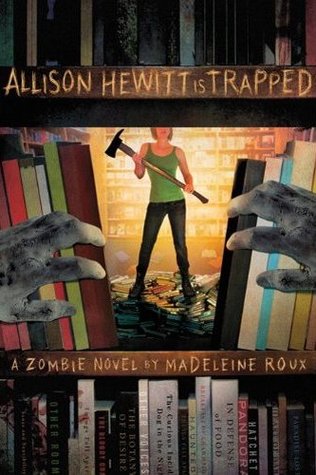
What I'm Reading: Allison Hewitt is Trapped

I am so far behind in reviews.  No excuses, just laying out the truth.  I am going to try to spend the week catching up.  Let's begin with a book I finished in early March. [Yes, 2 full months ago now, as Shelfari informed me today.]

Allison Hewitt is Trapped [herein AHiT] by Madeleine Roux is a first novel in what will become a loosely based series of novels following different people, in different parts of the country as they deal with a zombie apocalypse and its aftermath.

The appeal for readers here is that the novel begins in a book store.  Allison is a few years out of college and struggling to find her place in the adult world.  She passes her time working in a bookstore in Madison, WI.

And then, the zombie apocalypse comes and Allison finds her calling...killing zombies!  She begins with a ragtag group of employees at the bookstore as they learn to kill zombies (with Allison in the lead) and finally make their way out into the devastated world.

Giving more plot would ruin it because the story is all about Allison's emotional and physical journey to safety.  In terms of the plot, though, it unfolds like many of today's zombie stories.  [Click here for more by me on zombie novels.]

However, what I want to focus on in this review is why AHiT is different from other zombie novels; in other words, why you would or would not want to read it for yourself.

The most striking thing about this novel is its format.  The entire novel is written as blog posts which Allison writes on the run and publishes when there is access to the government's emergency wireless.  So each chapter is a post and they end with comments.

Not only then are Allison and her group's actions part of the plot, as readers we also start to follow the shortened stories of those who leave comments.  This adds an interesting layer to the story in that we see Allison and her struggles in detail, but we also get a glimpse into the struggles, heartbreak, and dilemmas of many others all over the world.  This was a great addition to the plot, action, anxiety, oh just to everything.

There is a further level of depth to the story here too.  The entire "novel" is presented to a publisher many years after the zombie apocalypse as an example of a first hand account of one survivor.  The books begins with the submission letter by a young professor (whose Dad the reader later meets as a child in the story) and ends with the publisher's response (which definitely adds a twist to what we just read and rooted for).

It is also important to note that Roux initially wrote AHiT as a series of blog posts before it was published in book form.

On a side note, as I mention in the new book, horror novels often use an interesting frame like letters, official documents, or blog posts to further enhance the unease and anxiety of the story.  Here it works quite well as not only are we worried for Allison's safety as readers, but we are also concerned with the safety of her laptop.  Without it, we will never know what happened to her!  Roux knows this and makes sure how Allison AND the computer escape each new trial are both clearly explained in the story.

And yes, this novel does fit into the horror genre, but it is on the tamer side.  In fact, I could see chick lit fans who don't mind a little blood and guts really loving this book.  Roux writes better than average horror action sequences.  They are scary, bloody, detailed, and action packed.  You are on the edge of your seat following the gruesome action.  But it is not over-the-top gratuitous.  In other words, it is a lot more than Sookie Stackhouse or Twilight but a lot less than an all out zombie horror scarefest like those by Jonathan Maberry or Brian Keene.

And like all good horror novels, AHiT has both supernatural and human bad guys.  Very bad human bad guys, both men and women.

Overall, I would call it a horror/women's fiction/humorous meld.  AHiT is an excellent reading option for someone who wants something a little scarier, but not too gory.  It is also a great option for horror readers looking for a strong female lead.

AHiT has great characterizations.  Besides Allison, there are many well rounded characters here.  In fact, during the times when Allison and her friends are a bit safer the characters carry the story.  I should note that these slower times also help to build the anxiety of what is to come.  The reader knows that a zombie apocalypse is a bad thing.  Safety is relative.  Just like Allison and her crew, we are all waiting for the next time they all have to race away from certain death.

Speaking of certain death, like any believable zombie horror novel, there is a high body count here.  Characters you grow to love will die.

I know I mentioned chick lit fans above.  I should expand.  There is a strong theme here of Allison looking to find her place in the world AND a looking for love angle.  There is a strong romantic story line between her and someone she meets.  It has all of the trapping of a romance novel: they meet, fall in love, his wife returns, Allison runs away, he ditches wife and finds Allison, they live happily ever after.  I could have done without this part of the story myself.  I found Allison and her quest to find safety, and possibly her mother, compelling enough without the romance angle, but I can appreciate how it would rope in a whole other subsection of possible readers.

AHiT is a very quick and fun read.  I would not give it to a hardcore zombie fan, but I will give it out to  my patrons who are tiring of paranormal fiction and want a little more "teeth" in their stories.

Three Words That Describe This Book: zombie apocalypse, darkly humorous, character centered

Readalikes:  For readers who want more novels which are horror (not paranormal romance) with zombies and dark humor, I would also suggest:

For those who want more horror with female protagonists, I would highly suggest:
Finally, although I don't think it is a readalike, I should mention that Justin Cronin's The Passage is similar to AHiT in that both are written as a series of found documents looking back on the early days of the apocalypse and the exploits of those involved.  The Passage is much more detailed and literary than AHiT, but if a reader really likes this aspect then The Passage or World War Z by Max Brooks are the perfect suggestion.  Just make sure you are clear that both of these suggestions are more literary, less overtly humorous, and definitely more methodically paced.

I plan to keep the reviews coming, so stay tuned.

Friday, March 4, 2022

What I'm Reading: Black Tide by K.C. Jones

I have a review in the March 1 issue of Booklist. The draft is reposted below with further appeal talking points, more readalikes, and my "three words."

Also, please note, I will be having at least 1 review in many of the upcoming issue of Booklist for the foreseeable future. There is so much good Horror coming out. Even titles like this one, which I did not give a star, will be VERY popular with a general library patron. This one in particular has a lot of overlap for SF readers and more than a touch of Lovecraftian influence. 

Black Tide
KC Jones
May 2022. 259p. Tor Nightfire, paper, $15.99  
(9781250792693); e-book, $9.99 (9781250792709)
First published March 1, 2022 (Booklist).
Screenwriter Jones’ debut novel unfolds like a movie, a terrifying nightmare come to life, one that will keep readers alternating between urgently turning the pages and an overwhelming desire to hide from this intense, realistic portrayal of an alien invasion. Beth and Mike are flawed, lost souls, holed up in neighboring homes in an upscale, Oregon coastal development during the off season. When Beth ventures over the fence, the two have a one-night stand, a very personal experience that coincides with a tear between multiple universes, opening up a flood of angry, confused, and violent creatures to descend upon Earth and start destroying everything in their paths. The action oriented, blisteringly fast paced plot is authentically rendered. Beth and Mike take turns telling the story in an engaging conversational tone, a narrative choice which not only captures the chaos and disorientation of the action but also allows for necessary character development to flow naturally. A solid, harrowing, apocalypse as it unfolds, Horror-SF hybrid for fans of The Silence by Lebbon and Bird Box by Malerman with a dash of Lovecraftian sensibility in the vein of Kiernan's Tinfoil Dossier series, but beware, the dog dies in the end
Further Appeal: I cannot stress enough how much like a movie this book is. Also the narration is very conversational– especially Beth as she talks to the reader honestly– baring her soul. Yes, there is a lot of focus on action here, but the character development is solid because of the authentic narrative voice of Beth and Mike.


This is an apocalypse as it is happening book with all of the confusion, action, and dread. It will have wide appeal. Flawed character who must overcome their personal issues and demons as well as a VERY real alien threat that is destroying the earth and humanity.


Speaking of, these are not evil aliens. They are just as confused as us, an original detail I really liked. They don't want to be here, a space time rip has brought them to us, and they are confused and angry.


Here is a line I couldn't get into the review: With a strong band of survivors theme, readers will root for Beth and Mike to make it through the initial onslaught, cheering them on despite the violence and destruction that surrounds them.


And I am sorry but it is a small spoiler-- not a huge one-- but the dog dies in the end. They cut that from the published review, but I cannot in good faith not let people know. The dog is a major character here.


Three Words That Describe This Book: harrowing, cinematic, apocalypse in real time


Readalikes: There is clearly a War of the Worlds by Wells vibe here. And of course the Lovecraftian elements can lead you down a rabbit hole of titles. But any apocalypse as it is happening story will work as a readalike here.


Also movie wise, I would suggest The Quiet Place.

Friday, March 2, 2012

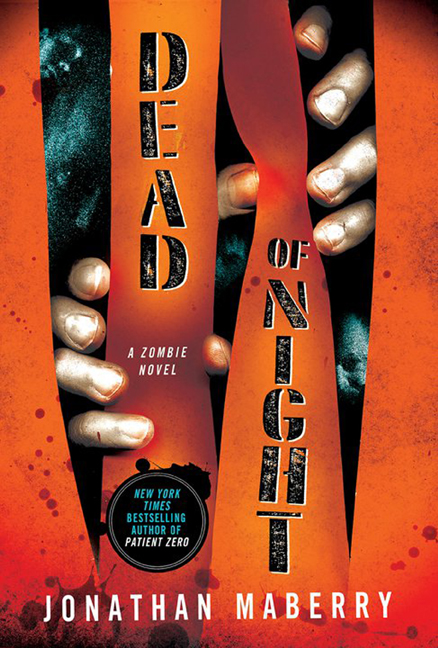
What I'm Reading: Dead of Night

We are 2 days away from Jonathan Maberry's visit to RA for All on his blog tour to promote Dead of Night.  Full disclosure: Maberry's publicist sent me a free copy of this book for review.  But, I also had already purchased a copy for the BPL before receiving my free copy.

In preparation for the interview, which does include specific questions about Dead of Night, here is my review of the book.

Dead of Night is a zombie novel (as the subtitle tells us), but it is different than the bulk of today's zombie novels, even different than Maberry's critically acclaimed YA zombie series which begins with Rot and Ruin (link goes to my review of that novel).  Why?  This can be answered by Maberry himself in Chapter One which reads, in its entirety: "This is how the world ends."

That being said, I should say, this is a horror zombie novel, not a literary fiction one like Zone One, or a humorous one like Breathers, or even a political thriller one like Feed.  Dead of Night  is for horror fans who want to feel the dread and anxiety, who know bad things are going to happen and are turning the pages expecting them.  Remember, as the first line tells us, "This is how the world ends." Do not pick up this book and expect a happy ending.  Personally, I love that, but some readers may not.

But if you are looking for a serious horror treatment of the popular zombie craze that is well written and  great fun to read.  This is the book for you.

While most of today's zombie novels take a critical look at the world as it stands after the zombie apocalypse (click here for numerous reviews of some of the best of these books), Dead of Night is the detailed, action-packed story of how the apocalypse begins.  Here we get a step-by-step account from all sides of how 1 infected person can mean the beginning of the end for human civilization.  There is no "after" picture here.  We get the details of the apocalypse as it begins from every angle, and we are left just as it is about to escalate.

As the novel opens we are in rural Western PA and a storm is quickly approaching (a double whammy of the popular isolated setting for horror).  Local law enforcement are called to a possible break-in at the local funeral home.  The body that was just delivered secretly (and unexpectedly) to that funeral home is of a notorious serial killer, Homer Gibbon.  But before he was executed in prison, Gibbon was given an injection by Dr. Volker containing a formula designed to keep him conscious and awake while his body rots in the grave.  Before he can be buried, Gibbon wakes up.  He is conscious and fully aware, but is also very hungry...

The story is told in what has become Maberry's go-to winning style.  He blends elements of traditional horror -- an unearthly monster, a troubled hero, an atmosphere of extreme unease, an isolated setting, and  a relentless provocation of terror-- with the emerging genre of the supernatural thriller-- detailed investigative elements, a human villain out to kill, fast paced action, and shifting points of view from heroes to killer.

Like all Maberry novels there are many characters, some who only get a moment or two's turn at telling the story from their perspective.  Some reader's may not like the jumping around, but anyone who has read one of Maberry's best selling Joe Ledger novels will be familiar with this story telling technique.  Personally, I love it, especially when we get just a moment from the perspective of someone as they are being attacked.  This technique adds to the unease of the story, and this anxious state of unease and terror is the main reason why someone reads and enjoys a horror novel in the first place.  Maberry has a compelling dread filled story already, but the switching point of view across many characters ratchets it up to a whole new level.

That being said, there are a few main characters here.  Our 2 heroes are Dez, a female, ex-vet, now cop who has had a troubled life and her ex-boyfriend "Trout," a journalist best known for his sensational pieces.  Our villains are Dr Volker and serial killer Gibbon mentioned.  There is one other pov that I found very moving and absolutely loved as it came out periodically throughout the novel, that of the funeral home director, Doc Hartnup.  In fact, without giving anything away, Doc's pov was a fresh addition to the zombie novel tradition.

The shifting points of view, also speed up the pacing here.  As a reader, you are seeing all sides to the issue.  We know a zombie plague has begun to be spread even before the police on the ground do.  We see the government preparing a response.  We see Homer running around the county.  We are afraid, but we keep turning the pages because we are rooting for Dez and Trout to figure it all out in time to save the day. You also keep reading because as a horror fan, you love this stuff.

I have to say I also enjoyed following the spreading infection in such a detailed fashion.  The short chapters and shifting action mimicked the confusion and panic that was spreading with the plague.

One of my general complaints about novels today is that many of them have "third act issues."  You are reading a great book and then the author runs out of steam, and it ends flatly.  Geraldine Brooks Dead of Night which delivers right through the last page.  The story line following Trout and Dez has its resolution, but we also have a great, twist at the end.

If you think traditional, strongly written horror is in decline, read this book.  The only unpleasant side effect you may have is that it will make much of the other books you are reading look bad.

Three Words That Describe This Book: dread, compelling, multiple points of view

Readalikes:  I have had much to say about zombie novels here.  And, yes they are my favorite horror subgenre, so I am biased.  I would suggest you read these posts to see my favorites, but I would like to highlight a few which I feel are fairly similar:

  • The type of zombie here are reminiscent of those in Nate Kenyon's Sparrow Rock.
  • The Rising by Brian Keene is the novel that is widely credited with beginning the 21st Century zombie craze.
  • Joe McKinney's excellent zombie series which begins with Dead City is a great all around readalike option here.  In McKinney's series we also follow a policeman as a zombie plague rising out of the destruction caused by a series of hurricanes slowly takes over an isolated town.  Fans of Dead of Night who are craving more should check out McKinney right away.

Although The Ruins by Scott Smith does not contain a single zombie, these two books are very similar in tone, story telling technique, and in how they are ended.  Readers of my blog know my love for The Ruins already though.

I also offered author readalikes to Maberry a few days ago here.

Come back on March 4th to see more about Dead of Night from Jonathan Maberry himself.

Thursday, August 31, 2023

What I'm Reading: Booklist E-Reviews

Today I have 2 e-reviews on Booklist Online. Why are the e-only? Well the reason matters to you, so I will share.

There are always going to be more books that deserve a review than can possibly be reviewed. There is not enough time or space in the trade magazines for every book. However, when I comes to Horror, I take my place as the library world's expert very seriously and work hard with my editors at both Booklist and Library Journal to get as many small press books into their review queues as possible. 

Some of those titles I am able to take on to review for myself, but as it is I am averaging more than 1 review a week for the year, so...

Add to this issue the fact that many small presses do not have review copies ready, even in PDF, with enough lead time for us to get them into the print magazines.

I know that for many libraries, if there is no professional review of a book they cannot even consider it to be added to their collections. So I do everything I can to get reviews for titles I believe in.

Today you can see that in action as I have two books that I think are MUST BUYS for all public libraries. These are titles you need to ge on your shelves and get into the hands of reads right now. I did a quick turn around on these reviews, but they still could not make the print deadlines to be published before they released. They are, however, on Booklist Online as e reviews here, here, and below. This means, you have the documentation to support an order.

The first is an anthology that sells itself and includes MAJOR authors whose titles you own and whose books you pardons request, while the second will appeal greatly to fans of Clay McLeod Chapman's What Kind of Mother which is out in a few weeks. It's a great "While You Wait" option. I have even helped a NJ library book the two of them for a joint, in person event this fall. 

Enough preamble. Here are my draft reviews with bonus appeal info.

The First Five Minutes of the Apocalypse: Tales from the Beginning of the End

Edited by Brandon Applegate

July 2023. 300p. Hungry Shadow, $28.99  (9798986920252); Hungry Shadow, paper, $14.999798986920245)First published August 31, 2023 (Booklist Online).


As Editor Applegate notes in the Forward to this terrifying anthology, the world is always ending, in big and small ways, and Horror provides a way to process that fact and the accompanying intense emotions at a safe distance. He leaves readers with that unsettling thought as they dive into 28 stories that each take widely different looks at those first moments of the end of the world. The stories are short, as the title hints at, but also, each is extremely immersive, as the dread, embedded in the title follows the reader from story to story. Do readers know what is causing the apocalypse in each tale? Sometimes. Do readers know what happens to the characters they are following once those first five minutes are over? Not really. Well known authors like V Castro and Gwendolyn Kiste present a violent Werewolf uprising or a macabre end of the world party. Lesser known voices like Carson Winter present a quieter, more private moment between a couple as they mourn the death of everyone they know and wait for their turn to die while Nick Bouchard’s blog post framed story, “Ten Totally Free Places to Watch the End of the World,” adds a note of hilarious dark humor. From nuclear war to unknowable supernatural forces, the breadth of ideas on how the world will end is as vast as the way the authors recount it. Not only will this book sell itself to readers by the title alone, but it will also introduce them to a wealth of strong voices in Horror.

Further Appeal: You don't actually need any. Just tell people the tile and they will either be super intrigued or completely repulsed. If they are intrigued, they will like it, I promise you.


Three Words That Describe This Book: dread, varied, intriguing


Readalikes: Books by Gwendolyn Kiste and V. Castro will be requested and you should own them. This World Belongs to Us: An Anthology of Horror Stories About Bugs, which I recently reviewed will also make a good fit.


And don't forget about the pre-apocalypse trilogy by Ben H. Winters, The Last Policeman. This would be a great time to promote that backlist gem.


Lacuna’s Point

By Tim Meyer

Aug. 2023. 371p. DarkLit, paper, $20 (9781998851096)
First published August 31, 2023 (Booklist Online).

Ellie and Mitch are connected by tragedy. 3 years ago their beloved daughters disappeared without a trace somewhere in Virginia. When Ellie receives a cryptic message appearing to be from her daughter’s canceled phone, however, the pair drop everything and head to the seaside, ghost town of Lacuna’s Point. Very shortly after arriving, they realize there is a sinister darkness not only controlling everything and everyone, but also, one that refuses to let anyone go. Meyer relays the original and intriguing plot through multiple points, allowing the pacing to stay fast, without sacrificing the necessary and nuanced development of each character and, especially, the place itself, a place that makes Twin Peaks look boring and safe, a place that is the most important character of all. While the unease is palabale on every page, there is also an existential dread that overlays it all, one anchored by the terror of being a someone who is driven by the need to create art at all costs. Utterly immersive and unapologetically visceral, this small press title will appeal to readers who embraced the weird, cosmic feel of This Thing Between Us by Gus Moreno and both the parental and crab nightmares of What Kind of Mother by Clay McLeod Chapman.

Further Appeal: Many points of view– allows the pacing to stay fast even though there is a lot of world building that needs to happen. It is never too many switches because they are necessary for the reader to understand the complexities of the situation and where each character is coming from. And each is built uniquely and with nuance.

Gives a whole new meaning to “ghost town” Like Twin Peaks– but way more deadly. 

The entire novel is also a metaphor for how terrifying being a creative can be. The need and desire to write, paint, play music, etc… the overwhelming need to make art at all costs is at the heart of this entire book and the anchor for the terror. 

A fast paced, immersive, and visceral pulp Horror tale that will leave you unsettled about your own choices long after you turn the final page.

Three Words That Describe This Book: multiple points of view, Weird, immersive

Readalikes:  The two above and Twin Peaks plus I definitely thought about Chuck Wendig's Wanderers and Brian Keene's The Complex while reading this novel. The feel of both yes, but also how the stories  are told with multiple points of view that allow for robust, nuanced, and emotionally satisfying character development.

Sunday, October 30, 2011

What I'm Reading: Zone One

This is a cross-post with RA for All Horror:

As promised, I read the most talked about zombie novel of the moment, Zone One by Colson Whitehead.   I liked Zone One much more than I anticipated I would, it is not a horror novel.

While Zone One is set in a very real feeling post-apocalyptic world, fear of the zombies is not the key motivator here.  This is a novel about trying to reclaim civilization. It is an interior novel; one that takes place mostly in our hero's, Mark Spitz, head. The moments of pure pleasure in reading this novel come from his observations about how the world has changed, and from Whitehead's amazingly realistic and chilling descriptions of the landscape in his created world.

I will be frank, over the year, I have never been as impressed with Whitehead's writing as the critics have been.  However, there are some absolutely beautiful and haunting passages here.  I did step back to re-read a few.  I also loved how detailed his setting is.  Not only do we have detailed descriptions about the Zone One operations and how they are run (a mix of army and civilian), but we have the unseen provisional government in Buffalo becoming its own character. Additions like giving the reconstruction a theme song (one which we cannot hear because of the medium, but which still somehow permeates our reading of the novel) and calling those who remain "pheenies" (short for the American Phoenix, how we will rise again) add authenticity to the setting. 

Our specific "pheenie" and guide through which we get a first person view of this wasteland is Mark Spitz (not his real name).  The story is set up like a suspense novel with a compressed time frame, in this case 3 days. Throughout the course of these three days, we see Mark and his team of "sweepers" cleaning out and buildings in lower Manhattan in Zone One, the only zombie cleared zone on the island.  Mark tells us what is going on now, but there are many flashbacks to how he got from the old world, through the end times.  He also look forward to more cleared out zones and the rebirth of this great city.

I don't want to give any more details about Mark or the setting away, because as the story it unfolded , I was enthralled.  You are going to have to trust Whitehead though.  The beginning is a bit bumpy, like most post-apocalyptic stories.  You have to just keep reading and trust that Whitehead will fill in the details.  But for me this was part of the joy of reading this novel.  I loved the details AND how Whitehead chose to reveal them.  It added satire and suspense.  Mark is also a great vehicle to tell this story because the only thing he excels at is being average.


Whitehead, a New Yorker, obviously knows his setting.  The haunting descriptions of a desolate New York drew me in.  In particular, I loved the scenes in the subway tunnels, and found them especially chilling. Anyone who has spent any time NYC will be moved by this novel.  I especially felt a kinship here because like Mark, I grew up in the suburbs of NYC and visited often, but with the eyes of an outsider still.

I also enjoyed the new type of zombie Whitehead has added to the pantheon.  He has created "straggler" zombies.  These are zombies who rather than reanimating and compulsively searching out fresh human meat, merely roam back to place of meaning from their past and stay there. For example, the psychologist who goes into the office after turning into a zombie, sits in his chair, and waits for the patient who will never arrive.  These zombies are much like the remaining humans with their different forms of PASD (post-apocalyptic stress disorder) who are straggling through what is left of life on earth.

The final thing I liked about Zone One was its ending.  As you read the book, Whitehead clearly foreshadows (really broadcasts) how this reclamation experiment is going to end, yet as you read, you continue to hold out hope.  Ash is raining down, the zombies are literally knocking on the door, Spitz keeps telling us each place he has found refuge post-apocalypse has only been a short respite until it is destroyed and he must run again, and the book is set in only a three day period with things going from so-so, to bad, to worse.  Yet we hope.

The fact that I had any hope while reading this book is a huge testament to Whitehead's writing.  Look, I read a lot of dark books, where bad things happen, and everyone ends up dead, yet I was rooting for the pheenies.  This is not to say that I was disappointed with the ending.  I loved it even more because of what a great job Whitehead did, but many readers who are flocking to this title because it is the "hot" book right now, may be disappointed.  In fact, on Amazon, the book is not getting good customer reviews.  Much of this is due to the fact that it is not scary enough for horror fans and it is too dark for mainstream literary fiction readers. But in the right reader's hand, Zone One is a gem.

I cannot stress enough, this book does not have rosy things to say about the future.  The zombies are merely Whitehead's vehicle for commenting about the path humanity is on.  And it is a path he does not see leading somewhere good, but even worse, he seems to be saying destruction is inevitable.  This is a bleak book.  But it is also a satisfying look into the human condition, what remains of society when there is very little left, and the hope to be found in the "average" citizen.

Three Words That Describe This Book: bleak, post-apocalyptic, thought provoking

Readalikes: If you liked The Passage by Justin Cronin, chances are you will enjoy Zone One.  The Passage is definitely a notch above Zone One, but that is because of the level of detail Cronin has built in to the story.  Click here to read my full review of The Passage which includes more readalike options.  You can also click here to read Cronin's review of Zone One.

Other post-apocalyptic stories I would suggest here are: The Walking Dead series, I Am Legend by Richard Matheson and Swan Song by Robert McCammon (a hidden gem that should be on the shelf at your library).

Monster Island is part of David Wellington's zombie apocalypse trilogy that is set on the island of Manhattan just like Zone One.  Monster Island is much less literary and much more scary than Zone One, but it is a great option for readers who really enjoyed the NYC setting and want to see a similar story line from a different angle.

I also found Wastelands: Stories of he Apocalypse, a well reviewed, 2008 collection with with stories by Stephen King, Orson Scott Card, Octavia Butler, and George RR Martin.  The collection is great because it runs the gamut in terms of tone, from the bleak and hopeless to stories of hope, and presents a broad view of this popular subgenre of science fiction and horror.

The interesting thing about Whitehead's career is that each book he has written is different from the last, so he is a hard author to match with another author who will be the same.  However, that being said, this novel specifically made me think of two other authors who write with a similar tone and mood to Zone One.

First, Doris Lessing writes character driven novels that are bleak and thought provoking, and often have a speculative element.  Try The Memoirs of a Survivor which is set in a post-apocalyptic landscape.

Chuck Palahniuk is the master of bleak novels which probe the inner turmoil of the human condition.  He uses anti-heroes (like Spitz) and everything he writes is a satire of something we take for granted.  He uses the same wry humor found in Zone One too.  Fight Club is a good starting point.

Friday, April 28, 2017

Readers' Shelf: Halfway to Halloween- Horror Stories for All

This is a cross post with RA for All: Horror 

On top of my article on helping horror readers in the May 1, 2017 issue of Library Journal, the April 15, 2017 issue saw the publication of my semiannual take over of Neal Wyatt’s Readers Shelf column. Every April 15th issue, she allows me to promote “Halfway to Halloween,” a holiday I am desperately trying to get to stick. For this issue, I can provide a list of suggested horror titles on any topic.  

This year, I decided to highlight short stories. These six titles range from literary fiction to science fiction to straight out horror.

Click here for the column on the Library Journal site, or read it below.

******************************************************

Early Scares: Halfway to Halloween | The Reader’s Shelf

Short stories are alive and kicking when it comes to tales of terror. Here are some recent anthologies that will deliver just the right amount of chills and thrills. From household names to fresh voices, from psychologically terrifying to blood and guts, there is something here for every future Halloween library display.
In the critically acclaimed A Natural History of Hell: Stories(Small Beer. 2016. ISBN 9781618731180. pap. $16; ebk. ISBN 9781618731197), Jeffrey Ford gathers 13 previously published stories into one collection that mixes fantasy and horror and shows his talent for distinctive sagas in which evil lurks just under the surface. Each installment relies on a dark and anxious mood with varying levels of speculative influence, outcast characters, and shocking conclusions. It opens with public exorcisms in the compelling and disquieting “The Blameless.” From there it ventures into vignettes as diverse as the “true” ghost story behind an Emily Dickinson poem and the sinister “Blood Drive,” in which every high school senior is required to carry a gun.
Richard Chizmar is the founder of Cemetery Dance Publications, working with the likes of Gillian Flynn, Justin Cronin, and Stephen King. The 35 stories in A Long ­December (Short, Scary Tales. 2016. ISBN 9781909640887. pap. $24.95; ebk. ISBN 9781596067943) offer a stand-alone volume of his own. Ranging from crime to dark fantasy to pure horror, the stories here all speak to a normal life turned upside down by terrible circumstances. The way Chizmar combines the dread and fear induced by his plots with a poignancy and kindness of tone makes them memorable. This is best showcased in the eponymous novella, where the protagonist is awoken one morning with the news that his best friend is a serial killer.
Laird Barron’s Swift to Chase (JournalStone. 2016. ISBN 9781945373053. pap. $18.95) perfectly encapsulates today’s literary genre-blend landscape. While terror is always at the center, cosmic horror, adventure, and even noir find their way into his writing. What sets Barron apart from the pack is how he crafts a wonderful sense of place—in this case, the beauty and menace of Alaska—and fills his settings with an oppressive atmosphere, great characters, original plots, and beautiful language. This anthology will play with readers’ minds in enjoyable ways, dragging them along for a satisfyingly scary ride and leaving them ­begging for more.
Editor Robert Silverberg gathers 21 works by a wide range of well-known authors, both living and dead, in This Way to the End Times: Classic Tales of the Apocalypse (Three Rooms. 2016. ISBN 9781941110478. pap. $19.95; ebk. ISBN 9781941110485). He further enhances the volume with a preface to each story, providing context on the time period in which it was written and how it may resonate with audiences today. See how writers such as Jules Verne and Connie Willis have embraced the apocalypse and used it to tell chillingly prescient narratives that reach across time and space. Silverberg reminds us that while the end of the world seems to be a hot trend today, it is actually only a blip in a long tradition of dystopian storytelling.
What the #@&% Is That? The Saga Anthology of the Monstrous and the Macabre (Saga: S. & S. 2016. ISBN 9781481434935. pap. $16.99; ebk. ISBN 9781481435000), edited by John Joseph Adams and Douglas Cohen, is among the best titles to focus on H.P. Lovecraft (1890–1937). Contributors were asked to write about a monster of their choosing, with only one rule: something must happen to make a character cry, “What the #@&% is that?” Accepting the challenge are 20 wordsmiths ranging from best-selling authors to up-and-comers, providing reading experiences from the utterly fearsome to the ­macabrely humorous. Playing along to see how the exclamation is employed gets more enjoyable the deeper one plunges into this ­Lovecraftian-inspired world.
The reigning sovereign of horror editing is Ellen Datlow, who is an acknowledged master of identifying and amassing the very best frights. Case in point is Nightmares: A New Decade of Modern Horror (Tachyon. 2016. ISBN 9781616962326. pap. $16.95; ebk. ISBN 9781616962333). Beginning where her ­essential Darkness: Two Decades of Modern Horror ends and spanning up to 2015, Datlow has compiled 24 of the finest stories written over the last ten years. By arranging them in chronological order, she illustrates the evolution and breadth of the genre, while spotlighting its brilliant new voices. Read this to see what you have been missing and to identify important titles to add to your collection before ­Halloween hits.
This column was contributed by Becky Spratford, a Readers’ Advisor in Illinois. She is the author of The Readers’ Advisory Guide to Horror (2d ed. ALA Editions, 2012) and a proud member of the Horror Writers Association. Learn more about her at raforall.blogspot.com
Neal Wyatt compiles LJ’s online feature Wyatt’s World and is the author of The Readers’ Advisory Guide to Nonfiction (ALA Editions, 2007). She is a collection development and readers’ advisory librarian from Virginia. Those interested in contributing to The Reader’s Shelf should contact her directly at Readers_Shelf@comcast.net

Tuesday, August 19, 2014

What I’m Reading: World of Trouble

There are very few times in life when you complete a series and it is just perfect.  As I mentioned in a previous Monday Discussion on this blog, this is how I felt about completing Ben H. Winters The Last Policeman Trilogy with the last installment, World of Trouble.

This review of World of Trouble as a novel will be short because to say too much would give away the joy of reading the series.

First, you need to see my reviews of The Last Policeman (book 1) and Countdown City (book 2) for more details.  Click through. I can wait.

Okay, you are back.  All I am going to say about World of Trouble as a book is that the story picks up where Hank left off, leaving his girlfriend at a safe house and headed back out into a world only weeks away from impact with the asteroid that will destroy most, if not all life on Earth.

Hank follows some leads to Ohio where most of the action in this book takes place.  I can tell you that before the asteroid hit the earth, Hank has put all the pieces into place from the last 2 books.  He knows what was going on with his sister, he solves a few other mysteries along the way, and still leaves time to end the novel in a beautiful, heart warming scene as the asteroid streaks across the sky.  It’s just perfect.

For Readers Advisory purposes what you really need to know is how to suggest this now completed trilogy to patrons. Here are a few tips and points on that front.

First, it stays completely true to the tone and focus of the first installment.  This means, Hank gets a bit more seasoned as he is investigating the mystery surrounding his sister, but he is still a bit naive and bubbling until the end.  He also remains endearingly good hearted and good natured despite the fact that the world may be ending any day. You can be sure Hank stays Hank no matter what.

Second, this series although set in a pre-apocalyptic time NEVER moves to post apocalypse.  Do not give this series to people who want to know what happens because of the asteroid!  This is a hard-boiled detective novel, albeit featuring an unexperienced detective, who refuses to accept defeat even as he faces down the end of the world.  He will fight to figure out what happened to his sister and why until the end. He will leave no stone unturned.  He will complete his mission before the deadline. Hank is nothing if not earnest, but Winters will not break our trust.  This is a pre-apocalyptic novel and it stays that way until the end.

But it is also a novel about what choices people make when they know the end of the world is coming.  There is no blue print for how you are supposed to act here.  We meet many, many people who all make different choices.  We see what happens to the country’s infrastructure, institutions, and community as the day of impact comes closer.  This is a lot to take in and makes the trilogy very thought provoking, but not as dark as you would imagine because of Hank’s positive personality.  Seeing these background details evolve over the course of the series is not only very interesting, but it is also a huge factor in why someone would read and enjoy these books. So my RA point here...take the term pre-apocalyptic literally.

Third, this is a great option for mystery fans with an off kilter sense of humor, who enjoy quirky characters, and a first person narration.

Fourth, if you commit to reading the entire trilogy, rest assured, it is extremely well paced.  You can read each book in a few sittings.  It would not be a huge investment in time.  They are also paperback originals, so I will be sending quite a few patrons with all three on vacation in the years to come.

Taking the entire series into consideration, I have been suggesting it to many more readers than before the publication of World of Trouble.  Until I finished the trilogy, I couldn’t be sure that it would  stay true to the mystery part.  I was worried that the gimmick of the asteroid would overtake the true story here.  So now, you can be sure the reader does not need to like apocalyptic fiction in order to enjoy these books; they just need to be okay with the pre-apocalyptic setting and the shadow it casts over the tone.

Three Words That Describe This Book: endearing narrator, pre-apocalypse, thought provoking [same three words I used at the start and they still are the key appeal of this series]

Readalikes:  I have plenty of readalikes listed from when I wrote about the first 2 books here and here.

I think your best readalike options have NOTHING to do with the science fiction aspects or apocalyptic stuff though. I do have those other options listed in the links from previous reviews.   Rather, your focus on readalikes should be for other mystery series with an endearing detective, an off beat sense of humor, and some level of thought provoking issues [in other words, it needs to be a bit more than fluff because there are some serious issues at the foundation of  the story...the end of the world is coming for goodness sake].  Thankfully, this is one of my favorite areas of mysteries.  So here are a few options with links to my reviews: