Running a bit late with the Monday Discussion today, but in keeping with the 31 Days of Horror over on RA for All: Horror, I wanted to ask people what their favorite horror TV Series are.
For me personally, I think The Twilight Zone is still sets a high bar for absolute creepiness. I can still remember watching the old black and white episodes as a child.
Currently, I love The Walking Dead. I love it for the post-apocalyptic storyline, the awesomely gruesome zombies, the action, the characters....just everything!
Finally, I enjoy True Blood, and although it is not horror, it does feature horror tropes, so I am including it here. This is my campy horror outlet. It is fun and outrageous. It is suspenseful, but not terror inducing. But with all of those standard horror characters (vampires, werewolves, shape-shifters), I just have watching it.
Be as broad as I am and share your favorite small screen scares from the past or present. I will follow up tomorrow with an annotated guest post listing some classic horror television series.
For past Monday Discussions, click here.
Monday, October 24, 2011


Friday, October 21, 2011
Hunger Games Reading Map

Christi made this wonderful, interactive, and just plain fun reading map for The Hunger Games Trilogy. This is a must see for anyone who works in a public library-- of course any fans out there will love it too.
But back to the library workers, since the point of this blog to showcase how your local Readers Advisor can help you. The Hunger Games is the hottest thing right now, and with the movie coming in March, you cannot have enough options for your patrons. Christi has provided a way for your readers to look deeper into many of the issues brought up in the trilogy, explore further reading, and connect with other fans.
I also want to remind you of Gennie's Hunger Games Readalikes for Adults list which I posted last Spring and continues to get a lot of hits. Christi's reading map includes readalikes for adults and young adults too.
Check out both links, you will not be disappointed.
Thursday, October 20, 2011
ILA Reports Part 1
I spent some time this week at the Illinois Librarian Association Conference and will be sharing a bit of what I learned over the next week or so.
Today I want to provide you with a few resources I compiled at the various programs I attended.
Anthony Molaro blogs as The Information Activist where his mission is: "to inspire and nurture a generation of imaginarians and information activists whose deepest desire is to create an environment where library members can explore and discover their world, relate and connect to their community, develop and foster their identity, grow and expand their mind, and find and inspire their creativity." Check him out.
Leah White is a Readers' Advisor at the Northbrook Public Library and she is active on tumblr.
I went to a program specifically on RA (which I will report on at greater length next week), but it did feature what is happening in readers' services at the Downers Grove Public Library, the Morton Grove Public Library, and the Skokie Public Library.
Check out these links for now and next week I will have specific reports on the three presentations I went to. Since as a condition of the BPL paying for me to go I have to write a report of what I learned (which by the way, is more than fair), I will write these reports while I am actually at work. Due to time spent attending the conference this week, that won't be until Monday.
Today I want to provide you with a few resources I compiled at the various programs I attended.
Anthony Molaro blogs as The Information Activist where his mission is: "to inspire and nurture a generation of imaginarians and information activists whose deepest desire is to create an environment where library members can explore and discover their world, relate and connect to their community, develop and foster their identity, grow and expand their mind, and find and inspire their creativity." Check him out.
Leah White is a Readers' Advisor at the Northbrook Public Library and she is active on tumblr.
I went to a program specifically on RA (which I will report on at greater length next week), but it did feature what is happening in readers' services at the Downers Grove Public Library, the Morton Grove Public Library, and the Skokie Public Library.
Check out these links for now and next week I will have specific reports on the three presentations I went to. Since as a condition of the BPL paying for me to go I have to write a report of what I learned (which by the way, is more than fair), I will write these reports while I am actually at work. Due to time spent attending the conference this week, that won't be until Monday.
Wednesday, October 19, 2011
BPL Book Discussion: Hotel on the Corner of Bitter and Sweet
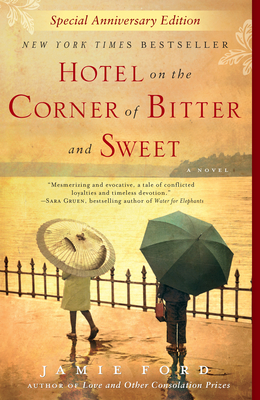
 This week, we gathered to discuss Jaime Ford's Hotel on the Corner of Bitter and Sweet. Overall, we had a great discussion and added a new member. We also celebrated National Friends of the Library Week by handing out these pins I had made for all of the Berwyn Friends of the Library (one of the other hats I wear at the Library is FOL Liaison).
Here is the publisher's summary to put us all on the same page:
In the opening pages of Jamie Ford’s stunning debut novel, Hotel on the Corner of Bitter and Sweet, Henry Lee comes upon a crowd gathered outside the Panama Hotel, once the gateway to Seattle’s Japantown. It has been boarded up for decades, but now the new owner has made an incredible discovery: the belongings of Japanese families, left when they were rounded up and sent to internment camps during World War II. As Henry looks on, the owner opens a Japanese parasol.
This simple act takes old Henry Lee back to the 1940s, at the height of the war, when young Henry’s world is a jumble of confusion and excitement, and to his father, who is obsessed with the war in China and having Henry grow up American. While “scholarshipping” at the exclusive Rainier Elementary, where the white kids ignore him, Henry meets Keiko Okabe, a young Japanese American student. Amid the chaos of blackouts, curfews, and FBI raids, Henry and Keiko forge a bond of friendship–and innocent love–that transcends the long-standing prejudices of their Old World ancestors. And after Keiko and her family are swept up in the evacuations to the internment camps, she and Henry are left only with the hope that the war will end, and that their promise to each other will be kept.Now the discussion:
- We began with taking a vote of liked, disliked, and so-so. We had 14 likes, 2 so-so, and 0 disliked. The so-sos agreed that they loved thinking about the book, but Henry point of view made for sparse, non-lyrical language. It worked, but they prefer more flowery language. The vast majority of the group however liked the book, had quite a bit to say about why as you will see.
- We talked about the internment camp issue for awhile. Comments included how enlightening it was to learn more about this troubling time in our history. We talked about how easily the Japanese went to the camps. At one point there were 10,000 in a camp; they could have easily over powered the guards, but since they desperately wanted to prove their allegiance to America and some even felt guilty about what Japan was doing they just wanted to comply. One woman shared how when she watched the newsreels of the Japanese evacuations as a child, she was under the impression that this was all done to protect them; she continued to think that until recently. As you can see just talking about the internment angle was a rich discussion point. I ended this part of the discussion by mentioning that maybe the fact that we don't know as much about this part of our history is a large reason why this book is so popular with book clubs.
- This novel has an interesting style. We get Henry's perspective at two distinct times in history, 1942 as a 13 year old, and 1986 as a recent widower. But the author chooses to have Henry speak in each time frame from that time frame. Henry of 1986 is not looking back at 1942. When we are in the 1942 chapters, Henry is a child. Overall the group really liked this narrative style. They called it rich and unique. They also felt that it helped to increase their enjoyment of the great secondary characters here. People especially liked Mrs Beatty and Sheldon. Seeing Sheldon through young and old Henry was mentioned as particularly enjoyable.
- This also led to a discussion of what a wonderful "voice" Henry has. Ford has created a clear and strong voice for Henry. He is very controlled, calm, and honorable throughout. Some were frustrated that he is not more exciting or flowery, but as I said to those people, if Ford had started having Henry speak in metaphors, we would all be complaining how out of character it was. The novel is plainly written, but Henry is plainly spoken. It all adds to the strength of his character. We appreciated this consistency as readers.
- Sheldon came up again. We saw him as the novel's catalyst. We discussed how he made Henry visit Keiko in the internment camp, how he gave Henry the last record to give to Keiko and how his death brought Keiko and Henry back together after 40 years. He also gives the reader a touchstone of a more familiar kind of racial injustice. Sheldon mentions discrimination of African Americans in passing, but in this novel we are involved in the discrimination against the Japanese and Chinese and the fighting between the Japanese and Chinese against each other. This is new to most readers, but with Sheldon commenting from the more familiar (to the reader) point of view of the African America struggle, we all see the bigger picture. Sheldon was also there to show how Jazz, one of America's indigenous musical forms, unified Americans across race and served as a minority voice. As you can see, we liked Sheldon.
- We then moved on to a discussion of the differences in the generations as we move from the immigrant to the American. We used Henry, his Dad, and his son Marty as our examples. This then led to people generously sharing their personal family immigrant stories. That is another line of discussion which this novel easily invites.
- Of course we discussed Henry and Keiko's relationship as children. Someone said they did love each other, but more like best friends. This led to use asking if Henry gave up on Keiko too easily. We were mixed saying yes and no. People were good about sharing their personal arguments on both sides. In end we agreed whether or not we thought he gave up too easily, we would have ultimately been dissatisfied with the novel if Henry had ditched Ethel for Keiko because Henry was noting if not honorable. He always made the honorable choice, no matter the personal sacrifice that choice entailed. This also led to a side discussion of the other sacrifices made by characters in the novel.
- Henry's son Marty's relationship with his white fiancee, Samantha was also discussed. As one lady put it, to Henry, Samantha is a ray of sunshine that opened up Harry and warmed the air between Marty and Henry. Samantha is Marty's Keiko, noted another participant.
- The ending was discussed at length. SPOILER ALERT At the end, Henry shows up at Keiko's apartment and they begin talking to one and other. I asked people to vote if this last scene meant they would start up a deeper relationship again or if he would spend some time with her and then go home, keep up a correspondence, but not go much deeper. I was surprised that 12 or the 16 voted for a deeper relationship. I used textual clues, such as Henry not being able to mend the broken record and his comments about how some things can never be fixed, along with the closing lines of the book which remark how they were standing again as if on opposite sides of the fence to argue that there would always be an insurmountable wall between them. But someone else said that the overall theme of the book is that broken relationships can be healed. We went back and forth and agreed to disagree. However, it is important to point out that Ford does have evidence in the novel on both sides of this issue which again, makes for a great discussion point and may be another clue as to why this book has been such a hit for book groups.
- We talked a bit about the title. The hotel is the only place where the pre-internment Japanese experience was preserved. It is also the site of Henry's "last stand" for Keiko and against his father. And the story is what happens between the bitter part of the story and the sweet part.
- Finally, we ended as usual with words or phrases to describe the book:
- poignant
- internment
- love
- bittersweet
- honorable
- respect
- assimilation
- loyalty
- repeatable history
- heritgae
- romantic
- racial issues
- it could happen again
When I was reading this novel, I kept thinking that the Pacific Northwest setting and Young Henry's struggle being not Chinese enough for the Chinese kids and not American enough for the American kids was similar to Sherman Alexie's The Absolutely True History of a Part-Time Indian, which has a modern setting but tackles the same issues in the Native American community.
For other suggests, NoveList listed Sea of Poppies by Amitav Ghosh, The Help by Katherine Stockett, and A Gesture Life by Chang-rae Lee which all look at cross racial relationships. And for nonfiction I like the choice of suggesting Brother, I'm Dying by Edwidge Danticat which is the author's memoir of her family's immigration to the US from Haiti.
Tuesday, October 18, 2011
Understanding Series Readers
My co-teacher, Joyce Saricks, focused her most recent monthly column in Booklist on series fiction.
Not only does she talk about why readers are drawn to series, but she also differentiates how series work in the different genres.
Click through to read for yourself.
Not only does she talk about why readers are drawn to series, but she also differentiates how series work in the different genres.
Click through to read for yourself.
Monday, October 17, 2011
Monday Discussion: What's Your Favorite Scary Movie
In honor of my Halloween celebration of 31 Days of Horror over on my other blog, the last Monday Discussion was all about your favorite scary books. Today we are heading over to the screen.
I want to know what your favorite scary movies are. I don't care if they are technically "horror," rather, I just want to know which movies most scare you and why
In Chapter 13: Moving Beyond the Haunted House: Whole Collection Options for Horror Readers of the new book, I suggest 10 horror movies for horror book fans, here are 5 to whet your appetite:
Now it is your turn. What are your favorite scary movies?
Remember you can follow past Monday Discussions here.
I want to know what your favorite scary movies are. I don't care if they are technically "horror," rather, I just want to know which movies most scare you and why
In Chapter 13: Moving Beyond the Haunted House: Whole Collection Options for Horror Readers of the new book, I suggest 10 horror movies for horror book fans, here are 5 to whet your appetite:
Of these, I still think The Exorcist is the best and scariest, mostly because it looks and feels so real. Although, The Ring is a close second.The ExorcistNight of the Living DeadThe RingRosemary’s BabyThe Shining
Now it is your turn. What are your favorite scary movies?
Remember you can follow past Monday Discussions here.
Friday, October 14, 2011
Weeding and NPR Report on Libraries Destroying Books
Over on Shelfrenewal, Rebecca posted about librarians' mixed feelings about weeding. She (like me) enjoys weeding because it is a great tool toward making our collections more efficient and effective. She moderated a webinar on the topic and included some of the transcript here.
I have had a few memorable rants on the importance of weeding. Use this link to access all of them.
From a post from last year simply titled, "Weeding":
Now you can see why Rebecca calls weeding a polarizing topic. But don't let that stop you. Go on out and weed something. Even if you just get rid of that one battered copy of a book that no one has checked out in 10 years, you are helping to make your collection stronger and more useful. You will have happier patrons as a result.
I have had a few memorable rants on the importance of weeding. Use this link to access all of them.
From a post from last year simply titled, "Weeding":
Without a solid commitment to weeding, all of our collection development work is for naught. It is hard for patrons and librarians to watch books being "thrown away," but we cannot keep everything; we have neither the space nor the money. That is the mission of The Library of Congress and they can barely keep up.
In order to make our collections useful to public library patrons, the professional librarians need to continually take the pulse of their collections, asses its strengths and weaknesses, make decisions about replacing worn materials, add where there are holes, and delete where necessary.Now NPR has brought up the question of what happens to the books when we weed them from the library. In this much talked about report, they give the issue fair treatment. Most books are sold for money to buy new books or donated, but yes, unfortunately sometimes the weeded books end up recycled. Although I do not want to ever be responsible for the destruction of a book, as the article points out, it is impossible to expect libraries to keep every book that ever enters their library forever.
Now you can see why Rebecca calls weeding a polarizing topic. But don't let that stop you. Go on out and weed something. Even if you just get rid of that one battered copy of a book that no one has checked out in 10 years, you are helping to make your collection stronger and more useful. You will have happier patrons as a result.
Thursday, October 13, 2011
Student Annotations: Genres of the Intellect
I forgot to remind everyone that last night the students updated their blog with annotations on mystery, literary fiction, science fiction, and psychological suspense.
Click through to see what they said about the books they read.
Also, a programming note. The students have midterms next week, so there will be no annotations for 2 weeks, but there will be new reading maps.
Click through to see what they said about the books they read.
Also, a programming note. The students have midterms next week, so there will be no annotations for 2 weeks, but there will be new reading maps.
What I'm Reading: Locke and Key: Keys to the Kingdom
Today is a cross post with RA for All Horror's 31 Days of Horror series:
 Anyone who reads either of my blogs know that I am a huge Joe Hill fan. In the new book, I outright proclaim him as the 21st Century King of Horror. Here is what I have said about Hill on NoveList:
Here is the gist of the series. It follows the three Locke children as they deal with their father’s murder, their alcoholic mother, and a supernatural being who is stalking them. These are typical 21st Century American kids; they listen to iPods and text each other, but they also live in a creepy, isolated, old house, filled with keys that can do magical and dangerous things. While they live in modern times, the feud between their family and the supernatural being out to collect all of the keys and destroy them has been going on for generations.
Click here to access my horror review index which includes my reports on the first three entries in the series including readalike options.
Anyone who reads either of my blogs know that I am a huge Joe Hill fan. In the new book, I outright proclaim him as the 21st Century King of Horror. Here is what I have said about Hill on NoveList:Joe Hill writes novels, short stories, and graphic novels. His work features extremely flawed but genuinely likable protagonists who are forced to confront their dark sides as they battle evil. A Hill tale also sets the stage with a menacing atmosphere from the first lines. Readers are also drawn to Joe Hill because he mines their modern lives for fear. Hill captivates readers with this ability to use the best of the time-tested horror traditions while injecting a shot of the new to keep things freshly frightening.Recently I read the newest entry in his Locke and Key series, Keys to the Kingdom. Keys to the Kingdom also garnered Hill a 2011 Eisner Award for Best Writer.
Here is the gist of the series. It follows the three Locke children as they deal with their father’s murder, their alcoholic mother, and a supernatural being who is stalking them. These are typical 21st Century American kids; they listen to iPods and text each other, but they also live in a creepy, isolated, old house, filled with keys that can do magical and dangerous things. While they live in modern times, the feud between their family and the supernatural being out to collect all of the keys and destroy them has been going on for generations.
Click here to access my horror review index which includes my reports on the first three entries in the series including readalike options.
Specifically, Keys to the Kingdom continues where we left off, with the Locke children using the keys they have found to battle a force out to destroy them however, in this installment the kids finally figure out that the physical manifestation of this force is masquerading as their best friend. The kids also begin turning on each other throughout the course of the book. The biggest key of them all is in play and causing problems, and things turn much, much darker.
This books packs a punch. It also takes a drastic and absolutely terrifying turn in the final pages. I was shocked and got chills. This is a big deal because at this point, it takes quite a bit to shock me.
As usual, the illustrations by Gabriel Rodriguez are gorgeous. The drawings and the over all visual feel of Keys to the Kingdom has a darker palate that also underscores the overall change in the series' tone. The wonder and awe that marked the start of the series as the kids discovered the power of the keys, best illustrated in Vol 2: Head Games, is gone. The rich and colorful drawings that accompanied that volume are replaced by grays, black, and lots of red blood. But it makes sense because the burden of the keys and the peril faced by the Locke family are all building to a climax. The illustrations perfectly reflect the overall feel of the book.
As I was reading Keys to the Kingdom, I was not enjoying it as much as the first 3. It felt plot heavy for the first 2/3's. But when I finished it, I totally understood what Hill was doing. He purposely ropes you into complacency thinking that nothing new is going to happen and then...BAM!...everything we knew and counted on is changed...for the worse. It was brilliant and shocking. This is horror storytelling at its best. I loved it.
I cannot stress enough how much darker the series has become. Yes, it has always been a horror series, but you always felt that good would win out in the end. After Keys to the Kingdom, I am not so sure about that anymore. For me, this is fine. It actually will add to my enjoyment as I continue to read the series, but for some readers, it may be a bit too much to take.
Three Words That Describe This Book: dark, compelling, unsettling
Readalikes: Specifically for Joe Hill, I suggest the following in the new book:
Fans of Hill’s writing who want to read more may also enjoy the horror novels of Jonathan Maberry, Stephen King, and Peter Straub, who are also highlighted in this chapter. These horror authors all write character centered horror that is rooted in the reader’s real-life experiences. The chilling suspense of Tom Piccirilli is also a great choice for Hill readers. Piccirilli began as a horror writer and has continued to keep a supernatural element in his works. Like Hill, Piccirilli has flawed but sympathetic protagonists, placed in frightening situations, with modern details. Another whole collection option for Hill fans is the psychological suspense of Peter Abrahams. Like Hill, Abrahams excels at leading his protagonist into a bad situation, while readers squirm as they watch it all spin out of control. The ultimate question with both of these authors is whether or not the protagonist will make it out alive. It is important to note here that both Piccirilli and Abrahams are NOT horror authors, but they would still greatly appeal to fans of Hill.In my review of the 3rd book, Crown of Shadows I said:
The graphic novels of Hill's father's Dark Tower books make for a good suggestion here. Also anything by Neil Gaiman from Sandman to The Graveyard Book (and everything in between) would work for fans of the Lock and Key Series. Also try Alan Moore and Frank Miller in graphic novels, and Bentley Little, Robert McCammon, or Peter Straub in novels.
I would also suggest the new graphic novel series, American VampireFor more graphic novel options that are original, dark, and compelling, I would also suggest that you try the Chew series of graphic novels which follow Tony Chu, a detective with the power to receive psychic impressions from whatever he eats or the Y Last Man series of gns by Brian K. Vaughan set in a time when a plague of unknown origin kills every mammal with a Y chromosome, Yorick Brown discovers that he is the only male left and embarks on a transcontinental journey to discover why.by Scott Snyder, Stephen King and Rafael Albuquereque (which I will review in a few days), Jonathan Maberry's Pine Deep Trilogy
, or Leopoldo Gout's Ghost Radio
. All three of these suggestions are original horror stories which push at the edges of horror conventions to extremely successful results.
Wednesday, October 12, 2011
Trending: Steampunk
Yes, I know Steampunk is not a new concept, but as I mentioned in the first trending post, I am going to use this semi-regular series to chronicle the biggest trends in leisure reading right now. Starting today, I have also begun an archive page called "Trending." You can also always use the tag trending to find past posts in the series. (I am librarian through and through; easy access to information is my goal).
Back to the issue at hand....Steampunk. Steampunk is the biggest trend in science fiction right now, and since I will be talking about science fiction with the students tonight, what better time to explore it here on RA for All than today. Also, in case you missed it, last week was Steampunk Week .
The term Steampunk is thrown around a lot these days, but what is it exactly? Well, it turns out this is not an easy question to answer. As the website Steampunk.com explains: "It is a genre AND a design aesthetic, AND a phlisophy." I will let them explain:
************************************************
This is the best definition I could find. While researching into the trend I also found a few other resources for those of you who are looking for more information:
So that's the trend, but in order to understand how to assist readers both new and established in finding a Steampunk title to read, you need to sample some of the core books in the genre for yourself. tThis is where I can take over. The following list includes my picks for the best in the genre today, including a start with title. All will be readily available at your library or through interlibrary loan:
Finally, I leave you with the most convincing evidence of why you need to care about this trend. Steampunk is becoming mainstream enough that there is an impending documentary about the movement entitled, Vintage Tomorrows. The film includes authors, fans, and artists who love this genre and its retro-furtuism world view. Watch the embedded trailer below. And then run out to the library and try some Steampunk.
Back to the issue at hand....Steampunk. Steampunk is the biggest trend in science fiction right now, and since I will be talking about science fiction with the students tonight, what better time to explore it here on RA for All than today. Also, in case you missed it, last week was Steampunk Week .
The term Steampunk is thrown around a lot these days, but what is it exactly? Well, it turns out this is not an easy question to answer. As the website Steampunk.com explains: "It is a genre AND a design aesthetic, AND a phlisophy." I will let them explain:
************************************************
What is Steampunk?
This is a good question that is difficult to answer.
To me, Steampunk has always been first and foremost a literary genre, or least a subgenre of science fiction and fantasy that includes social or technological aspects of the 19th century (the steam) usually with some deconstruction of, reimagining of, or rebellion against parts of it (the punk). Unfortunately, it is a poorly defined subgenre, with plenty of disagreement about what is and is not included. For example, steampunk stories may:
- Take place in the Victorian era but include advanced machines based on 19th century technology (e.g. The Difference Engine by William Gibson and Bruce Sterling);
- Include the supernatural as well (e.g. The Parasol Protectorate by Gail Carriger);
- Include the supernatural and forego the technology (e.g. The Anubis Gates by Tim Powers, one of the works that inspired the term ‘steampunk’);
- Include the advanced machines, but take place later than the Victorian period, thereby assuming that the predomination by electricity and petroleum never happens (e.g. The Peshawar Lancers by S. M. Stirling); or
- Take place in an another world altogether, but featuring Victorian-like technology (e.g. Mainspring by Jay Lake).
“It’s sort of Victorian-industrial, but with more whimsy and fewer orphans.”- Caitlin Kittredge
There are probably plenty of other combinations I’ve forgotten, but that’s steampunk as a genre in a nutshell. Steampunk has also cross-pollinated its way into other genres, so there is steampunk romance, steampunk erotica, and steampunk young adult fiction. I haven’t spotten any steampunk picture books yet, but I won’t be surprise when I do.
And it isn’t just written fiction anymore. There are steampunk games (e.g. Bioshock II), steampunk graphic novels (e.g. League of Extraordinary Gentlemen), and even steampunk movies (e.g. Sherlock Holmes) and TV shows (e.g. Warehouse 13). There is even steampunk music and steampunk performance art.
“To me, it’s essentially the intersection of technology and romance.” – Jake von Slatt
But steampunk has become a lot more. What with all the cool contraptions in the stories, it was only natural that some people would decide to make some of them (or at least things like them). Thus, steampunk gadgets came into the real world. People has “steampunk’d” everything from computers, desks, telephone, watches and guitars to cars, motorcycles, and whole houses. These objects can vary from a grungy look of a forgotten antique to the shiny overwrought newness of a Victorian gentleman’s club. Think brass and copper, glass and polished wood, engraving and etching, and details for the sake of details. So, steampunk is also a design aesthetic.
“Steampunk is what happens when goths discover brown.” – Jess Nevins
This aesthetic carries over into personal style with both clothing and jewelry being made in a “steampunk” style. The clothes are not exactly Victorian, adding in technological bits or hints of a more adventurous life than a typical Victorian citizen likely enjoyed.
So, steampunk is a genre and a design aesthetic.
But wait, there’s more! Steampunk has a philosophical angle as well, which is somewhat of a combination between the maker ideals of creativity and self-reliance and the Victorian optimistic view of the future. This last bit has led to accusations that steampunk includes a fair amount of empire worship, which is a reasonable concern. Another criticism has been that steampunk focuses on the best of the past and quietly sweeps the bad (i.e. slavery, child labor, widespread disease, etc.). Again, this may be a valid criticism and it is somethat that steampunk will have to address. Paul Jessup’s piece “The Future of Steampunk” offers a good discussion of these issues.
Final answer: steampunk is a genre AND a design aesthetic AND a philosophy.
********************************************This is the best definition I could find. While researching into the trend I also found a few other resources for those of you who are looking for more information:
- Steampunk.com (referenced above)
- Steampunk Workshop-- a site which explores all aspects of the movement with a focus on objects
- Steampunk Magazine-- pretty self explanatory
- Steampunk Lab-- a repository for Steampunk projects and ideas.
- Steampunk's entry on Wikipedia and their compiled list of Steampunk in popular fiction
So that's the trend, but in order to understand how to assist readers both new and established in finding a Steampunk title to read, you need to sample some of the core books in the genre for yourself. tThis is where I can take over. The following list includes my picks for the best in the genre today, including a start with title. All will be readily available at your library or through interlibrary loan:
- Jeff and Ann VanderMeer have compiled a few anthologies of the genre. Start with the aptly titled Steampunk. Use the link to find more of their work. Jeff is also an accomplished and award winning fiction author himself. Start with the first book in his Ambergris trilogy Shriek: An Afterword.
- Neal Stephenson is the best known of the steampunk writers. Some of his work moves more into cyberpunk (which has less history and more technology), but The Diamond Age is an accessible and enlightening Steampunk classic.
- Cherie Priest and Paolo Bacigalupi are award winning authors writing both YA and adult titles which all easily crossover between the two audiences. Start with Boneshaker (Priest) and The Windup Girl (Bacigalupi).
Finally, I leave you with the most convincing evidence of why you need to care about this trend. Steampunk is becoming mainstream enough that there is an impending documentary about the movement entitled, Vintage Tomorrows. The film includes authors, fans, and artists who love this genre and its retro-furtuism world view. Watch the embedded trailer below. And then run out to the library and try some Steampunk.
Subscribe to:
Posts (Atom)


