RA FOR ALL...THE ROAD SHOW!

I can come to your library, book club meeting, or conference to talk about how to help your readers find their next good read. Click here for more information including RA for All's EDI Statement and info about WHY I LOVE HORROR.

Wednesday, May 15, 2013

What I'm Reading: Between Man and Beast

Last month I listened to the new history of science nonfiction title Between Man and Beast: An Unlikely Explorer, the Evolution Debates, and the African Adventure That Took the Victorian World by Storm by Monte Reel

I was drawn to this book because I enjoy history of science particularly in this time period (mid-19th Century).  Actually to be more specific, I really enjoy the mid-19th Century as a setting in general, but for nonfiction of any kind, it is a time period I return to frequently. But when it is a history of science title, I love how this time period marks the crisis point in science.  It is when religion finally lost out to science.  It is when the scientists who went in the field, buckled down and spent their lives studying and experimenting with the actual world in front of them and stopped using the Bible as their source material.  This was also a time when you no loner had to have a high social standing to be considered a serious scientists. Provable scientific method was finally beginning to be what mattered in the world of science.

I knew all this about the time period going in and not only did Between Man and Beast support this, but it also presents a scenario even crazier than a 21st Century person could believe if it were not so well supported with documented research by Reel.

Time for a few particulars (even though the essence of the book is really captured above). At the center of the book is the life and work of Paul Du Chaillu, a mysterious figure who lived in and traveled throughout Eastern Africa and was one of the first Europeans to see a gorilla.  Reel was researching the time period, Darwin, and the obsession in popular culture of the gorilla during this time and found mentions of Paul.  The more he looked into Paul's past, the more intriguing and unbelievable the story became.

There are long descriptions of Paul's trips into the jungle where he observed and killed gorillas.  There is time spent on Paul's life in London trying to work his way into the upper class scientific community, but it is with Paul's return trip to Africa and Reel's discovery of Paul's true identity that the story really picks up.

Reel jumps around quite a bit in his storytelling style, but Paul is always at the center.  Even when Reel veers off into a longer discussion of other people, he eventually brings it back around again to Paul.  This made the book move at a compelling pace.  It also adds some foreshadowing which also makes this well researched history story move briskly. As Reel introduces rivals and enemies to Paul, the reader knows problems are coming, but with all of the crazy accusations that get thrown around (in the name of "science"), it is hard to imagine what bad thing is around the corner.  You read on just to find out what they will throw at Paul next, how he will handle it, and what the outcome will be.

The good thing in reading Between Man and Beast is that we know that science will win.  We know that Apes really do walk on the ground, we know that evolution is true, and we know that the scientist who goes into the field, collects specimens, and conducts actual research will be taken more seriously than the rich guy in his armchair back home. But going back to that pivotal, emotional, and stressful point where the fate of science hung in the balance made for a great read.

A note on the Audio:  I listened to Between Man and Beast (as I do with most of the history of science books I read). Click here to listen to a snippet. It is narrated by Bob Walter.  I checked to see what else he has read.  I have apparently not listened to him before but nonfiction seems to be his specialty.  I found his narration to be clear, commanding, and unobtrusive (good for nf in my opinion).  He also added the right intonations to note the important foreshadowing aspects I mentioned above. Walter helped the keep the brisk pace going.  He probably made the book more compelling for me than I would have made it for myself.  But again, it was subtle.

Three Words That Describe This Book: dramatic, compelling, well researched

Readalikes:  Books I have read which are also dramatic, compelling and well researched nonfiction with a similar time period setting that I would suggest are:


You can click on the titles for detailed reviews of these books and even more readalike options.

Tuesday, May 14, 2013

What I'm Reading: His Majesty's Dragons

Today I have a review of a book that is part of my reading resolutions for 2013. Ironically, I have finished 3 books in the last 3 days, so I am seriously behind on the resolution to not have more than 3 books waiting for review at any time.  But here is the resolution to which His Majesty's Dragon by Naomi Novik fits:
"Genre Resolution:  Last year I resolved to read 2 "new to me" contemporary romance authors. Not only did I accomplish this small goal, but by making the resolution, I also did a lot to educate myself on the newest trends in romance throughout the year. This year I am picking a new area to focus on-- Epic Fantasy.  I am a big watcher of epic fantasy in TV and movies, but not a big reader.  I love lighter, shorter single titles or series in my books. The big epic series are very popular though and I am not as well versed in them beyond George R R Martin. I am also currently working on a Game of Thrones readalikes list for the library, so a little more research will be helpful. Thus, I resolve in 2013 to read 2 first books in epic fantasy series that are new to me."
His Majesty's Dragon is the first in Novik's Temeraire series [and the first of my resolution], one that I have long admired and even lectured about. I knew it had a historically accurate Napoleonic War setting only with an aerial assault courtesy of intelligent, talking dragons.  The historical details are extremely accurate (despite the dragons), placing it firmly in the historical fantasy subgenre and making it very appealing to historical fiction readers.  It is also military (specifically naval) based so it also has fast paced battle action and the camaraderie of soldiers.

That's what I knew BEFORE I read this novel, and I am happy to confirm that my perceptions were all correct after I actually read it.

As a first book in what is an on-going epic fantasy series, what we have in His Majesty's Dragon is a whole lot of world building.  Personally, this is why I love first books in fantasy series and tend to lose interest as the series continue. I love this setting the stage detail and character focus.

In this case the story begins with our narrator, William who is an experienced ship captain for the British Navy.  After overtaking a French ship at the novel's open, his crew finds that the conquered ship was carrying a dragon egg.  This is huge because in the British's fight against Napoleon, they are strong in naval defense, but weak in dragons.

What follows is the story of the birth of Temeraire and William's reluctance at leaving the Navy behind and entering the strange world of Aviators (those who control the dragons for the British army).

The joy in reading the story is William and his "fish out of water" status.  Most Aviators come to the profession as young children. William has to enter a new world with what is already a strange and unidentified dragon species. His social faux pas are amusing, but they are shed a lot of light on the customs and behaviors of the era.  William is the traditional 19th Century man and his new Aviator compatriots challenge him.

But no one affects William more than Temeraire.  He is an amazing creature this dragon.  He is intelligent and brave, true to William and good hearted. He questions everything and opens both William's and the readers' eyes to the truth in our flawed human world and interactions with each other.  I lived for the moments when the two, William and Temeraire, sat together and talked.

The world building and relationship building is what takes up most of this novel, the battles are few and far between, but that is to be expected in a first book in an epic fantasy series.  I have heard from readers that while the character-centered story found here does give way to more action and plot oriented battles as the series goes on, the character centered focus still lays at the heart of this long running and popular series.

The pacing is compelling, but not brisk.  There is much set-up that needs to be done since William (and readers) know nothing about dragons. There are pages and pages of dragon lore, harnessing rules, and discussions of caring for dragons.  But I was so invested in William and Temeraire that the pacing felt faster; I wanted to keep reading to know what would happen to them next. I wanted to read just one more section so I could learn more about dragons and the people who loved them, cared for them, and entered battle with them.

The ending of this book sees William and Temeraire take part in a huge battle and ends with them recuperating back at base, assessing their losses, and beginning to move on to their next adventure. Novik is asking you to go along on the next adventure in the final lines.

Overall, I loved being immersed in this world and I can see myself returning back to book 2 but not right away.  I think when I get bored of my same-old-same-old and need a shakeup, I will know exactly where to turn.

A note on the audio:  I listened to His Majesty's Dragon narrated by Simon Vance. I love Vance.  Click here to hear a snippet of the audiobookfor yourself.  His voice makes me listen harder.  I would listen to him read anything.  In fact, he also read the Millennium Trilogy by Stieg Larsson which I also listened to.  You can click here for those reviews. Vance made that series better for me too.  But specifically here with Novik's book, I was drawn to the voices of William and Temeraire.  In fact, Temeraire in particular came alive to me through Vance's portrayal of him.  And at only 10 hours for the full unabridged, you are looking at a fairly short time investment given the genre.

Three Words That Describe This Book: historical-military, dragons, fish out of water

Readalikes:  Novik's series reminded me most of some of the best historical, naval fiction writers, most of who ply their trade during this rich Napoleonic Wars time period when there were no airplanes and naval warfare was still king.  Specifically Bernard Cornwell (the Sharpe series in particular, but all his books are great), Patrick O'Brien, and C.S. Forester.

Another historical fantasy author who I think would appeal here is Susanna Clarke and her Jonathan Strange and Mr. Norrell.  There is plenty of the historical detail from a similar time period that Novik fans would enjoy, but there is not the large military component.

A few readers have mentioned that the Temeraire series is like The Hobbit with a lot more dragons.  I agree.  You have the fish out of water protagonist, great battle scenes and a clear sense of right and wrong.

I am going to include Novik's series in my list of readalikes for George R.R. Martin for people who want more dragons.  The dragons are not the main appeal here or in the Martin series, but there are many readers out there who will read anything with dragons. If you, or one of your patrons, fits this bill, click here to pull up a list on Goodreads of every book that got a "dragons" tag.

So as you can see, readailke options are kind of all over the place depending on which parts of the story you most enjoyed.  However, there will be people [myself included] who like the whole package.  Readers like this will want a series that has the actual history, mixed with the interesting characters, and an added slice of a fantasy creature to bring it all together.  For these readers, I think you get a whole package readalike with Scott Westerfeld's Leviathan series.  Now I should begin this suggestion by mentioning that the Leviathan series is technically YA, but I know plenty of adults who enjoy it too.  The setting is historically WWI, with the British against the Germans, but the British use these genetically engineered airships made out of living creatures.  Both series also have a steampunk feel without really being part of steampunk proper. I would highly suggest the Leviathan series for fans of Novik's Temeraire series.

Monday, May 13, 2013

Monday Discussion: Do You Read a Book Differently Depending On What You Read Before It?

[Ed's Note: Sorry for the delay. I had a meeting that took up most of my day.]

Today's Monday Discussion is to satisfy my own curiosity.

Over the weekend I finished Joe Hill's awesomely creepy, anxiety producing new horror opus, NOS4A2.  I loved every pulse quickening moment of it. A review will come very soon.

Without much thought, I went right into the YA title Eleanor and Park by Rainbow Rowell, another book I have been dying to read.  While my brain knew that Eleanor and Park was a realistic teen story set in 1986, my emotions were still in the world of NOS4A2.  As a result. for the first 100 pages of the teen title, I was waiting for a villain to kidnap Eleanor or Park, I was figuratively peering around the corner looking for evil lurking in the shadows, and I was still completely unsettled.  This is crazy because while Eleanor and Park is framed around their reading of Romeo and Juliet in school (so you know things will not end well here), there is no chance for a supernatural evil to kill them.

I literally had to put the teen book down and give myself some emotional space for a bit.

Now I am all good, but it did make me think about how a book may read differently depending on what you read immediately before it, especially with those of us who read so many books right in a row.  I even went back at looked at some of my reviews to see if this has happened before, and I realized that when I reviewed Haruki Murakami's 1Q84 I noted, in the readalike section, how its proximity to my reading of Stephen King's 11/22/63 made me think of the two as readalikes.

So I guess this happens more than I think. At least for me.

So that leads to today's Monday Discussion.  Does this ever happen to you? Do you read a book differently depending on what you read before it?

For past Monday Discussions click here.

Friday, May 10, 2013

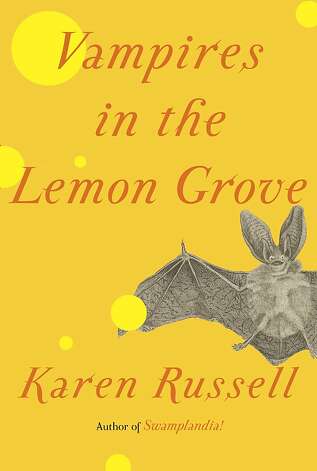
What I'm Reading: Vampires in the Lemon Grove

It is not a secret that I adored Karen Russell's only novel Swamplandia!, but when I heard her new book would be short stories, I was a bit sad.  I wanted to sink my teeth into one of her worlds for another whole novel. But that didn't stop me from placing a reserve on Vampires in the Lemon Grove (herein VitLG) so I could read it soon after it came out.  And, my goodness, I had nothing to worry about.

VitLG was awesome. Each story grabbed on to me, shook me around a bit, and let me go, a little unsteady on my feet, but excited to see what the next story had in store.

But I am getting a little ahead of myself.  VitLG is a book of 8 short stories.  They are all on the "things are not as they seem" side, but for different reasons.  They range from funny to scary to just plain odd, but each one is thought provoking. But before I go into more of the appeal detail, I found this great review by Jenny on Goodreads where she very quickly summarizes each story:
  • Vampires in the Lemon Grove - two ancient vampires try to satiate their desires by eating lemons
  • Reeling for the Empire - human silkworms
  • The Seagull Army Descends on Strong Beach, 1979 - maybe the seagulls are the only ones really paying attention
  • Proving Up - starts as a struggling farm family story, ends in a ... i can't even.... *shiver*
  • The Barn at the End of Our Term - dead presidents alive in horses' bodies (actual presidents, not the band)... this one made me laugh more than any of the others.
  • Dougbert Shackleton's Rules of Antarctic Tailgating - Sometimes you're the whale, but you're probably usually the krill.
  • The New Veterans - PTSD, massage, tattoos, and what is healing, exactly?
  • The Graveless Doll of Eric Mutis - I couldn't decide what I thought of this one. It did have the only bit I marked, because it is about a librarian: "I think we needed that librarian to follow us around the hallways for every minute of every school day, reading us her story of our lives, her fine script of who we were."
You can go to Jenny's blog for more of her reviews. I think she has parsed down each story into the soundbite of what it is about and why you would like it.  If you click through to her full review you can also see that she provided a readalike for each story.

 Most of the stories are on the creepier side, which I personally love, but the range is from pure out terror-- like in the AMAZING "Proving Up" which begins as a tale of the American frontier and slowly builds an uneasy atmosphere to an all our horror ending [loved it]-- to seemingly silly-- like in the story of Antarctic tailgating where our narrator risks life and limb to root for the krill to beat the killer whale.  I say seemingly silly because the story's glib tone and structure hide a larger issue of the fate of the underdog in real life.

But I think the story that best summed up the entire book for me was "Reeling for the Empire."  It had a darker tone and an original premise-- poor Japanese girls being taken from their homes to make silk in a factory but in reality they were being turned into silk worms.  So it also had speculative elements.  It was a thought provoking, coming of age story that made you really think about how much say you have on your place in the work.

A combination of some of these things can be found in most of the stories, but in "Reeling for the Empire," they are all in one place. I get the marketing decision to put the first story as the title since it is provocative and Vampires sell books, but "Reeling" is the anchor story here.


The best way to describe the overall feel of this book is-- slightly askew.  It is a reality that seems true but something is off.  And when you are confronted with this askew picture, it makes you think about how and why things are the way they are.  This is what the stories is VitLG do to the reader.
For me as a reader, this is the perfect kind of story.  I think "slightly askew" will replace "macabre" as my new sound bite description of my personal reader profile.

On a side note, I have been reading books of connected short stories recently (click here for details) so this was a change for me.  Since each story was a complete piece on its own, I was able to read this book in chunks, which fit my reading needs at that time.  I was able to read a bit and then take a break to prepare for the March book club, I was able to read a bit more and then leave it at home while I went on Spring Break where I read a novel, and I was able to pick it right back up and finish after returning. So that is another appeal of this book, the ability to read it piecemeal in the midst of a million distractions and still enjoy it.

Three Words That Describe This Book: stories, thought provoking, slightly askew

Readalikes:  As I was reading VitLG, especially during "Reeling for the Empire," I could not stop thinking about my all time favorite "slightly askew" short story writer, Steven Millhauser. Then this led me to thinking about other writers like Millhauser who I enjoy: Kevin Brockmeier and Keith Donohue. Back in 2011, I had this post talking about all three writers and their style:
Why I was particularly happy to see Donohue's review is that authors like Brockmeier, Donohue, and Millhauser, are very hard to suggest readalikes for. It is because they do not write traditional genre fiction. You could categorize them all as literary fiction, but that would not hit at their appeal. They all have a level of fantasy in their work. It is a bit more speculative than magical realism, but not really straight fantasy. They also all use their speculative elements to raise thought provoking questions about our world and the choices we make. If you laid out the plot summaries of they work side-by-side, however, you would not be able to see any similarity between their books. Their similarity lies in the tone, mood, characterizations, and style of their work. Things that are harder to assess.

Russell is very similar to these three writers.

A female short story writer whose tone and feel comes close to Russell's is the Japanese writer Yoko Ogawa.  She also crafts "slightly askew" short stories and novels.  Her most recent collection is Revenge, which I have been meaning to read.  A few years ago I did read The Housekeeper and the Professor, a story which has stayed with me to this day. Its unsettling premise of a man whose memory is on a 80 minute loop. That's right, his memory only lasts 80 minutes. Intriguing odd, and slightly askew, right?

I would also suggest the 4 novella length stories that make up Stephen King's Full Dark, No Stars. Click here for my review.

Have a great weekend and a nice Mother's Day

Thursday, May 9, 2013

Backlist Not to Miss: Short Story Edition

As I have discussed on this blog many a time, the backlist is what we libraries have that the book store does not.  We have old, out of print books that may be hard to find for purchase, but with the public library card each and every person here in America is entitled to (citizen or not), you can read just about anything.

Again, click here for all of my posts that specifically ponder the backlist.  But, today, I want to consider reading the backlist of short stories.

When I first started at the BPL, almost 13 years ago, we had a HUGE backlist collection of short stories.  We had every single copy of The Best American Short Stories from the 1930s to the present taking up rows upon rows on our shelves.  Now that was a bit extreme for a public library in a community of about 55,000 people.

But books of short stories are relatively popular at the BPL. We made a collection development decision to continue buying most of the titles in The Best American series for the library, but to only keep the current 3-5 years (depending on demand and which piece in the series it was; for example, general short stories we keep longer than genre editions).

So we got rid of all of those old collections, but we did replace them with The Best American Stories of the Century, a collection that included the very best of the stories which appeared in the original annual collections. This item still circulates regularly.

So in general, the BPL has a pretty solid Best American Stories backlist collection to choose from.  But it is by no means comprehensive in any way.

It is hard to know which stories are worth keeping once we get past the 5 year self-life.  Or, what backlist stories from years gone by are worth your time as a reader?

Well, I have found a place where you can hear some of the best short stories ever written as judged by the best practitioners of the form today.  The New Yorker is best place to find the most interesting short fiction today and you get a story a week.  Since May of 2007 though, they have expanded their short story reach by having a monthly FREE podcast in which a short story writer (quite often someone whose current work was featured in the print magazine that month) read one of their favorite short stories.

Click here to access the archive and listen for yourself.

Not only are are these stories hand picked and read by great writers of today, but the authors also take time to comment on the writer whose story they chose and the work itself.  It puts it all in a historical perspective that increases my enjoyment of the stories I have encountered there. And did I mention, in the spirit of the pubic library, these stories are FREE.

This month's offering is Richard Ford reading and discussing Harold Brodkey's "The State of Grace."

As the summer begins and we all spend more time outside and on the go, consider downloading some classic short stories to take with you. You can have the best of the backlist at your command.

Wednesday, May 8, 2013

Circulating Ideas Kickstarter

Back at the beginning of this year I was honored to be asked to a guest on Circulating Ideas, Steve Thomas' podcast interviewing interesting librarians.  You can click here to see my specific contribution to his podcast or here to access the homepage and see everything.

A few weeks ago, Steve let me know about his Kickstarter initiative to raise $2000 to make the podcast more mobile, specifically to take it on the road to the ALA Conference in Chicago next month and interview Nancy Pearl (among others). Click here to see all of the details.

I am embarrassed to say that I filed away his email, meaning to get to it, and lost it in the shuffle of life. But, not only did I remember in time to ask you to help contribute, but also, in the meantime, he has hit his initial Kickstarter goals and has added new stretch goals.

So please consider clicking through and backing Steve (as I have).  He is highlighting some of the best people in our field, giving us all access to new ideas, for free.

I am excited to see what comes out of Steve's podcasts from ALA. I will keep you posted.

Tuesday, May 7, 2013

Sure Bet Book Picks For Most Moms

A good book is an excellent option for a Mother's Day present.  My mother is getting one on Sunday [can't divulge the title here but I will tell you the book is mentioned in this post].

Not surprisingly, no one buys me books for Mother's Day.  I mean who buys the lady who matches people with the best book for them as her career a book? Probably not the best idea.

But, as a mother and a readers' advisor, I figure I can give you some "sure bet" ideas for the mothers on your shopping list.  But first, what do I mean by "sure bet." Of course I know that I cannot guarantee a list of books that everyone, everywhere will enjoy every time, but over the course of a career, it does help you, the librarian, to come up with some key titles or authors that you feel like you can confidently suggest to a wide swath of readers who give you nothing more than that they want a good story. These titles become your security blanket of go-to authors, otherwise known as "sure bets." For more on "sure bets" from me, click here for this post from 2011.

So here I have broken down some authors and titles to make your shopping go a bit more smoothly.

Sure Bet Authors:

  • Adriana Trigiani-- I have yet to have a general fiction reader dislike her books
  • Jacqueline Winspear-- If your mom likes historical fiction and mysteries, the Maisie Dobbs series is also a crowd pleaser.  
  • Speaking of mysteries, Alan Bradley and Louise Penny write series that I cannot get enough of, and I am not a huge mystery fan.
  • Gillian Flynn is great only if your mom doesn't mind high suspense, huge plot twists, and bad women (including more than a few horrible mothers).  Flynn is an amazing writer but you better get along well with your mom before you hand her something like Sharp Objects.
Sure Bet Titles:

At the BPL, we have taken many of our past book discussion titles and placed them on spinners near our desk.  While they are ostensibly there for other book clubs, they have also become a de facto "sure bets" collection for the staff when we need a "good read" for a patron. Why? Well, between Kathy's group and my group, we have seen the hand picked selections on these spinners go over well with a widely diverse group of (mostly) women.  We are confident that others will enjoy them too.  To access detailed reports about all of the books my group has discussed, click here.  I begin each of these discussion reports with a vote by the group on how they felt about the book, so you can sort through and see the most enjoyed titles.

But here are a few other titles I have read that I would feel confident gifting to most moms. All have very little to zero sex and/or violence, happier endings, are solidly written, and have an overall compelling pace. Please click on the titles for a full review, by me, on each.
I hope this list helps you to find your mom a good read for her to settle down with this Sunday.  [That's what I plan to do.] A trip to your local independent book store should be all you need to get a copy of one of these books in plenty of time.  Click here to find your local store.  If you were wondering, my book store of choice is The Book Table in Oak Park.

Monday, May 6, 2013

Monday Discussion: Name Your Favorite Literary Villain

As you can see from the side bar, I am reading Joe Hill's NOS4A2, and LOVING it.

Over the weekend, I received my monthly Goodreads Newsletter and Joe Hill had this essay about some of his favorite horror villains.

Click through to read it.  The list includes BPL fav Gillian Flynn's Amazing Amy.

Also, next week, I will be introducing Bram Stoker winning author John Everson at the ARRT Genre Boot Camp, so I have bad guys on the mind.  I figured I should run with it for today's discussion and have us all list our favorite villains.

I will start.  I read a lot of twisted books, so I have many villains to chose from.  For today's purposes I decided I would limit myself to books I have read in the last couple of years that are in different genres from horror, so as to spread the wealth (so to speak). But if it is more horror you want, don't forget to visit the horror blog too.  For the villains listed here today, I have noted the genres and linked to my full reviews for more details:
  • The first villain that jumped into my mind was "The Past" in Stephen King's 11/22/63 [Science Fiction].  Click here to read my full review but here is the excerpt where I talk about "The Past":
    • "The Past", in capital letters, is a character here. It is the main villain actually, more than Oswald, and it is not until after the assassination is stopped that we see the full fury and evil "The Past" can throw at us. "The Past" is constantly after Jake and this adds a chilling and menacing aspect to the novel.
  • Ben in Before I Go To Sleep by S.J. Watson [psychological suspense] is one villain I keep thinking about. The fact that our narrator has a limited memory, but her journal screams at her, "Don't Trust Ben," should give it away, but Watson does such a great job lulling us into trusting Ben, that we don't see it coming. Click here for details.
  • The villain who is finally revealed in Jo Nesbo's The Leopard, is pretty darn awful.  He is smart, violent, and creepy.  That book had me squirming. And since it is more of a traditional mystery, our villain meets a very fitting end. Details here.
  • The level of menace that pervades Haruki Murakami's 1Q84 is overwhelming. Villains abound, but there is one physical man who stalks our main characters.  It is not often that a true villain emerges in a literary fiction novel, but I would say this one qualifies. Details here.
So there are some suggestion of a few great villains. But I purposely left a lot of fabulously awful bad guys out of the discussion because I want to here from you.

For today's Monday Discussion, let me know your favorite villains and why you love to hate them.

For past Monday Discussions, click here.

Thursday, May 2, 2013

RA Links Round-Up

My list of saved links that haven't begot a post is getting loooooong, so it's time for another round-up of links.

This is the first real round-up since I started using NetVibes as my feed reader too.  I had to get used to saving posts by clicking "read later" as opposed to the old Google Reader  standby of "starred."

So here are a the best of the "read later" bunch:

Wednesday, May 1, 2013

Two New Training Webinars By Me Now Available To Everyone

In March and April I was very busy creating two brand new programs for the Mid-America Library Alliance.  These programs were my first ever webinar based programs.

I am happy to report these webinars are now up and ready for anyone to purchase.  The price is quite reasonable too ($30 for nonmembers).  The classes available are all listed here, but mine specifically are:


Both are brand new and completely updated. Use the links above for more details on the content to be found in each. I am particularly happy with the Book Club one because  I took 2 different book discussion training lectures I had given over the years, updated them, and merged them into one class.  This webinar is the best of my training for librarians melded with the talk I give to patrons about jazzing up their own book clubs.  The result was a new look at how to reignite the spark in your book club.

After I taped the webinar, I had even energized myself and the results were seen in my own April book discussion.

I am currently booking live appearances for Fall 2013 (spots are filling up though). You can always contact me about any training needs you have, but I also realize that it can be cost prohibitive for me to travel to you.  Not to mention that I have other jobs and two kids, so I cannot travel out of the Chicagoland area more than once a month. Webinars are a great compromise though. Since there is no travel involved, you only have to pay me to speak.  And, if you want a presentation I already have prepared, I knock $50 off the price since I just need to refresh them and update for your audience.

After a few initial kinks, I am happy to report that the overall experience of taking my programs to a webinar format went very well.  It was weird for me not to have an audience to interact with, but I got used to it.

If you are interested in viewing either of the webinars listed above, click here and get the RA for All: Roadshow experience from the comfort of your home or library.