RA FOR ALL...THE ROAD SHOW!

I can come to your library, book club meeting, or conference to talk about how to help your readers find their next good read. Click here for more information including RA for All's EDI Statement and info about WHY I LOVE HORROR.
Showing posts sorted by relevance for query stolen child. Sort by date Show all posts

Thursday, October 22, 2009

BPL Book Discussion: The Stolen Child

This week our group met to discuss The Stolen Child by Keith Donohue. This debut novel was a huge hit when it came out it 2006. The Stolen Child was inspired by this Yeats poem that tempts a child from home, and has been described as mystical, a dark fairy tale, a bedtime story for adults, and a classic tale of leaving childhood and searching for your identity.


I have used this novel on many displays. Here is a modified version of the annotations I have used in the past:

At age 7, Henry Day is kidnapped by a pack of hobgoblins who replace him with one of their own. The chapters alternate between the experiences of human Henry and hobgoblin Henry. Neither Henry feels content in his life, and both are losing a grip on their true pasts. Their concurrent struggle to find where they came from lead the two Henrys to finally meet decades later. Although the ending of this magical novel is open, both Henrys do come to terms with who they have been, who they are, and who they will be.

The Stolen Child is a great choice for adults who want to try something with a touch of fantasy, but is still grounded in reality. It is especially appealing to readers who like Neil Gaiman, Audrey Niffennegger, and Gregory Maguire, but don't read much other fantasy. Trust me there are a lot of these people, and for them, we have a Fantasy for Beginners list which I created posted on the BPL website. I am always searching for new fantasy titles for non-fantasy readers.

Now on to our discussion. This was the first blatant fantasy book we tried as a group. I was a bit worried because as a group, these women prefer realistic stories. As we began, it was clear they were a bit uncomfortable with the fantasy elements. One of the participants put it best when she said, "Once I suspended reality, it was okay." Another said, although each Henry's story was not based in reality, they each felt "real" for that character. In other words, Donohue created a convincing place in which hobgoblins and people could realistically be living side-by-side.

No matter the opinion of the group on the fantasy aspects, they all agreed that the writing was amazing and his imagination "awed" one group member. Specifically, people liked how he intertwined with double, alternating stories without blatantly having each scene told from the two Henrys perspectives. Their stories overlapped at times, but there were many connections and references to objects, events or characters that the reader had to piece together. We all enjoyed discovering where things overlapped.

We discussed the 2 huge themes of "doubles" and "memory" in The Stolen Child at length. People also liked that each of the 12 faeries had their own personality, and even though their names seemed out of "Star Wars," as one participant put it, they were easy to distinguish and "get to know."

One of our lines of discussion centered on why the changelings world was falling apart. We talked about the encroachment of the suburbs on the forest, but then moved to talking about their destruction as a symbol of human "advancement." We modern Americans do not believe in magic as much anymore. We are too rational to have time for the superstitions of our parents and the old world. We then discussed the popularity of Halloween in America (It is now the 2nd most popular holiday in America behind Christmas), and thought that maybe it is so popular because it is our only chance to explore magic and superstition today.

We also talked about whether or not The Stolen Child is the "fairy tale for adults," that the publisher markets it to be, and if so, what is its moral. We decided there were 2 morals. First, to try to look at the world with a child's point of view from time to time. Second, remember to add a touch of fantasy into your adult life.

Of course I had to ask, who is the "stolen child" of the title; since3 it is singular, I forced people to only pick one child. Some said, Aniday (the faerie Henry) since he is literally stolen and is forced to stay a child. Some said, Gustav/Henry because his childhood was stolen and he got to relive it as an adult. But overall we decided the answer was us, the adult readers. We are each the "stolen child" because our childhood is gone; it cannot be relived and we may have lost its lessons.

That being said, this is not a depressing book, in fact, the two main characters meet towards the end and feel that they have forgiven each other. They have also each "written" their story as a confession to the woman they love, and that is another sign that they have come to terms with their lives and can move forward.

Appeal: mystical fiction, debut novel, dark fairy tale, doubles/twins, doppelgangers, changelings (hobgoblins), myths and legends, 2 points of view, history and details of the growth of the suburbs in the mid-20th century, details about music both classical and popular, families, domestic fiction, identity issues, magical realism, thought provoking, coming of age, blurring of good and evil, alienation, identity, genealogy, bedtime stories for adults, lost/missing children, wild children, impostors, secret identity, coping and loss, belonging, parallel universe, literary fantasy, open ending.

Readalikes:
The Stolen Child has so many appeals to match that I have a huge list of fiction readalikes. I am going to list them as I instruct my students to do readalikes; I will list the book and give a few key terms as to why I feel the books match. See the appeal terms above also.

All books by Gregory Maguire (dark fairy tales, retelling of familiar stories)
Dr. Jekyll and Mr. Hyde by Robert Lewis Stevenson (doppelgangers, magical realism, gritty)
The Lovely Bones by Alice Sebold (debut novel, lost children, magical realism, coping and loss parallel universe, multiple narrators)
Drood by Dan Simmons (doppelgangers, magical realism)
The Graveyard Book by Neil Gaiman (magical realism, lost child, parallel universe)
American Gods by Neil Gaiman (folklore and legend, bedtime stories for adults, parallel universe)
Kafka on the Shore by Haruki Murakami (lost children, magical realism, coming of age)
The Thirteenth Tale by Diane Setterfield (twins, fairy tale for adults, literary, secret identity)
Her Fearful Symmetry by Audrey Niffenegger (twins, magical realism, literary fantasy, supernatural)
The Jungle Book by Rudyard Kipling ("wild child," coming of age without human family)
The Confessions of Max Tivioli by Andrew Sean Greer (coming of age, identity, magical realism)
You Remind Me of Me by Dan Chaon (three people's stories, memory, mythical)
The Wild Things by David Eggers (lost children, mystical fiction, coming of age)
Peter Pan by J.M. Barrie (magical realism, forever a child, fairy tale)
The Book of Lost Things by John Connolly (child narrator, parallel world, dark fairy tale)
Post-Birthday World by Lionel Shriver (2 stories told side-by-side, magical realism)

For nonfiction, the most obvious choices are books about missing children, books about changelings, faeries, or hobgoblins, and books about myths and legends.

You can see why this book makes for a great discussion. There are so many other books it reminded the participants of. Even though reading fantasy was new and different for them, there were many familiar links we could make together.

Friday, September 7, 2012

What I'm Reading: The Snow Child

Many moons ago I read the debut novel by Alaskan author Eowyn Ivey, The Snow Child.  The novel is based on a traditional Russian folk tale in which a childless couple make a snow child and it comes to life, but eventually it melts when the warm weather comes.  Click here for a recent picture book adaptation of the tale.

In Ivey's version, the couple, Jack and Mabel, are homesteaders in 1920s Alaska, not a very forgiving landscape.  They are barley making it.  She is lonely and he is physically unable to keep up with the intense labor of the farming.  During the season's first snowfall in the nadir of their time in Alaska, the couple has a fun moment building a snow child.  The next morning, the snow child is gone but they glimpse a blonde, wild girl running into the woods.  So begins their relationship with this mysterious child, Faina.

Now Jack and Mabel are well educated and understand that what they are seeing could only come out out of a fairy tale, but over time, Farina becomes a part of their life, and their family.  While Mabel accepts Faina without question, Jack sets out to prove where she really came from.  She gives them purpose, but in a story based on a fairy tale, the ending can only be bittersweet at best.

This is a novel for people who like retold fairy tales. Even though we know how the story will eventually end up, there are still surprises, enchanting moments, wonderful characters, and a just a feeling for being utterly transfixed by the story.  You get lost in this book, and don't want to leave the characters.

The setting here is so vivid it becomes a character.  It is stark and unforgiving.  It is cold and wet.  We can feel the wind as Ivey describes it.  But it is also beautiful and mysterious.  When spring comes we breathe a sigh of relief with the homesteaders.  I was transfixed by the descriptions.  I also enjoyed the historical aspects too.  There is much detail here about how one would actually have to live on a homestead in 1920s Alaska, how you would (or wouldn't) be able to communicate with your family back East, and why one would make the choice to live literally in the middle of nowhere.

The characters are also an important part of whether or not you will like this story.  Because the plot is not action oriented-- the seasons come and go with regularity and life does not vary much-- it is the characters you must read for.  Mabel and Jack are well fleshed out, as we get alternating chapters from their different point s of view.  Their only friends and neighbors are great secondary characters and add a bit of humor to the story.  And their youngest son becomes a pivotal character in the tale.

Since the story takes place over a 2 decade period, we see the characters grow and change.  We see how the harsh landscape grows on them.  And we come to love them all like family.

The language is lyrical and slightly old fashioned but it works for the setting and frame of the retold fairy tale. This is a great book to curl up with and read in one of 2 sittings.  The ending is resolved but a bit open.  Overall this is a dreamlike read with a bittersweet ending.

Three Words That Describe This Book: retold fairy tales, strong sense of place, dreamlike

Readalikes: The first book I thought of when reading The Snow Child was Keith Donohue's The Stolen ChildClick here for my review of that novel.

Really anything by Donohue, Kevin Brockmeier, or Steven Millhauser would work here.  In fact, take a look at this post where I summarize the appeal of all three of these authors.  But for those of you who don't want to open a new window, I would say these men share with Ivey a style in which they tell a story and you, the reader, sit back and experience it.  Their work is  lyrical, dreamlike, and character driven with details frames anchoring it all.

The Night Circus by Erin Morgenstern also has a similar fairy tale quality, where the setting and characters reign supreme.  Again, it is a book that will transfix you.  Click here to read my detailed review.  (You can also see me interview live next month for free by clicking here).

Other books I read that would work as readalikes (use links for details):
One of my favorite backlist titles is The Miracle Life of Edgar Mint by Brady Udall.  Here is what I have to say about it on the Browsers Corner:
Edgar is a half-apache, half white child whose life the reader enters when his head is crushed under the wheel of the mailman’s truck.  After a miracle recovery, Edgar is abandoned by his family and begins a remarkable journey. This is an uplifting and inspiring story of a truly unique and lovable protagonist. Fans of John Irving will love this novel
Finally, here is the link to the GoodReads page on Fairy Tales that includes links and lists for traditional fairy tales and retellings.

Thursday, September 8, 2011

What I'm Reading: Centuries of June

Centuries of June: A NovelI first encountered Keith Donohue when I read the wonderfully original and thought provoking The Stolen Child.  It was a book that stayed with me for a long time after I closed it.  I have since found ways to incorporate it into displays and even got my book club to read itClick through to see Donohue himself comment on our discussion.

I was hotly anticipating his new book late this spring, as I wrote about here.  I had heard that Centuries of June was a departure from his other work, but I was not daunted by this because I trusted Donohue's interesting imagination and technical skill as a writer.

Having finish Centuries of June (CoJ), I agree it is a bit of a departure on the surface, but when you really think about it, CoJ hits at the same themes-- what makes a life, who are we, why are here, what is love-- that The Stolen Child looked at, just from a different point of view.

This is an unconventional book in terms of how the story is told which makes it fun to booktalk.  You see the plot as it involves our protagonist, Jack is very simple.  Jack wakes up at 4:52 am, goes to the bathroom, is smacked on the head, and dies.  The end. Literally, that is it.  I am not holding back on you here.  But then why is it 352 pages? Ahh, it is in figuring out that "why" where one finds the appeal of this book.

If you read for plot, do not pick this book up.  But if you like an entertaining, slowly meandering story that will smack you in the head  and make you contemplate what it means to live a life to its fullest, this is the book for you.

After Jack gets hit in the head, all of the clocks in the house stop and he meets his guide, an elderly man who appears familiar to him.  And then, over the course of the night, Jack is visited by 8 women, who one by one come into the bathroom, try to kill him, and then tell their stories.

The title "Centuries of June" comes from the fact that each of these women has a story from the past.  Their lives span over centuries, from a pre-European Native America, to a woman from the Salem Witch Trial Era, to the Gold Rush, and up into the present.  The point of the book is these stories.  We sit back with Jack in his disoriented state and become entranced the by these women and the tales of their lives.  While each is telling her tale, there are breaks where fo one reason or another, the reader and Jack are snapped back into the "present" and the old man, Jack, and the gathered sisterhood comment on what was said.

These women all have a tale to tell of how a man let them down.  Some live long lives, other short one, but they all are able to tell us of their death too.  They have anger for men and Jack in particular (remember I mentioned they all try to kill him).  This point is key to the book's conclusion.

Speaking of the ending, this is an open ended book.  We do find out what has been going on and why, but the novel is all part of a larger cycle that concludes and begins anew on the final page.  It is a philosophical but satisfying ending.
This is not a "hard" book to read once you get into the flow, but for some readers, the style may be too distracting.  I found it enhanced the story, but for others the unconventional nature of the storytelling will overshadow the story. For still others the lack of a single plot beyond what happens to Jack, will also be frustrating.

But on the other hand, fans of magical realism or historical fiction or even historical women's lives would all find something to enjoy in this book.  It could be enjoyed by a large audience as long as they were warned upfront about the unconvetional style.

Personally, I loved this book.  I was absorbed in the women's stories as much as in the "present" tale of Jack.  I inhaled this book while I was reading it, and then pondered the larger issues it brought up after stepping away.  This is a book that you are meant to sit back, relax, and just experience.  It is beautiful storytelling.  And the ending alone is thought provoking enough to justify reading the book.  Without giving anything away, I will say again as I said above, this is a book that asks what it means to live your life.  When does it begin and when does it end?
Readalikes:  Keith Donohue is a hard author to find a readalike for in that his work does not fit a specific genre; in fact, he writes across many different genres.  With CoJ you could easily classify it as literary fiction, historical fiction, women's lives, or fantasy and have a valid argument for all.

Two authors I have linked to Donohue in the past are Kevin Brockmeier and Steven MillhauserClick here to see a full reason why these authors are great readalikes for each other, but also here is an excerpt:
They all have a level of fantasy in their work. It is a bit more speculative than magical realism, but not really straight fantasy. They also all use their speculative elements to raise thought provoking questions about our world and the choices we make. If you laid out the plot summaries of they work side-by-side, however, you would not be able to see any similarity between their books. Their similarity lies in the tone, mood, characterizations, and style of their work. Things that are harder to assess.
Another author who fits this above description on a regular basis is Neil Gaiman.

As I mentioned above, my book group read Donohue's Stolen Child before and I have a huge list of readalike options there too.

Two books I read recently which would also be great suggestion options here are Swamplandia! by Karen Russell and The Monsters of Templeton by Lauren Groff.  Use the links to see my full reports on those books which also have readalike options listed.  Read and decide if any of the books listed would work for you.

Finally, some readers may have enjoyed the novel in stories style of this book so much that they want to read more books with this format.  For these readers I suggest Olive Kitteridge by Elizabeth Strout, and Away by Amy Bloom both of which also deal with "women's lives.  Or Hearts of Atlantis by Stephen King, A Visit From the Goon Squad by Jennifer Egan, or The Madonnas of Echo Park by Brando Skyhorse for solid "novel in stories" offerings sure to be owned by most libraries.

Wednesday, August 27, 2014

What I'm Reading: Prayers for the Stolen

Earlier this summer I was helping out at the Circulation desk when a patron returned Prayers for the Stolen by Jennifer Clement, and could not stop gushing about it. So I grabbed it for myself and immediately read it.

And am I sure glad I did.

Prayers for the Stolen  is narrated by a captivating, smart, funny, and strong young woman, Ladydi Garcia Martinez.  Yes, she is named for Lady Diana, which leads to some funny scenes spread throughout the book.

Ladydi lives up in a mountain village in Guerro, Mexico, not far from Acapulco.  In Guerro, the men have all left for better opportunities in America and those who are left work for the drug kingpins.  Life is harsh for the women left behind on the mountain.  Bodies are dumped in their neighborhood with regualrity, drive by shooting happen all the time, even the natural world is harsh, full of bugs, snakes, scorpions, and the repeated spraying of chemicals from government helicopters to kill the fields of drugs growing all over the mountain. [These poisons rain down without warning].

But the biggest problem of all is that the worst thing a young girl can be int he village is beautiful because the pretty girls are stolen and taken to live in the compounds of the drug lords and are used for their bodies.  So Ladydi, her friend,s and their mothers are always trying to come up with ways to make the girls look ugly.

Now, I understand that from this description, Prayers for the Stolen sounds depressing.  But trust me it is a beautiful book.  That's why plot summaries are often not enough to give you the feel of a book.  So that's what I am going to do now.

Why you would want to read this book: First and foremost, this is a character driven story. Ladydi is spirited and determined, but NOT in that "plucky" way that can sometimes annoy readers.  Rather she is honest and inquisitive.  She understands her situation, but is also willing to question how messed up it is.  She is self aware and critical, but also adventurous and caring.

This book is also the story of her journey from a child living with her mother on the mountain, to moving to Acapulco to be the nanny for a rich family, to something happening that I don't want to give away but pulls every thread of the story together and from which Ladydi emerges as an adult ready to face the world head on. She will no longer cower in the mountains trying to hide her beauty (both inner and outer).

But it's not just Ladydi who is a great character here.  All the women on the mountain, and the other women Ladydi encounters in that third act of the story are richly drawn and interesting.

This is a book you are reading for the characters

The tone and writing style of this novel are also striking.  This is a haunting and gritty tale, but it is told in a lyrical way.  Clement is an amazing writer who lives in Mexico and was the President of PEN Mexico for a few years.  Her mastery of the technique of writing a compelling and beautiful story with fantastic characters is awe inspiring. Her writing captured me and brought me into Ladydi's world.

The frame was also extremely interesting.  We know about the horrors of the drug trade on the people of Mexico from the news, but to be put into the intimate world of one small mountain village, and then even more focused, into the life of 1 young woman was an appeal for me. Also, the hopelessness of village life juxtaposed by the excess in Acapulco was powerful.

The pacing was also very fast for the complexity of the story.  Again, I think this is a testament to Clements technical skill, but we are talking about a literary fiction title, with intense and serious topics that moves steadily and surprisingly quickly.  One factor I think is Ladydi.  But also, it is the three part structure of the story-- part 1 in the mountain village, part 2 working in Acapulco, part 3...as I said you have to read it to find out-- that keeps you turning the pages.

The ending is open, but triumphant.  Ladydi is finally in charge of herself and her future, but what exactly will happen to her, we can’t know for sure. But what is even more striking about the ending here is that Clement manages to tie up all of the loose ends of the story and make them important to everything that happens. This is hard for many authors to do; in fact, I get complaints from readers when authors do NOT managed to accomplish this.  This is not an ending that will disappoint, despite the fact that it does not spell out what is next on Ladydi's horizon.

This is a book for people who want to be put into the hands of a captivating narrator and placed into a world outside of your every day existence, but not so foreign that you cannot relate. It is serious, and even sad at times, but ultimately the tone is one of triumph. Ladydi is a survivor and I was happy to spend a couple hundred pages in her company.

Three Words That Describe This Book: haunting, gritty, lyrical

Readalikes: The first book I thought of when reading Prayers for Stolen was Into the Beautiful North by Luis Alberto Urrea which I read and loved. They are both set in Mexican towns where the men have all gone and the drug lords are terrorizing everyone, but they share more than this.  They both feature strong and interesting female characters, and involve a gritty and haunting story that is ultimately uplifting.

Another moving story with a coming of age theme that is haunting, character driven and heartbreakingly beautiful is Canada by Richard Ford. Here the setting is on the US Canada border, but many of the issues and themes are the same.  Click through for details.

Right after I read Canada, I also read The Round House by Louise Erdrich and I also described it as heartbreakingly beautiful. Click here and here for lots more on that novel.

A Thousand Splendid Suns by Khaled Hosseini is also a gritty, haunting and lyrical story with female characters facing impossible choices at its center.  Here the setting is Afghanistan.  Click here for my detailed review.

Finally, Ladydi reminded me of June, the young narrator in Tell the Wolves I’m Home by carol Rifka. In my review of that book I mention a colleague saying about this novel, "This was a wonderful book that broke my heart in the best possible way.” That is how I feel about Prayers for the Stolen.

Tuesday, March 8, 2016

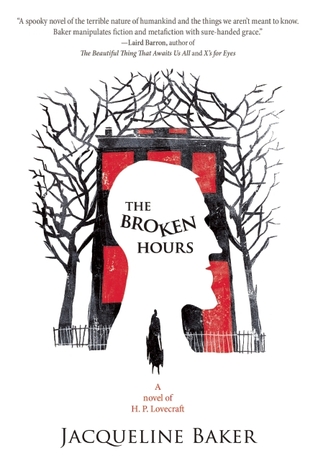
What I’m Reading: The Broken Hours

The Broken Hours: A Novel of H. P. Lovecraft
Baker, Jacqueline
Apr. 2016. 320p. Skyhorse/Talos, hardcover, $24.99  (9781940456553)
REVIEW.  First published March 3, 2016 (Booklist Online).

Here is the draft of the review I turned in to Booklist:
The year is 1836 and Arthor Crandle, desperate for a job and needing space from his troubled homelife, accepts a temporary position in Providence working as the assistant for a reclusive and mysterious author. But all is not as it seems in this “novel of H.P. Lovecraft,” and Crandle is quickly thrust into a world where nightmares, ghosts, and giant tentacles are now a part of his everyday life. This novel is a homage to Lovecraft, his work, and his legacy, but told with only a hint of the terror found within the master’s own stories. Rather Baker’s intent is to authentically recreate the eerie atmosphere that surrounded Lovecraft, before wrapping the reader up in a compelling, Hitchcock-esque plot that keeps everyone on edge, constantly questioning the real versus the imagined, up to the final shocking pages. Lovecraft fans will delight in seeing the author’s biography unfold on the page, but, those with no previous attachment to the horror master will easily be drawn into this satisfying, Gothic tale on its own merit. Suggest to fans of last year’s historical, horror hit The Quick or backlist darling The Thirteenth Tale.
Three Words That Describe This Book: eerie, Gothic, biographical

Readalikes: Besides the two titles mentioned in the review-- to which I have added the links to my blog reviews that contain MANY more readalike options-- I would also suggest:

Some may want to read Lovecraft after reading this novel. To those people I would suggest trying his stories from Weird Tales, the ones which are referred to throughout Broken Hours.

Wednesday, May 22, 2013

What I'm Reading: Raven Girl

Last week I read the short story graphic novel by Audrey Niffenegger entitled Raven Girl. Talk about bridging the Dewey divide, this volume is the result of a joint collaboration with the  Royal Ballet of London.  Niffenegger was asked to write the story for a brand new ballet.  They requested that it be in the fairy tale mold.  This slim, illustrated volume is the result.

Although this is more of a single illustrated story, I felt that since the author is such a big name and the book will be in high demand, this was worth a short review.

The story is simply explained.  It is the tale of a girl who is half raven, half human and her coming of age. But it is how the story is told which would determine whether or not you would enjoy it.

This story is short, sweet, and beautiful in a traditional fairy tale way.  What we have a a Gothic story in words and picture. It is atmospheric and a bit macabre.  For example, the Raven Girl herself cannot speak human words, but can understand them.  She goes to human college but yearns for bird wings.

The story is original but based in tradition.  As I read it, I felt the story was familiar and I knew where it was going, but while in general theme, tone, and story arc, I was correct, the journey of getting to the end of the story was a delight, both in the originality of the plot and the execution of the drawings.

Also because it is meant to be performed as a ballet, there is a lyrical, flowing, movement to the story.  It has a gracefulness that hints at its root in the dance format.

This is a volume for fans of Niffenegger's work but not for those who only like  The Time Traveler's Wife. It is for fans of macabre and Gothic stories. There is a darkness here, but it is enveloped by hope and beauty.

Raven Girl is also a good entry point for people who are new to graphic novels.  There are pages without pictures, just text.  It is really more of an illustrated story; a picture book for adults.

I was enchanted by this tale, but recognize that it is not for everyone.  However you would only have to give up an hour or two to see for yourself. In fact, I do suggest reading this volume in one sitting.

Three Words That Describe This Book: atmospheric, fairy tale, graceful

Readalikes: The Raven Girl is just my kind of story.  As I result, I have so many ideas of books that it reminded me of.  Here is a short list of those titles with links to the reviews for details, and don't forget, each review has readalikes also, many of which could be readalikes here also.  But in general, these are all atmospheric, moody stories with a Gothic and/or fairy tale feel:

Tuesday, December 29, 2009

What I'm Reading: Her Fearful Symmetry


Recently I devoured Audrey Niffenegger's new novel, Her Fearful Symmetry. I was nervous before I began because I really enjoyed The Time Traveler's Wife and the new book was getting mixed reviews. Well, I am happy to report that I actually enjoyed Her Fearful Symmetry (herein, HFS) even more than The Time Traveler’s Wife (herein, TTW).

The reason I enjoyed the newer novel more and others disagree has to do with the difference in the appeal of each novel. The overall tones of these novels are on opposite ends of the spectrum. TTW is a love story with a science fiction element and a heart-warming ending. (click here to read my full report on TTW).

On the other hand, HFS is a dark ghost story about deep family secrets with seriously twisted characters and an unsettling ending.  I loved it! But this huge shift in tone, mood, and storyline focus can easily explain why fans of the more heartwarming TTW were disappointed.  Whereas Claire and Henry in TTW are good, well meaning, loving people, the main characters in HFS are manipulative, selfish, and mean.

Without giving anything away, here is the basic plot. Edie and Elspeth were identical twins growing up in London, Edie married and moved to the Chicago Suburbs and had twins of her own, Julia and Valentina.  When Elspeth dies in London, she leaves her flat, overlooking Highgate Cemetery to the twins with the condition that their parents don't come over the ocean with the girls.  However, Elspeth finds herself a ghost, stuck in the flat and eventually figures out how to communicate with the girls. Elspeth's lover, Robert, and the upstairs neighbor, Martin (who has a serious case of OCD), are also key to the story.

But there are many twists and turns through this story and at the end, there is one HUGE plot twist that makes the book even darker and more sinister.  Again, I liked that, but it is not for everyone.

Appeal: This is a complex, character-centered, gothic tale told in a modern setting. With its focus on death, family betrayal, mental illness, and cemeteries, the novel is shrouded in a darkness of tone and mood that rarely lifts. But HFS is also filed with lyrical language, beautiful scenes, and amazing passages that beg to be read a second, or a third time. TTW, the sequel, this is not.

3 Word That Describe This Book: dark, twins, character-centered

Readalikes: HFS is very similar to a few other books I have read and loved.  The Graveyard Book by Neil Gaiman, The Thirteenth Tale by Diane Setterfeld, The Good Thief  by Hanah Tinti and A Brief History of the Dead by Kevin Brockmeier.

Also, use this link for my report on my book discussion on The Stolen Child for a longer list of books that are similar to HFS.

Books about Highgate Cemetery, London travel guide (the twins use them when they first move to London), books about twins (especially those trying to have separate lives), and books about ghosts could all be of interest to readers after finishing HFS.

Wednesday, October 7, 2015

Crowd-Sourced List of Hidden Gem Book Discussion Titles

Yesterday marked the end of 3 presentations I did for RAILS on Book Discussions over the last few weeks.

The first 2 were webinars on how to Recharge Your Book Club.  You can access the recording of one of them with a link to the slides here.

Yesterday though, I did one of my favorite trainings-- a book discussion for book discussion leaders.  We discussed The Winter People by Jennifer McMahon.  I will have notes on our discussion up tomorrow, but today I have a treat that was promised to attendees from all 3 presentations.

During the course of all three presentations I asked participants to share their favorite “unique” titles that worked well in discussion-- those hidden gems that made for an awesome discussion.

Below, you can see the slide where I listed mine to start off this ask:


Click here for access to the full presentation with 
clickable links [slide 11]

At the end of this post I have reproduced the fantastic crowd-sourced list with links to book discussion information about these titles to help you start using one of these with your group. Each of these titles has been used in a successful book discussion, I just don’t know who did which books.

But first, before we get to that, I also promised a few people at yesterday’s discussion that I would include a mention of the ARRT Literary Book Discussion and Leadership Training for which I will be the 2016 coordinator.  These discussions are meant for book discussion leaders and happen 4x a year.  All ARRT members are welcome [membership is only $10]; in fact, 2 regulars at these ARRT events were with me for yesterday’s discussion too. All details can be found here.

Now here is the list that we all made together. It is long. Thanks to everyone who offered up their own hidden gem titles. This is going to be a great resource for all of us who run book clubs.  What a great example of using the compound interest of all of our experiences to make for better experiences for all of our patrons. YAY sharing.

If anyone else wants to add to this list, please leave a comment. I am totally using a few of these myself.

Friday, August 12, 2016

What I'm Reading: Booklist's Horror Spotlight Issue

In the August 2016 issue of Booklist I had three reviews and 1 online only review. I know there are still three more turned in reviews in the pipeline for the September issues and I have another stack piled up here at home to read.

The haunting season is coming fast. Time to get ordering. Also a quick note, I will not add extra readalikes to these reviews because I have a ton in the review, but I will pull out my three words and I have added links to authors and such.

A Long December
By Richard Chizmar
Oct. 2016. 520p. Subterranean, hardcover, $40  (9781596067936)
First published August, 2016 (Booklist).

STAR REVIEW!
Chizmar may not be a name readers know, but they certainly know the names of those he has published in his 27 year career running the award-winning Cemetery Dance Publications- Stephen King, Justin Cronin, Joe R Lansdale and Gillian Flynn to name only a few. This huge collection of 35 tales spans Chizmar’s entire career offering a wide range of genres from crime to dark fantasy to horror. Some pieces, published previously are included as is, while others have been reworked, and still others were never available before now, but all are subtly terrifying tales of normal lives that are completely upended by circumstance beyond anyone’s control. Chizmar’s stories are united by the feelings they produce, dread, anxiety, and suspense, but more remarkable is how they are presented with a poignancy and underlying sweetness that cannot be ignore like in the eponymous novella where the protagonist wakes up to police surrounding his neighbor and best friend’s home because that man is a serial killer. How can you process that? It’s well past time to let the man behind so many other great stories have a chance to wow readers with his own chilling words. This is a must read for fans of intense tales where psychological suspense and horror overlap like in the novels of Peter Straub, Scott Smith, or Adam Nevill.


Three Words That Describe This Book: suspense, stories, chilling


The Motion of Puppets
by Keith Donohue
Oct. 2016. 272p. illus. Picador, hardcover, $26  (9781250057181); e-book (9781250057211)
First published August, 2016 (Booklist).

STAR REVIEW!
Donohue [The Stolen Child, The Boy Who Drew Monsters] has written a masterpiece of psychological horror that will change the way you look at puppets forever. Kay, a performer in the cirque and her new husband, Theo, a French professor in New York, are spending the summer in the old portion of Quebec City while Kay performs and Theo translates the biography of the artist and pioneering photographer of motion, Eadweard Muybridge [whose macabre yet intriguing life adds wonderful depth to the novel]. After a late post-show dinner, Kay walking home alone, frightened and disoriented, enters an old toy store which was surprisingly unlocked, only to find herself transformed into a puppet and held prisoner in the back of the shop, where all the puppets can come alive between midnight and dawn. What follows is each of their tales, told in alternating points of view. Theo desperately searching for his vanished beloved begins to find connections to the old toy shop but is having trouble believing those who say the puppets may be alive; meanwhile Kay is slowly forgetting the human world she came from and is embracing her life as a puppet with her new friends. Time may be running out for Theo to locate Kay and convince her to come back to him. Intricately plotted, absorbing, dark, and suspenseful, this is a moving, modern story set in what could feel like a fairy tale world, but is actually terrifyingly realistic. It is a tale of true love, missing persons, and the beauty of the mechanics of motion all wrapped up in one awesome creeptastic package. Give this to readers who love creepy doll stories like those in Ellen Datlow’s award winning The Doll Collection, as well as any fans of Neil Gaiman, Steven Millhauser, or Elizabeth McCracken.


Three Words That Describe This Book: askew, macabre, compelling


Last Train from Perdition [I Travel By Night, Book Two]
by Robert McCammon
Oct. 2016. 184p. Subterranean, hardcover, $35  (9781596067387)
First published August, 2016 (Booklist).

Horror legend Robert McCammon is back with book two in his highly entertaining, vampire western series. Trevor Lawson, a reluctant vampire and his human sidekick, sharpshooter Ann Remington, are still on the hunt for LaRouge, the woman who turned Lawson into a vampire during the Civil War and kidnapped Ann’s father and sister, in the hopes that killing her will allow Lawson to become human again. While they search, Lawson takes discreet, dangerous jobs with the business motto, “All Matters Handled.” It’s now 1886 and a new job takes the pair from New Orleans to the frontier town of Perdition, MT to rescue a wealthy young man from a band of outlaws. Lawson tries to extricate the man without violence, but between the outlaws and the vampire Dark Society, it appears a peaceful getaway is not going to be an option. This thrilling story culminates with a fantastic battle scene on a train where unlikely alliances are formed, adding a new wrinkle to Lawson’s quest for freedom from his vampiric curse. No need to have read the first book as the necessary details are supplied without sacrificing the pace. Clear a couple hours because you will want to devour this in one sitting. And while there are no new additions to vampire lore here, you will be having too much fun to care. This is perfect for fans of the TV series Deadwood and the award winning American Vampire graphic novel series by Scott Snyder.

Genre Note: This is clearly equal parts western and horror. That is a huge appeal that cannot be underestimated. It does both genres VERY well.

Three Words That Describe This Book: vampires, plot driven, the old west


Zombie Gold
by John L. Lansdale
Aug. 2016. 202p. Short Scary Tales, hardcover, $29.95  (9781909640641)
First published July 21, 2016 (Booklist Online).


Chris and Will are your average, modern day 20-somethings. Chirs’ family has owned the Flying G Ranch for generations and Will is a college student and Civil War history buff who is working the ranch for the summer. The boys strike-out alone, to the local mountain, named for Ernest Kaman  a Civil War soldier turned gold robber, whose band of thieves is said to still haunt the isolated area. But they aren’t ghosts...they’re zombies, stuck on the mountain, protecting their plunder. Chris and Will escape the zombies but end up being transported to 1863, only miles away from the impending battle of Gettysburg. Chris and Will are thrown into a much bigger adventure than they bargained for trying to explain themselves, avoid being forced to enlist in the army, and dodging the constant bloodshed. Their only hope to return to the 21st Century is to find Kaman and follow him back to the mountain as he steals the gold. Can they make it back in time and will it be before the zombies wreak havoc on those searching for the missing boys? Zombie Gold is an entertaining, well paced science fiction-historical-horror blend with resourceful protagonists and a solid cast of secondary characters. While this will obviously appeal to fans of the weird western, Hell’s Bounty that Lansdale co-wrote with his brother, bestselling author Joe R. Lansdale, fans of Jonathan Maberry should also give this a try.

YA: Teens will love watching Chris and Will make their way through time, struggling to survive in the 1860s and battling the zombies who have crossed into the 21st Century.

Genre Note: More time travel/historical fiction blend than horror so will still be a great suggestion for Civil War era fans.

Three Words That Describe This Book: time travel, coming of age, Civil War

Wednesday, July 9, 2008

Suggestions for a Guys Book Group

I had a patron come to the desk at BPL on Monday to tell us about his new book group. It consists of a dozen or so 30-something, fathers, who meet in a local bar to hold their discussions. They had their first meeting last month and they read The Road by Cormac McCarthy. They are reading Confederacy of Dunces next and Motherless Brooklyn in August. All three are excellent choices to get a guys group going.

I told him I would compile I list of suggestions for future months. His requirements were that the books be less than 350, they wanted fictions and nonfiction, a few classics, short stories, a "scary book for Halloween, and anything I just thought might be good.

So here are the suggestions, for both his group, and anyone else out there, to peruse.

Let's start with the "scary" book suggestion. I have three. The first two might have less to discuss in the traditional book discussion sense, but are VERY scary, and the third is not as scary, but a good book discussion title. Joe Hill's Heart-Shaped Box and Scott Smith's The Ruins, are the two best horror books of the last few years (IMO). The Stolen Child by Keith Donohue is about changelings and has provoked a lot of conversation and accolades. It also deal with fatherhood.

Now onto other suggested titles. I will list fiction and nonfiction separately. Each is linked to Amazon, where interested readers can find not only summaries, but comments from actual readers. When choosing titles for a book discussion, I always look at a few 5 star reviews and a few 1 star reviews to get the full spectrum of opinions on a book. It has served me well for 7 1/2 years of picking book discussion titles.

I have placed a * in front of my top 10 picks for discussion. But this is only my opinion.

FICTION
*Catcher in the Rye by J.D. Salinger
The Sun Also Rises by Ernest Hemingway
All Quiet on the Western Front by Erich Maria Remarque
The Brief Wondrous Life Of Oscar Wao by Junot Diaz
Neverwhere by Neil Gaiman
*Blindness by Jose Saramago
*Extremely Loud and Incredibly Close by Jonathan Safran Foer (which is technically 18 pages over the limit, but many of the pages are just pictures)
Blind Willow, Sleeping Woman by Haruki Murakami (Short Stories)
Hateship, Friendship, Courtship, Loveship, Marriage by Alice Munro (Short Stories)
*
Interpreter of Maladies by Jhumpa Lahiri (Short Stories)
High Fidelity by Nick Hornby
Lullaby by Chuck Palahniuk
*On the Road by Jack Kerouac
The Van by Roddy Doyle

NONFICTION
(The page limit really held my choices back here, but these are all great options. Many are under the limit in text, but over when you count the notes sections)
Cod
by Mark Kurlansky
*Fast Food Nation by Eric Schlosser
*Maus or In the Shadow of No Towers by Art Spiegelman (both graphic novels)
The Professor and the Madman by Simon Winchester
*Isaac's Storm by Erik Larson
*Longitude by Dava Sobel
The Orchid Thief by Susan Orlean
*1776 by David McCulough
Founding Brothers by Joseph Ellis
Freakonomics by Steven Levitt and Stephen Dubner
The Tipping Point by Malcolm Gladwell

Good luck to the Berwyn guys and anyone else who chooses to use this list. Please feel free to use the comments to add to the list. I know there are a lot more books to add because I had to force myself to stop.