RA FOR ALL...THE ROAD SHOW!

I can come to your library, book club meeting, or conference to talk about how to help your readers find their next good read. Click here for more information including RA for All's EDI Statement and info about WHY I LOVE HORROR.
Showing posts sorted by relevance for query what i’m reading french. Sort by date Show all posts

Friday, July 22, 2011

What I'm Reading: Faithful Place

Faithful Place: A NovelI am very far behind in my reviews of what I have read, so unless something BIG breaks in the RA world (hey, that's a funny thought) over the next week or so, you can expect lots of reviews for the time being here on RA for All.

Back in June I listened to Faithful Place by Tana French.  What I love about French is that she writes dark, literary crime novels that share a lot of the appeal of the popular Nordic Noir, but with more subtle psychological suspense and less in your face violence.  The other thing I enjoy with her books is that they are NOT a series.  Both as a reader and as a librarian, I can have someone pick up any of her three books.  There is no worry about the order here.

Here the plot involves Frank Mackey, the head of the Dublin Undercover unit, who 22 years ago left his family and old life behind, but is forced to return home when the suitcase of Rosie, the girl he had planned to run away with 22 years ago is discovered.  Did she stand Frank up back then as he has thought all this time, or did some harm come to her?  Frank must help solve the case and confront his family; a family he has ignored for two decades. Can he survive, both physically and emotionally, being drawn back into the drama of Faithful Place?

Last year  I read French's debut novel In the Woods, and looking back, I was surprised by how much of what I said about the appeal of that novel applies here too:
In the Woods can best be described as: police procedural meets psychological suspense.  This is a dark book, with an extremely flawed narrator.  Bad things are happening here and even when the crime is "solved," no one is satisfied; in fact, just about everyone involved with the case has been ruined as a result of the investigation.   And the kicker is, you know that it will not end well from the start, but you are so compelled by the complex plot, the interesting, 3-dimensional characters and their interactions that you cannot look away.  I found myself cleaning out a closet, just so I could have 1 hour to myself to listen to this novel. I was completely absorbed by the story, the atmosphere, and the characters.  Even when not much was happening, I needed to keep listening.  It was a bit scary, like an addiction.
That's the thing about French, it is how her books make you feel that is way more important than what happens.  Her books are well plotted police procedurals, but the mysteries are not always solved, and if they are, the bad guy does not always get brought to justice.  You are not quite sure what to expect.  With the number of suspense books I read, this is a huge compliment.  It is no wonder that her books end up on every award and best books list each time she writes a new one.

I also especially enjoy how she includes the politics behind the scenes at police headquarters, class issues (which are huge in these books), violence, especially between family and loved ones, the deep characterizations, and the emotion she brings out in her characters and the reader.

For example, there is an amazing extended scene at a wake in Faithful Place in the middle of the novel that reveals so much about the characters and the story without much happening, as well as an emotionally raw conversation between Frank and his ex-wife toward the end of the book. All of this detail could easily bog down the pacing, but it does not. This novel may be dark, atmospheric, and unsettling, but it is also steadily paced.

In the two books I have read by French, she also uses a case from the past to draw ties to the present.  In both cases, the past case was also connected to the lead investigator.  I found this a compelling plot device in both cases.  The sense of place is also huge.  I could see, smell, and hear the neighborhood of Faithful Place.  I was there with Frank, even though I nave never been to Dublin.

Three Words That Describe This Book: unsettling, psychological suspense, family

Where This Book Took Me (Summer Reading Feature): Working-Class Dublin


Readalikes: Kate Atkinson also has the past intrude upon her literary, atmospheric, crime novels featuring Jackson Brodie.  Fans of French or Atkinson would enjoy the other. Click here to see what I have had to say about Atkinson in the past.

Also, click here for my report, with tons of readalikes from when I read French's first novel, In the Woods.

I also think people who like the unsettling psychological suspense of Peter Abrahams (try, Oblivion) or Ruth Rendell (try, 13 Steps Down) would find enjoyment in French.  But if you like the atmosphere of French but want a little more meat to the police procedural part of the plot, I suggest Tess Gerritsen (try, The Keepsake), C. J. Box (try, Blue Heaven) or John  Lescroart (try, Dead Irish).

Wednesday, December 22, 2010

What I'm Reading: Favorites of 2010

Okay, so I finally sucked it up and picked the 10 books I most enjoyed reading in 2010.  This year was harder than most for me.  So what follows is my "Year in Reading," a list of the 10 books which I loved for one reason or another.  The links are to my initial reviews on each title and any comments are further thoughts about the book.

Interestingly, I have almost all fiction this year (8 fictions vs only 2 nonfiction).  I think this has to do with the year I had though.  I spent most of 2010 researching and writing my new book and read a lot of horror and disturbing books.  Since I was engaged in writing about them, many of these stuck with me.  In fact, 5 (or half) of the books on this list ended up mentioned in my book in one way or another.

Finally, as I look at the overall list, in most of these books, things do not end well.  Thankfully it is only in 2 of them where the main protagonist end up dead, but in almost every book, there is a level of uneasiness, defeat, or unsettledness that ends each story.  But by no means does that mean these books are sad or upsetting.  Many are hopeful that better things are to come; we just might have to wait awhile.  If you use the links to click through to my reviews, you will get a better sense of what I mean.

The first 2 books listed were my absolute favorites, but after that it is a toss up depending on what mood you catch me in.  For the record, No. 11 is The Reapers Are the Angels.  See, I couldn't actually get the list to only 10 in the end. Enough analysis, here is the list:

  • The Passage by Justin Cronin: No other book this year has stayed with me longer than this 700+ page epic.  It is the best book I have read in a long time.  I still think about the story, the characters, and the beauty of the language.  It has it all: it is thought provoking, character-centered, steadily paced, has great action sequences, and is engrossing.
  • Await Your Reply by Dan Chaon:  I read this book twice this year, and loved it both times. Click here for the book discussion report. Back when I finished it in the beginning of January, I predicted that it would end up on this list.  I was right.  This is also a disturbing but thought-provoking look at what makes up our identities.  Await Your Reply was one of the most popular "best books" of 2009.
  • The Lonely Polygamist by Brady Udall.  Again this book stayed with me.  It was layered, well constructed, realistic, and fascinating. It was my second favorite book with a 2010 copyright.
  • The Little Stranger by Sarah Waters.  Creepy and historical, all wrapped up in a compelling story of a British family in decline during the post-WWII era.  Don't read this book however, if you like nicely closed and clearly defined endings.
  • Shades of Grey by Jasper Fforde. This is infinitely darker than his Thursday Next series, but if you don't mind that, this book is great.  I also read the highly touted The City and the City by China Mieville this year, and I thought Shades of Grey tackled the same issues, better.
  • Horns by Joe Hill.  I think Joe Hill could write a phone book and I would love it.  He has really taken over as THE horror author in the world right now.  What is so interesting about Horns however is that our protagonist is slowly turning into the Devil and although we are rooting for him, we do not trust him.  It makes for an interesting read.
  • The Glass Castle by Jeanette Walls.  I read this memoir for book club and can't stop thinking about it.  I loved how Walls recounts the crazy but true episodes from her life in a way that does not make the reader feel bad for the family's misfortune.  She infuses optimism and hope even when the family is starving and their house is falling down around them.  And as an added bonus, the writing is great too.
  • Solar by Ian McEwan.  This is a hysterical and dark novel in which the protagonist keeps making the worst decisions and the reader just sits back to watch it all collapse on him.  McEwan is a genius.
  • In the Woods by Tana French.  This is one I just finished after years of it being on my to read list.  I knew it was supposed to be good, but I was pleasantly surprised by how good it turned out to be.
  • The Big Year: A Tale of Man, Nature, and Fowl Obsession by Mark Obmascik.  This is the shocker on my list, at least to me.  The reasons I read this book had nothing to do with RA principles, and the reasons I loved it were purely personal.  (use the link to see) But, I also loved how much this book taught me about birds, competitive birding, and the American landscape.  I read a few nonfiction books about America and nature this year (click here for 2 more), but this was the best of the bunch for many reasons. When I went back to look at my year of reading, it was only then that I realized how much this book stuck with me.


So that's the list.  Remember, you can see everything I have read and reviewed by using the What I'm Reading tag.  Also, for my list of the best horror titles of 2010, click here.

Feel free to continue to share your favorite books here on RA for All.

Friday, January 31, 2014

Flashback Friday: What I Was Reading in January of 2008

Well, I had grand plans for catching up on reviews today, but the weather beat me yet another time this winter.  Due to a severe storm bearing down on us, our sold-out chocolate program at the BPL tomorrow was cancelled and rescheduled all before 1 pm today.  Thankfully, I was able to at least leave a message for just about everyone who was signed up and those I talked to were very understanding.

I have to say, I have gone out of my way this winter NOT to complain about the cruddy weather we have been having (record cold and almost record snow--if this storm starts a bit earlier in the evening tonight we just might make the snow record too), but the weather still keeps trying my patience.  I still will not complain because that is not going to do a bit of good, but I will protest by not posting the new review I had in the works. That will show the weather.

I was looking back on the first January I had the blog-- January 2008-- and I thought it was funny that I complained about how snowy it was that January.  Boy was I wrong there.  I hadn’t seen anything yet. I thought I would do a Flashback Friday and repost my reading report.

One last note.  Back then I tried to get everything I read in a month all in one post.  Now, I read more, and write more about each book, so I do a post for each book.  I found looking at the reviews interesting.  I hope you do too.

Stay safe and warm out there.

+++++++++++++++++++++++++++++++++

THURSDAY, JANUARY 31, 2008

What I'm Reading: January 2008

It has been cold and snowy here in Illinois this January. That and a vacation early in the month means I got through 6 books this month, cover to cover. I have decided to focus on the three shorter works I read. All are very different in scope, tone, and theme; however, due to their little number of pages, each could be easily consumed on one cold, winter night.

Michael Chabon has now completed his second cycle of following a large tome with a short novella. His latest novella, Gentlemen of the Road (or as he has been quoted as wanting to have titled it, Jews With Swords), is historical fiction set in 10th Century Khazaria, a mythical city of red headed Jews on the western shores of the Caspian Sea. The two main characters are both Jewish "gentlemen of the road," men who travel the Silk Road because they have nowhere else to go and no one waiting for them. One is a pale, German doctor and the other a "giant" black man. These two seemingly different men are inseparable. Their adventure involves bringing the heir to the murdered King of Khazaria back home and re-instating him onto the throne.

Although Gentlemen of the Road's plot is dependent upon the intricacies its 1oth Century setting, the novella is a true adventure novel in the style of mid-20th century pulp fiction. It was originally published in the NYT's Sunday magazine in 15 installments. Faithful to its genre, the story moves quickly and each chapter ends with a cliff hanger, and the main characters are almost too good and kind to be true. Therefore, those who enjoyed this novella tone and style may be happier trying a classic adventure tale such as those by Robert Louis Stevenson or Jules Verne rather than trying to find another historical novel set in the 10th Century. This novella has also been compare to Don Quixote, although, Cervantes is a bit harder to get through.

Award-winning British playwright Alan Bennett's new novella An Uncommon Reader is capturing American attention and is quickly becoming an underground hit (see this posting). The premise is simple enough. The Queen (post Diana's death) is chasing after her Corgis and discovers the library bookmobile part on her property. She investigates and slowly becomes obsessed with reading. We see her evolve as a reader and even move into writing. In between these plot details Bennett raises issues of class, the burden of being the Queen, and the British people's mixed feelings the Monarchy. The ending is also very satisfying.

Those who enjoyed last year's Oscar Nominated film The Queen will love this novella. For readalikes, I had trouble finding the right feel in any one book until I remembered P.G. Wodehouse's Jeeves' novels . They are old but owned by just about every public library. These funny, British novels, filled with not too thinly veiled social commentary, still hold up over time.

Finally, I also read a short nonfiction work which I highly recommend to all librarians who work with leisure readers, How to Talk About Books You Haven't Read by French Professor, Pierre Bayard. Here, Bayard gets at the history of non-readers throughout examples in literature and film. It was an intriguing look at how people remember what they have read, and how they discuss what they have only skimmed or heard of. Bayard does seem to have his tongue planted at least a bit in his cheek here though. I mean advocating not reading books and writing a book about it. So to honor him...I listened to it.

Anyone who likes this book should look at Alberto Manguel's excellentA History of Reading.


Tuesday, September 8, 2015

What I’m Reading: Books Set at Boarding School

Today I have 2 quick reviews of books by authors who I have read all or most of their books. While these are both very popular and safe to suggest to a wide range of library patrons (as I will discuss below), personally, I think I am done with both for awhile. Why? Well for me it is because I feel like I know what I will get with these authors and there are plenty of reading surprises out there for me.

I mention this up front for a couple of reasons-- both of which have RA implications.  First, I like to keep my reviews to being about the best reader for each book, and since these are solid authors who provide a great reading experience with each book, there are many readers who will love each new release. But, second, there are readers, like myself, who love a series or an author, but have also had enough.  For every reader who wants the safety of a known quantity book, there are readers who are looking for something new and need to move on.

With that general RA dichotomy out of the way, here are quick reviews of 2 books I read back in the early days of 2015. Both are Crime Fiction and both are set in boarding schools, although the share very little else in common.

As Chimney Sweepers Come to Dust is the 7th Flavia de Luce Mystery.  I have read all 7 and have very detailed reviews which you can access here.

I am not going to waste the time rehashing it all, but a key point that needs to be said upfront in that the series made a big shift with this 7th book.  It was not a surprise, as book 6 ended with a huge twist revealing....wait....SPOILER ALERT...skip until you see the next book cover if you don’t want to know....

Okay, as I was saying, book 6 ended with Flavia learning that she is actually part of a super secret spy ring (which her mother was also a part of) and that her whole family knew about it. This explains why they let her get involved with so many mysteries at least.  So as promised in book 6, book 7 is Flavia being shipped off to a special school for brilliant, girl, spies in Canada.

What follows is pretty much the same type of story/mystery that Flavia has been involved with in the past except without all of the characters we had grown to love back in England, which is good or bad depending on the reader.

The key to suggesting this series is to have people start at the beginning. If they love Flavia they will love the change of scenery. These books are too smart to be stuck in place forever.  But then again, many readers will not be happy, that the story they love has changed so much.  Just be forewarned. I have found it to be 60-40 in favor of the change. The 40% were mostly unhappy that the predictability of one of their favorite series was shook up.  I am wondering when book 8 comes out if they will settle back into the pro-Flavia camp-- once they are used to it.

Three Words That Describe This Series: quirky, intelligent, engaging

Series Readalikes: I have given many here. But here is one new one, The Mary Russell and Sherlock Holmes Mysteries beginning with The Beekeeper’s Apprentice by Laurie  R. King. Both feature young, precocious female detectives.

Now while Flavia is a bit on the cozy side, Tana French is not.  Her dark, psychological suspense novels featured troubled protagonists, troubled victims, and troubled suspects.  Everyone has secrets to hide, skeletons in their closets, and rarely does anyone make the “right” decision. Yes, even the “good” guys are not all good.

I have read most of her standalone (but loosely linked) Dublin Murder Squad novels. You can access the reviews here.  While they can all stand alone, French’s quality and style is demonstrated in all of her works.

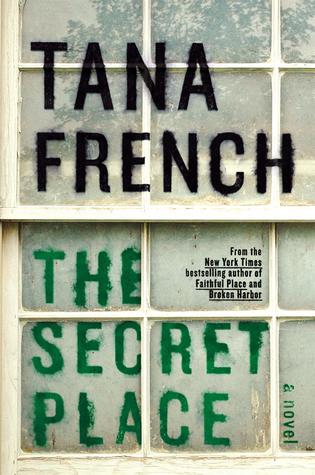
In her newest novel, The Secret Place, French makes a wink and a nod back to her third novel, Faithful Place [details from me on that novel, here], although I should say from the start that having read Faithful Place is not necessary at all here, it only adds an extra layer of interest.

But something I said in my review of Faithful Place holds true also in The Secret Place:
That's the thing about French, it is how her books make you feel that is way more important than what happens.  Her books are well plotted police procedurals, but the mysteries are not always solved, and if they are, the bad guy does not always get brought to justice.  You are not quite sure what to expect.  With the number of suspense books I read, this is a huge compliment.  It is no wonder that her books end up on every award and best books list each time she writes a new one.
The specifics of the plot here involve a girl’s boarding school and their bulletin board where secrets can be posted. The year before, a young man at the neighboring boys' school turned up dead on the grounds of the girls’ school. But now, a year later, on the “the secret place” there is a picture of the dead boy and a note saying “I KNOW WHO KILLED HIM.” Who posted it? Who killed the boy? Was it one of the girls?

So the story unfolds intricately from this moment.  We have the investigation in the present, told from the perspectives of 8 girls (2 groups of 4 besties, and each group hates the other) and the detective, plus a plot thread that goes from the beginning of the end for the dead boy to his final evening.  That last plot thread is especially creepy because as those scenes begin, we, the readers, get a countdown to exactly how many days and even hours he has left to live. It gives you the willies each time [in a very cool way].

This is a complex and dark story, not for the feint of heart, but also very compelling.  I only had a mini quibble with a small, possibly supernatural subplot that is never fully developed nor did it seem wholly necessary when it was all said and done.

A Note on the Audio: I have actually only ever listened to French’s books and have always enjoyed the narration.  Since they are set in Ireland, I greatly enjoy the brogue of the narrators, something I cannot provide to the story when reading it in print. It adds to the atmosphere and since these are brooding, dark, atmospheric novels, the audio enhances that.  Specifically here the novel is narrated by a man for the present story line and a female for the past.  The woman’s voice in particular is breathy and creepy to go with her ominous storytelling charge.

Three Words That Describe This Book: unsettling, richly drawn character, intensely suspenseful

Readalikes: I have made many suggestions for readalikes in the past here, but here is one more new one-- S.J. [Sharon] Bolton’s Lacey Flint novels. As Shauna Griffin says in NoveList, "These psychologically intricate, suspenseful crime series offer intelligent, richly drawn characters whose investigations become intensely personal.” I have had great luck moving readers of one series to the other.

Tuesday, January 23, 2018

Why I Love Romance: A Guest Post By Rachel Stevenson

Today I am kicking off a new occasional series to coincide with the beginning of the ARRT Romance Genre Study [first meeting is 2/1; details at this link]. The series I am kicking off is inspired by the work I do every October gathering “Why I love horror” posts from library workers and authors. I do these posts both the help and inspire all of you out there who are afraid of helping horror readers.

Romance, like horror suffers from a huge lack of respect, especially among library workers. Yes there are some in our ranks who love these genres, but in general, horror and romance get disparaged as not as “good” as other genres. I often argue in my programs that this is a direct result of the fact that both genres appeal to the readers’ emotions, thus making them more susceptible to being waved off as less serious. And with Romance, everything is magnified because it is a genre mostly read and written by women. This is a fact that is undeniable. 

No matter the reason, the truth is that many of you [library workers] don’t like Romance, don’t read it personally, and as a result, don’t really understand what the appeal of the genre is to its fans. The remedy for this is to educate ourselves and a genre study is a fun way to do this. It allows allows you to learn from others, gathering different perspectives as you go.

As we embark on this 2 year journey through romance, one you can all follow along via the notes, I am going to add to the conversation by providing another level of training, the voice of romance fans from all over sharing their personal passion for romance [pun intended]. I am tagging all of these posts “Why I love” in the hopes that some day other genres will also be represented under this label.

Today we begin with Rachel Stevenson. Rachel is a librarian in Erie County, Pennsylvania. She received her masters in library and information science from the University of Pittsburgh in 2009 and her masters of art in arts administration from Goucher College in 2014. Stevenson is an avid reader and love traditional Regency romances, historical fiction especially about the World Wars and the Long Weekend, Jane Austen, and historical mysteries. She acts as Lois Alter Mark’s bibliotherapist on her blog Midlife at the Oasis and has been featured in the Huffington Post. 

Right after the Romance NYT controversy, which is part of our first Romance Genre Study Assignment [and which I also blogged about it here], I was a guest at the PA Lib Association Annual conference.  Many of us were chatting about it and Rachel, was one of the most vocal about why the whole hub-bub made her mad. I asked Rachel to share her passion for romance with my readers. Below, is her response and the very first Why I Love Romance guest post.

If you are a romance fan, drop me a line and we can talk about you contributing to this series.

But for now, here is Rachel.

**********************************************

I have a group of fabulous friends and every time we talk the badinage flows. Badinage? You might say. Well it’s a word I recently learned while reading romance novels. It means witty conversation. Romance novels are how I grow my vocabulary even though most people think the romance industry is selling mendacious propaganda and they get all lachrymose and mumpish about it. Personally, I think they are all a bunch of quidnuncs and should go study lepidoptery instead. Most of the people who decry the romance industry would prefer we pay obeisance to “better genres” like literary fiction and Nobel Prize winners. Even Hillary Clinton has criticized the romance industry and I bet she hasn’t read a romance book either ever or in a really long time. 

Years ago I was ashamed I read romance, but not anymore. Now I read it freely, openly, with abandon, and I even talk about it with people I think would look down on romance novels. Why? Because romance isn’t bad. It doesn’t hurt us. And it can have some really positive aspects. Case in point….my vocabulary. 

The opening paragraph uses words that many people have never heard before and I learned them all from reading romance novels. Romance is like every other genre out there. Some are really bad. Some are really good. And some are in between. I’m sure we can all find Pulitzer and Nobel Prize winning novels that fall into the exact same categories. I’m actually convinced to win a Pulitzer all you have to do is write a 700 page novel that someone wants to read. So Diana Gabaldon and George R. R. Martin should be next. 

Romance books fall into so many categories and the category I read the most take place in the Regency time period when Jane Austen was alive and mad King George III (he’s the guy we fought against in the Revolutionary War) could no longer rule so his son took over as Prince Regent hence the title The Regency Period. This period ended when George III died and his son, George IV became king. Look at all that history I just learned and it came from reading romance novels. 

In Regency England the upperclasses were better educated knowing words and phrases from the Ancient Greek and Latin. Women needed to know how to speak French and Italian as well as their native English to be considered accomplished. So today when I read a Regency romance, the authors I choose research well and include history and correct terminology in their stories. 

For me this is great. I love words. As a librarian I like to learn new words and I like to share them. I like to use my two years of Latin to try to figure out some of the Latin words like quidnunc, which means a person who gossips. My Latin tells me that quid means what and nunc means now. So the Latin translation is “what now” and of course that is perfect to describe a gossip because they always want to tell you what happened now. Or quidnunc. Obviously they know their French as well since badinage comes from the French term “to jest”. 

Finding these words is like a hidden treasure in romance novels. Not only do I get a good story with a happy ending I also get to sleuth by looking up words I’ve never heard before and then go deeper by finding out from where they originated. If you have teenage children you should be pushing romance novels on them so they too can build their vocabulary. Mendacious and lachrymose are great SAT words. And here’s another newsflash not all romance have sex. Shocking I know. Not everything is a bodice ripper. In fact, traditional Regencies, what I read most, barely have any sex at all because women and men didn’t just sleep around whenever. There were very strict rules about men and women and what they could or could not do. If you were found alone with a man….you had to marry him. Even if it was by accident. Even if you’ve only just met. Even if you despised him. If they were that strict for just being in a room alone with a man you have no idea what premarital sex would get you. 

For those who are intrigued, but not enough to find a dictionary mendacious means a lie. Lachrymose means full of tears or weepy (hint: for those of us who are also adults but read children’s books there is a Lake Lachrymose in Lemony Snicket’s A Serious of Unfortunate Events). Mumpish is sullen and lepidoptery is the study of moths. Finally obeisance is deferential respect like something you would show Queen Elizabeth II if you ever happen to meet (in a romance novel you just might!). And these words are just a few. Each book is filled with more words than I can count that I have not heard before and am willing to learn and use to broaden my vocabulary. 

So what we need to do is not only broaden our vocabulary, but also our minds by reading romance novels. I just finished one by Mary Balogh that taught it was kindness that is the most important aspect of love. To be kind and to be treated kindly in return. Now that doesn’t seem like a bodice ripper or a bad story for our children to learn while growing up. In conclusion, don’t judge romance just because you think you know what it is and what the plot devices are. Stop being so Spanish Inquisition and become inquisitional. Pick up a romance novel. Try it out. Learn a new word and maybe learn something new about life, love, and yourself. 

Friday, December 28, 2012

What I'm Reading: Broken Harbor

I have 3 more books that I finished in 2012 that still need reviews.  Two of them, including this one, are 4 out of 5 stars in my opinion and just missed out on my top 12 of 12. So let's get the reviews going so I can finished up before 2013 begins.

Tana French's latest literary suspense, Broken Harbor continues with her winning style.  Here is what I have said in the past and it still holds true:
...police procedural meets psychological suspense.  This is a dark book, with an extremely flawed narrator.  Bad things are happening here and even when the crime is "solved," no one is satisfied; in fact, just about everyone involved with the case has been ruined as a result of the investigation.   And the kicker is, you know that it will not end well from the start, but you are so compelled by the complex plot, the interesting, 3-dimensional characters and their interactions that you cannot look away. 
The titles of all of French's novels refer to a place.  In this case the place used to be called Broken Harbor.  It was a vacation area where our lead detective and narrator, Scorcher Kennedy used to go on vacation as a child.  It also happens to be the place his mother committed suicide when he was a teenager. Today it is a half-built, mostly abandoned, "luxury" housing development known as Brianstown.

Speaking of Scorcher, he also represents a trademark of French's, she takes a character from a previous story and brings him or her back for his or her own tale.  Scorcher appeared in Faithful Place.

Scorcher and his rookie partner are called out to Brianstown where a family is dead. Well, the kids and husband are, the wife is hanging on by a thread at the hospital. What follows is the story of the investigation, but like all French novel's we have Scorchers story from the past, and, in this case, his relationship with his mentally ill sister as a parallel story.

Like all of French's novel's the story from the past plays into the present investigation.  And also like her other novels, the entire story is told in the past tense, by the investigator in first person, confessional narration.  We know the narrator is unreliable from the start, since he tells us that this is a story of how it all went wrong.  There are small asides all along the way where Scorcher says things like.. if I had pushed him just a little more right then things might not have gone all to hell.  We the reader are constantly reminded that the story is a giant train wreck waiting to happen, but we cannot turn away, rather French sucks us in and grabs us for the duration, only letting go near the end.

As a result, the pacing begins quickly as the facts of the case are laid out, then pulls back as we meet the key players, finally building in intensity for the full last third as we barrel down to the resolution, which is not satisfying for anyone involved.

Broken Harbor also directly addresses the global economic downturn.  Anyone living in any middle class neighborhood, anywhere in the West can understand French's setting and context.

Of the three books I have read by French, Broken Harbor  is the most traditional of the bunch.  The link between the past story and the present one is more tenuous and Scorcher's issues are more guilt based than actual wrong doing.  Although once you figure out both stories, I liked how the deaths in each mirrored one and other.  But in the end, it was not as creepy as In the Woods or as full of rich characters as Faithful Place.  Also, the "twist" was not that shocking.

However, Broken Harbor is better than most stuff out there and I can still give out this one like any of her books to anyone who like suspense who is looking for a good read.  One thing I love about her books is that while they are slightly linked, you can read them in any order. There is usually at least one on the shelf.

Personally, I have listened to 3 of French's 4 books on audio and have loved them in this format.  Since she always uses a first person, confessional style narration, the audio makes the story even creepier and more personal than it already is.  Scorcher is recounting the case the\at ruined his career directly to us, the readers, but when you are listening to him tell it to you, it is even more real and chilling.  I would highly suggest any French audio to someone looking for a good listen.

Three Words That Describe This Book:  suspense, unreliable narrator, intense

Readalikes: I have many, many readalike authors mentioned if you click here. There are literally a dozen with one click.  I will not waste your time repeating them.

I will be back on Monday with one more post reviewing my last 2 books of 2012-- one brand new and one a few years old.

Tuesday, May 14, 2013

What I'm Reading: His Majesty's Dragons

Today I have a review of a book that is part of my reading resolutions for 2013. Ironically, I have finished 3 books in the last 3 days, so I am seriously behind on the resolution to not have more than 3 books waiting for review at any time.  But here is the resolution to which His Majesty's Dragon by Naomi Novik fits:
"Genre Resolution:  Last year I resolved to read 2 "new to me" contemporary romance authors. Not only did I accomplish this small goal, but by making the resolution, I also did a lot to educate myself on the newest trends in romance throughout the year. This year I am picking a new area to focus on-- Epic Fantasy.  I am a big watcher of epic fantasy in TV and movies, but not a big reader.  I love lighter, shorter single titles or series in my books. The big epic series are very popular though and I am not as well versed in them beyond George R R Martin. I am also currently working on a Game of Thrones readalikes list for the library, so a little more research will be helpful. Thus, I resolve in 2013 to read 2 first books in epic fantasy series that are new to me."
His Majesty's Dragon is the first in Novik's Temeraire series [and the first of my resolution], one that I have long admired and even lectured about. I knew it had a historically accurate Napoleonic War setting only with an aerial assault courtesy of intelligent, talking dragons.  The historical details are extremely accurate (despite the dragons), placing it firmly in the historical fantasy subgenre and making it very appealing to historical fiction readers.  It is also military (specifically naval) based so it also has fast paced battle action and the camaraderie of soldiers.

That's what I knew BEFORE I read this novel, and I am happy to confirm that my perceptions were all correct after I actually read it.

As a first book in what is an on-going epic fantasy series, what we have in His Majesty's Dragon is a whole lot of world building.  Personally, this is why I love first books in fantasy series and tend to lose interest as the series continue. I love this setting the stage detail and character focus.

In this case the story begins with our narrator, William who is an experienced ship captain for the British Navy.  After overtaking a French ship at the novel's open, his crew finds that the conquered ship was carrying a dragon egg.  This is huge because in the British's fight against Napoleon, they are strong in naval defense, but weak in dragons.

What follows is the story of the birth of Temeraire and William's reluctance at leaving the Navy behind and entering the strange world of Aviators (those who control the dragons for the British army).

The joy in reading the story is William and his "fish out of water" status.  Most Aviators come to the profession as young children. William has to enter a new world with what is already a strange and unidentified dragon species. His social faux pas are amusing, but they are shed a lot of light on the customs and behaviors of the era.  William is the traditional 19th Century man and his new Aviator compatriots challenge him.

But no one affects William more than Temeraire.  He is an amazing creature this dragon.  He is intelligent and brave, true to William and good hearted. He questions everything and opens both William's and the readers' eyes to the truth in our flawed human world and interactions with each other.  I lived for the moments when the two, William and Temeraire, sat together and talked.

The world building and relationship building is what takes up most of this novel, the battles are few and far between, but that is to be expected in a first book in an epic fantasy series.  I have heard from readers that while the character-centered story found here does give way to more action and plot oriented battles as the series goes on, the character centered focus still lays at the heart of this long running and popular series.

The pacing is compelling, but not brisk.  There is much set-up that needs to be done since William (and readers) know nothing about dragons. There are pages and pages of dragon lore, harnessing rules, and discussions of caring for dragons.  But I was so invested in William and Temeraire that the pacing felt faster; I wanted to keep reading to know what would happen to them next. I wanted to read just one more section so I could learn more about dragons and the people who loved them, cared for them, and entered battle with them.

The ending of this book sees William and Temeraire take part in a huge battle and ends with them recuperating back at base, assessing their losses, and beginning to move on to their next adventure. Novik is asking you to go along on the next adventure in the final lines.

Overall, I loved being immersed in this world and I can see myself returning back to book 2 but not right away.  I think when I get bored of my same-old-same-old and need a shakeup, I will know exactly where to turn.

A note on the audio:  I listened to His Majesty's Dragon narrated by Simon Vance. I love Vance.  Click here to hear a snippet of the audiobookfor yourself.  His voice makes me listen harder.  I would listen to him read anything.  In fact, he also read the Millennium Trilogy by Stieg Larsson which I also listened to.  You can click here for those reviews. Vance made that series better for me too.  But specifically here with Novik's book, I was drawn to the voices of William and Temeraire.  In fact, Temeraire in particular came alive to me through Vance's portrayal of him.  And at only 10 hours for the full unabridged, you are looking at a fairly short time investment given the genre.

Three Words That Describe This Book: historical-military, dragons, fish out of water

Readalikes:  Novik's series reminded me most of some of the best historical, naval fiction writers, most of who ply their trade during this rich Napoleonic Wars time period when there were no airplanes and naval warfare was still king.  Specifically Bernard Cornwell (the Sharpe series in particular, but all his books are great), Patrick O'Brien, and C.S. Forester.

Another historical fantasy author who I think would appeal here is Susanna Clarke and her Jonathan Strange and Mr. Norrell.  There is plenty of the historical detail from a similar time period that Novik fans would enjoy, but there is not the large military component.

A few readers have mentioned that the Temeraire series is like The Hobbit with a lot more dragons.  I agree.  You have the fish out of water protagonist, great battle scenes and a clear sense of right and wrong.

I am going to include Novik's series in my list of readalikes for George R.R. Martin for people who want more dragons.  The dragons are not the main appeal here or in the Martin series, but there are many readers out there who will read anything with dragons. If you, or one of your patrons, fits this bill, click here to pull up a list on Goodreads of every book that got a "dragons" tag.

So as you can see, readailke options are kind of all over the place depending on which parts of the story you most enjoyed.  However, there will be people [myself included] who like the whole package.  Readers like this will want a series that has the actual history, mixed with the interesting characters, and an added slice of a fantasy creature to bring it all together.  For these readers, I think you get a whole package readalike with Scott Westerfeld's Leviathan series.  Now I should begin this suggestion by mentioning that the Leviathan series is technically YA, but I know plenty of adults who enjoy it too.  The setting is historically WWI, with the British against the Germans, but the British use these genetically engineered airships made out of living creatures.  Both series also have a steampunk feel without really being part of steampunk proper. I would highly suggest the Leviathan series for fans of Novik's Temeraire series.

Wednesday, August 3, 2011

What I'm Reading: A Fatal Grace

A Fatal Grace: A Chief Inspector Gamache NovelRecently I finished listening to second book in Louise Penny's Chief Inspector Armand Gamache series, A Fatal Grace.

I wrote the author statement on Penny for NoveList, subscribers can find the full one there, but here is some paraphrasing of what I said about Penny's overall appeal:

Chief Inspector Armand Gamache works in the of the Sûreté du Québec. He is a man of moral integrity, who is very intelligent, loves to eat, and has the loyalty of his colleagues. While Gamache is the main attraction here, readers also enjoy her cast of secondary characters, especially the residents of Three Pines, a town near the American border. These books have a timeless feel, and the tone is one of hope and resilience despite adversity. The mysteries themselves are intricate and quirky, while their pacing reflects the thoughtful pace of Gamache himself.
Every single one of the books in the series has been highly praised.  The series is also one of my go-to suggestions when I am having trouble finding a reader something "good."  It works for those who want a gentler story (read: murders without much blood) but it is also complex enough for readers who want a mystery with meat.  These are nuanced tales which not only explore the psychological affects of crime on those in a community, but also look at the moral ambiguity of all people. These books remind us that no one is all good or all bad.

Also, most readers find the setting, French Canada just exotic enough without being too foreign.  The setting 's details are fabulous too.  I feel like I have been to Three Pines myself.

In terms of the murder here, again someone in Three Pines has died; this time of what appears to be a deliberate and elaborately staged electrocution.  Gamache returns to his favorite little town to solve the case.  The murdered woman it turns out, was not well liked in town.  I was not shocked by who committed the murder, but the secrets Gamache uncovers about many of the characters kept me reading.

My favorite parts though are the descriptions of the town and the people.  I love how Penny talks about all of the layers of clothing needed in the coldest days of winter and how people know each other by their hats.  Her details about the way food smells, the winter landscape looks, and the people move about keep me reading.

If you want to start at the beginning, try Still Life, and if you are already a fan, get on the list for A Trick of the Light, coming out on 8/30/11.

Where This Book Took Me (Summer Reading Feature): Three Pines, Canada in the dead of winter.  Brrrrr.

Three Words That Describe This Book: character-centered, detailed, nuanced

More Appeal and Readalikes:  Here is some of what I said when I read Still Life last year:
This book is for fans of smart cozies: fairly bloodless mysteries which are character centered, with interesting settings, that still contemplate larger issues. The overall tone here is fun, but can move to serious and thoughtful at times. Gamache is a complex lead investigator who is always thinking, teaching, and observing.  
The point of view is interesting. It is 3rd person omniscient, which allows us to see what just about everyone is thinking at any and all times. Penny moves between people and their thoughts very fluidly.  People will either love this pov or hate it.
The setting is detailed with lots of information about the issues between the "French" and the "English" in Quebec. Three Pines feels like a place you want to go visit, sit in the cafe, walk in the woods, and chat with the characters.  This is a huge appeal that cannot be overlooked. Even cosmopolitan Montreal resident Gamache cannot seem to get enough of this charming small town, despite one resident's murderous impulses. 
Penny's series is also for people who like series because once you read Still Life, you will be compelled to keep going with the series. These are people and a town you will want to visit again and again.
Other mystery authors who share this overall appeal and are good matches for fans of Penny are Alan Bradley, Peter Robinson, Deborah Crombie, and Jacqueline Winspear. 
Nonfiction options would include books about Quebec and/or books on the separatist movement there. Also, people may want to know more about archery. I would also suggest Tracy Kidder's Hometown, a nonfiction account of a small town in MA.
To these suggestions, I would also add:

  • PD James (police procedural, character driven, explore the psychological affects of crime, strong settings, middle aged inspectors)
  • Charles Todd (character driven, psychological affects, strong setting, layered plots)
  • Julia Spencer-Fleming (strong setting, character driven, compelling)
  • Donna Leon (police procedural, character driven, moral issues, great secondary characters, strong setting)
  • Benjamin Black (a bit darker, but psychological aspects, strong setting, complex, nuanced)

Wednesday, September 1, 2010

What I'm Reading: The Girl Who Kicked the Hornet's Nest

The Girl Who Kicked the Hornet's Nest
There has been so much press surrounding Stieg Larsson and his Millenium Trilogy that it feels anti-climatic to write up this review of my reading experience. But I did finish The Girl Who Kicked the Hornet's Nest last month and it was a bittersweet experience.

If you recall, I read the first two books in the series last year. Reading them back-to-back was an interesting experience, and now, having finished the third, I wish I had read all three together. They really are 1 giant book in three volumes. The entire story plays out in a more cohesive manner when they are read together.

The stories of Mikael Blomkvist and Lisbeth Salander pick-up exactly where they left off in The Girl Who Played With Fire. Most of this novel deals with Lisbeth's trial and Mikael's attempt to bring down a secretive organization within the Swedish government. Stylistically, this third entry in the series has much more political intrigue and exposition into the various investigations and conspiracies that are all going on at once. As a result, there are many plot threads, lots of new characters, and a slowing of the frenetic pace in points, but during the last 200 pages, everything comes together, and it is hard to put down.


Why are these books so popular? I think it has a lot to do with Lisbeth. She is an original, intriguing, complex, and simply fascinating character. In fact, these books have lots of interesting, intelligent, complex and powerful women. Some have questioned whether the portrayal of women is refreshingly feminist or misogynistic. (click here for more on that discussion) I will stay out of the fray here since I see valid points on each side of the argument; however, I do know for sure that these books are highly entertaining.

Other reasons for the Larsson mania. These books are different from everything else being offered in the crime fiction genre, and I am not just talking about their setting. I think the popularity of these novels lies in their appeal.

Here is what I said about their appeal last time I read Larsson:
Appeal: These books are intricately and cunningly plotted, with extremely sympathetic series characters. The two main characters are very flawed individuals, but we, the reader, love them despite their quirks and issues. Readers will love following a subplot into the next book. This series must be read in order. Intriguing and detailed secondary characters are introduced and given a chance to tell the story from their point of view. Like all good suspense novels, we get the villain's point of view, so we know more than the protagonists. This adds to the suspense. We know how bad the danger is before they do. Both books resolve the main mystery but leave other secondary story lines and issues totally open. This is not a problem because there is another book; however, Larsson conceived this as a 10 book series and he died only completing 3. After The Girl Who Kicked the Hornet's Nest comes out next year, we may all be left up in the air. The thought already worries me.

Red Flags: Lots of violence against women, hero and heroine in grave peril, and graphic depictions of sex and rape. Violence and gore throughout.
I think this all applies to TGWKTHN also. And I am happy to report, things do all resolve at the end of the book.

Three Words That Describe This Book: detailed, complicated, great characters


Readalikes: I have had a lot to say about Larsson and possible readalikes on this blog in the past. Click here for dozens of options.

But since this series has been credited with bringing a lot of men and women back to reading (especially those under 50 who previously did not read more than a book a year), I want to make sure that I really think these readalike options through and provide balanced and well thought out options.

I stand by my previous suggestions of Tana French, Asa Larsson, Henning Mankell, Kate Atkinson, and Arnaldur Indridason. But after finishing the trilogy, I see a few more, less obvious readalike options.

With help from the new NoveList I found these suggestions very intriguing. Rock Paper Tiger by Lisa Brackmann, the international crime thrillers of John Burdett, Box 21 by Anders Roslund, and  Learning to Lose by David Trueba.

That should keep you Larsson fans reading for awhile, but don't forget, if you run out of ideas, your local public librarian can help.