Join me in support of WHY I LOVE HORROR (updated as events are added)

Why I Love Horror: The Book Tour-- Coming to a Library and a Computer and a Podcast Near You [Updated Jan 2026]

RA FOR ALL...THE ROAD SHOW!

I can come to your library, book club meeting, or conference to talk about how to help your readers find their next good read. Click here for more information including RA for All's EDI Statement and info about WHY I LOVE HORROR.
Showing posts sorted by relevance for query karen russell. Sort by date Show all posts

Friday, April 17, 2020

Flashback Friday Reads: Swamplandia!

My daughter and I were discussing a Tiger King read alike list she found. She pointed out Swamplandia! by Karen Russell on the list as looking pretty good.

Anyone who has read this blog for any amount of time know how much I love Karen Russell. [Click here for all the love; warning, it's a lot love.]

I book talked Swamplandia! to her and did a super fast Libby check and saw it was ready for immediate download as an ebook or an audio book at my library. She's busy with school reading now, but put it on her list for the future.

But, she also gave me the idea to re-post my original review of the novel today. I have also recommended or mentioned the work of Russell dozens of times here on the blog. So while below and here you can find my review of Swamplandia! from 2011, I want to also remind you that this link will bring you to my other reviews of Russell's story collections and the other times I have suggested her as a readalike for other books

Every one of her books I have read have subsequently ended up in that year's "Best Books I Read This Year" list too.

Finally, click here to run a Google search for Tiger King Readalikes

______________________________________

CLick here for original post

WEDNESDAY, MAY 25, 2011


What I'm Reading: Swamplandia!

I recently finished the heralded Swamplandia! by Karen Russell.  This is one that I felt lived up to the hype.  But a disclaimer here, Swamplandia! is exactly the type of book I adore:  dark, odd, completely character driven (almost without a plot really), quirky, and just plain fascinating.

This book is more of a character sketch of a family in transition, during said transition, than it is a typical story.  The plot follows the Bigtree family, owners of a shabby alligator wrestling tourist attraction called Swamplandia!, deep in the Ten Thousands Islands of the Florida Everglades.  When we meet the Bigtree's things have taken a grave turn for the worse.  The mother, the star of the show, has recently died of cancer and their grandpa has just been put into a nursing home.  Left is the father, Chief, and three siblings: oldest brother Kiwi, middle sister Osceola, and our main narrator, 13 year old Ava.  We also do get some alternating view points from Kiwi when he goes off to take a job at an amusement park on the mainland.

The story stretches over a few months period as the family completely falls apart.  Chief goes to the mainland in an effort to raise funds to save Swanplandia, Kiwi leaves, Osceola tires to elope with a ghost, and Ava goes on an adventure to try to save her sister, getting more than she bargained for along the way.  Each must come to terms with their grief and face reality; some just take longer than others.  As the novel ends, they have been reunited and there is a plan to finally move forward again as a family, albeit probably without Swamplandia!.

This "slice-of-life" quality of the story is one of the reasons someone would either love or hate this novel.  All we see is this transitional period.  As readers we do not see the glory days of the past or know what will become of the Bigtrees once they are reunited.  We are just along for the ride during the most trying period of their lives.  I enjoy this type of book.  It is more like a big character sketch; however, many readers will be frustrated by the lack of a clear plot.

This novel's sense of place is the next big appeal.  Russell nails the descriptions here.  I could feel, see, smell and hear the Everglades.  She meticulously describes the islands, the waterways, the vegetation, the animals, the humidity....everything.  I felt like I was there.  It is beautiful and secluded, but also sinister and creepy.  She relayed that dichotomy perfectly.  It almost made me want to visit.

The time period here is unclear too.  It seems like it is set in the recent past, but that feeling could be from their isolated home too.  No matter when it is supposed to be set, the story has a timeless feel which I enjoyed.

Other key appeals are the methodical pace, the magical feeling of the story without any actual supernatural elements, the two adolescent narrators, and the open ending.  This is a character centered story about loss, mourning, and independence.  It is ultimately about growing up and being forced to face the real world.

Before I finish, I should also say that there is one fairly disturbing scene involving Ava in the last third of the book.  It is not graphic, but it is upsetting.  It may taint the book for some readers.  I thought it made sense and pushed the novel from the magical realism realm firmly back into the cold hard truth.  I thought it made sense as a symbol of Ava's maturation from dreamy to serious.  Although I wish she could have been spared the hurt, I think the story needed it as a plot development for the reader to believe that she too was ready to move on.  Everyone else in the family had their reality check moments, hers was just the most disturbing.


Three Words That Describe This Book:  slice-of-life, sense of place, quirky

Readalikes:  I have been suggesting Swamplandia! to my readers who enjoyed The Monsters of Templeton by Lauren Groff.  Click here (and scroll down) to see my report on when I read this novel.  Also from that report, I would also suggest these readalikes for Swamplandia!:
But in terms of readalikes matched by the overall appeal of The Monsters of Templeton, I would suggest 3 novels: The Thirteenth Tale by Diane Setterfield which is a Gothic novel that also recounts a twisted family history (click here to see my take on this novel); Special Topics in Calamity Physics by Marisha Pessl in which a Yale Freshman (with a narrative voice eerily similar to Willie's) recounts her life history as if it were a class in Western Literature including her interesting family history and the death of a high school teacher (again, click here to see my take); andThe Stolen Child by Keith Donohue which is a magical tale of a 7 year-old who is kidnapped by a pack hobgoblins to be replaced by one of them. It is the story of the two boys' experiences and their concurrent struggle to find where they came from.
Two other novels that come to mind are Extremely Loud and Incredibly Close by Jonathan Safran Foer and Edwin Mullhouse: The Life and Death of an American Writer 1943-1954 by Jeffrey Cartwright by Steven Millhauser.  Both are quirky, slice-of-life novels about times of transition involving young people.  These two novels also happen to be 2 of my favorites of all time.  I don't think Swamplandia! is in that tier for me, but it was very good.

If you loved the setting and want to read more books set in Florida, no one describes the place better than Carl Hiaasen.

For nonfiction, try Washington Post writer Michael Grunwald's The Swamp: The Everglades, Florida, and the Politics of Paradise.  It is the perfect book for people who want to learn more about the region depicted here.  It received starred reviews when it came out in 2007 and Grunwald is an award-winning journalist.  We even own it at the BPL.

I was also reminded of Susan Orlean's The Orchid Thief: A True Story of Beauty and Obsession which also takes place in the Everglades and has a similar magical, timeless feel to it.

Look for more reviews of What I'm Reading the rest of this week leading into the holiday weekend.

Thursday, April 6, 2023

Using Awards Lists as a RA Tool: National Book Foundation's 5 Under 35 List

This is part of my ongoing series on using Awards Lists as a RA tool. Click here for all posts in the series in reverse chronological order. Click here for the first post which outlines the details how to use awards lists as a RA tool.

Click for more

Every year one of my favorite lists is the National Book Foundation's 5 Under 35 list. It's not that I think you have to be young to be a great writer, but I love how writers who have won National Book Awards and even some who have have this honor get to pick the new class each year. More about the honor and its mission here.

I also love this list for its RA Service implications and for what you can learn and use from the backlist. Below I explain why you should like and use this list all year long too.

[Click here to see the 2023 list of 5 Under 35 and which author chose that person.]  
 
First, this list is awesome. It is not just the young authors who are being highlighted, the established authors are also a great resource. You get 10 suggested authors from this 5 person list. 

Which leads to second, the established authors are your conversation starter and readalike stepping stone. So when you see: 

Morgan TaltyNight of the Living Rez
Tin House Books
Selected by Karen Russell, 2009 5 Under 35 Honoree
You can confidently suggest Talty to fans of  Karen Russell. This fits in with one of my "5 Resources You Cannot Live Without" from my 10 Rules of Basic RA page-- Author Recs of Other Authors. Click here for a longer post where I explain why authors recommending other authors is a near perfect readalike option. 

Third, the backlist is amazing. Seriously. Even more amazing than backlists usually are, and many of you know how excited I get about the backlist in general. You can access the winners and the authors who chose them going back to 2006 from the main 5 Under 35 page (scroll the bottom). I scanned many of the lists and WOW, did they identify some amazing authors who are household names now. Karen Russell above is one of those examples. Yes, there are a few who never broke through, but it is amazing how many have. You can easily use the backlist list of winners to help readers identify good under the radar reads, especially for your literary fiction and book club selection readers. You can also make a display of current and past winners.

I know some people will say, Becky these authors are emerging and at my library I can barely afford to get the established authors. But it would be a mistake to ignore these "emerging voices" for many reasons-- 3 of which I gave you here. 

Don't sleep on new voices. They will have wide appeal  on their own AND you can use establish  authors to  book talk them to your readers.

Thursday, May 17, 2012

Carnegie Medal for Excellence in Fiction and Nonfiction Finalists

Back in March I posted this big news:
...RUSA and Booklist announced that they will be using the RUSA Reading List winners for adult genre fiction and the Booklist 50 Editor's Choice titles as finalist lists for a brand new award for Adult Fiction.  Nancy Pearl has agreed to be the Chairperson of the inaugural award committee. The ALA and the Carniegie Corporation are sponsoring this award.
Well, today those finalists have been announced, and Karen Russell is on a tear this week. She should play the lottery.  Here is the official announcement:

Andrew Carnegie Medal for Excellence in Fiction 2012 Finalists:


Russell Banks. Lost Memory of Skin,
published by Ecco, an imprint of HarperCollins Publishers
An intelligent and fearlessly sympathetic portrait of a group of society’s outsiders—sex offenders—that illuminates the moral complexities at the heart of our justice system.

Anne Enright. The Forgotten Waltz,
published by W. W. Norton & Company
The vicissitudes of extramarital love and the obstructions to its smooth flow—including spouses, children, and the necessary secrecy surrounding an affair—are charted in sharp yet supple prose.

Karen Russell. Swamplandia!,
published by Alfred A. Knopf, a division of Random House, Inc.
This dazzlingly inventive first novel introduces 12-year-old gator-wrestling Ava Bigtree and her eccentric family, whose lives (and the Florida theme park they run) straddle the boundaries between the real and the surreal.

Andrew Carnegie Medal for Excellence in Nonfiction 2012 Finalists:


James Gleick. The Information: A History, A Theory, A Flood,
published by Pantheon Books, a division of Random House, Inc.
A comprehensive study describing the melodious interplay between science and literature documents the transmission of human knowledge from talking drums to the Internet.

Manning Marable. Malcolm X: A Life of Reinvention,
published by Viking Penguin, a member of Penguin Group (USA)
This definitive work on the life of the Malcolm X corrects previous misconceptions and offers new information about the charismatic leader’s life and death during the turbulent years of the civil rights era.

Robert Massie. Catherine the Great: Portrait of a Woman,
published by Random House, an imprint of the Random House Publishing Group
A compulsively readable biography of the fascinating woman who, through a combination of luck, personality, and a fine mind, rose from her birth as a minor German princess to become the Empress of all the Russias.

The winners will be announced at the ALA Annual Conference.

Wednesday, May 16, 2012

Karen Russell Wins the Young Lions Award

As I read here as well as other places:
The New York Public Library revealed that Karen Russell is the winner of the 2012 Young Lions Fiction Award for her debut novel,Swamplandia! The award includes a $10,000.
This award recognizes an American writer 35-years-old or younger for publishing a novel or a short story collection. Russell... has published a novel and a short story collection (St. Lucy’s Home for Girls Raised by Wolves).
Readers of this blog know how much I loved Swamplandia!  If you can't recall, here is a link to all the love.

Tuesday, April 19, 2016

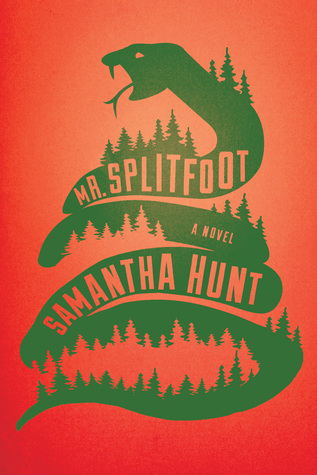
What I’m Reading: Mr Splitfoot

Becky’s Soundbite Review of Mr Splitfoot by Samantha Hunt:
Creepy and compelling, this contemporary Gothic has much to offer a wide range of readers. Ruth and Nat are orphans living in a severely religious and corrupt group home who begin conducting seances to contact the dead or missing parents of their fellow orphans. Many years later, Cora, Ruth’s single and pregnant adult niece awakens to find her Aunt Ruth, who she has not seen in many years, has returned, mute, to lead Cora on a journey across northern NY State on foot.  Where are they headed? Where has Ruth been all these years? The skillfully told dual narratives, move back and forth between the two time frames, compelling readers to join Ruth and Cora, following both the women and the clues from the past into the present.  Plot twists, lyrical language, and a heartbreakingly beautiful ending make this a satisfying read.
Further Appeal Notes: For such a lyrical novel, with sentences that beg to be re-read, and for one with such a focus on the characters-- particularly Ruth and Cora-- this is a surprisingly compelling novel. It could have been much more methodically paced since much of the action in Cora’s storyline involves her and Ruth simply walking, with only Cora talking because in the present storyline, Ruth cannot or will not talk. [Don’t worry, this “or” question is resolved.] But it is not slow at all. Much of this is a result of the well constructed dual storylines. Each separate storyline is intriguing, but it is the frequent switching back and forth that drives the action and keeps readers turning the pages. Readers are compelled forward to find out what in the past is driving the storyline in the present. And rest assured, there is no confusion here because the Ruth of the past and Cora in the present are such unique and strong narrators that you clearly know which storyline and time frame you are in at all times.

This is also a story about a journey, about the limited choices poor kids have, especially poor women. It is a novel about the place, far upstate NY, too.  There is a reverence for the natural beauty of the place, but it is balanced with a sadness about what it is like to live there too.

I cannot stress enough how beautifully this novel ends. It may not be a typical or standard example of a closed ending, but it is resolved beautifully and movingly. Readers who enjoyed the journey will be satisfied.

This is a surprising book in that it is not your typical story in any way; however, I do think it would appeal to a wide range of readers nonetheless. As I mention below, it reminded me greatly of Karen Russell and Wiley Cash, two authors who I would also describe this exact way.

Three Words That Describe This Book: atmospheric, parallel narratives, lyrical

Readalikes: The publisher says Mr Splitfoot is for fans of Aimee Bender and Kelly Link.  I agree with that, but I felt more of a connection to Karen Russell and in particular, Swamplandia! Both are atmospheric and follow young women on the outskirts of “normal society” who are on a journey. They are also equally as lyrical with a strong sense of place [just different places]. They are also offbeat with a slightly mystical or magical element.

Also, I don’t like the idea that a female author can only trigger female author read likes because the first author I thought of when reading Mr Splitfoot was Wiley Cash. Here is a sample of what I said in my review of his debut novel A Land More Kind Than Home:
This is a beautifully wrought story that at every turn gives you more than you expected.  The "plot" involves the killing of a mute child at a prayer "healing" by the creepy preacher mentioned above.  But we know from the first pages that the child will die.  Thus, this novel is not about the murder.  It is about rural communities and the intimate links between the people who live there.  And it is about the setting.  In the end this is a story where a drama unfolds, a conflict which has it roots back a generation from the current murder, and once we reach the last page, everything has changed and yet, at the same time, we are back to the way it always was.
Much of the commentary here about the appeal of this story also holds true for Hunt’s novel.

Finally, try Delicious Foods by James Hannaham. How the stories are told with a manipulated time frame, the overall ominous tone, and the theme of lives lived on the edges of “normal" society, are all shared here.

Please click on the links for both the authors and the specific titles in this readalike section to find many more readalike options.

Friday, September 11, 2015

What I’m Reading: The Booklist Reviews Edition

I am now doing reviews for Booklist. As they go up on the site and are published in the magazine, I will link to them here. But for the blog purposes I will repost the unedited versions with a little bit extra, including my 3 words and possibly a few more readalikes than the ones I managed to work into the review itself.

In terms of my new “soundbite” feature I have been adding into my posts on the books I have read, think of the official review [which you can access with the link at first for free and then with your library’s subscription login as they get older] as that soundbite.

Okay, now that the housekeeping portion of the post is out of the way, time to move into the reviews of three HUGE books which will have a very wide readership.

Here we go:


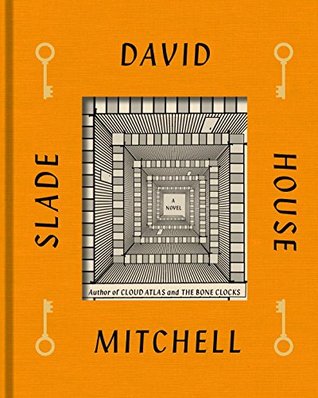
Slade House by David Mitchell [not out until October]. The review was first published in the 9/15/15 issue of Booklist.


In this slim and compelling novel, literary fiction stalwart Mitchell offers his most accessible book yet- a haunted house story in the vein of classics like The Turn of the Screw and The Haunting of Hill House. Written as five distinct chapters, each set on the last Saturday in October, spaced nine years apart, the novel follows the nefarious exploits of the Grayer Twins who inhabit the eponymous home, hidden in a narrow alley, behind a pub. Each chapter is told through the point of view of the poor soul who has been unknowingly summoned to the home as a sacrifice to the twins. Readers will appreciate how over the thirty-six year span, characters and story threads overlap to craft a unified, psychological tale. As in his more ambitious works,Mitchell gives reads the same genre blending, intricate plotting, and thought-provoking storylines, but here his scope is smaller, as he narrows his focus onto the intensely unsettling tone. Suggest to fans of Audrey Niffenegger, Karen Russell, and Steven Millhauser, and expect it to be read as a Halloween staple for years to come.

This book was awesome and can be given to many more readers than you normally would for a Mitchell novel. It has everything that is great about Mitchell in one short, fast paced book.

Three Words That Describe This Book: genre-blending, unsettling, episodic

Readalikes: There are plenty packed into my review.


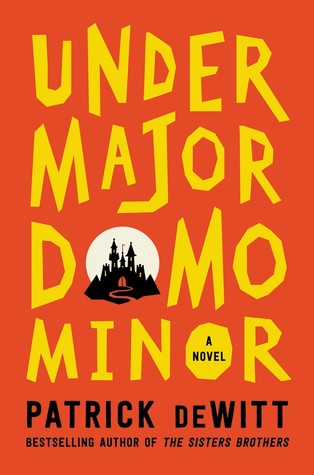
Following up on the huge success of The Sisters Brothers, deWitt has another askew masterpiece on his hands, this time turning his unique narrative voice onto the familiar tropes of the fairy tale. Lucien (Lucy) Minor leaves his home, by train, to accept the position of the assistant to the majordomo of Castle Von Aux— aka “undermajordomo.” A darkly humorous adventure ensues, as Lucy leave home as a boy and becomes a man. Throughout this journey, Lucy encounters many memorable characters, including, two thieves who become his best friends and surprising moral conscious, a tall, dark, and handsome solider, fighting an unseen war against an unnamed enemy, and the beautiful Klara who captures his heart but not without competition. The highly nuanced characters are king in this tale. More than a compilation of quirks, each new character adds depth to the story, opportunity for growth in Lucy, and just plain fun for readers. To keep the pace moving swiftly, deWitt breaks up the novel into several sections with tongue-in-cheek titles of their own such as, “The Location, Apprehension, and Restoration to Normality of the Baron.” Readers who love The Princess Bride or the movies of the Cohen Brothers will be thrilled with this novel. deWitt has delivered another intriguing, compelling, and thought provoking winner that will appeal to anyone who wants to be captivated by a smart, entertaining read.

Three Words That Describe This Book: askew, captivating, adventure

Readalikes: Like the Mitchell above, Karen Russell is a great readalike, but more her stories. Also, Elizabeth McCracken, Kevin Brockmeir and Keith Donohue. Click on their names to get more info from me on each of them.


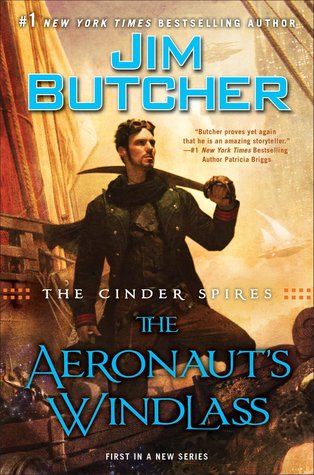
Butcher, the best-selling author of The Dresden Files, introduces a new epic fantasy, steampunk hybrid series that has shades of both Naomi Novik and Cherie Priest, set in a world where people live in highly developed societies housed in spires that protrude into the sky. Each spire has its own guard and fleets of airships to use for trade and defense; fleets made up of Master and Commander style ships that float through the mist shrouded skies, powered by magical crystals. A disgraced fleet captain and a group of young guardsmen and women loyal to Spire Albion are forced together after a surprise attack by Spire Aurora, but as they soon learn, this attack is much more than a simple war between Spires. With shifting points of view, short chapters, fast-paced action, and awesome battle scenes, the large cast of characters, world building, and intricate plot are revealed quickly and realized fully. It all reminds readers of when they first fell for Harry Dresden. The Cinder Files will be sure to attract fans new, old, and even lapsed to Butcher, increasing interest in all of his novels.

This is an exciting and fun read. I haven’t read a Dresden Files novel in years and was not expecting much, but this was great. I think the new setting and characters really energized him. This was an excellent book and will make a fascinating new series.

Three Words That Describe This Book: steampunk, fast-paced, large cast of characters

Readalikes: I listed 3 up there in the review. They all work for different reasons. For me, the Novik is the closest, but the Priest ticks all of the same steampunk and coming of age boxes. The links go to my reviews of their books previously posted her on the blog.

I think that Jack Campbell’s science fiction Lost Fleet Series is also a great readalike option here.

And although this novel is firmly in the “steampunk” subgenre, it also has space opera tendencies. So the Star Wars novels by Timothy Zahn will work too.

Monday, October 23, 2017

Horror Debuts Column in Library Journal

This is a cross post with RA for All: Horror

------------------------------------------------------------
31 Days of Horror: Day 23-- My Annual Library Journal Horror Debuts Column

Earlier this month, my semi-annual take over of Neal Wyatt's Reader's Shelf column in Library Journal went live. Every October they ask me to do horror debuts. Each year I offer up 6 excellent choices for all library collections; and because they are debuts, I am alerting you to authors when they are emerging.

When you read this year's column below, you will notice that the first two are not quite horror, the third straddles the line between dark fantasy and horror, four and five are 100% horror, and six is one of the best debut books I have read in any genreHere is the direct link to the column, and I have attached it below.

You can find more in depth reviews of Haven and In the Valley of the Sun, with readalike options using the links I have provided or in my Horror Review Index.

Finally, you can see all of my Library Journal columns archived on this page here on the blog, at any time.

First-Time Scares | The Reader’s Shelf

As we creep closer to Halloween, celebrate with some fresh and frightening tales. Stretching across a range of genres and styles and presenting different levels of terror, these debuts will satisfy a variety of readers looking for a scare.
A harrowing apocalyptic thriller presented through chillingly realistic sf, The End of the World Running Club(Sourcebooks Landmark. Sept. 2017. ISBN 9781492656029. pap. $15.99; ebk. ISBN 9781492656036) by Adrian J. Walker became an international best seller. Edgar Hill is never going to win father of the year; when asteroids begin falling, he is busy nursing a hangover. Still, he loves his family and after being separated from them in the chaos, he joins a group of survivors and does the only thing he can: he runs. He runs in an attempt to reunite with his loved ones; in the hopes of surviving; to flee from all his many mistakes; and to live to see an uncertain future. This tale of action and dread set in a devastated landscape showcases the endurance of the human spirit.
Emil Ferris uses the imagery of horror movies and magazines from the 1960s to set an unsettling tone in her historical mystery My Favorite Thing Is Monsters (Fantagraphics. Feb. 2017. ISBN 9781606999592. pap. $39.99). Ten-year-old Karen Reyes has a tough life—her mother is dying of breast cancer—in a diverse, working-class Chicago neighborhood. With a rich imagination, superior artistic skills, and a questing mind, Karen is on the case when her neighbor, a Holocaust survivor, is murdered. Under­pinning it all is Karen’s realization of her own blossoming homosexuality. Ferris weaves an astounding story through text and image in a moving and original graphic novel.
Emily B. Cataneo’s first collection, Speaking to Skull Kings and Other ­Stories (JournalStone. May 2017. ISBN 9781945373619. pap. $15.95), is brimming with ghosts, haunted books, alternate ­dimensions, and dark fantasy in an assemblage of lyrical pieces best classified as weird fiction. The complex female characters, creepy settings, and magic-filled story lines draw in readers much like the award-winning works of Karen Russell, Jeff VanderMeer, and Kelly Link. Cataneo provides all the chills and anxiety of horror in every turn of the page without the gore many fear they will encounter when first trying the genre.
Violent and haunting, Abode (Bloodshot. Jul. 2017. ISBN 9780998067971. pap. $14.99) by Morgan Sylvia is a good old-­fashioned novel of monsters wreaking havoc. It unfolds in a locale many horror fans know well: an old house in the middle of the woods. As one can expect, bad things start to happen when a new family moves in, but the story gets fresh power in the way the frights are revealed. The opening chapter sets the scene perfectly with an urgent email from someone mysterious, addressing “you” about the harrowing events that have already come, even if “you” cannot fully ­remember them. The unique frame and voice create an extra found footage layer of fear and suspense. Librarians will need to go a bit out of the way to order this indie title, but it is entirely worth it.
Tom Deady won this year’s Bram Stoker Award for Best First Novel for Haven (Greymore. Jan. 2017. ISBN 9780990632726. pap. $15.99; ebk. ISBN 9781587675973). It follows a man recently released from jail as he returns to the New England town where he was accused of a killing spree 17 years earlier. The strange murders suddenly ­begin again, but the evidence clearly points to something evil lurking in the forest caves and lakes around town. To learn the truth, a ragtag group of unlikely but sympathetic heroes band together. Shifting narration, breathless action sequences, and unearthed puzzles ratchet up the dread and tell a story reminiscent of the genre’s classics by Stephen King and Peter Straub.
Everyone has a secret, and no one is completely innocent in Andy Davidson’s In the ­Valley of the Sun (Skyhorse. Jun. 2017. ISBN 9781510721104. $24.99; ebk. ISBN 9781510721111). Desperately trying to escape his past, Travis Stillwell suffers an encounter with a pale-skinned girl who leaves him bloodied and weak, unable to tolerate the light of day, and tormented by an overpowering hunger. Widowed motel owner Annabelle Gaskin stumbles upon Travis and offers him a job in exchange for board, and the two lonely souls strike up an awkward friendship, along with her young son. But monsters, both real and imagined, can’t be hidden forever. This evocatively dark yet oddly beautiful debut will have wide audience appeal. The plot and characters play with the mind, and the pacing reflects the story’s harsh landscape—a slow, riveting burn.
The column was contributed by Becky Spratford, who runs the critically acclaimed library training blog RA for All, http://raforall.blogspot.com, and is the author of The Readers’ Advisory Guide to Horror. Follow her on twitter @RAforAll

Monday, December 12, 2011

Monday Discussion: Best Book of 2011 (1,000th Post!)

It's the second Monday in December, so we are on to Part 2 of the Best Books of 2011 discussion.  This also happens to be my 1,000th post!

But before we begin talking about your favorite 2011 release, I wanted to recap the numerous responses I got to last week's post on the best books you read in 2011 that do NOT have a 2011 copyright.

Here they are in no particular order.  You can also use this link to read the contributors' comments on why they chose that title:
 This is a great list.  Thanks to everyone who contributed.  And thanks for helping me to remind everyone that an older book can still be a great read!

Now on to the best book you read with a 2011 copyright.

I just went through my Shelfari to look at my highest rated books, and two books clearly stood out, one I will save for another person who I know is posting it today.  The other is Swamplandia! by Karen Russell.  My full review is here, but I have also included an excerpt below:
This novel's sense of place is the next big appeal.  Russell nails the descriptions here.  I could feel, see, smell and hear the Everglades.  She meticulously describes the islands, the waterways, the vegetation, the animals, the humidity....everything.  I felt like I was there.  It is beautiful and secluded, but also sinister and creepy. She relayed that dichotomy perfectly.  It almost made me want to visit.
Okay, now it is your turn.  What is the best 2011 released title you read this year?  I will recap next week when I will be asking what books you are most looking forward to in 2012.

You can follow past Monday Discussions here.

Wednesday, May 25, 2011

What I'm Reading: Swamplandia!

I recently finished the heralded Swamplandia! by Karen Russell.  This is one that I felt lived up to the hype.  But a disclaimer here, Swamplandia! is exactly the type of book I adore:  dark, odd, completely character driven (almost without a plot really), quirky, and just plain fascinating.

This book is more of a character sketch of a family in transition, during said transition, than it is a typical story.  The plot follows the Bigtree family, owners of a shabby alligator wrestling tourist attraction called Swamplandia!, deep in the Ten Thousands Islands of the Florida Everglades.  When we meet the Bigtree's things have taken a grave turn for the worse.  The mother, the star of the show, has recently died of cancer and their grandpa has just been put into a nursing home.  Left is the father, Chief, and three siblings: oldest brother Kiwi, middle sister Osceola, and our main narrator, 13 year old Ava.  We also do get some alternating view points from Kiwi when he goes off to take a job at an amusement park on the mainland.

The story stretches over a few months period as the family completely falls apart.  Chief goes to the mainland in an effort to raise funds to save Swanplandia, Kiwi leaves, Osceola tires to elope with a ghost, and Ava goes on an adventure to try to save her sister, getting more than she bargained for along the way.  Each must come to terms with their grief and face reality; some just take longer than others.  As the novel ends, they have been reunited and there is a plan to finally move forward again as a family, albeit probably without Swamplandia!.

This "slice-of-life" quality of the story is one of the reasons someone would either love or hate this novel.  All we see is this transitional period.  As readers we do not see the glory days of the past or know what will become of the Bigtrees once they are reunited.  We are just along for the ride during the most trying period of their lives.  I enjoy this type of book.  It is more like a big character sketch; however, many readers will be frustrated by the lack of a clear plot.

This novel's sense of place is the next big appeal.  Russell nails the descriptions here.  I could feel, see, smell and hear the Everglades.  She meticulously describes the islands, the waterways, the vegetation, the animals, the humidity....everything.  I felt like I was there.  It is beautiful and secluded, but also sinister and creepy.  She relayed that dichotomy perfectly.  It almost made me want to visit.

The time period here is unclear too.  It seems like it is set in the recent past, but that feeling could be from their isolated home too.  No matter when it is supposed to be set, the story has a timeless feel which I enjoyed.

Other key appeals are the methodical pace, the magical feeling of the story without any actual supernatural elements, the two adolescent narrators, and the open ending.  This is a character centered story about loss, mourning, and independence.  It is ultimately about growing up and being forced to face the real world.

Before I finish, I should also say that there is one fairly disturbing scene involving Ava in the last third of the book.  It is not graphic, but it is upsetting.  It may taint the book for some readers.  I thought it made sense and pushed the novel from the magical realism realm firmly back into the cold hard truth.  I thought it made sense as a symbol of Ava's maturation from dreamy to serious.  Although I wish she could have been spared the hurt, I think the story needed it as a plot development for the reader to believe that she too was ready to move on.  Everyone else in the family had their reality check moments, hers was just the most disturbing.


Three Words That Describe This Book:  slice-of-life, sense of place, quirky

Readalikes:  I have been suggesting Swamplandia! to my readers who enjoyed The Monsters of Templeton by Lauren Groff.  Click here (and scroll down) to see my report on when I read this novel.  Also from that report, I would also suggest these readalikes for Swamplandia!:
But in terms of readalikes matched by the overall appeal of The Monsters of Templeton, I would suggest 3 novels: The Thirteenth Tale by Diane Setterfield which is a Gothic novel that also recounts a twisted family history (click here to see my take on this novel); Special Topics in Calamity Physics by Marisha Pessl in which a Yale Freshman (with a narrative voice eerily similar to Willie's) recounts her life history as if it were a class in Western Literature including her interesting family history and the death of a high school teacher (again, click here to see my take); andThe Stolen Child by Keith Donohue which is a magical tale of a 7 year-old who is kidnapped by a pack hobgoblins to be replaced by one of them. It is the story of the two boys' experiences and their concurrent struggle to find where they came from.
Two other novels that come to mind are Extremely Loud and Incredibly Close by Jonathan Safran Foer and Edwin Mullhouse: The Life and Death of an American Writer 1943-1954 by Jeffrey Cartwright by Steven Millhauser.  Both are quirky, slice-of-life novels about times of transition involving young people.  These two novels also happen to be 2 of my favorites of all time.  I don't think Swamplandia! is in that tier for me, but it was very good.

If you loved the setting and want to read more books set in Florida, no one describes the place better than Carl Hiaasen.

For nonfiction, try Washington Post writer Michael Grunwald's The Swamp: The Everglades, Florida, and the Politics of Paradise.  It is the perfect book for people who want to learn more about the region depicted here.  It received starred reviews when it came out in 2007 and Grunwald is an award-winning journalist.  We even own it at the BPL.

I was also reminded of Susan Orlean's The Orchid Thief: A True Story of Beauty and Obsession which also takes place in the Everglades and has a similar magical, timeless feel to it.

Look for more reviews of What I'm Reading the rest of this week leading into the holiday weekend.

Monday, June 25, 2012

First Annual ALA Andrew Carnegie Medal for Excellence

The ALA Annual Conference has been going on all weekend in Anaheim, CA.  The biggest news in adult leisure reading if the conference is the awarding of the first ever Carnegie Medal for Excellence in Adult Fiction and Nonfiction. Here is the link to the press release from RUSA which I have also re-posted below:

For Immediate Release 
Mon, 06/25/2012 - 19:40
Contact: Macey Morales
RUSA, Conference Services (cs), Publishing (pub)
Anaheim, Calif. – The American Library Association (ALA) is proud to announce the first recipients of the Andrew Carnegie Medals for Excellence in Fiction and Nonfiction, funded through a grant from Carnegie Corporation of New York. Anne Enright’s "The Forgotten Waltz" received the medal for fiction and Robert K. Massie’s "Catherine the Great: Portrait of a Woman" received the nonfiction prize. The medals recognize the best fiction and nonfiction books for adult readers published the previous year in the United States. The selections were unveiled during the ALA Annual Conference in Anaheim, Calif. 
This is the first time that the ALA, which sponsors the prestigious Youth Media Awards, including the John Newbery and Randolph Caldecott Medals for children’s literature, is offering single-book awards for adult trade fiction and nonfiction. Andrew Carnegie Medals for Excellence in Fiction and Nonfiction winners and finalists were selected based on the expert judgment and insight of library professionals who work closely with adult readers.  This is a departure from most major book awards, which are judged by writers and critics.
In Enright’s "The Forgotten Waltz," published by W. W. Norton & Company, the vicissitudes of extramarital love and the obstructions to its smooth flow—including spouses, children, and the necessary secrecy surrounding an affair—are charted in sharp yet supple prose. In a year without a Pulitzer Prize in fiction, this award becomes even more meaningful for the literary community.
Massie’s "Catherine the Great: Portrait of a Woman," published by Random House, an imprint of the Random House Publishing Group, is a compulsively readable biography of the fascinating woman who, through a combination of luck, personality, and a fine mind, rose from her birth as a minor German princess to become the Empress of all the Russias. 
“Congratulations to Anne Enright, Robert K. Massie and our finalists,” said Nancy Pearl, high-profile librarian, NPR commentator and chair of the Andrew Carnegie Medals for Excellence in Fiction and Nonfiction selection committee. “We are so excited to have such a talented and deserving group of authors for our inaugural awards.”
The medals are made possible by a grant from Carnegie Corporation of New York and are co-sponsored by ALA’s Booklist magazine and the Reference and User Services Association (RUSA).
“In many ways, librarians are the first book critics many readers come into contact with, and hence we are deeply thankful for their insight and guidance,” said Vartan Gregorian, president of Carnegie Corporation of New York and a former president of the New York Public Library. “The Andrew Carnegie Medals for Excellence in Fiction and Nonfiction take that notion one step further and place the librarians’ seal of approval on these wonderful books.”
Enright and Massie each receive a medal and $5,000, and each finalist receives $1,500.
Nonfiction finalists include "The Information: A History, a Theory, a Flood," by James Gleick, published by Pantheon Books, a division of Random House, Inc., and "Malcolm X: A Life of Reinvention," by the late Manning Marable, published by Viking Penguin, a member of Penguin Group (USA).
Fiction finalists include "Lost Memory of Skin," by Russell Banks, published by Ecco, an imprint of HarperCollins Publishers and "Swamplandia!," by Karen Russell, published by Alfred A. Knopf, a division of Random House, Inc.
For annotations and more information on the winners, finalists and the awards please visit http://www.ala.org/carnegieadult.
Members of the 2012 Andrew Carnegie Medals for Excellence in Fiction and Nonfiction inaugural selection committee include: Chair, Nancy Pearl; Brad Hooper, editor, Adult Books, Booklist, Chicago; Danise Hoover, associate librarian, Public Services, Hunter College Library, New York; A. Issac Pulver, director, Saratoga Springs (N.Y.) Public Library; Nonny Schlotzhauer, librarian, Collection Development/Social Sciences, The Pennsylvania State University, University Park, Pa.;  Donna Seaman, senior editor, Adult Books, Booklist, Chicago; and Rebecca Vnuk, editor, Reference and Collection Management, Booklist, Chicago.
About Carnegie Corporation of New YorkCarnegie Corporation of New York was created by Andrew Carnegie in 1911 to promote the advancement and diffusion of knowledge and understanding. In keeping with this mandate, the Corporation's work focuses on the issues that Andrew Carnegie considered of paramount importance: international peace, the advancement of education and knowledge, and the strength of our democracy.
About BooklistBooklist is the book review magazine of the American Library Association, considered an essential collection development and readers' advisory tool by thousands of librarians for more than 100 years. Booklist Online includes a growing archive of 135,000+ reviews available to subscribers as well as a wealth of free content offering the latest news and views on books and media.
About Reference and User Services Association (RUSA)The Reference and User Services Association is responsible for stimulating and supporting excellence in the delivery of general library services and materials, and the provision of reference and information services, collection development, readers' advisory, and resource sharing for adults, in every type of library.
About the ALAEstablished in 1876, the American Library Association (ALA) is a non-profit 501(c)(3) organization created to provide leadership for the development, promotion, and improvement of library and information services and the profession of librarianship in order to enhance learning and ensure access to information for all.

Friday, May 10, 2013

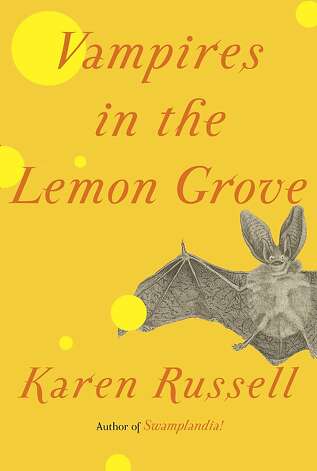
What I'm Reading: Vampires in the Lemon Grove

It is not a secret that I adored Karen Russell's only novel Swamplandia!, but when I heard her new book would be short stories, I was a bit sad.  I wanted to sink my teeth into one of her worlds for another whole novel. But that didn't stop me from placing a reserve on Vampires in the Lemon Grove (herein VitLG) so I could read it soon after it came out.  And, my goodness, I had nothing to worry about.

VitLG was awesome. Each story grabbed on to me, shook me around a bit, and let me go, a little unsteady on my feet, but excited to see what the next story had in store.

But I am getting a little ahead of myself.  VitLG is a book of 8 short stories.  They are all on the "things are not as they seem" side, but for different reasons.  They range from funny to scary to just plain odd, but each one is thought provoking. But before I go into more of the appeal detail, I found this great review by Jenny on Goodreads where she very quickly summarizes each story:
  • Vampires in the Lemon Grove - two ancient vampires try to satiate their desires by eating lemons
  • Reeling for the Empire - human silkworms
  • The Seagull Army Descends on Strong Beach, 1979 - maybe the seagulls are the only ones really paying attention
  • Proving Up - starts as a struggling farm family story, ends in a ... i can't even.... *shiver*
  • The Barn at the End of Our Term - dead presidents alive in horses' bodies (actual presidents, not the band)... this one made me laugh more than any of the others.
  • Dougbert Shackleton's Rules of Antarctic Tailgating - Sometimes you're the whale, but you're probably usually the krill.
  • The New Veterans - PTSD, massage, tattoos, and what is healing, exactly?
  • The Graveless Doll of Eric Mutis - I couldn't decide what I thought of this one. It did have the only bit I marked, because it is about a librarian: "I think we needed that librarian to follow us around the hallways for every minute of every school day, reading us her story of our lives, her fine script of who we were."
You can go to Jenny's blog for more of her reviews. I think she has parsed down each story into the soundbite of what it is about and why you would like it.  If you click through to her full review you can also see that she provided a readalike for each story.

 Most of the stories are on the creepier side, which I personally love, but the range is from pure out terror-- like in the AMAZING "Proving Up" which begins as a tale of the American frontier and slowly builds an uneasy atmosphere to an all our horror ending [loved it]-- to seemingly silly-- like in the story of Antarctic tailgating where our narrator risks life and limb to root for the krill to beat the killer whale.  I say seemingly silly because the story's glib tone and structure hide a larger issue of the fate of the underdog in real life.

But I think the story that best summed up the entire book for me was "Reeling for the Empire."  It had a darker tone and an original premise-- poor Japanese girls being taken from their homes to make silk in a factory but in reality they were being turned into silk worms.  So it also had speculative elements.  It was a thought provoking, coming of age story that made you really think about how much say you have on your place in the work.

A combination of some of these things can be found in most of the stories, but in "Reeling for the Empire," they are all in one place. I get the marketing decision to put the first story as the title since it is provocative and Vampires sell books, but "Reeling" is the anchor story here.


The best way to describe the overall feel of this book is-- slightly askew.  It is a reality that seems true but something is off.  And when you are confronted with this askew picture, it makes you think about how and why things are the way they are.  This is what the stories is VitLG do to the reader.
For me as a reader, this is the perfect kind of story.  I think "slightly askew" will replace "macabre" as my new sound bite description of my personal reader profile.

On a side note, I have been reading books of connected short stories recently (click here for details) so this was a change for me.  Since each story was a complete piece on its own, I was able to read this book in chunks, which fit my reading needs at that time.  I was able to read a bit and then take a break to prepare for the March book club, I was able to read a bit more and then leave it at home while I went on Spring Break where I read a novel, and I was able to pick it right back up and finish after returning. So that is another appeal of this book, the ability to read it piecemeal in the midst of a million distractions and still enjoy it.

Three Words That Describe This Book: stories, thought provoking, slightly askew

Readalikes:  As I was reading VitLG, especially during "Reeling for the Empire," I could not stop thinking about my all time favorite "slightly askew" short story writer, Steven Millhauser. Then this led me to thinking about other writers like Millhauser who I enjoy: Kevin Brockmeier and Keith Donohue. Back in 2011, I had this post talking about all three writers and their style:
Why I was particularly happy to see Donohue's review is that authors like Brockmeier, Donohue, and Millhauser, are very hard to suggest readalikes for. It is because they do not write traditional genre fiction. You could categorize them all as literary fiction, but that would not hit at their appeal. They all have a level of fantasy in their work. It is a bit more speculative than magical realism, but not really straight fantasy. They also all use their speculative elements to raise thought provoking questions about our world and the choices we make. If you laid out the plot summaries of they work side-by-side, however, you would not be able to see any similarity between their books. Their similarity lies in the tone, mood, characterizations, and style of their work. Things that are harder to assess.

Russell is very similar to these three writers.

A female short story writer whose tone and feel comes close to Russell's is the Japanese writer Yoko Ogawa.  She also crafts "slightly askew" short stories and novels.  Her most recent collection is Revenge, which I have been meaning to read.  A few years ago I did read The Housekeeper and the Professor, a story which has stayed with me to this day. Its unsettling premise of a man whose memory is on a 80 minute loop. That's right, his memory only lasts 80 minutes. Intriguing odd, and slightly askew, right?

I would also suggest the 4 novella length stories that make up Stephen King's Full Dark, No Stars. Click here for my review.

Have a great weekend and a nice Mother's Day