RA FOR ALL...THE ROAD SHOW!

I can come to your library, book club meeting, or conference to talk about how to help your readers find their next good read. Click here for more information including RA for All's EDI Statement and info about WHY I LOVE HORROR.
Showing posts sorted by relevance for query housekeeper and professor. Sort by date Show all posts

Friday, May 21, 2010

BPL Book Discussion: The Housekeeper and the Professor

The Housekeeper and the Professor: A NovelOn Monday the book group got together to discuss The Housekeeper and the Professor by Yoko Ogawa. This was a very different book for us. Firstly, we had never read a Japanese author in translation before, nor had we ever read a book set in modern Japan.  Our only experiences with the Japanese perspective were through Memoirs of a Geisha (written by a white man about WWII era Japan) and When the Emperor Was Divine (written by a Japanese American about Japanese internment)..

Here is the plot as I described it about six months ago when I first read it:
A housekeeper is assigned by the agency she works for to take care of the a former mathematics professor's home and make his meals. She is the 9th housekeeper assigned to the professor. This is because the professor has a brain injury. He can remember everything that happened before his accident (1970s), but since, his memory is on a 80 minute loop. That's right, his memory only lasts 80 minutes. Intriguing, huh?

The ensuing story is about her time working for the Professor and the bond they form. It is about her son's relationship with her and the Professor. It is about the loss of a genius; we still see sparks of the old Professor as he works on complicated math problems. And finally, it is a story about living, no matter the obstacles; about living a life with meaning even if you cannot remember what happened 81 minutes ago.
[On an interesting side note, The Housekeeper and the Professor is also the book that inspired Kathy (our fearless leader at BPL) to get our entire Browsers' Corner project started. Here is her recommendation for the book, which inspired me to read it back then, and our entire department to start writing blurbs of our own.]

As usual I began by asking for a show of hands voting for if they liked, disliked, or were so-so on the novel. I was surprised that all but two said liked and those two hold outs voted for so-so. Also, before I begin with the details, I think it is important to let you all know that the characters have no names here. We have the Housekeeper, her son (nicknamed Root) and the Professor. That they have no names is obviously a discussion thread in and of itself.

Now on to the discussion itself.  Here are some of the major issues and themes that were brought up over our thoughtful discussion:
  • Although I was fine with all of the math (and to put it nicely, I am not a numbers person), many of the participants thought there was too much math. The overall consensus was that they loved the story and the characters but that the math distracted them from that. They spent too much time trying to figure the problems out. Others just skimmed the math parts.I tried to counter that the math was there to give us a way to connect with the Housekeeper, but the group as a whole didn't need the math to connect with her.
  • Some did find the math integral to the book though. One participant said it was as if there was another language (besides the Japanese and then English translation) in the story...the math. Others who enjoyed the math thought that it served as a leveler in the relationship between the Professor and the Housekeeper. He may need her to teach and reteach the everyday things to him, but he can teach her math. He is impaired, but not stupid.
  • This lead us to discuss how similar the Professor's condition is to those suffering from Alzheimer's. Many of the participants (being mature women) have seen others go through this disease.
  • Of course, this lead to a lengthy discussion of the Professor's condition. We talked about the soothing power of numbers on him, his suit covered in notes, and what could be going on in his head. Talking about what life would be like with a memory on an 80 min. loop was an huge part of our entire discussion.
  • How can you have a relationship with anyone when your memory only lasts 80 mins? This book is about the bond that is created between the Housekeeper, Root, and the Professor. But how? This lead into how much the Housekeeper grew as a person as a result of her time working for the Professor, and how much stronger her relationship with Root became.
  • Again back to the no names. We talked about how this technique by Ogawa has the effect of putting the reader in the dark, much like the Professor always is. It also made it easier for our group to empathize with the characters. We liked how this made the characters relationships with each other more important than their personal identity and how it kept the setting fairly nonspecific (creating a more universal feel). Many participants said that if Japanese names were introduced, that could have been a barrier to their enjoyment. Without the foreign names, the group felt like these characters could be anywhere.
  • The Legacy of the Professor was another topic. Their time with the Professor was the first time Root and the Housekeeper had a family. All together they were a family. Being with the Professor also gave Root's life meaning and purpose as Root goes on to be a math teacher when he grows up. Even those of us who did not like the math in this book had to admit that the Professor's love of it was contagious.
  • We also discussed Ogawa's unique writing style. It would be hard not to as this book is really about the characters and the language over plot. We liked how she spent a lot of time on the little, everyday details of their lives. Images like the Professor's suit covered in reminder notes, his moldy shoes, or how the Housekeeper was preparing dinner were written about with such care and reverance.
  • We talked about how such a complex story was told in only 180 pages and then shared examples of how this was accomplished with sparing but powerful prose. One participant used the example of two scenes, one where Root cuts himself, and the other when the Professor knocks over Root's birthday cake and the Professor's inappropriate responses in each scene as powerful examples of just how diminished the Professor really was.
  • Finally I ended by asking people to tell me one thing they learned about math from reading this book. A few brave souls offered the following list
    • 2 is the only even prime number
    • the concept of a perfect number
    • the concept of amicable numbers
    • zero had to be discovered
As you can see, the great thing about using The Housekeeper and the Professor for a book discussion is that is really forces the group to talk about what the author is NOT explicitly saying, The book is under 200 pages and is thin on plot, but, as you see in the list above, it is full of issues and themes worth spending time to talk about together. And my group didn't even get into all of the baseball metaphors in the novel.

If you need a short title that packs a big discussion punch, try The Housekeeper and the Professor.


Readalikes: Here are the original readalikes I gave when I first read this book:
One reviewer said that this novel with its larger message and nameless characters felt a lot like Aesop's Fables.

The Housekeeper and the Professor is similar to the works of other Japanese writers. If you liked this novel, try Haruki Murakami or Kobo Abe.

I also found this novel to be very similar to Japanese American author Julie Otsuka's When the Emperor Was Divine about the Japanese-American internment camps. Both are short, but leave you thinking. Both are very domestically focused but look at a much larger and thought provoking picture.

Richard Powers' award winning, The Echo Maker also looks at a man unhinged by a mental defect caused by an accident. However, here we get the perspective of the person living with the brain injury.

The Housekeeper and the Professor also reminded me of the work of Jose Saramago. Try Blindness where everyone has gone blind, save for one "survivor."

For Nonfiction options, people may be interested in books about popular Japanese literature (Ogawa has won many awards in Japan), failed memory, and, of course, mathematics.
To this varied list I would also add the backlist gem, The Universal Baseball Association by Robert Coover.

Wednesday, December 2, 2009

What I'm Reading: The Housekeeper and the Professor

On Kathy's recommendation, I just read The Housekeeper and the Professor by Yoko Ogawa. This slim (under 200 pages), moving novel can be read in just a sitting or two, but the story will stay with you for days after that.

The story is deceptively simple with a compelling twist. First of all I should state that no one has a name in this book, which leads to so many questions without even mentioning the plot. So our three main characters are "the housekeeper" (who is also the narrator and from whose point of view we get the entire story), "the professor," and the housekeeper's 10 year-old son, who the professor nicknames "Root."

The housekeeper is assigned by the agency she works for to take care of the a former mathematics professor's home and make his meals. She is the 9th housekeeper assigned to the professor. This is because the professor has a brain injury. He can remember everything that happened before his accident (1970s), but since, his memory is on a 80 minute loop. That's right, his memory only lasts 80 minutes. Intriguing, huh?

The ensuing story is about her time working for the Professor and the bond they form. It is about her son's relationship with her and the Professor. It is about the loss of a genius; we still see sparks of the old Professor as he works on complicated math problems. And finally, it is a story about living, no matter the obstacles; about living a life with meaning even if you cannot remember what happened 81 minutes ago.

Appeal: There is math in this book, but it is just enough to catch our interest. If you think the book looks like a good match for your tastes but you do not like math, don't be scared off. The math is presented in an accessible and interesting way. Trust me, I don't like math myself and I enjoyed this book.

This novel obviously has a speculative element that is key to the story. You need to buy the whole memory lasting 80 minutes thing to like the book. This adds a touch of fantasy to what is otherwise a very "real" story. The memory issue is well explained early on though, and it is consistently applied throughout.

When you are reading it, The Housekeeper and the Professor seems leisurely paced, but it is so engrossing and original (and short) that I literally gulped it down.

At its heart, Ogawa's novel is a domestic story about every day things. It is also about the universal topics of friendship, love, and admiration.

But most of all, you have to like characters over plot to enjoy The Housekeeper and the Professor. It is the interaction between the three main characters and how they handle the Professor's illness that makes the book. Ultimately it is both heart-wrenching and touching, both surprising and reassuring.

Thinking about how your life changes when your memory (or the memory of one in your midst) only lasts 80 minutes is a huge appeal here. You will not stop thinking about what it would feel like to live that way.

Readalikes: One reviewer said that this novel with its larger message and nameless characters felt a lot like Aesop's Fables.

The Housekeeper and the Professor is similar to the works of other Japanese writers. If you liked this novel, try Haruki Murakami or Kobo Abe.

I also found this novel to be very similar to Japanese American author Julie Otsuka's When the Emperor Was Divine about the Japanese-American internment camps. Both are short, but leave you thinking. Both are very domestically focused but look at a much larger and thought provoking picture.

Richard Powers' award winning, The Echo Maker also looks at a man unhinged by a mental defect caused by an accident. However, here we get the perspective of the person living with the brain injury.

The Housekeeper and the Professor also reminded me of the work of Jose Saramago. Try Blindness where everyone has gone blind, save for one "survivor."

For Nonfiction options, people may be interested in books about popular Japanese literature (Ogawa has won many awards in Japan), failed memory, and, of course, mathematics.

Look for more on The Housekeeper and the Professor in the next few months as my book group will be reading and discussing it soon.

Thursday, July 17, 2014

Backlist Not to Miss: The Housekeeper and the Professor

Today I am taking a break from new reviews and posting the links to the 2x I read The Housekeeper and the Professor by Yoko Ogawa.

I have been giving this book out to many people this summer.  Why?  Well, one, it is part of our popular book discussion collection so I have multiple, paperback copies.  Two, it is a quick, compelling read suitable to a wide audience.  And, three, it has this killer soundbite I use to book talk it:
A housekeeper is assigned by the agency she works for to take care of the a former mathematics professor's home and make his meals. She is the 9th housekeeper assigned to the professor. This is because the professor has a brain injury. He can remember everything that happened before his accident (1970s), but since, his memory is on a 80 minute loop. That's right, his memory only lasts 80 minutes. Intriguing, huh?
The ensuing story is about her time working for the Professor and the bond they form. It is about her son's relationship with her and the Professor. It is about the loss of a genius; we still see sparks of the old Professor as he works on complicated math problems. And finally, it is a story about living, no matter the obstacles; about living a life with meaning even if you cannot remember what happened 81 minutes ago.
So click here to see my initial review and here to see the book discussion report. And please don’t forget to push older titles.  There are more good books in your stacks than there are on your new shelf.  And that’s not a dig at the new books, it’s simple mathematical truth!

Friday, March 14, 2014

Pi Day Reading List

Happy Pi Day.  It's 3.14 today.  And I have set this to post at 1:59.  So yes, this post is 3.14159.  You can thank my math loving 6th grade daughter for this bit of nerdy fun.

While math is not my thing, books are.  So my contribution to Pi Day is this list of great reads featuring math. Annotations are courtesy of NoveList and all links go to Goodreads unless otherwise noted.  Feel free to use this list at your library, just credit this link.  Also, this list is just a sampling.  There are many great reads featuring math out there.  Please add your favorites in the comments.  The more the merrier.

RA for All's Pi Day Reads

A housekeeper is assigned by the agency she works for to take care of the a former mathematics professor's home and make his meals. She is the 9th housekeeper assigned to the professor. This is because the professor has a brain injury. He can remember everything that happened before his accident (1970s), but since, his memory is on a 80 minute loop.
That's right, his memory only lasts 80 minutes. Intriguing, huh?The ensuing story is about her time working for the Professor and the bond they form. It is about her son's relationship with her and the Professor. It is about the loss of a genius; we still see sparks of the old Professor as he works on complicated math problems. And finally, it is a story about living, no matter the obstacles; about living a life with meaning even if you cannot remember what happened 81 minutes ago.
  • The SF novels of Neal Stephenson tend to include a mathematical frame.  Try Anathem. "Having lived in a monastery since childhood, away from the violent upheavals of the outside world, Raz becomes one of a group of formerly cloistered scholars who are appointed by a fear-driven higher power to avert an impending catastrophe."
  • If Stephenson is a little too Cyber Punk for you, why not try a classic SF math based title like Carl Sagan's Contact, "December, 1999, the dawn of the millennium. A team of international scientists is poised for the most fantastic adventure in human history. After years of scanning the galaxy for signs of somebody or something else, this team believes they've found a message from an intelligent source, and they travel deep into space to meet it. Who or what is out there?"
  • For a Women's Fiction and math double shot try, The Geometry of Sisters by Luanne Rice. "Desperate to rebuild her life, English teacher Maura Shaw comes to Newport Academy, an elite private high school, with her two children, but the ghosts of the past, including her estrangement from her sister, continue to haunt her."
  • How about a mystery featuring math?  I have two great options for you.
    • The Oxford Murders by Guillermo Martínez. "A sequence of mathematical symbols holds the key to a series of murders that Oxford mathematician Arthur Seldom and his assistant, a young Argentine mathematics student, must solve to find the killer before he can strike again."
    • No One You Know by Michelle Richmond. "Twenty years after the unsolved murder of her sister Lila, Ellie's chance meeting with the man accused of the crime leads to the discovery of Lila's secret notebook, filled with mathematical equations that lead to other enigmas in her sister's life."
  • How about a satire? Try Flatterland by Ian Stewart which was reviewed in Booklist as follows, "Scientific American’s math writer offers a sequel to Flatland, Edwin Abbott’s late-nineteenth-century fantasy about a two-dimensional universe disturbed by a visitor from the third dimension, the Sphere. Since Abbott’s era, mathematicians and physicists have latched onto fourth, nth, and fractional dimensions, which mandates an update. Stewart introduces Flatlander Vikki Line, who discovers a great-grandfather’s book that mentions the third dimension. Apoplectic about such apostasy, Vikki’s father destroys the book, but she has saved a copy in her computer. She summons the Space Hopper to guide her through the “Mathiverse,” the set of all possible spaces and times. As they alight in Topologica, Hyperbolica, Planiturthia, and elsewhere, the Space Hopper surveys the inhabitants’ horizons while Vikki, bright line though she is, sweats her way to understanding. She and the Space Hopper proceed to atomic physics, where a quantum cat talks about being dead and alive in Schrodinger’s box, and to relativity, ruled by the Hawk King. Yes, the puns are groaners, but Stewart’s Flatland-plus makes it fun to think in more than three dimensions. (Reviewed May 15, 2001) -- Gilbert Taylor"
  • Or try the original, Flatland by Edwin Abbot. "In a parody of Victorian society, A. Square meets a tragic fate when he dares to inform the inhabitants of his two-dimensional universe that there is a third and fourth dimension."

Wednesday, August 28, 2024

Backlist Not To Miss: The Memory Police

I am trying to make an effort to actively promote excellent backlist titles. I have been doing it more frequently verbally, as I talk to readers and give presentations, but here on the blog, I really haven't done it. So while I will not hold myself to a schedule, I am going to make more of an effort to post reviews of older titles.

The other nice thing about sharing backlist titles, it brings up more backlist titles as the readalikes. So I am sharing even more.

Today, let's start with The Memory Police by by Yōko Ogawa, translated by Stephen Snyder. I was reminded of this book because Ogawa had another English release this month (originally published in Japanese in 2006), Mina's Matchbox. I have not read that one yet, but as I remark below, not only did I love The Memory Police but The Housekeeper and the Professor is also an all time favorite. 


Three Words That Describe This Book: Orwell updated, character centered, thought provoking

This is a short book that packs a punch. I dare you to read it and NOT keep thinking about it for weeks and months.

It takes the old fashioned, Orwell type dystopian story of a police state that keeps taking away something-- in this case actual things in the world and also the memory of them.

What an amazing translation too. This is a short book, meaning there is an economy of words, but these words are very important. They have to convey the urgency of the situation and how it feels to lose memories. 

The entire frame of the dystopia is purposely difficult to wrap your head around. This makes it even more disorienting. But the fact that Ogawa could do this in Japanese and then it is translated well enough to convey the weirdness of it all. And the horror.

Yes this is a dystopian SF story, but it is also a visceral horror story that delves into all out body horror in multiple places.

This is a book about the way it makes you feel-- extremely uncomfortable and yet, you can't stop reading. As things get worse and worse, as more things disappear, the human connections become more important. Our main character hides someone who is unable to forget memories.

Speaking of our narrator, I loved how she is NOT one of the exceptional ones. In most of these dystopian stories, the one who we see the story through is someone who resists or who can see the truth. She cannot and that made it all more visceral, real and disorienting. We meet people who remember, but we are never allowed into their heads. 

Our narrator is also a novelist. So there is a second narrative which is the book she is writing. This book is even more scary and unsettling than what is happening "in real time," or is it? 

Reading this book was an emotional experience. There is so much to digest but it is all at a level that anyone can relate to. The writing is lyrical and words are chosen carefully, but it is not pretentious. It is thought provoking precisely because it takes something so mundane...the regular every day objects in our daily lives... and makes you think about what happens when you are forced to live without them.

It is a story that is both practical and symbolic at the same time. And it is absolutely terrifying watching it all unfold.

Readalikes: The idea that some people can still remember the supposedly lost things and some still have kept many of these lost things secretly hidden and that those fugitives need to be hidden or they will be rounded up and killed and the danger those who remember pose to the order of the society, reminded me so much of FAHRENHEIT 451 by Bradbury

For fans of Murakami and Atwood, yes, but those authors take so many more words to get across the same feelings. And unlike the old school, Orwellian dystopian classics, this one has a female perspective, so those older titles might not be a great readalike for everyone. 

Books like THE POWER by Alderman are so much more heavy handed than this novel. But the horror novel, THE RUST MAIDENS by Gwendolyn Kiste , a traditional horror novel, is not. The Kiste pairs better with this title. https://raforall.blogspot.com/2018/10/what-im-reading-rust-maidens.html

There is a lightness and beauty underneath the terror and unsettledness. It needs to be experienced.

I think I haven't read a book this intense, thought provoking, and yet still short since THE VEGETARIAN by Han.  

Also, I should note that the equally beautiful and disorienting THE HOUSEKEEPER AND THE PROFESSOR also by Ogawa is one of my all time favorites. And the 2 books make a great pair to read back to back.

Friday, September 6, 2019

New Set of Bite Sized Book Lists for NoveList by Me

One of the most common communications I get is from people looking for interesting book club titles. I have been working with NoveList to make more "grab and go" lists of inclusive and interesting books for book clubs over the last year to help satisfy the demand.

My first group of 5 lists with 6 books in each went live last year and you can see the categories and titles for those here. Now below you can access my second group of 5 lists of 6 books that recently went live on NoveList.

While all you get here on the blog are the titles and the annotation for the category, all of the title annotations are available through NoveList, When you look up a title go to the "Lists and Articles" tab and "Bite- Sized Book Lists" will be listed there. That link then brings you directly to the full list. [See the entry example photo for Unbury Carol to the left]

With both sets of lists that is 60 books total! You can use these to make displays, as sure bet suggestions based on the categories, or for book groups. And, there is no excuse not to book talk these titles-- again 60 of them-- because I wrote you a 30 second [or less] book talk for each. They are sure bet titles for adult readers. And most are also good for teens.

Even without Novelist access, you can at least book talk the category and then offer title suggestions. So get out there and start book talking.

************************************

Not Your Father’s Westerns: Westerns are making a comeback carried on the backs of a new crop of writers, led by women and own voices authors, who are turning their pens to the legacy of this rich, cinematic and uniquely American genre. The results are a spate of fresh, entertaining, and thought provoking tales that are perfect for book discussions because Westerns are tales not only of heroes and adventure, the vast and often unforgiving landscape, but also of outsiders and loners looking for their place in the American story.  
  • The Son by Philipp Meyer
  • Little Century by Anna Keesey
  • Unbury Carol by Josh Malerman
  • The Hunger by Alma Katsu
  • Wake of Vultures by Lila Bowen
  • River of Teeth  by Sarah Gailey
**********************************************************************
Graphic Novels for Book Discussions: This may shock your average book club participants, but some of the most thought provoking and discussable books being written also come with pictures. If you are dismissing graphic novels as childish or think they are not for YOUR book club, you are missing out on some great stories and thought provoking discussions. Here is a list of six graphic novels that will engage your group to discuss the themes, the art, the writing and how it all works together to create a memorable story. 
  • The Best We Could Do: An Illustrated Memoir by Thi Bui
  • Journalism by Joe Sacco
  • Here by Richard McGuire
  • My Favorite Thing Is Monsters, Volume 1 by Emil Ferris
  • Destroyer by Victor LaValle
  • Lumberjanes Vol 1: Beware the Kitten Holy written by Noelle Steveson and Grace Ellis, illustrated by Shannon Watters and Brooke Allen
**********************************************************************

Books in Translation: Over the last few years, there has been a dramatic increase in the number of books not originally written in English, being made available in translation. We can thank the success of novels like those by Haruki Murakami and series by Stieg Larsson and Elena Ferrante for making books in translation a viable commercial endeavour for American publishers. This list includes titles from all over the world and from a variety of genres, all of which make for an excellent book club experience in English. 
  • The Perfect Nanny by Leila Slimani
  • Fever Dream by Samanta Schweblin
  • Snow by Orhan Pamuk
  • Floors Up by Eshkol Nevo
  • The Three-Body Problem by Cixin Liu
  • The Housekeeper and the Professor by Yoko Ogawa
**********************************************************************
True Crime: No longer a genre only read in secret,True Crime is a genre that is loudly proclaiming its place in the mainstream. With the popularity of true crime based podcasts like “My Favorite Murder” and “Serial,” there is a huge appetite for books to fill the gap between episodes. The genre has also seen a renaissance in the writing style, as until very recently, the books were mostly written by those doing the investigations. Now, we see more writers entering the genre, leading to a narrative focus that goes beyond the specific “facts” of the cases and engenders further inquiry into larger, universal issues, creating a perfect space for book groups to enter the picture. Here is a list of 6 true crime titles, split up into three pairings that will further enhance discussion over multiple meetings. 
Popular True Crime-Memoir Mash Ups: These books feature true crime stories where the author also inserts themself and their life story into the narrative; as a result, they are an excellent choice for groups already comfortable discussing memoirs.
  • I’ll Be Gone in the Dark: One Woman’s Obsessive Search for the Golden State Killer by Michelle McNamara 
  • Black Klansman: Race, Hate and the Undercover Investigation of a Lifetime by Ron Stallworth
True Crime With Lots of Frame: These books are as much about the details of the time, place, and worlds in which they are centered as they are about the crimes in question; as a result, they make a great choice for group’s who already enjoy historical fiction and narrative nonfiction. Both of these titles are also excellent on audio.
  • The Feather Thief: Beauty, Obsession, and the Natural History Heist of the Century by Kirk Johnson
  • The Poisoner's Handbook: Murder and the Birth of Forensic Medicine in Jazz Age New York by Deborah Blum
True Crime Set Outside America: Most of the true crime being read in America and featured on the most popular podcasts is set right here. Why not try reading about a crime overseas? These books are a great choice for groups who like, or want to try, internationally set stories.
  • There Are No Dead Here: A Story of Murder and Denial in Columbia by Maria McFarland Sánchez-Moreno
  • A Death in the Lucky Holiday Hotel: Murder, Money, and an Epic Power Struggle in China by Pin He and Wenguang Huang.
**********************************************************************
Take a Trip Around the World: While I’d be willing to guess that your book club does not have the budget to travel the world in person, since you already meet regularly, you could plan some armchair travel, together. Below is a list containing one book from each of the 6 inhabited continents. All are set in the 21st century, allowing your group to explore the world as it is now, compare experiences across continents, and make true connections with characters and cultures from all across the globe.
  • Europe: Ordinary People by Diana Evans
  • Africa: Welcome to Lagos by Chibundu Onuzo 
  • Asia: The White Tiger by Aravind Adiga 
  • Australia: A Hundred Small Lessons by Ashley Hay
  • North America: There,There by Tommy Orange
  • South America: The Discreet Hero by Mario Vargas Llosa

Wednesday, June 29, 2011

BPL Book Discussion: Wait Till Next Year

WAIT TILL NEXT YEAR: A MEMOIRWell, due to part one of the installation of our new chiller at the BPL, book club met a week late.  This month we all read historian and numerous award-winning author Doris Kearns Goodwin's light memoir of her childhood growing up in the NY suburbs during the 1950s, Wait Till Next Year.

After appearing as one of the stars of Ken Burns' Baseball documentary talking about her childhood as a Brooklyn Dodger fan (yeah!) and her adulthood as a Red Sox fan (boo!) people were asking her for more.  She was very engaging on the small screen and I have to say her memoir is equally as engaging.

Before we get to the discussion I have a few comments to frame it all for you because the make up of the group did drive this discussion more than others we have had in the last 10.5 years.  This was one of those discussions where I didn't go to one of my prepared questions until we were almost an hour in.  Also, I should note that my ladies are all Goodwin's age, or at the most 10 years older, so they understood the world she was describing because they had lived it, just in Chicago (mostly) rather than NY.

I fell like as the only younger member of the group, I should let you know how I felt so that you don't think that you need to have lived during this era to enjoy this memoir.  I really enjoyed the book.  However, I love baseball and baseball history.  I still prefer to listen to ball games on the radio or go to a game than watch them on TV.  Also, I grew up in the NY area and am a huge Yankees fan.  My Dad grew up in Queens during this era too.  His Dad was a huge Dodger fan (my Dad has the 1955 Championship poster in his home still) and he was a huge Yankees fan in the late 60s. (He was under 10 when the Dodgers moved to LA).  So I was predisposed to liking this memoir based on setting and main subject.

So in terms of appeal, I think you need to have a love for baseball as our National Pastime, a connection to or interest in the 1950s, or a love of memoirs in order to enjoy this book.
  • We began with the liked, disliked, so-so question and all but 2 were an enthusiastic LIKEs!  The two who voted so-so enjoyed her writing and the time period nostalgia, but one has no interest in sports or rooting for teams and the other grew up in Minnesota at that time where they did not have a baseball team so she couldn't get into the rivalry between the Dodgers, Giants, and Yankees. 
  • The 10 who liked it had many reasons.  First they all agreed it was super easy to just imagine the rivalry between the Cubs and Sox of the same era.  In fact, many of them just changed the teams and players names in their heads.  They all talked fondly of scoring games, listening on the radio, going to the ball park, rooting for their team, following every game, and arguing with friends and neighbors who rooted for the other team.  
  • We also talked about the time period.  The participants spent most of the discussion reminiscing with Goodwin.  I brought up the fact that the best memoirs make you recall your own memories, which led one lady to bring out her own list of her memories which this book made her think about.  her list started a longer discussion about all of the great memories this book brought up.  I will not list them all here, but let me say that talk of the era and of life at that time, took up most of our discussion.  It was a fun and dynamic discussion.  It flowed on its own with one participant bringing up a memory and relating it to the book and then another and another.  I had to really do a lot of moderating on Monday, making sure everyone got to have their say.  It was great!
  • One participant felt the book was too light and positive.  She wanted more depth and nuance, knowing what a great and well respected historian Goodwin is.  Another participant who has read and enjoyed Goodwin's heavier books, presented a counterpoint here.  She felt the entire tone of the book was one of nostalgia and adding more negativity, no matter how appropriate, would have spoiled the cohesive tone of the book.
  • We did bring up the few troublesome issues from her childhood:
    • Sick Mother: One participant grew up at the same time with a sick mother.  She said this is how it was.  People did not talk about it or dwell on it, but neighbors just picked up the slack with the kids.  I mentioned how I wanted more depth here, but this participant said as a child, there would not have been more depth for Goodwin.  Yes, looking back she could analyze it, but the memoir is written so that Goodwin is describing how she felt as she experienced her childhood.  This participant felt Goodwin accurately portrayed how it was as it was happening.
    • Polio: Again, I thought Goodwin was sort of flippant about how serious the threat was.  As a mother, those discussions of polio attacking children in a seemingly random pattern with no one knowing how or why it was transmitted was terrifying.  But again, the ladies told me as a kid, you did feel like Goodwin.  You were bummed at not being able to go to the pool or being forced inside on a nice day.  For the parents it was a nightmare, but for the kids, it was a nuisance.  She captured it as they had felt it.
    • The McCarthy Hearings: Probably the most troubling thing Goodwin brings up is living through the McCarthy hearings.  She describes the games her friends all played recreating the hearings that their mothers watched on TV all day, every day for months. They had their own hearings which ended up heated and nasty, much like the ones on TV.  While none of the ladies said they played games like this, they did talk about how scary the hearings were, and how they were all people were talking about at the time.
  • We talked about how much easier it was to have ball players as heroes in the 1950s. First of all, Jackie Robinson was Goodwin's favorite player. A better role model would be hard to find.  We talked about how the people weren't better then, but that the media ignored the bad and focused on the good.  Today, the media looks hard for dirt on any famous person.  We thought that it was still okay for kids to look up to sports figures, but that as parents, we needed to help guide their choices in who they look up to.
  • Goodwin talks about her dual devotions to the Dodgers and the church.  Many of the participants had similar experiences. People talked about meeting kids with different religions, nuns who love baseball, saying lots and lots of prayers before bed, and many of the other things she brings up.
  • We also talked about how unique the 50s were in America.  Things got a bit better every year for all of their families, even those who grew up poorer.  This led to a discussion about the sustainability of that life style and how today's young people may be the first Americans to not do better than their parents in almost a century.
  • There a strong father-daughter relationship theme to this book.  Goodwin and her Dad were very close due to her mother's illness and their shared love of baseball.  This topic, although not discussed specifically, came up frequently and is a huge overriding arc in the memoir.
  • I ended as I always try to with  having people throw out words or phrases to describe the book:
    • memories
    • homespun
    • light
    • baseball
    • relaxing
    • nostalgia
    • comfortable
    • childhood
Readalikes:  There are many directions to take a reader who enjoyed this book.  Next month we are reading another memoir which is a great compliment to Wait Till Next Year, Bill Bryson's memoir of growing up in Iowa during the 1950s, The Life and Times of the Thunderbolt Kid.

For those who want a full account of the history of the era, I would suggest the wonderful The Fifties by the late historian David Halberstram.

Many might want to read more about the Brooklyn Dodgers and Jackie Robinson.  For those readers I would suggest the following books: Jackie Robinson by Arnold Rampersad, Branch Rickey by Jimmy Breslin, and Forever Blue by Michael D'Antonio. Also, don't forget the aforementioned Baseball by Ken Burns and the companion book.

For those who want more memoirs about fathers and daughters, try Swing Low by Miriam Toews.

For novels, I happen to love novels which feature baseball.  Here are some of my suggestions which capture the tone and feel of Goodwin's memoir:
  • Snow in August by Pete Hamil (NY, baseball, religion)
  • The Housekeeper and the Professor by Yoko Ogawa (previous book discussion book, Japan but baseball and scoring it are key, nostalgic and positive tone)
  • Shoeless Joe by W.P. Kinsella (the book on which Field of Dreams was based)
  • Underworld by Don DeLillo (a bit more literary, but begins with "The Shot Heard Round the World" in the Dodgers-Giants game, also this novel tells the history of the second half of the 20th century and readers who also like Goodwin's award winning history titles will really enjoy Underworld)
  • For more, I have this post on Baseball Reads.

Thursday, November 19, 2015

What I'm Reading: 2015 National Book Award Winner-- Fortune Smiles

As I was watching the live stream of the National Book Awards last night, I was hoping for one of the two books I had read to win, fully prepared to post a review of that book today.

And....Fortune Smiles, the new short story collection by Adam Johnson won! I think everyone thought it was a 2 horse race between Fates and Furies (the other book I read and will have a review of very soon) and A Little Life.  I am wondering if those two books ended up splitting the vote leading to Johnson's win.

But I would also not be surprised if that theory is completely wrong because I was completely enchanted and amazed by Fortune Smiles when I read it last month. This is one of the best story collection I have ever read because of its technical genius and the fact that each story, while emotionally difficult, was an "entertaining" read. Each captivated me into its world while I was reading it. None are connected at all either, in fact they are all very different, which makes it even more amazing how well each grabbed ahold of me on its own merit-- and so quickly.

I am getting ahead of myself though. Let's step back a tiny bit with some basic details. There are 6 stories here. Since the book is over 300 pages, that makes each hefty enough to read like a mini novella more than a short story.

You can click here for summaries of each story and some background information in Ron Charles' Washington Post review. I am going to write about three in more details for particular appeal reasons, as well as offer general appeal statements about the entire collection to help you to book talk it to the numerous interested patrons who will be coming in to ask for it today.

Let me go to the last, and title story first. "Fortune Smiles," is set in South Korea and follows 3 North Korean defectors. This story shares a lot in common with Johnson's Pulitzer Prize winning novel, The Orphan Master's Son (which I LOVED when I listened to it). I think it was a great idea to put this story last. As a reader who knew nothing about Johnson besides his N. Korean set novel, I loved that I had 5 stories to appreciate how amazing a writer he truly is before I was taken back to the familiar themes and settings of his novel. I don't know who was responsible for this restraint [was it Johnson, or his editor, or the publisher (probably not the publisher)?], but it would have been very easy to put the title story first. It was daring to save it for the end from a marketing standpoint.  Whoever made this choice, I thank them. I appreciated the other stories and his technical skills much more for this reason.

The overall appeal of Johnson as a writer goes way beyond the North Korea frame. All of these stories were surprisingly powerful and brutally honest. They were tragic but not depressing.  The people all have extraordinary experiences yet the way Johnson writes, the characters still feel relatable and ordinary. These are stories that "stick to" you more than they "stick with" you. You cannot escape the characters, the ideas, the events. You will turn them over in your head for days after finishing the stories. You will want a hologram of an assassinated President to help you sort through the ideas and feelings these stories bring up (see the story in this collection "Nirvana" to get the reference.)

Here are two more examples from my two favorite stories.

"Interesting Facts;" blew me away. Johnson writes a VERY personal story of a woman, married to a Pulitzer Prize winning novelist who wrote a book about North Korea, who is dying of breast cancer.  It is from her perspective as she slips away. It is full of love for her family but also anger, frustration, and confusion.  How brave of him to write a story from his own wife's perspective (she is a cancer survivor), yes, but this story was also honest and believable. I am a wife and mother and if I didn't know a man wrote this, I would have sworn it was a woman writer. I have told many people to read this story. Anyone who is in a loving relationship will find much of themselves in this tender yet brutally honest story. But, beware, if you are not self aware, this story and its honesty may bother you.

My absolute favorite story was "George Orwell Was A Friend of Mine." This story is narrated by an unapologetic, retired East German prison warden at a notoriously awful prison. He still lives nearby and walks his dog on the prison grounds every day. It is current day and the prison has become a memorial to its victims. The guard is estranged from his wife and daughter. He talks to visitors who come to the museum now, trying to explain why the prison was fine and did not do anything that didn't need to be done.  It is heart breaking how he lives in denial. We know he is wrong, yet Johnson subtly fills the character with so much humanity that we do not hate him. We should, but we do not.  If that wasn't enough the second half of the story takes off in a surprising and emotional direction. You will not be able to turn away. Johnson will challenge you to, but you won't be able to do it. Talk about a jumble of confused emotions.

Please read this collection whether you liked The Orphan Master's Son or not.  That book was definitely hard to follow for many (worth it for me, but not everyone I suggested it to). Fortune Smiles has everything that made his novel great, but in smaller packages.

I am so happy that many more will read it now that it has won The National Book Award.

Three Words That Describe This Book: thought provoking, engaging narration, brutally honest

Readalikes: You will need suggestion today for Fortune Smiles because someone has already come and checked it out this morning, and more people are coming through the door to ask for it.

The first place to go here is to suggest story collections that are BOTH thought provoking AND entertaining. All of these will be owned by most libraries:

Tenth of December by George Saunders
Vampires in the Lemon Grove by Karen Russell
Thunderstruck and Other Stories by Elizabeth McCracken
Interpreter of Maladies by Jhumpa Lahiri

But what about some novels? Here are some shorter novels (under 300 pages) that are also powerful, thought provoking, engaging, and brutally honest. Links are to my reviews where possible:

Prayers for the Stolen by Jennifer Clement
The Book of Unknown Americans by Cristina Henriquez
Anything by Marilynne Robinson [I read Housekeeping, pre blog]
The Housekeeper and the Professor by Yoko Ogawa
We Have Always Lived in the Castle by Shirley Jackson
On Chesil Beach by Ian McEwan

Let me know if you run out of titles and need more suggestions.

Friday, May 10, 2013

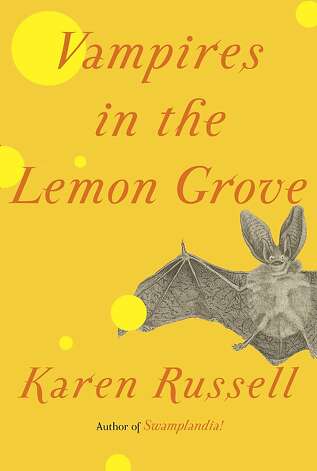
What I'm Reading: Vampires in the Lemon Grove

It is not a secret that I adored Karen Russell's only novel Swamplandia!, but when I heard her new book would be short stories, I was a bit sad.  I wanted to sink my teeth into one of her worlds for another whole novel. But that didn't stop me from placing a reserve on Vampires in the Lemon Grove (herein VitLG) so I could read it soon after it came out.  And, my goodness, I had nothing to worry about.

VitLG was awesome. Each story grabbed on to me, shook me around a bit, and let me go, a little unsteady on my feet, but excited to see what the next story had in store.

But I am getting a little ahead of myself.  VitLG is a book of 8 short stories.  They are all on the "things are not as they seem" side, but for different reasons.  They range from funny to scary to just plain odd, but each one is thought provoking. But before I go into more of the appeal detail, I found this great review by Jenny on Goodreads where she very quickly summarizes each story:
  • Vampires in the Lemon Grove - two ancient vampires try to satiate their desires by eating lemons
  • Reeling for the Empire - human silkworms
  • The Seagull Army Descends on Strong Beach, 1979 - maybe the seagulls are the only ones really paying attention
  • Proving Up - starts as a struggling farm family story, ends in a ... i can't even.... *shiver*
  • The Barn at the End of Our Term - dead presidents alive in horses' bodies (actual presidents, not the band)... this one made me laugh more than any of the others.
  • Dougbert Shackleton's Rules of Antarctic Tailgating - Sometimes you're the whale, but you're probably usually the krill.
  • The New Veterans - PTSD, massage, tattoos, and what is healing, exactly?
  • The Graveless Doll of Eric Mutis - I couldn't decide what I thought of this one. It did have the only bit I marked, because it is about a librarian: "I think we needed that librarian to follow us around the hallways for every minute of every school day, reading us her story of our lives, her fine script of who we were."
You can go to Jenny's blog for more of her reviews. I think she has parsed down each story into the soundbite of what it is about and why you would like it.  If you click through to her full review you can also see that she provided a readalike for each story.

 Most of the stories are on the creepier side, which I personally love, but the range is from pure out terror-- like in the AMAZING "Proving Up" which begins as a tale of the American frontier and slowly builds an uneasy atmosphere to an all our horror ending [loved it]-- to seemingly silly-- like in the story of Antarctic tailgating where our narrator risks life and limb to root for the krill to beat the killer whale.  I say seemingly silly because the story's glib tone and structure hide a larger issue of the fate of the underdog in real life.

But I think the story that best summed up the entire book for me was "Reeling for the Empire."  It had a darker tone and an original premise-- poor Japanese girls being taken from their homes to make silk in a factory but in reality they were being turned into silk worms.  So it also had speculative elements.  It was a thought provoking, coming of age story that made you really think about how much say you have on your place in the work.

A combination of some of these things can be found in most of the stories, but in "Reeling for the Empire," they are all in one place. I get the marketing decision to put the first story as the title since it is provocative and Vampires sell books, but "Reeling" is the anchor story here.


The best way to describe the overall feel of this book is-- slightly askew.  It is a reality that seems true but something is off.  And when you are confronted with this askew picture, it makes you think about how and why things are the way they are.  This is what the stories is VitLG do to the reader.
For me as a reader, this is the perfect kind of story.  I think "slightly askew" will replace "macabre" as my new sound bite description of my personal reader profile.

On a side note, I have been reading books of connected short stories recently (click here for details) so this was a change for me.  Since each story was a complete piece on its own, I was able to read this book in chunks, which fit my reading needs at that time.  I was able to read a bit and then take a break to prepare for the March book club, I was able to read a bit more and then leave it at home while I went on Spring Break where I read a novel, and I was able to pick it right back up and finish after returning. So that is another appeal of this book, the ability to read it piecemeal in the midst of a million distractions and still enjoy it.

Three Words That Describe This Book: stories, thought provoking, slightly askew

Readalikes:  As I was reading VitLG, especially during "Reeling for the Empire," I could not stop thinking about my all time favorite "slightly askew" short story writer, Steven Millhauser. Then this led me to thinking about other writers like Millhauser who I enjoy: Kevin Brockmeier and Keith Donohue. Back in 2011, I had this post talking about all three writers and their style:
Why I was particularly happy to see Donohue's review is that authors like Brockmeier, Donohue, and Millhauser, are very hard to suggest readalikes for. It is because they do not write traditional genre fiction. You could categorize them all as literary fiction, but that would not hit at their appeal. They all have a level of fantasy in their work. It is a bit more speculative than magical realism, but not really straight fantasy. They also all use their speculative elements to raise thought provoking questions about our world and the choices we make. If you laid out the plot summaries of they work side-by-side, however, you would not be able to see any similarity between their books. Their similarity lies in the tone, mood, characterizations, and style of their work. Things that are harder to assess.

Russell is very similar to these three writers.

A female short story writer whose tone and feel comes close to Russell's is the Japanese writer Yoko Ogawa.  She also crafts "slightly askew" short stories and novels.  Her most recent collection is Revenge, which I have been meaning to read.  A few years ago I did read The Housekeeper and the Professor, a story which has stayed with me to this day. Its unsettling premise of a man whose memory is on a 80 minute loop. That's right, his memory only lasts 80 minutes. Intriguing odd, and slightly askew, right?

I would also suggest the 4 novella length stories that make up Stephen King's Full Dark, No Stars. Click here for my review.

Have a great weekend and a nice Mother's Day