Join me in support of WHY I LOVE HORROR (updated as events are added)

Why I Love Horror: The Book Tour-- Coming to a Library and a Computer and a Podcast Near You [Updated Jan 2026]

RA FOR ALL...THE ROAD SHOW!

I can come to your library, book club meeting, or conference to talk about how to help your readers find their next good read. Click here for more information including RA for All's EDI Statement and info about WHY I LOVE HORROR.
Showing posts sorted by relevance for query jeff vandermeer. Sort by date Show all posts

Tuesday, February 27, 2018

What I’m Reading Flashback Edition: Annihilation

At first, I had just planned to rerun this review because the movie is out, but then I realized how many times I have suggested VanderMeer as a readalike recently [click here to see for yourself]. That got me thinking that I need to say a bit more before reposting this review.

I have been a huge supporter of Jeff Vandermeer and his work as both an author and editor [and even champion] of Weird Fiction. You can click here or read below for details, but the rest of America is catching up with me in my Weird Fiction love as this subbgenre which confidently straddles the line between horror and fantasy is having its moment in the sun.

Here are just a few of my favorite authors who you should have in your library collections who write Weird Fiction [with links to the times I have mentioned them on the blog]: Karen Russell, Carmen Maria Machado, Damien Angelica Walters, and Jeremy R. Johnson. Each link willed you to more authors too.

I mention Bird Box below by Malerman, but in the three yearsisince I read Annihilation I have to say his newer Black Mad Wheel is THE PERFECT readalike here [just with men, not women, on a doomed excursion to a strange place].

Back to this book-- Annihilation. I read this book in one sitting, on a plane to Hawaii. I talk about it below, but what I want to add [almost exactly 3 years after I read it in March 2015] is that not only do I still remember this book, but I still viscerally remember how it felt to read this book on that plane. To remember how a book made you feel, like actual feel the feelings still when you think about it three years later....that is pretty cool.

Below is my review with plenty of links. Consider seeing the movie, but also read more VanderMeer or at least, read more Weird Fiction [link to Goodreads books tagged Weird Fiction], if only to see what all the fuss is about.

____________________________________

MONDAY, JULY 13, 2015


What I'm Reading: Annihilation
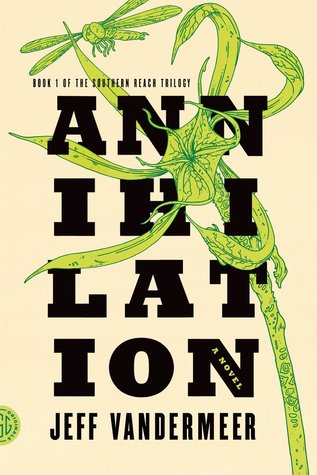

This weekend, Annihilation by Jeff Vandermeer won my favorite book award, The Shirley Jackson Award. It has also won the prestigious Nebula and was a huge hit on this year’s Tournament of Books [among many other deserved accolades].


Here is the Becky soundbite review for this genre defying book: “Four female scientists set out on the 12th expedition to explore the undefined and possibly expanding Area X, in the swampy southern reaches of the US. The previous 11 expeditions have failed, leaving no survivors. Our unreliable narrator, the biologist, leads us through this compellingmenacing and unsettling story that ranges in tone from adventurous, to weird, finally moving into the grotesque. But, I dare you to stop thinking about this book after you close its final page.”

Again, I write these 30 seconds or less soundbites to hit at enough of the major appeal for you to use at work. You can use this as you are hand-selling books to patrons. It gives the patron a feel of the story with carefully selected strong words that will let the patron [and therefore you the librarian helping them to find their next good read] know right away if this is a book they want to look at more closely. If you use them in print, please cite this post.

Here those strong words- the key appeal terms-- have been bolded for you above.

I am really trying to make my reviews more useful as you help readers in the library.  I have included the link to the Goodreads entry- complete with summary info- in the first line. You don’t need me to recap. You need me to help you to market the book to its best reader. And traditional reviews talk more about the quality of the book. I am trying to help you understand the type of reader it is best for.

Now let me talk about this novel as a reading experience. Why? Because reading Annihilation was unlike any reading experience I have has in a long while-- in a good way.  This book consumed me much like the expeditions consumed their participants. I inhaled this book in one sitting on an airplane ride from Chicago to Honolulu back in March.  It was the perfect length, it’s only in paperback, and the writing style and pacing lends itself to being read in 1 big chunk (or at the very least 2 slightly smaller) ones.

The set up is intriguing and compelling. You want to read to see what happens to this specific expedition.  Will they make it? What will they find? What has heaped to the others? You are holding your breath from the start.  But then there is a surprise beyond the plot, and it is the writing itself. The language gets more beautiful and intricate the weirder and more grotesque the story gets. That was also a very cool experience. It adds to the squirm factor here. [Although to be fair, I did give this book to a patron who I thought would love it, but not being a reader for language, she felt it had “too many words.”]

In the process this novel that started as an adventure, morphed into something more [italics intentional, but you have to read the novel to see why]. It becomes a story about the biologist and her inner psyche. It also becomes a story about the power of nature and what it means to be a scientist.  And it becomes a cautionary tale about life itself.

This novel is the perfect example of how great storytelling trumps “genre” labels.  Is this science fiction? Horror? Dystopian? Psychological Suspense? Scientific Thriller? Literary Fiction?

Who cares? It’s a great, unclassifiable story.  It has a bit of all of those in it. It is also the epitome of what the very best fiction is today. I wrote about that in more detail last moth here.

One final point about Annihilation is that it is Book 1 in The Southern Reach trilogy. These books were all released last year, in a row,  all in paperback, but it is a series that does not require you to read all 3.  The other 2 books are based in the world of Area X but from different angles.  Many will be happy with just this first one. Others will want all three. The choice is nice to have. If you do read more than 1, please read them in Vandermeer’s preferred order, however.

Three Words That Describe This Book: unreliable narrator, menacing, thought provoking

Readalikes: Interestingly, I thought of 2 authors as readalikes immediately and was only slightly surprised to see that they were both also finalists with Annihilation for this year’s Shirley Jackson Award.:
  • Bird Box by Josh Malerman which I love, love, love. The two novels are strikingly similar in their feel and overall appeal. Click on the title for details.
  • Lauren Beukes who was nominated for Broken Monsters and for whose The Shining Girls I still have to write a review. [Preview of my thoughts: it was the best, most original serial killer book I have ever read.]
Which leads me to an excellent point, one of my favorite RA suggestion tools is to find an award list that works for a specific reader.  Here is my popular post on how to use awards list as a RA tool.

I am currently doing this with a former patron (still working for her via text even though I left the library) using the Mary Higgins Clark award list.  And here is a post about my general love for The Shirley Jackson Award.

If you like how this is an unclassifiable novel with many genre fiction tendencies, a thought provoking plot, but no specific genre to call home you should definitely read Zone One by Colson Whitehead.

The Caretaker of Lorne Field by Dave Zeltserman is a backlist “weird” title that can also be inhaled in 1 sitting.  Here is my review of that title with more readalikes. Thinking back on it, the Zelserman novel shares a lot of similarities with Annihilation in storytelling style, and tone, but mostly in how such an odd story completely traps you into its world.

Finally, in their Weird Fiction Review, the Vandermeers are constantly suggesting “weird” authors.  I would suggest going there to get some more ideas of unique, dark storytellers. Here is a post from back in 2011 when I talked about this site; it includes an interview about what “Weird Fiction” is with Neil Gaiman.

Wednesday, September 4, 2019

Genre Blending in Speculative Fiction

This week the ARRT Steering Committee is finalizing our final draft of the 5th Edition of the Popular Fiction List, a product we sell to NoveList. This has been two years in the making.

I will have more to say about how you can best use this resource for staff training and self-evaluation and about the changes we have made overall when we get closer to its release [November 14th], but today I wanted to chat a little bit about the section for which I was the "team captain"-- Speculative Fiction.

[Insert sarcastic shouts of "Shocking!" here. What did you expect. Seriously, I am nothing if not always on brand people.]

As the captain of the Speculative section, I was tasked with leading our team through the landscape of Science Fiction, Fantasy, and Horror, making sure that we not only gathered a diverse and inclusive list of authors, but placed them in the subgenre they most fit into.

Sounds easy on paper, but if you know anything about the speculative genres, you know this was a difficult task because they all have a tendency to blend within books and authors often write in more than one. In fact, just revising the cumbersome genre-subgenre classification within Science Fiction and Fantasy was difficult enough, but then, the bigger issue. We were left with a large number of authors who clearly write "Speculative" but who could not be fit accurately into any one genre, they belonged to all three, with every single one their books they belonged to all three.

Now, this will make more sense when you see the final product, but stay with me here as I use a mainstream example, an author who HAD to be included somewhere, Jeff Vandermeer.

What genre does VanderMeer write in? There are arguments to put him in Science Fiction or Fantasy or Horror. Also, one of the things we consider with all of the speculative authors, because many actually write in both SF and Fantasy regularly, is how readers categorize them. In other words, in which genre would most readers place the author overall.

Well, with VanderMeer the answer is all three. How do I know that? One of the best ways to see how readers categorize an author is to see which "shelves" readers put a book on in Goodreads.

To the left is a screen shot for one of his most popular books, Annihilation.

As you can see, I circled the most popular shelves that people put this book on and Science Fiction, Fantasy, and Horror are all in the top 5.

I always label VanderMeer as one of the benchmark authors in "Weird Fiction" myself, but the Speculative section didn't have "Weird Fiction" before. And more importantly, as the person who could change that by adding it, where would I put it? Under which main genre, Science Fiction, Fantasy, or Horror?

All of this is the long intro to announce that I took my job as captain of Speculative Fiction as a chance to blow up the entire structure as you can see in the new scope note for the revised section [bold added by me for the blog today]:
Speculative Fiction: Speculative fiction explores the wide world of “what if.” The appeal for readers is in the otherworldly quality of the stories. They like to follow the characters into a setting where the impossible is possible. The intricate world-building in these novels often means the elaborate settings are used in long-running series. In speculative fiction the “what-if” could arise by magic, science that is not yet possible, a supernatural monster, or anything else the author can dream up. The speculative genres and the authors who write them also have a tendency to overlap and blend with each other; however, most readers of these genres both understand and expect this. Fans crave stories which ask them to look at their current world from a different perspective. The speculative fiction genres include: Science Fiction, Fantasy, Horror and Further Explorations of the Unreal.
Yup, I added an entire new "genre" that isn't a genre...."Further Explorations of the Unreal." I mean, you figured they knew what they were doing by putting me charge of anything, right? Chances were I was going to do something crazy.

Seriously though, when we really broke down the issue as a group, it went beyond shoe horning "weird fiction" in somewhere. There were still other categories and authors that needed consideration. And, we were also finding that almost all of the authors we were struggling to fit into the old categories were the, popular, one voices authors we were trying to make sure we included. 

So today, I present a preview of some of our work, as I give you the scope note for this new category under Speculative and the three new "subgenres" with their scope notes, all created, from scratch, by my group for ARRT.

All of these categories have authors assigned to them, but you need to have access to NoveList later this year or become an ARRT member in order to see those. I have given 1 example author for each category to help you orient yourself though.

Even without all of the authors, I know many of you can use this to help readers right now.

FURTHER EXPLORATIONS OF THE UNREAL: The genres encompassed by the Speculative Fiction umbrella have always overlapped, but one of the three main genres has taken a leading role. Over time, genre blending has resulted in the emergence of distinct subgenres which are hybrids of the larger speculative genres. Readers of these blended speculative subgenres enjoy stories where the unreal can come from a mixture of magic, horrific creatures, and science and are interested in the space where they all can work together. Authors of these hybrid subgenres must work twice as hard as their binary cousins to build their worlds, making sure that readers feel confident that the rules are consistent within the two [or more] frameworks they have created.

  • Science Fantasy: These authors mix what readers will find in science fiction and fantasy, resulting in stories where magic and science, instead of being in opposition, work in tandem. Steampunk’s mix of science fiction and fantasy elements means it is included here. Not surprisingly, this in-between space is also where you can find a higher concentration of diverse authors looking to probe the boundaries of classic genre classifications.

    --N.K. Jeminsin

  • Weird Fiction: Although weird fiction traces its roots back to the 19th Century, the term was popularized by H.P. Lovecraft in the 1920s. Today’s weird fiction is more than just an homage to a Lovecraftian aesthetic. These stories actively blend tropes common to horror, mythical fantasy, and science fiction with an intent to disorient both protagonist and reader, creating feelings that run the gamut from confusion and dread to wonder and enlightenment.

    --Jeff Vandermeer

  • End of a World: Whether the world ends via science, magic, or horrific monsters, fans are drawn to this subgenre for similar reasons. End of a World fiction is often bleak, violent, filled with loneliness, and existential questions of what it means to be human, but the themes of human resilience and hope are also present. End of a World stories can be apocalyptic, focused on stopping or preventing the disaster or post-apocalyptic, concerned with how people, often just small bands of survivors, learn to exist in the nearly annihilated, post-technology future. The trends in the End of a World fiction often reflect current geopolitical fears and threats.

    --Karen Thompson Walker

Monday, June 29, 2020

Using Awards Lists as a RA Tool: Locus Awards Edition

This is part of my ongoing series on using Awards Lists as a RA tool. Click here for all posts in the series in reverse chronological order. Click here for the first post which outlines the details how to use awards lists as a RA tool.

Over the weekend, the Locus Awards were announced. These are of particular interest to library workers because they cover SF, Fantasy, and Horror. There are also categories for nonfiction, editor, magazine, and publishers, as well as many shorter fiction options to identify great up and coming writers. There are numerous resources embedded within this list of finalists and winners to educate yourself, enhance your collections, and help readers.

Please go here or see below for a list of winners and nominees. These are titles and authors you should be adding to your collections. 

Also remember this is a great time to make virtual and physical displays of the authors and editors who were nominated, and not just these specific titles.


Congratulations to all the nominees and winners. Now let's get some good reads into our patrons' hands.

2020 Locus Awards Winners

The Locus Science Fiction Foundation has announced the winners in each category of the 2020 Locus Awards. Winners were announced June 27, 2020 at the virtual Locus Awards Weekend; Connie Willis MCed the awards ceremony, available online, with co-presenter Daryl Gregory. Additional weekend events included readings and panels with leading authors.

SCIENCE FICTION NOVEL

FANTASY NOVEL

  • WINNER: Middlegame, Seanan McGuire (Tor.com Publishing)

HORROR NOVEL

YOUNG ADULT NOVEL

FIRST NOVEL

NOVELLA

NOVELETTE

SHORT STORY

ANTHOLOGY

COLLECTION

MAGAZINE

  • WINNER: Tor.com
  • Analog
  • Asimov’s
  • Beneath Ceaseless Skies
  • Clarkesworld
  • F&SF
  • File 770
  • Lightspeed
  • Strange Horizons
  • Uncanny

PUBLISHER

  • WINNER: Tor
  • Angry Robot
  • DAW
  • Gollancz
  • Harper Voyager
  • Orbit
  • Saga
  • Small Beer
  • Subterranean
  • Tachyon

EDITOR

  • WINNER: Ellen Datlow
  • John Joseph Adams
  • Neil Clarke
  • Gardner Dozois
  • C.C. Finlay
  • Jonathan Strahan
  • Lynne M. Thomas & Michael Damian Thomas
  • Ann & Jeff VanderMeer
  • Sheila Williams
  • Navah Wolfe

ARTIST

  • WINNER: John Picacio
  • Kinuko Y. Craft
  • Galen Dara
  • Julie Dillon
  • Bob Eggleton
  • Donato Giancola
  • Kathleen Jennings
  • Shaun Tan
  • Charles Vess
  • Michael Whelan

NON-FICTION

ILLUSTRATED AND ART BOOK

SPECIAL AWARD 2020: INCLUSIVITY AND REPRESENTATION EDUCATION