RA FOR ALL...THE ROAD SHOW!

I can come to your library, book club meeting, or conference to talk about how to help your readers find their next good read. Click here for more information including RA for All's EDI Statement and info about WHY I LOVE HORROR.
Showing posts with label IndiePicks. Show all posts

Wednesday, January 17, 2018

What I’m Reading: Indie Picks January Column

Here are my reviews for the January 2018 issue of IndiePicks with added content.  Enjoy.
--------------------------------------------------------------------------
The flip of the calendar to another year is the perfect time to try something new. Why not start by diversifying your reading choices and give a new genre a try? This month I have some recent collections that offer a horror smorgaboard where readers can pick and chose the terrifying tale that is right for them, whether they are new to horror or long time fans.


How to Sculpt the Scares


Authors ranging from best-selling household names like Stephen King, Loe R. Lansdale and Clive Barker to genre mainstays like Richard Thomas, Lisa Morton and Jonathan Maberry and exciting up and comers like Silvia Moreno-Garcia contribute their advice on writing horror in WHERE NIGHTMARES COME FROM: THE ART OF STORYTELLING IN THE HORROR GENRE. In 28 articles, interviews, and essays, over 30 writers share the secret to their craft- how and why they take harmless words and masterfully string them together into sentences, that build the stories that scare the stuffing out of readers. While some pieces are more technical with advice on topics such as adapting your story to a visual medium or how to create better characters, others are more personal, like award-winning horror poet Stephanie M. Wytovich’s lyrical memoir pondering why she became the writer she is today or Mark Alan Miller’s “Why Horror?” a persuasive argument for the genre’s importance in all of our lives. This book is a must read for writers of any genre because the advice is from authors who have proven their chops both in the number of awards they have garnered and the millions of fans who read their every word. But for readers, fans and newbies alike, there is an even better reason to dive in as these essays and interviews break open the scary shell of horror and reveal its tantalizing secrets, demonstrating exactly why the genre has captivated readers since the dawn of storytelling. WHERE NIGHTMARES COME FROM will keep readers up for many nights to come as they will be frantically searching for more-- a book, two, or 10 by the authors who have contributed here.

Three Words That Describe This Book: genre secrets, essays, writers on writing

Readalikes: As I mentioned above, you can read the works of the authors included here, but there is an entire body of literature of writers on writing if that is something you are interested in. Here is a crowd sourced list of those books [in all areas] via Goodreads and for horror, here is a link to my posts on the horrorblog catgeorized as “Why I Love Horror” which features authors and library workers sharing their love for the genre.


Female Voiced Fears


Women writers, once noticeably left out of the horror conversation, are no longer lukring in the genre shadows, rather they are front and center, writing some of the most interesting and enjoyable tales of terror, tales that use the horrors, torment, and violence faced by women as they navigate a male driven world as their inspiration and emotional center. Damien Angelica Walters’ second story collection CRY YOUR WAY HOME is the perfect example. Featuring 17 stories like “Tongue, Tooth, Claw” which take fairy tales and twist them, blatantly acknowledging the violence towards women at the center of these “children's’” fables and deliver a satisfyingly dark twist at the end, and the engrossing and timely comment on rape culture in, “The Floating Girls: a Documentary” which looks back on an evening, twelve years before when 300,000 girls between 11 and 17 vanished- all over the world. This is a collection that is beautifully written, hauntingly realistic, and terrifyingly thought provoking. However, not to be outdone, newcomer
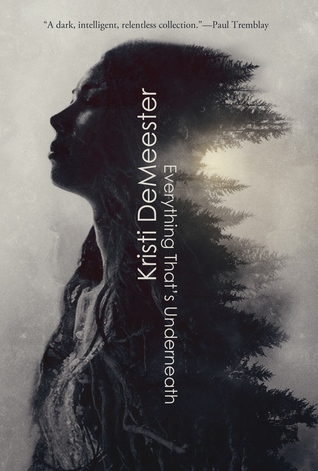
Kristi DeMeester’s first story collection EVERYTHING THAT’S UNDERNEATH takes the darkness and the weird a few steps beyond what Walter’s provides crafting nightmarish scenarios that draw readers in-- often so far as to feel like they are involved in the action, even somehow responsible for its horrifying twists, and then abruptly drop them at the tale’s conclusion, reeling, disoriented, and frightened, but also, reaching to turn the page to do it all over again. These are intense stories of body horror, abuse, and terrifying violence that will universally resonante with a wide range of readers despite their genre preferences. Either collection would make a wonderful suggestion to readers who found Carmen Maria Muchado’s stories in HER BODY AND OTHER PARTIES after her National Book Award nomination and are now hungry for more raw, feminist driven horror.

Further Appeal: The hottest trend in horror right now is how awesome the work is by female horror authors. Best showcased in a National Book Award Nomination for Muchado mentioned above, but it is more than just her. I talked about this trend at more length here.

Also, both are from Apex Publications. I highly recommend their catalog of science fiction, fantasy, and horror. Most of their titles seem to blur genre lines which is PERFECT for library collections. Also they put together a solid product that can stand up to multiple checkouts.

Three Words That Describe These Books: feminist horror, disorienting, twists

Readalikes: Other books I would suggest as similar to Walters and DeMeester [besides Machado] are Emily Canteneo, Seanan McGuire, and Kelly Link.
Hardboiled Horror


Horror has never been a stagnant genre. It’s speculative tropes and terrifying tone have been blended with every genre, and in the anthology, HARDBOILED HORROR, New York Times best-selling author and editor Jonathan Maberry illustrates how the traditional PI novel can be livened up when you add a dash of monsters, mayhem, and even a little life after death to the mystery. The 15 authors included are veterans of both the horror and crime genres, such as Josh Malerman, Seanan Maguire, Max Allan Collins and Heather Graham. While their stories have a range of fears from merely creepy to hide your book in the freezer, they are all firmly grounded within the rules of the mystery presenting an investigator, a murder, and the puzzle of whodunnit. Readers may be familiar with the characters in Lois H. Gresh’s “Sherlock Holmes: The Adventure of the Pin-Pricked Corpse,” in which the famed detective may have met his supernatural match; or Kevin J Anderson’s “Head Case,” which features his popular zombie PI, Dan Shamble. Other entries include“Sleep Debt,” by novelist Jacopo della Quercia, featuring a PI who solves crimes in his sleep, and “GasLight: Tampa Bay” by Nancy Holder an incredibly creepy and atmospheric tale set in Ybor City, the Cuban community in Tampa with a its own rich history and monsters. HARDBOILED HORROR is a great introduction to the chills and thrills of horror wrapped up in a well-tread PI package, making it a good starting place for those brave enough to give horror a try in 2018.

Further Appeal: I cannot stress enough now much this collection must be added to most public libraries. Not only are there hugely popular authors included, but these stories are good and so much fun. JournalStone is a larger small press so you can order this book easily through regular channels. And it is so easy to book talk- the title alone does it for you. Library patrons will LOVE this book.

Three Words That Describe This Book: mystery-horror blend, fun, surprising

Readalikes: This is done for you-- 15 authors to explore further if you are interested.

Monday, December 11, 2017

What I’m Reading: December Issue of Indie Picks


Have you subscribed to Indie Picks yet for your library? The December issue is out and I have three reviews that showcase the full breadth of horror from spooky to terrifying and a feature interview.  [You can visit the horror blog here for the feature interview]


You can click here to see tons of sample material. This magazine is a must read for library workers and patrons. We work very hard to let you know about a small sample of the independently published, books that would be perfect for your library, if only you knew to buy them.  You can click here to read my longer post about why Indie Picks is worth your money.

Today I have my draft reviews from this issue. A final reminder though. I pick these books very carefully. I truly believe most public libraries should add every title I include. I wouldn’t review them if I didn’t think they would work for a general public library audience. To help you booktalk each title I have also included multiple readalike options at the end of each review and my “three words."

********************************************
Becky’s December 2017 DRAFT Indie Picks Magazine Horror Column


Horror is more popular than ever, but what readers find horrific is highly personal and varies widely from those who cannot handle more than a few ghosts to some who want to intensely experience the fear with all five of their senses. Thankfully, there is a wide range of horror to satisfy just about every reader, from spooky to terrifying here are three options that capture the full spectrum of thrills and chills.


Spooky Suspense


Patricia V. Davis follows up her National Book Critics Circle Award nominated COOKING FOR GHOSTS with her second entry in the Secret Spice Cafe series, SPELLS AND OREGANO [HD Media Press, Inc; 978-0-9899056-8-8; $15.95; 2017]. Once again the setting is on the Queen Mary, and its well known status as one of the most haunted places in America sets the uneasy atmosphere before you even open the cover, and once you do open it, Davis hits the ground running with an excellent dual plotline, supernatural thriller. Sarita is the manager of The Secret Spice Cafe, the upscale restaurant aboard the Queen Mary [founded in book one]. She is a troubled young woman with psychic abilities and a strong connection to the ship’s spirits. Luca is a young man who has suffered much personal loss but a family connection draws him to the Queen Mary. Luca and Sarita meet and fall in love, but their pasts are literally coming back to haunt them. As Sarita and Luca’s stories unfold, their plot lines converge, and the danger increases. Along the way, Davis throws in well developed secondary characters and many engaging and well researched details about food, magicians, psychics, and the stately Queen Mary herself, all without sacrificing the compelling pace; in fact, these details are equally as engrossing as the heart-racing suspense. By the end the stakes are high and all are held breathless awaiting the shocking conclusion. Don’t worry if you missed the first book in the series, this one can stand alone. It is perfect for both readers who enjoy the supernatural psychological suspense of Jennifer McMahon and also those who love Nora Roberts’ storytelling prowess across many genres. This is spooky suspense that will frighten just enough to make readers give any movement in the shadows a hard, second look.

Three Words That Describe This Book: Supernatural Suspense, Multiple Storylines, Interesting Frame


Dark Dread


There is no question the dread and fear are ratched up in the next book, a dark fantasy by John Urbancik, THE CORPSE AND THE GIRL FROM MIAMI [DarkFluidity; 978-0-99838-824-3; $15; 2017]. The unease grabs the reader from the very first scene and really never lets go. A man returns from the dead, resurrected in a cemetery, in the driving rain, in a seedy section of Boston, with no memory, only an ID with an address. With no other options, he heads to the address and meets Ofelia and Mr Maker, both who have been waiting for him. Ofelia is a fem fatale who wants revenge, Mr Maker, a being with connections to a mythological world standing just outside of our own, and our corpse, Lucas, is just trying to figure out who he is and how he fits into the story. The three protagonists, in their three storylines, are laid out in alternating chapters, with the point of view quickly bouncing back and forth. Readers will be engrossed, turning the pages, following the leads, seeing the stories converge, and finding out that they are all after the same thing-- a diamond with more power than any of them can imagine. The mythological details about the magic inherent in a place are captivating, the old fashioned pulp heist story fantastic, and the resurrected corpses add just the right amount of supernatural horror. Come for the awesome action and world building, but stay for the characters, especially Lucas as he searches for the answers to the man he was and struggles to figure out who he is supposed to be now. This original, dark fantasy tale is a must read for fans of Richard Kadrey’s Sandman Slim series with touches reminiscent of Seanan McGuire and Gaiman’s American Gods.

Three Words That Describe This Book: Mythological Tone, Engrossing, Original

Traditional Terror


While the first two books showcase how horror can slip into stories that are firmly rooted in other genres, sometimes readers just want a traditional tale of terror by a master of the form. Enter Bentley Little and his terrifying supernatural mystery THE HANDYMAN [Cemetery Dance Publications; 978-1-58767-616-1; $25; 2017]. Daniel, now an adult real estate agent, recounts the story of his family’s encounters with Frank, the handyman who built their Arizona vacation home back in the 1980s, who at best is a con artist, but at worst is a man with a connection to an otherworldly evil. Daniel thought his family was the only one destroyed by Frank and the homes he built, but after hearing a client mention the problems with his family’s “Frank” home, Daniel goes on a cross country search to try to understand the truth behind Frank. What Daniel undercovers, however, is much more sinister and dangerous than he could have ever imagined, and now his life and all those he knows and loves may be in perilous danger. Told in three distinct parts each with a unique style, the terror intensifies throughout. Part one reads like a traditional supernatural investigation, while part two is a series of impressions of Frank from the point of view of others over the years, and finally, part three brings Daniel and his friends back for the horrific and disorienting conclusion. Little has also infused the story with Asian horror influences, some overt and others more subtle. The result is a trippy and terrifying story of an insidious horror hidden just behind the walls. Pair this with other terrifying, surreal tales of deadly haunted homes like THE HOUSE OF LEAVES by Danielewski or SLADE HOUSE by Mitchell. Fair warning though, don’t hire anyone to do work on your house for a few weeks before or after reading this one.

Three Words That Describe This Book: Terrifying, Surreal, Asian Influences

Tuesday, October 24, 2017

First Issue of Indie Picks Is About to Drop: Don't Be Left Behind

It’s hard to believe after all these months of planning and work [mostly by Editor in Chief Rebecca Vnuk] the first ever issue of IndiePicks Magazine is about to be sent out. What is IndiePicks? Well it is a game changer in the way libraries can identify books to add to their collections.

As I said in more detail in this post back in August:
This magazine is going to be a game changer for libraries in many ways and not just because I will be writing for it.
One of the biggest problems libraries are facing right now in terms of collection development is the fact that the Big Five dominate the publishing market and therefore the review space. 
As we all know [but surprisingly most authors do not know], most libraries require that a book have at least 1 review from an “official” source in order for it to be added to their library’s collection. People like me and Robin Bradford [among others] argue publicly that it is time for this rule to change if want our collections to truly reflect the best of what is being published today- especially in terms of diverse titles and genre representation. This rule is why I try to mention as many small press horror books as I can in my columns and on the horror blog so that you can at least have some kind of argument for adding them to your collections. It has helped some of you add independent horror, but for others, you still need that official review. 
My travels throughout the country have shown me that for many libraries, this rule is not going to budge any time soon. Most public libraries are small, single branch operations where they can barely keep up with the Big Five books let alone have time to seek out reviews of independent books on their own, no matter how good these titles may be.But, a library collection focused magazine which will hand deliver these independent titles to you just like our other trusted review spruces do for the larger publishers, this, just about any library worker, anywhere in America can easily add to their repertoire.... 
...I cannot wait to see how Indie Picks makes our library collections better by allowing us to add titles that are more representative of what our patrons actually want to read regardless of who published the title. I am also excited for the implications this magazine will have as a RA tool- a topic I will explore in detail after we have a few issues under our belts.
Well guess what? The first issue can be seen by you using this link...right now....a few days early! 

I cannot tell you how proud I am of being a part of this venture. As I said above, this is a cause I believe in. There are so many great books out there being published by smaller presses and we library workers have no idea they exist. How can we? We are so busy and the small presses don't have the budget to market directly to us. You can read the full post I wrote about this issue [the above is just an excerpt] here.

I am proud of our entire team. This first issue is professional, with thoughtful reviews and articles that I know can help library staff and patrons right this minute. And, we can only get better from here on out. In fact, we are all already busy handing in the copy for issue two-- due before the print issue hits the stands.

Please support us so we can keep up this great work by showing the first digital issue to those who have the power to get a subscription for your library. Details at https://indiepicksmag.com/subscribe/.

Specifically, my reviews are awesome- and I'm going to say so myself. No seriously, I thought long and hard about including titles that were well written, come from trusted publishers who put out a solid hard copy product that will stand up to multiple checkouts, and will appeal to a wide range of readers. You can head over to the horror blog to see my specific reviews with added content, or click here for the free link to the first issue to see all the reviews.

Thursday, September 14, 2017

Indie Picks Website is LIVE with Sample Horror and Romance Columns!


IT’S ALIVE!!!!! [As you can imagine, I have always wanted to say that for real.]

As I have been mentioning here on the blog and on Twitter, IndiePicks Magazine, is very close to being a reality, so close in fact, that they have put their first ever review columns on their website-- my horror column and Robin Bradford’s romance column.

In case you have missed the news below is more information from Naomi Blackburn, Publisher of IndiePicks from the “Our Story” page:
Being the dedicated bibliophile I am, I am also a fan of my library. I couldn’t afford to read as much as I do if wasn’t. I often tried to seek out some of my favorite “outside” authors and was always told that the libraries didn’t carry them. I researched why and although the reasons made sense, I knew there had to be a solution; one that was a win for the authors, addressed librarians’ concerns, and met industry requirements.  
As I plunged deeper into studying the availability of books, other areas popped up and I saw the same issues related to both music and film. There were a number of great recording artists and movie producers who chose not to go with a traditional studio, but didn’t scrimp on quality.  
I wanted to do something that would serve both industries. To achieve this librarians had to be the ones to review the works. I knew that for a review to have credibility, it had to have the librarian seal of approval. Our editor, Rebecca Vnuk, comes to IndiePicks Magazine with over a decade of library experience, including the American Library Association’s Booklist. If our librarians wouldn’t feel comfortable purchasing the work for their own catalog, we won’t recommend it for your reading list.  
As I got to know the independent authors and artists, I found they were just as passionate about their craft as those Big 5 authors and major studios. These people became my friends and I knew in my heart, if I could do ANYTHING to help them I would.  
I understood library policy and knew librarians wanted to work with authors outside the Big 5. I heard the call from the ALA to open their libraries to these works, but the lack of a recognized review source was still at the forefront of the problem. In searching out a solution my mind went back to my favorite little review magazine and the concept of IndiePicks was born.
Just like with my Booklist reviews, I will be posting my IndiePicks reviews here too. And just like those posts, I will add my “Three Words” to the post. Unless there was something I couldn’t fit in the review, however, I will not add more readalikes or appeal statements. I get a little more room in these columns than normal reviews, so we should be good.  They will also be archived and cataloged on the horror blog for easy retrieval by author last name.

I am contracted to provide at least 3 horror reviews per month, but I know for a fact that in future issues I will have more content than that. [But, that being said, I am the only horror reviewer and I only have space for 3 reviews a month, so please be patient with me.]

And now, here is my first IndiePicks review column. Buy all of these books for your library. They are all out right now!


A NEW GENERATION OF ZOMBIES

Bracken MacLeod is on quite a roll. Last year he released Stranded, which was a finalist for the Bram Stoker Award for Best Novel, and this year he follows up with an utterly original and chillingly realistic take on zombies with Come to Dust (JournalStone/Trepidatio Publishing, $17.95, ISBN 9781945373664). Mitch is an ex-con who lives for his toddler niece, Sophie. He is her unofficial guardian since her mother abandoned her, but he doesn’t mind because this little girl is his everything—until she tragically dies in her sleep. But Sophie’s death is not final. Soon after she dies, children all over the world begin to rise from their graves. The children who return, including Sophie, seem normal (except for varying states of decay) but they also have a terrifying power—one that is not apparent at first. As governments and religious leaders debate what to do about this unique zombie problem and how to regulate these undead citizens, Mitch and his girlfriend go on an adventure to save Sophie from danger and find a safe place for families like theirs to survive in this new world. With a fast-paced, thriller style of storytelling, an emotionally intense premise which will hit anyone who has ever loved a child right in the gut, and a twist that makes it feel fresh, Come to Dust is a story that does not disappoint. Fans of M.R. Carey, Dean Koontz, and The Leftovers will find this a sure bet.

Three Words That Describe This Book: fast paced, emotionally intense, chillingly realistic


SISTERS OF SLAUGHTER 

Also nominated for a Bram Stoker Award last year (in the Best First Novel category) were Michelle Garza and Melissa Lason, twins who are better known as The Sisters of Slaughter. In their second novel, Those Who Follow (Bloodshot Books, $14.99, ISBN 978-0998067995),  the Sisters employ their trademark style of holding no punches on the bloody details in a way that never feels gratuitous. Here we have two alternating storylines about two young, troubled women, twin sisters who do not know of the other’s existence. Celia has been kidnapped in the Arizona desert by Byron, a very evil man with an unknown supernatural power. Held captive with others in an abandoned church, Celia has had the year of her capture (age 14) carved on her forehead. Casey is living in a mental institution. Her behavior is getting more erratic until one day, the number 14 appears scratched into her forehead out of nowhere. Casey and Celia are special girls, with a connection to each other, and the power to overthrow the monster Byron—but will they find each other in time to save themselves (and the others)? They don’t even know what or who they are each looking for. The back-and-forth narration transitions smoothly and keeps the dread and the pace steadily building. There is necessary setup here, but it is all worth it, and the payoff is fantastic. Those Who Follow is a great choice for readers who miss the early 2000’s Leisure Horror line or the horrific tales of the late Richard Laymon.

Three Words That Describe This Book: parallel storylines, intense dread, violent but not gratuitous


TOP HORROR PICK 


Speaking of fantastic, Hematophages (Sinster Grin, $15.99, ISBN 9781944044558) by Stephen Kozeniewski is one my recent favorites. Paige, an academic who has never left her space station home base, gives the reader insight into a new world of the future where the male gender is extinct, corporations have replaced governments, and most humans live off-Earth. Paige is hired as a historian, part of a team sent on a salvage mission to find a ship that has been lost for centuries. As they travel to their destination, readers meet an intriguing cast of characters and get a tutorial in the intricate workplace politics (remember, this is a world controlled by corporations). When the team reaches the lost ship, the true terror begins, a terror which springs from the hematophages, lamprey-like creatures who attach onto their prey and suck out their insides for nourishment. And these sentient creatures particularly enjoy the human brain. Hematophages has a direct and snarky narration and a seamless inclusion of accurate science which never intrudes upon the fast-paced storytelling, only enhancing it. But because this novel is also horror, it also has terrifyingly awesome and gross scenes of the creatures as they take over the crew, one by one. While this novel is perfect for fans of classic horror movies in space like Alien or Event Horizon, it is also equally influenced by twenty-first-century horror classics like The Rising and The Ruins with more than a touch of the humor of Office Space. All that and a perfect horror ending means that the only problem you will encounter as you hand-sell this book to readers is how to pronounce the title and author’s last name.

Three Words That Describe This Book: dark humor, great world building, terrifying

Monday, August 14, 2017

Guest Post: A Critically Acclaimed Midlist Indie Author Proves Why We Need Indie Picks Magazine

I am so happy about the impending existence of Indie Picks- a magazine of book reviews by non-big 5 published books aimed at library workers [click here if you missed the detailed announcement]. This is the review journal we have been waiting for. All of you who have wanted to add great books but you couldn’t because there was no “official” review [a requirement of many library’s collection development policies], now you can add these titles.

Earlier this year I was the  Librarian Special Guest at the Horror Writers Association’s StokerCon 2017. All of the authors wanted to know how to get their books into libraries. I spent most of my time at the conference explaining this unfortunate circumstance to small and self published authors. I agreed with many of them that their books were just perfect for a library audience but without a publisher who could get them an official review in one of the major review publications, the vast majority of libraries could do nothing about adding their titles. Many of them didn’t even know that libraries had complex acquisition policies. Why would they? We know that libraries are giant bureaucracies, but most authors and patrons have no idea.

One of those authors I met was Patricia V. Davis. She serves as the perfect example of what is wrong with our current Big 5 publisher dominated system. She chose to publish her novel Cooking for Ghosts with a smaller publisher, but that doesn’t make it any less good. In fact, this was proven by the fact that it was nominated for a National Book Critics Circle award!

I was so compelled by Patricia’s story and her series [which is a spooky, food mystery that library patrons would LOVE] that I asked her to write about this issue from the author perspective. Meeting her and many other authors heightened my frustration which I have expressed on the blog many times before [here is just one example]. I work as hard as I can to get books in the various publications I work for, but I am only 1 person. 

While I was at the conference I began working on my own plan to help alleviate this problem. I even started putting the pieces into place, but what I had planned was not nearly on as big a scale as Indie Picks, so I abandoned my first plan and jumped on the Indie Picks ship. Actually I didn’t totally abandon the plan, I diverted it to Indie Picks. 

Now, Indie Picks still cannot review every single great book out there, but it will give the smaller publishers a fighting chance. They will have a voice and an advocate in the publishing world. I have started letting all of my horror author and small publisher contacts about the magazine and have encouraged them to advertise and send in ARCs. I am contacting the library reps for all of the writers associations and told them to get the word out to their publishers. I have even begun talking to Indie Picks about including author profiles and feature articles so that even more great reads can be given a chance to shine on their limited pages.

It’s a start.

I really want all of your libraries to subscribe. I don’t want you to give up your Library Journal, PW, and Booklist subscriptions [especially Booklist since I am still writing reviews for them]. And honestly, these publications are not upset with Indie Picks. They know they cannot do every book. More attention on good reads helps everyone, publishers, book sellers, authors, and libraries. More attention means more readers. More readers translates to more dollars. The people in charge listen to dollars.

I know it is another expense, but there will be plenty of content. The first issue doesn’t come out until November but I just turned in a pre-publication review column of three great titles that will serve as a preview of this resource before it comes out.

But enough from me. Here is Patricia V. Davis to explain why we need Indie Picks from the author side of the coin.

_____________________________________________

On the (Vital) Importance of Libraries for Midlist Authors 

When authors who write good books you’ve never heard of talk among themselves, the mantra most often repeated is the wish to get on The New York Times bestseller list. Those who see this as the golden ticket to success are surprised when a number of us say that our wish is different. Our wish to the publishing gods is for our novels to be in every library in the United States. 

“Libraries?” some of those authors say. “You won’t get any repeat sales in a library. And besides, how many people still go to libraries?” 

Since this is a site for librarians, I can only imagine the collective eye roll at that last question. You don’t need me to tell you who “still” goes to libraries. But as a former teacher and an author with a wide and varied social media following, I know the answer is, “everyone who can manage it.” Recently one of my favorite Twitter accounts, Librarian Problems @librarianprblms retweeted an article that talked about libraries as a “dying industry.” Needless to say, they begged to differ. Libraries are not at all a dying industry. What they are is a changing industry, and millennials are frequenting them more than ever.  

But for those who don’t recognize the rich resource the library system is, I tell them about the first time I took my son into a library. He was three. When, after two hours, I told him it was time to go, he started to cry. I tell them about my underprivileged teenage pupils who viewed their library as a haven of promise and possibility ─ a colossal-sized room filled with ideas, imagination, hopes, and inventiveness they might never have been exposed to in the world of financial hardship that restricted their families. I tell them about the homeless woman who wrote to me weekly on my blog by using the computer available to her at her library. I tell them how librarians are different than booksellers in that they are not motivated by sales, but by a literary quest is to discover a great, new story, whether or not it ever becomes a bestseller, and that their patrons are looking for just that ─ the wondrous, the unique, the undiscovered.  But, on the purely practical side, I point out that there are currently over one hundred thousand libraries in the United States. Getting just one copy of any novel in all of those libraries is far better than a fleeting mention on a list that is not really a “bestseller” list, in the actual meaning of the word.  

But how to attract the attention of librarians when one is a midlist author, published by a small, independent publisher? That is the frustrating challenge for the many of us in that group.  

Take my novel, Cooking for Ghosts. (And, if you’re a librarian, I mean that in the same way Henny Youngman did.)  It’s a magical realism story about four diverse women who meet on a food blogging site and decide to open a restaurant aboard the modern-day, haunted RMS Queen Mary, which is now a floating hotel berthed in Long Beach, California. Cooking for Ghosts was nominated for a National Book Critics Circle Award for Fiction, is an Official Selection of the Pulpwood Queens Book Club, and is the only book about the Queen Mary, fiction or non, chosen by the ship’s staff to be presented aboard at their monthly Salon Series.  That series was such a success, I have been invited back to present Book II, SPELLS and OREGANO, in the trilogy. 

As for the publisher, HD Media Press, I have no complaints about the marketing they’ve done for the book series. Their publicist has worked hard to get me a number of speaking gigs, including at StokerCon 2017, which, by lucky coincidence, was held aboard the Queen Mary, and I know their distribution is as good as, if not better than, other indie publishers. They’ve been reasonable and fair in regards to giveaways, promotions, blog tours and the like, and they offer above standard industry discounts, as well as returns to any retail outlets and wholesalers such as amazon and Baker & Taylor. In addition to the printed version offered through direct sales and distributors, HD Media Press has made a POD version of the novel available for those indie booksellers who wish to go through Ingram as their wholesaler.   

And yet, while Cooking for Ghosts is doing better than I might have hoped, and my agency tells me several foreign publishing houses are eyeing the title, domestic sales so far are mostly online sales and through independent bookshops. Much to my dismay, in libraries across the country the novel is almost invisible. And this I believe mostly has to do with the industry perception of smaller houses.  

Let’s take what happened with the ARCS of Cooking for Ghosts, as an example. While the final version of the novel included intricate interior graphics inspired by the royal salons of the Queen Mary, a unique cover that pays homage to vintage Cunard travel posters with a supernatural bent, an interior Art Deco style QR code that scans to an interactive Readers Guide that includes video, and another Art Deco style QR code on the back cover that scans to the viral book trailer, the ARCS had none of these extra features or beautiful graphics. They were standard, the back cover including the required marketing material and other necessary information for reviewers. The ARCS were submitted everywhere, including Booklist and Library Journal, and they looked no different than ARCS from larger houses. But with the exception of the Huffington Post and Midwest Book Review, HD Media Press was not able to garner any mainstream professional reviews. Additionally, Barnes & Noble turned down the title.  

And then, HD Media Press re-submitted the final version of the book to Barnes & Noble, and suddenly the title was accepted. With that in mind, even those at the publishing house contemplated that not seeing the professional work (and money) they were willing to put into the final version of the book, reviewers assumed the ARC was an example of the end quality that could be expected from such a small publisher.  

While frustrating, this is certainly understandable. But I know of many truly wonderful books that the public who frequents libraries are missing out on as a result of this mindset. Librarians cannot pick new authors and discover new titles if those titles are not visible through the channels they trust. 

Someone reading this might ask, “Um, excuse me ─ but if this novel is so ‘noteworthy,’ why wasn’t it published by a bigger publisher, one that might have more clout in the industry?”  

I’m glad you asked, but I won’t be surprised if you’re skeptical when I tell you that I turned down two ‘really-big-deal’ agencies to go with the more innovative agency I have now.  I know that those RBD agents would have likely sold Cooking for Ghosts to a bigger publisher, and for a very nice advance too. But after talking with those agents, I learned that their plan was to sell it to a publisher who would produce it as a pricey hardback along with an ebook edition at 12.99 USD. And this is where the tough choice comes in for an author: a great advance, accolades from your fellow authors for landing such a deal, but limited retail sales because readers have no idea who you are, or why, even with a good review, they should buy an unknown’s book in hardback or in ebook at a price that rivals the cost of a paperback.  

At the end of the day, I decided that I’m more like a librarian than a book merchant. I wanted to introduce as many readers as possible to my work. I wanted to give them the best story I could possibly offer, whether that story becomes a bestseller or otherwise. And I wanted a publisher that would present it at a price point that would entice as many readers as possible. HD Media Press produces my novel in a paperback version and a reasonably-priced Kindle version. They make a hardback version for libraries. So far, the hardback sales have been rather sad, and that’s because so few libraries even know it exists. 

So, on even-numbered days, I’m happy with my decision to publish with a small publisher, because they have the commitment to get to as many readers as possible. But on odd-numbered days, I wonder whether I should have made a different choice. Particularly when I go to a library. 

Patricia V. Davis is the author of Cooking for Ghosts: Book I in The Secret Spice Café Trilogy, (October 2016, HD Media Press) and Spells and Oregano: Book II of The Secret Spice Café Trilogy (November 2017, HD Media Press).  Visit The Secret Spice Book Series Page 


Friday, August 4, 2017

Brand New Indie Publisher Magazine Headed By Rebecca Vnuk and Featuring Horror Reviews By Me!

Let’s start with the announcement and then get into how it will effect me and all of you!

From Patomi Media Group:
In a literary world dominated by the Big Five publishers, IndiePicks Magazine launches this fall as a review source that focuses solely on the talent and works of indie imprints, small/medium press, and non-traditionally published authors. The magazine will highlight books, non-major studio film and music—all reviewed by librarians, for librarians. Rebecca Vnuk, formerly of Booklist and a respected readers' advisory librarian herself, will take the helm as Editor in Chief. She can be reached at rebecca.vnuk@patomimediagroup.com. The first issue of IndiePicks is slated to publish in November 2017 and will be aimed at both library selection staff and at general readers. Please check out their Facebook page (https://www.facebook.com/indiepicksmag/), and sign up at the website for notification of the official launch!  http://indiepicksmag.com/

This magazine is going to be a game changer for libraries in many ways and not just because I will be writing for it.

One of the biggest problems libraries are facing right now in terms of collection development is the fact that the Big Five dominate the publishing market and therefore the review space.

As we all know [but surprisingly most authors do not know], most libraries require that a book have at least 1 review from an “official” source in order for it to be added to their library’s collection. People like me and Robin Bradford [among others] argue publicly that it is time for this rule to change if want our collections to truly reflect the best of what is being published today- especially in terms of diverse titles and genre representation. This rule is why I try to mention as many small press horror books as I can in my columns and on the horror blog so that you can at least have some kind of argument for adding them to your collections. It has helped some of you add independent horror, but for others, you still need that official review.

My travels throughout the country have shown me that for many libraries, this rule is not going to budge any time soon. Most public libraries are small, single branch operations where they can barely keep up with the Big Five books let alone have time to seek out reviews of independent books on their own, no matter how good these titles may be.

But, a library collection focused magazine which will hand deliver these independent titles to you just like our other trusted review spruces do for the larger publishers, this, just about any library worker, anywhere in America can easily add to their repertoire.

It is the same format we are used to but with content we cannot get anywhere else. And, Rebecca has already assembled a superstar team of reviewers with a demonstrated commitment to promoting independent publishing including me, Robin Bradford and Kaite Stover among others. There are experts already lined up to help you help readers.

Recently I had a series of vague Tweets about my plan to take over the book world. That plan had involved getting all of the writers associations from the different genres united to promote their small press authors to libraries directly because I was so done with the major publishers ignoring genre titles and their readers. But then Rebecca told me about this new venture, and I put those plans on hold, instead directing my writers association contacts directly to Indie Picks. This magazine will do so much more to reach every library than I could have done alone. My plan was a start, Indie Picks could be the solution.

I cannot wait to see how Indie Picks makes our library collections better by allowing us to add titles that are more representative of what our patrons actually want to read regardless of who published the title. I am also excited for the implications this magazine will have as a RA tool- a topic I will explore in detail after we have a few issues under our belts.

So go to http://indiepicksmag.com/ right now and sign up for notification about the first issue. This is going to become one of your favorite RA and Collection Development Tools. And I can say that with confidence because I trust Rebecca AND I will make sure of it in the content I provide.