RA FOR ALL...THE ROAD SHOW!

I can come to your library, book club meeting, or conference to talk about how to help your readers find their next good read. Click here for more information including RA for All's EDI Statement and info about WHY I LOVE HORROR.
Showing posts sorted by relevance for query suite francaise. Sort by date Show all posts

Thursday, May 21, 2009

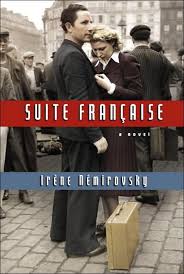
BPL Book Discussion: Suite Francaise

This past Monday the group got together for a great discussion of Irene Nemirovsky's Suite Francaise. First some background on the book. One reason Suite Francaise makes such a great book discussion book is that it has the powerful double pronged attack....the book itself (really 2 novellas) is a well crafted and entertaining work of literature, while the back story, Nemirovsky's life (and death) story add another dimension to the work. The two are so intertwined, it is impossible to separate her from her novellas.

Suite Francaise is the title Nemirovsky gave for her planned collection of 5 novels about France during WWII. Nemirovsky wrote the first 2 books and outlined the third while she and her family were trying to allude the Germans, who had occupied Paris and its suburbs. As stateless Jews (of Russian descent) Nemirovsky and her husband were subject to deportation. Ultimately, Nemirovsky and her husband were sent to concentration camps (separately) where they died. Their children were hidden and managed to save the manuscripts and notes, which published with her translated notes and correspondences with her husband and publisher once Nemirovsky was arrested by the Germans, make up the book Suite Francaise.

For more on Nemirovsky's story you can go here.

What is so intriguing about this work is that it is almost definitely the earliest work of fiction about WWII. Writing in 1942 about the 1940 fall of Paris and the German occupation of France, Nemirovsky was not even sure where the last 2 unwritten sections of her work would go. The war would have needed to progress further and her life would have needed to be extended for her to figure out where the book would go.

This led our group to discuss how different Suite Francaise was from the myriad of WWII books and novels we have read. This work is not a readalike for The Diary of Anne Frank or Night; these books would be readalikes for her biography, rather, this work is about the day to day aspects of living in a country controlled by the enemy. We marvelled in her descriptions of how the villagers coped with housing the German officers in their homes, while their own young, male family members were either fighting the Germans, prisoners of war, or already dead. One participant likened their arrangements and general friendliness to one and other as remarkably similar to the relationships between plantation owners and house slaves in the American South.

We spent most of our time talking about the second novella,"Dolce," which is set entirely in one village, as mentioned above, and goes into remarkable detail about the occupation and how the villagers lived. While the relationships between the Germans and French was important here, there was also quite a bit about the strict class distinctions among the French villagers. The situation was described multiple times as the "eye of he storm." It was a soft, sweet time as the novella's title suggests, but it was all the more powerful after reading her notes, knowing Nemirovsky planned to follow "Dolce," with a novel entitled "Captivity."

The characters in "Dolce" were sympathetic and fully realized. Many participants remarked on the detail in character descriptions and the lyrical language (how she could describe the weather so beautifully, for example). Even without the fact that she wrote this novella while literally on the run, we were amazed by the work's technical virtuosity.

We did talk about the first novella, "Storm in June," we just spent less time on it. A lot of this has to do with the style of the section. "Storm in June" follows a few characters who are frantically fleeing Paris as the Germans take over the city. We talked about how the style of this first section accurately reflects the plot. The narration jumps around to different people's points of view. It is scattered and incomplete; filled with violent and mean spirited acts. In short, is is as uncomfortable and unsettling to read as the evacuation itself.

We hit a few other topics such as the French resistance and where Nemirovsky might have gone with her book if she had lived.

I would highly suggest this title to groups who are looking for a different view on a popular topic, who are willing to mix fiction and nonfiction, and/or groups who do not mind an unfinished work.

In terms of readalikes, click here for a list of books on occupied France.

Fiction readers who enjoyed this book should also try Sebastian Faulks, most notably Charlotte Gray and Birdsong. I would also suggest Geraldine Brooks' most recent title People of the Book which I also wrote about here. This novel hits at the issues within Nemirovsky's novellas, living with the enemy and surviving through war, as well as addressing the author's life story, keeping a book safe despite terrible odds.

Friday, May 22, 2009

Is Suite Francaise Historical Fiction? Depends on Who's Asking.

When writing about my book discussion group's meeting on Nemirovisky's book, I forgot to talk about our discussion of historical fiction.

For the record, Suite Francaise is not historical fiction because Nemirovsky was not writing about the past, she was writing contemporary fiction both during and about the 1940s; it was simply not published until recently.

For you librarians, historical fiction is defined as a novel written about a time before the author's birth. So Pride and Prejudice is not historical fiction since Austen was writing about her own time, but the novels of Bernard Cornwell are.

That being said, if our patrons come up talking about how they love historical fiction and you ask what they have read recently and enjoyed and they say, "Suite Francaise," this is not the time for you to correct them. To that reader (to many in fact), Suite Francaise is historical fiction simply because it is about the past and is realistic. Go with their lead and find that reader novels set in the past (whether true historical fiction or not) that would fit with their overall reading tastes.

For specific historical fiction resources to help you help your patrons, click here. For things I have tagged histoical fiction, click here.

Monday, April 28, 2014

Monday Discussion: Holocaust Remembrance Day

Sorry to be a downer on this gray, rainy day, but this week the Monday Discussion falls on Holocaust Remembrance Day, also known as Yom HaShoah. From Wikipedia:
Yom HaZikaron laShoah ve-laG'vurah (יום הזיכרון לשואה ולגבורה; "Holocaust and Heroism Remembrance Day"), known colloquially in Israel and abroad as Yom HaShoah (יום השואה) and in English as Holocaust Remembrance Day, or Holocaust Day, is observed as Israel's day of commemoration for the approximately six million Jews who perished in the Holocaust as a result of the actions carried out by Nazi Germany and its accessories, and for the Jewish resistance in that period. In Israel, it is a national memorial day. It was inaugurated in 1953, anchored by a law signed by the Prime Minister of Israel David Ben-Gurion and the President of Israel Yitzhak Ben-Zvi. 
The United States Holocaust Memorial Museum has an entire week dedicated to Remembrance.  Click here for details.

For RA purposes, I am sure you are all aware that books about WWII and the Holocaust are especially popular.  So, to honor the day and to help give each other ideas on good leisure reading choices for patrons who want to read about the Holocaust, I though we could all suggest some options here today.

I'll go first. I have read many books about the Holocaust, but I thought I would suggest two titles that took a slightly different path to telling a story for which I thought I "knew everything," ultimately teaching me something new while still being a compelling read.  Both were read in my book club, so the links go to a full report on the book.

First, is nonfiction: The Zoo Keeper's Wife by Diane Ackerman.  From my book discussion report:
This is a book about people, animals, nature, and war.
Jan and Antoninia Zabinski were the zookeeper and his wife in Warsaw when the Germans invaded. Over the years that Warsaw was occupied, working with the Polish resistance, they were able to shelter and save over 300 Jews from certain death by hiding them in the zoo. Naturalist Ackerman, has scoured Antoninia journals, interviewed her son, and scoured the surviving records of the Polish resistance in order to recreate the fascinating, forgotten, true-life story of the zookeeper's wife and the true nature of the obsessive evil that was Nazism.
The second is fiction: Suite Francaise by Irene Nemirovsky.  From my book discussion report:
Suite Francaise is the title Nemirovsky gave for her planned collection of 5 novels about France during WWII. Nemirovskywrote the first 2 books and outlined the third while she and her family were trying to allude the Germans, who had occupied Paris and its suburbs. As stateless Jews (of Russian descent)Nemirovsky and her husband were subject to deportation. Ultimately, Nemirovsky and her husband were sent to concentration camps (separately) where they died. Their children were hidden and managed to save the manuscripts and notes, which published with her translated notes and correspondences with her husband and publisher once Nemirovsky was arrested by the Germans, make up the book Suite Francaise.

Now it's your turn.  Share a book appropriate for Holocaust Remembrance Day.

For past Monday Discussions, click here.

Friday, September 23, 2011

BPL Book Discussion: Sarah's Key

On Monday the BPL Book Discussion group met both to have our discussion and say goodbye to long time member Helen as she embarks on a new journey, moving to Tennessee.  So after a fun party with a book shaped cake, we settled in with a VERY large turnout (Helen is much loved) of 18 people to discuss Sarah's Key by Tatiana De Rosnay.
Before I begin with the discussion particulars, I do want to make a comment about the optimal size for a book discussion group.  I always say if you can have 12 people, that is perfect.  18 eager participants was a bit difficult for me to handle.  Thankfully, we all know each other and generally do not have such a large group, but I did spend more time trying to make sure everyone who wanted to talk got their chance and less time trying to help us delve deeper into the book.  Overall, I left dissatisfied with the quality of our discussion.  Others noted this too.  It was not the book though, it was the size of the group. But if it meant Helen got a bigger send-off after 50 years of living in Berwyn, it was worth it.

Paris, July 1942: Sarah, a ten year-old girl, is brutally arrested with her family by the French police in the Vel’ d’Hiv’ roundup, but not before she locks her younger brother in a cupboard in the family's apartment, thinking that she will be back within a few hours.
Paris, May 2002: On Vel’ d’Hiv’s 60th anniversary, journalist Julia Jarmond is asked to write an article about this black day in France's past. Through her contemporary investigation, she stumbles onto a trail of long-hidden family secrets that connect her to Sarah. Julia finds herself compelled to retrace the girl's ordeal, from that terrible term in the Vel d'Hiv', to the camps, and beyond. As she probes into Sarah's past, she begins to question her own place in France, and to reevaluate her marriage and her life.

Tatiana de Rosnay offers us a brilliantly subtle, compelling portrait of France under occupation and reveals the taboos and silence that surround this painful episode.
Now on to our discussion:
  • As usual we began with liked, disliked, and so-so.  With 18 people we had almost a 50-50 split between liked and so-so. The "why" people moved from liked to so-so came up throughout.
  • Before I get into the specifics of the book, I do want to mention that a few times we did talk about the parallels between the French forgetting the events surrounding the Vel’ d’Hiv Roundup and the 9/11 10th anniversary coverage.  We talked about how no one thought people would ever forget Pearl Harbor, but they have.  The idea of making sure that horrible atrocities in history are not forgotten is the crux of this novel.  Whether or not you liked the story or how de Rosnay chose to tell it, this central theme is an honorable one.
  • We started with talking about Julia.  Julia dominates the book.  Yes, the story alternates for the first half between her story in 2002 and Sarah's in 1942, but it is Julia who we are with for the long haul. Many were annoyed by Julia.  Her obsession was maddening and we found her a bit selfish, but we all agreed that she grew over time.  Her immaturity was manageable because as she got pregnant, decided to leave her husband, and helped 2 families confront their deep secrets and begin to heal, we saw her growth. 
  • On the other hand, Sarah's story in Sarah's voice was loved by all.  One person said it felt like Anne Frank's Diary. We were riveted by her dilemma and her anguish.  We were also split as to being surprised to find out that Sarah kept her family secret for her entire life, taking it to her grave without passing the truth on to her son.
  • We talked about the style..  We all agreed that the short alternating chapters at the beginning of the book helped to alleviate the difficult story of the roundup of the Jews and the terrible conditions they were put through.  There are some truly terrible descriptions in this novel of what these people were put through; particularly upsetting is the scene of the children being separated from their parents in the French internment camp.  However, de Rosnay's decision to interrupt Sarah's story with Julia's modern day quest to find herself and the truth about that terrible time 60 years before, made it slightly more manageable. It also gave the reader a second to catch her breath and get some perspective on the entire situation.  This is a lot of tragedy to take in all at once here.
  • Some people though felt cheated by the style.  One participant elaborated by saying it felt like a simplistic trick of sensationalism to alternate the stories and stop each with a cliff hanger before going back to the other.
  • The discussion of style led to one about the writing.  People were disappointed with the writing.  One called it "mediocre" while another said "uneven." I reminded the group that the novel was originally written in French, so it could be a translation issue.  But I also suggested that de Rosnay (who is a very successful French novelist) chose to use a more plain style of writing to reflect and enhance Julia's position as a journalist.  They conceded this, but others also noted that they felt too many of the secondary characters were stereotypical.  With this point, I agreed and could not offer a counter opinion.
  • The theme of the destructive power of secrets was discussed at length.  Sarah knows this all too well, as she locks her brother in the cabinet thinking he was safe when the French police came to get them because her parents kept the secret of how bad things truly were for the Jews in Paris.  If she had only knew what was going on, she never would have locked him in what became his death chamber.  She would also have tried harder to escape sooner.  Julia is a journalist whose job it is to uncover secrets.  She uncovers her in-laws secret of their connection to Sarah, a secret which has put a physical distance between the members of their family ever since 1942.  So many secrets, and they all are so destructive.
  • These secrets violate the mantra of all Holocaust memorials which tell us all "To Never Forget."  Unfortunately the French people had forgotten what terrible things they did to their own citizens.  While it may seem too atrocious to discuss, de Rosnay, as a Frenchwoman, took a huge stand by writing this book.  She is vowing "To Never Forget." We admired this.
  • We talked about the importance getting and saving the stories from our veterans of WWII.  But we also understand from reading books like Sarah's Key, that we only get the stories on their terms.  Some things may still be too terrible for them to share with anyone.  It made us wonder about the secrets that are still being held tight, all of these years later.
  • The title was not really discussed since it is fairly obvious.  Sarah carries the key to the cupboard with her for her entire life.  By the end, her son has reclaimed the key along with the family history he never knew about. Also Julia has found the key to living her life by researching Sarah's story.  I think we should assume that it is her key to happiness.  The participants were sad that the title could not be mined for a longer discussion.
  • We talked about Julia's future and specifically if she and Sarah's son William have a romantic future together.  We felt that if nothing else they will be dear friends due to their love of Sarah and her agonizing story.
  • As usual we ended with words or phrases to describe the book:
    • guilt
    • secrets
    • forgiveness
    • never forget
    • shame
    • family
    • illuminating
    • uncomfortable
    • atrocities
    • the camp
    • the key
    • death
    • tragic
    • the truth
Readalikes:  We made a lot of connections to Irene Nemirovsky's Suite Francaise in our discussion.  We read and discussed this novel back in May of 2009.  You can click here for the full report, but both are set in occupied France during the early years of WWII.  The big difference here is that in Suite Francaise was written as the war was happening, while Sarah's Key looks back at the atrocities.  Nemirovsky's prose is also much more lyrical.  That is not a slight on Sarah's Key.  Julia, our narrator, is a journalist and her chapters, which hold the majority to Sarah's are in a more journalistic, "just the facts," style.  Sarah's chapters reflect her child's eye view.

Other WWII books we have discussed here at the BPL that would also work as readlaikes are The Guernsey Literary and Potato Peel Pie Society by Mary Ann Shaffer and Annie Barrows (multiple story lines, exposing hidden atrocities) and The Zookeeper's Wife by Diane Ackerman (exposing a hidden story of WWII).  The links for each title go back to the post on our discussion.

Obviously, the Holocaust angle works well here as a readalike, but it is not the only direction you could go with this book.  Books with alternating view point, following suffering women in an unfamiliar setting are some of the big appeals here.  For readers who want more of this, I would also suggest Snow Flower and the Secret Fan by Lisa See and A Thousand Splendid Suns by Khaled Hosseini.

Cutting for Stone by Abraham Verghese is a layered story about war, family secrets, and the search for the truth at all costs.  It is a much longer novel, more complex, and lyrical than Sarah's Key, but it is also a popular book discussion title.

Some readers will also want to be directed to nonfiction titles about life in occupied France.  NoveList suggests The Journal of Helene Barr; Barr was a young Jewish girl who lived this story.  I also suggest using this link to learn more about what actually happened during the Velodrome d'Hiver Roundup.

Thursday, March 18, 2010

BPL Book Discussion: The Zookeeper's Wife

 
This month the BPL book discussion group met to discuss the unique WWII nonfiction title, The Zookeeper's Wife by Diane Ackerman. I actually began the discussion with a comment from a participant in Kathy's evening group back when they discussed it in January. She said, "It is important to read stories about heroes who aren't warriors." I think this one sentence sums up the entire book and its appeal.

We have read a lot of titles with a WWII frame in our group, but that did not diminish the appeal of this book; all but 2 people absolutely loved the book and "couldn't put it down." This is a book about people, animals, nature, and war.

Jan and Antoninia Zabinski were the zookeeper and his wife in Warsaw when the Germans invaded. Over the years that Warsaw was occupied, working with the Polish resistance, they were able to shelter and save over 300 Jews from certain death by hiding them in the zoo. Naturalist Ackerman, has scoured Antoninia journals, interviewed her son, and scoured the surviving records of the Polish resistance in order to recreate the fascinating, forgotten, true-life story of the zookeeper's wife and the true nature of the obsessive evil that was Nazism.

Here are some of the major issues we discussed:
--Even though there were many details about the animals in their lives, you did not have to be a people person to appreciate all of the detail.  We were especially riveted by Ackerman's descriptions of the Nazi's obsession with back breeding the wild Polish horses to their "pure" state.
--We would have liked a map of the zoo grounds. The Jews and resistance workers were hidden fairly out in the open, in a pheasant house and in their home on the grounds. Many were disguised as gentile workers, all while the Germans were also on the zoo grounds. How lcose were the Germans to the hidden people. Also, where was the Ghetto in relation to the zoo? We had many location questions that a map would have answered.
--We spent a good deal of time talking about the Polish resistance. Even living in the Chicago area, home to the most Poles outside of Poland, we were all always taught that the Poles gave up when the German invaded. Not so, we have now learned. They fought each and every day their were occupied. --We all now have a heightened appreciation for the Poles and their intricate and organized resistance.
In terms of the language, Ackerman's writing is beautiful. Multiple people discussed how it drew them in. We appreciated her choice to spend time on the day-to-day details of life living under the Nazi's (who by the way, only hated Jews more than Poles), and the daily life and death struggle of ordinary people.
--But especially, we loved Antoninia. One participant called her "the animal whisperer." Her courage and ability to read people and animals in a way that literally saved all of their lives many times. We loved her passion and eccentricity. We also found her and Jan extraordinary since they did not see themselves as heroic; they just felt they were doing their part for the underground machine to save Poland.
--We discussed the contradictions here. Antoninia and Jan's story is one of survival and the best of what a humans can become; juxtaposed with the outright evil of the Nazi's.
--Finally we talked about what we would have done in their situation. This is a heartbreaking story of good people who put others first. If they had been found out, everyone would have been killed immediately. We all hoped we would have been like A and J and actively save others, but until it happens, you don't know what you would do.

    We ended by talking about what a great example this book is of the fact that reading exposes you to so much more of the world.


    Three Words That Describe This Book: Inspirational, WWII, Animals

    Readalikes: Some readalikes that came up as we were discussing this book were Leon Uris' Exodus, Suite Francaise by Irene Nemirovsky and the nonfiction of Temple Grandin.

    For those who want more info about the Polish underground, try Fighting Warsaw. I would also suggest Faithful Elephants, a memoir by a Japanese zookeeper during WWII.

    Friday, May 29, 2009

    New Book Discussion Group Beginning at BPL!

    Our book discussion groups at BPL are getting so popular that beginning in July we will be adding a Saturday group led by Briana. She has decided to go with a "greatest hits of Berwyn's book discussion" theme. After polling Kathy and me she has come up with the following 6 month schedule (links are to my blog posts about past discussions):

    July - My Sister's Keeper
    August - Thirteenth Tale
    September - River of Doubt
    October - Behind the Scenes at the Museum
    November - Suite Francaise
    December - Loving Frank

    Briana's group also highlights the fact that Briana, Kathy, and I take our old book discussion books and create kits that patrons can check out. Each kit contains at least 9 paperback copies of the book, discussion questions and read alike suggestions. Click here to see our full list of available titles.

    Kathy and I have also announced our July-December schedule. Click here to see it. We accept anyone who can make it in person to the meetings, whether you live in Berwyn or not.

    While I am talking about book discussions I should also mention our list of book discussion resources, available here. Personally, my absolute favorite free resource is Reading Group Guides. I use this to get ideas for titles to discuss, read author interviews, acquire discussion questions, and just to read their great blog.

    A new resource I just found is Readers Place. I like this one because it is from the UK and offers a different perspective.

    That should keep your book clubs busy for the next few months.

    If you have had a great discussion and want to share with the rest of us, let me know.

    Wednesday, December 30, 2009

    What I'm Reading: The Best Books I Read in 2009

    Time for my annual post of the best books I read this year (from January to December 2009). I have listed the genre for each and the month in which I read it.  Also the links go to my original post on each title, and all posts include multiple readalikes options for each title.

    I did not rank these in order, but I will say that the first three I listed were my favorites, for such different reasons (click through on each title for details)

    Here we go...my list of the 10 best books I read in 2009:

    Click here for the posts on every book I have read.

    Happy New Year and thanks for reading my blog!

    Wednesday, January 20, 2010

    BPL Book Discussion: The Guernsey Literary and Potato Peel Pie Society

    To start off the new year, our group finally read The Guernsey Literary and Potato Peel Pie Society (herein GL3PS) by Mary Ann Shaffer and Annie Barrows.

    First, let me set the stage for our unusal set up for this discussion. The table in our library's "Board Room" was being refinished and due to be returned in the morning on the day of the discussion (1/18).  Of course it was late and came just as I was reading the group some background information on Guernsey. So, picture 15 women with an average age of about 70 trying to move themselves, their books, and their chairs into a staff area near the periodicals storage to have a discussion.  To their credit, no one complained and we spent the first 30 minutes a bit put out, but otherwise fine.  I lightened the moon by saying what a perfect book this was for our situation.  The members of the GL3PS had to meet while being occupied by the Nazi's, so our temporary relocation was nothing compared to that.

    Now on to the book.  Here is the official plot from the publisher:
    “I wonder how the book got to Guernsey? Perhaps there is some sort of secret homing instinct in books that brings them to their perfect readers.”

    January 1946: London is emerging from the shadow of the Second World War, and writer Juliet Ashton is looking for her next book subject. Who could imagine that she would find it in a letter from a man she’s never met, a native of the island of Guernsey, who has come across her name written inside a book by Charles Lamb….

    As Juliet and her new correspondent exchange letters, Juliet is drawn into the world of this man and his friends --- and what a wonderfully eccentric world it is. The Guernsey Literary and Potato Peel Pie Society --- born as a spur-of-the-moment alibi when its members were discovered breaking curfew by the Germans occupying their island --- boasts a charming, funny, deeply human cast of characters, from pig farmers to phrenologists, literature lovers all.

    Juliet begins a remarkable correspondence with the society’s members, learning about their island, their taste in books, and the impact the recent German occupation has had on their lives. Captivated by their stories, she sets sail for Guernsey, and what she finds will change her forever.

    Written with warmth and humor as a series of letters, this novel is a celebration of the written word in all its guises, and of finding connection in the most surprising ways.
    The first issue to tackle with this book is its style.  GL3PS is a novel in letters, otherwise known as an epistolary novel. Some pepople couldn't get past their dislike for this style.  But overall, the response to the use of letters to tell what one person called, "a group story," was positive.  We liked to see how each person was changed by those around them, and letters were an effective way to communicate this. People also enjoyed how although the letter writer was constantly changing, the plot didn't jump around. The letters went in order and we saw Juliet and the members of the literary society move on from the tragedies of war.

    Also, we liked how the style reflected the time period.  This was a time when people wrote letters. A few participants talked about how not only is letter writing a lost art, but also we are losing a lot of our personal history as people and as families without old letters to go through.

    Finally we loved the letters as they were used to develop the characters. Each letter writer had their own voice (in the audio they literally have a different voice); each character got a chance to present his or her personality to the reader.  For me personally, I fell in love with Isola through her letters toward the end of the novel.  She was adorable.

    Many in the group were happy to finally read "that book with the crazy title." Once done they found it to be about many things.  Here is a list of some of the themes and issues we discussed:
    • We loved how Juliet served to show the power of "the listening writer."
    • We talked about books and their power.  How the right book in the right reader's hand can transform your life.
    • We spent time talking about how this novel reinforces the power of true friendship.
    • An interesting side conversation began about how terrible stress brings out the true personality of people.
    • We loved how this novel presented an "even picture of humanity." There are characters from the too good to be true to the very petty and nasty and all  in between.
    • This led to a spirited conversation about some specific characters.  We loved Juliet. Words used to describe her included, "spunky, empathetic, open, good sense, independent, plucky." Remy, the concentration camp survivor evoked the torture of the war for us.  As a literary device she also allowed Elizabeth's story to be completed; she gave closure to the group because they heard the story of Elizabeth's death from someone who was there. And on a lighter note, she makes Juliet realize that she really is in love with Dawsey.
    • Overall, we liked the hopefulness of this novel.  In the face of Nazi occupation, death of loved one, and the bleak post-war landscape, here is a story of good, decent people moving forward with a positive outlook.  We all agreed it was great advice for tough times.
    By the way, we all want to read a book by Charles Lamb now.

    At the end of the discuss I closed by asking each person to tell me what was most appealing about this novel to them personally.  Their choices with votes in after were: that is was about the power of books (4), the setting (1), or the characters  (8). So we loved the characters the most as a group.  All agreed they would suggest this book to friends and family, no matter their age.

    Readalikes:  Two books that we have read in this book club are also excellent readalikes for GL3PS, Excellent Women by Barbara Pym and Suite Francaise by Irene Nemirovsky (click through to read about our discussions).

    Another epistolary novel with a similar reading theme is Ella Minnow Pea by Mark Dunn.

    Books about book clubs that may appeal to readers of GL3PS are Angry Housewives Eating Bon Bons by Lorna Landvik and The Jane Austen Book Club by Karen Joy Fowler. Both have humor with serious undertones, and are good for book discussion groups.

    This novel also reminds me of the Elm Creek Quilters books by Jennifer Chiaverini. Here the group quilts instead of reads, but these are also multi-generational and hopeful stories.

    For many more readalikes including nonfiction, check out this reading map my student Elizabeth did last semester.

    Monday, December 28, 2015

    What I'm Reading: All the Light We Cannot See

    Many months ago I listened to All the Light We Cannot See by Anthony Doerr. I have book talked this one, particularly the brilliance of the audio, so much that I forgot that I hadn't written a review here on the blog yet. In fact, I only realized that I did not have a review when I went to list my favorite reads of 2015 and I couldn't find the review. That's because I never wrote it.

    Well time to fix that right now.

    Before my soundbite review, I am going to use the publisher's plot summary. Why? Well it is not just to save time; I actually have a teaching moment planned here. It is to show you how a plot has nothing to do with why you love or book or not. So, summary:
    Marie-Laure lives with her father in Paris near the Museum of Natural History, where he works as the master of its thousands of locks. When she is six, Marie-Laure goes blind and her father builds a perfect miniature of their neighborhood so she can memorize it by touch and navigate her way home. When she is 12, the Nazis occupy Paris and father and daughter flee to the walled citadel of Saint-Malo, where Marie-Laure’s reclusive great-uncle lives in a tall house by the sea. With them they carry what might be the museum’s most valuable and dangerous jewel. 
    In a mining town in Germany, the orphan Werner grows up with his younger sister, enchanted by a crude radio they find. Werner becomes an expert at building and fixing these crucial new instruments, a talent that wins him a place at a brutal academy for Hitler Youth, then a special assignment to track the resistance. More and more aware of the human cost of his intelligence, Werner travels through the heart of the war and, finally, into Saint-Malo, where his story and Marie-Laure’s converge.
    So that is what happens, but that is not why people love this book. Here is my soundbite review which gets more to the heart of this novel's appeal

    Becky's Soundbite Review:
    "This stunning, Pulitzer Prize winning historical novel tells the story of two children, on opposite sides of WWII. We follow each of them, one a blind, French girl who may be in possession of a rare jewel, and the other, a German, orphan boy with a talent for fixing radios, as they come of age during wartime.  Each gets their chance to narrate their separate story from their perspective, but as the novel moves forward, it becomes clear that their lives are meant to intersect. With memorable and authentic characters, lyrical but accessible language, a haunting tone, and a plot that carefully unwinds itself in a way that is suspenseful and compelling, this story will wrap you up and refuse to let you go."
    That is the appeal hand sell highlights, but here is a little more.

    First and foremost, this story is focused on the characters. Marie-Laure and Werner, yes, but there are many, many more. One of my favorites is Etienne, Marie-Laure's PTSD suffering uncle who offers her shelter in Saint-Malo. Even Marie-Laure's father, who is taken away by the Germans fairly early in the story is a presence throughout. His intricately carved model of Saint-Malo becomes vital to the story's final, heart pounding moments.

    While this story does have intrigue due to the fact that the Germans are trying to find the one real jewel among many fakes and Marie-Laure may be the one with the real deal, readers who put plot first, will be disappointed. There are long stretches here where character development is the main goal of the narrative. Now it is not character development for no reason. Every detail we learn about the characters comes into play at some point in the plot; however, there are long stretches when "nothing happens." For a historical fiction story, set during wartime, well that may seem odd to some readers. In fact, the plot summary I shared above, makes the novel sound way more action-oriented than it truly is.

    The language and tone are also beautiful in a haunting way. The tone is enhanced by Marie-Laure being blind and Werner living much of his life listening intently.  I also still remember a few descriptions from this book, namely the first time Marie-Laure went to the sea, and Werner's descriptions of surviving a bombing raid. The words that Doerr used have stayed with me.

    Finally, the style. The story is mostly chronological but overall I describe it as stylistically interesting. I did not chose "complex" because while it is not straight forward, it is not hard to follow either. "Interesting" is my word because the multiple narrations mean the time line is a little fluid with some back and forth, but it also allows for compelling hints at how their lives will eventually overlap. Reading the book is like a small puzzle [which I know is on purpose due to some major plot points]; it is not hard to solve it, but it takes time and patience. And the unraveling toward a resolution is a large part of the enjoyment.

    This is a book that is hard to forget after you have read it.

    Note on the Audio: Look, there is not much to say here because Zach Appleman's narration has won all the awards. So instead of talking about how well he narrates it, here is why I think this book is improved as a story when it is listened to instead of read. Both story lines rely heavily on listening. The first is because Marie-Laure is blind. Obviously, she experiences everything without sight. When you listen to this novel recounting her life during WWII, you never forget that she is blind because in a way, you are too.  We both only have our ears to tell us the story. And then there is Werner, whose entire life is changed by hearing a science radio broadcast from France, so much so that he dedicates his life to radios and listening. It is what he is better at than anyone, it is what allows him to leave his mining town, it is what gets him into the war at a young age. When we listen to his story, we are more firmly placed in Werner's head than if we just read the words on the page.

    Three Words That Describe This Book: character-centered, haunting, stylistically interesting

    Readalikes: By far the book that is most similar here in appeal, but not in plot at all, is Constellation of Vital Phenomenon by Anthony Marra.  Like All the Light We Cannot See, Marra's novel is impossible to forget after you have read it. Read my review because it explains why they are so similar and all of the readalikes there would also work here.

    Marra's novel is a bit more contemporary, but if you want another historical fiction with multiple perspectives that is both haunting and compelling, try Mudbound by Hillary Jordan. It is also award winning, with a great audio.

    Of course, some will be drawn to All the Light We Cannot See because it is set during WWII and that is a very popular frame.  You can click here for a crowd-sourced list of the "best" WWII books, but specifically for fans of All the Light We Cannot See, I would send you to Life After Life by Kate Atkinson or Suite Francaise by Irene Nemirovsky.  The titles link to my reviews for details, but in both of these we have the same haunting tone, amazingly authentic characters who drive the story, a compelling story line, and interesting styles.

    Finally, All the Light We Cannot See was a finalist with Station Eleven in the 2015 Tournament of Books. Click through to see there final battle with commentary. I read Station Eleven last year and it made my 2014 best list also. Both novels are stylistically interesting with multiple narrators and a haunting tone.