Although I am not on Twitter myself [the reasons why would take an entire post], I am all about passing on as much information as possible here on RA for All.
There have been a series of posts by Matt Anderson, editor of the online newspaper Library Science Daily, about the best tweeters in the library world.
Here is his list of the 100 libraries to follow on Twitter.
And here he compiled the 125 Librarians to follow.
These are all libraries and librarians, so the focus is not only RA specific.
However, the library marketing team at Harper was inspired by Anderson and compiled their own list of the most active librarians they follow on Twitter. This list is the better one if you are looking for the best Librarian Tweeters from the RA perspective.
My pick, Kaite Stover, but you have to register to follow her.
Thursday, February 28, 2013


Wednesday, February 27, 2013
World Book Night: My Title and Where To Get Your Books
Over the weekend, I was notified that the title I was assigned to give out on World Book Night is my first choice-- City of Thieves by David Bennioff. Back from my original review in October of 2008:
Jose, who works in Circ and runs our popular Decidedly Dystopian Book Club, also got his first choice, Looking for Alaska by John Green.
That's the giver side of the World Book Night equation, but here at the BPL we have news on the distribution side of the evening. We are an official pick-up location for givers! So if you are a giver and live in our area, choose the Berwyn Public Library as your pick-up location. We'd love to meet you.
I also read another historical fiction with some adventure elements and a similar title, but with a completely different setting and tone. City of Thieves by David Benioff is a WWII drama. St. Petersberg (or Pitter as its residents refer to it) is under siege by the Nazis and Lev, the son of a poet (and victim of Stalin) is literally starving while protecting his beloved Pitter. One evening he is caught out after curfew, thrown in jail, and awaiting his punishment...death. In his cell, Lev meets an army deserter and university student named Kolya. The two are offered a reprieve by the Colonel if they can locate a dozen eggs for his daughter's wedding cake in less than a week's time. The boys set out into the wild streets of Pitter, and eventually slip behind German lines. Along the way, as Lev narrates, the two form a true friendship, meet many interesting people, and come to understand the beauty and horrors of war.You can click through to see readalikes from back then. Also, use this link to see all of the times I have mentioned City of Thieves since 2008 (hint, its a lot). It has become one of my favorite, sure bet, go-to titles over the years. I have even featured it on the Browsers Corner.
Jose, who works in Circ and runs our popular Decidedly Dystopian Book Club, also got his first choice, Looking for Alaska by John Green.
That's the giver side of the World Book Night equation, but here at the BPL we have news on the distribution side of the evening. We are an official pick-up location for givers! So if you are a giver and live in our area, choose the Berwyn Public Library as your pick-up location. We'd love to meet you.
Tuesday, February 26, 2013
BPL Book Discussion: Bury Me Standing
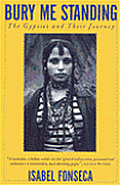
To set the book up both for you readers, and as I did with the group, I have this review from Kirkus from when the book first came out:
A journalist's vivid study of Eastern Europe's Gypsies (the Roma) that explores the myths, customs, and actuality of Gypsy life while addressing the central question of Gypsy identity in the post-Holocaust 20th century. Partly because they do not have a written tradition of their own, Gypsies have not figured prominently in mainstream scholarly and journalistic writing. Here Fonseca aims to give them the attention they deserve. Bury Me Standing is actually several works in one: socio-anthropological tieldwork, journalism, oral history, and colorful narrative. Although the ordering of its parts is at times chaotic, the study's diversity is an asset; it provides captivating, intimate accounts of Gypsy customs and gender and social relations, as well as serious consideration of scholarly debates and issues concerning the ill treatment of Gypsies in European history (slavery, persecution, the Holocaust, contemporary injustices). Fonseca has a knack for linking insight to wit and observation, as in this comment on Gypsy dogs: ""All seem to be lame or one-eyed or stub-tailed, as if their main job wasn't to protect or to appear faithful but to make people feel better about their own shortcomings."" But at the core of Fonseca's investigation lies her interest in the Gypsies' ""continual self-reinvention"" and their ""search for a positive identity"" to offset the reputation that burdens them in society. Some Gypsies have returned to their supposed Hindu roots. On the other hand, they have a strange reluctance to respond to the Holocaust (500,000 dead). If suppression of past Gypsy suffering continues, contends the author, their fate in the faltering democracies of Eastern Europe may be bleak. In the post--Cold War atmosphere of renewed nationalism and economic uncertainty, scapegoating is rampant. Fonseca's book comes at a crucial moment and could open an important discussion.Earlier today I posted the questions I created for our discussion here. Click through to see them as they guided the discussion you will seen in note form below.
Here are the notes from our discussion:
- 6 voted that they "liked" the book, 4 disliked, and 5 so-so. We were all over the map.
- Much of the so-so and disliked votes had to do with the way the book was written. Throughout the discussion comments came up about the lack of narrative flow throughout the book and Fonseca's insistence to not give us any insight into why she wrote this book. I went through my notes and compiled them all here in one place. But I think it is important to note that this part of the discussion was particularly organic; it came up frequently was discussed a bit and then even after we moved on it came up again.
- Was this a dissertation? It felt like it a bit. (The answer is no)
- I liked the travelogue organization. I went to this area in 1992 and again in 2005. I went with the idea that "I would see what I saw." I felt like she did this too, and wrote the book this way. But even though I went to the same places, I never saw what she did. I got a new perspective.
- There was a lot of repetition in the book.
- A GoodReads reviewer said that this book is full of characters but lacks character. I liked that description of the frustrating way it was written.
- It was part ethnography, part history, part personal stories, part political, it was all over the map in terms of how it was written.
- Although I appreciated how much I learned, I could never really get into reading it. It is not a book you settle in to read by the fire.
- I wish Fonseca had a section, even a paragraph where she told us why she wrote the book. It would have helped unite the text and give the work a general framework.
- As the discussion went on, one participant had an epiphany that we decided may explain why the book is written in an "all over the place" style. She pointed us to a quote on page 79 which says that the Roma have "No priorities. All events are equal, but serially important." Another example is given of a gypsy telling a story of a trial in the book and then describes when a chicken wandered in. To the Roma storyteller, the two incidents are equal in importance. This led us to think that maybe Fonseca wrote the book as a gypsy would tell the story of his people. She tried to take us Western readers out of our comfort zone and put us in the head of a Roma. Those of us, like me, who were frustrated by the lack of narrative flow in the book, loved this idea. We decided to go with this reasoning, and all present liked the book more when viewed in this light.
- We all shared stories of what we knew about gypsies before reading this book. Of course, our experiences were mostly Chicago based. Lots of participants remembered encountering gypsies and being told to stay away from them. Many also knew of them as performers or fortune tellers.
- I then asked people to talk about the things they learned by reading this book:
- I didn't know there were so many different "tribes" and that they couldn't or didn't necessarily communicate with one another.
- I never realized that they have no written language and that they are mostly illiterate. They have no history beyond 3 generations of the present. They have no origin stories. They have no united culture beyond the group they are currently with. Some do not even know that there are others like them scattered all over the world.
- They really are an invisible people. They get marginalized because of the way they live. They also seem to use this invisibility to their advantage so they do not get persecuted. They want to be invisible so they are not seen.
- They seem to make an Art of Forgetting. This is so against our way of thinking that it was jarring.
- I was shocked at how the gypsies live still, in free European countries, but I was equally as shocked that some of the "rich" Roma still choose to live this way.
- I can't believe how often and how recently they are still burnt out of their homes (2005 was the most recent one mentioned in the updated Afterward).
- It seems the Roma live in the moment. As a result, they can adapt better to change, but on the other hand, they can't move past living in the moment. For example, the intellectual Roma are at a huge conference, but the three most important members are missing from a key panel because they are outside admiring cool cars. They shoot themselves in the foot a lot.
- But, someone said, they have had to live in the moment for thousands of years to avoid extinction. How can you change your culture so completely after that long?
- We all agreed that while Fonseca is definitely sympathetic to the Roma, she presents them fairly objectively. She admits where they have failed themselves. One line toward the end I pointed out was when Fonseca says that the Roma need to understand that they have a right to have their children educated, but they also need to understand the necessity of it as well. This is a fairly critical statement. But, Fonseca says things like this so dispassionately. One person stated that she wanted Fonseca to step away from the objectivity for a moment and convince her (the reader) to be more empathetic. She never did that. As a group we agreed with that point. This book made us feel bad for the gypsies but did not necessarily make us want to drop everything to help them either. That might not be quite right. We want to help them, but we still don't know how.
- We talked for a bit about the early 1990s in Eastern Europe. This book couldn't have been written without the fall of the Iron Curtain. We talked about the people living through the transition to democracy and how the gypsies made good scapegoats when things were going badly.
- One participant also brought up that the human rights issues surrounding the Roma are a huge issue right now because these countries all want to get into the EU and they have to clean up their human rights issues to get in.
- This book is possible because of the borders being more open to Fonseca, democracy making information more available, and people feeling more willing to share their feelings.
- After reading this book, I asked the group to talk about what the future holds for the Roma. Here are the responses:
- More of the same
- Still scapegoats
- They are the largest minority in Europe; there has to be some power there.
- Why hasn't anyone taken up where Fonseca has left off and written part 2 of this story.
- In America, black and gays only made strides with mainstream support. We don't see that here. Can the Roma move forward without it? No one else has. Need another book by a non-Gypsy like this one to help.
- But on the other hand, they don't want mainstream, Western people's help because then they would have to play by mainstream rules. Such a catch-22.
- Without increased literacy, I do not see improvement
- Like the American Indians they have been dumped in uninhabitable places. How can they move forward when starting off so badly?
- I asked what people thought the overall tone of this book was. Here are the answers:
- sobering
- frustrating
- tragic
- sadness
- uplifting to know it was written and people read it
- inspiring
- futile
- educational
- Before we closed, I gave people time to share favorite "characters" and memorable events. I had trouble keeping everyone from talking at once here. I will not recount what was said because it would spoil some of the better parts of the book, but I will say that this was a great line of questioning.
- We ended with a discussion of the title. Actually, I had to stop people from talking about it at the beginning. I usually don't make people wait for specific questions; I tend to let the discussion dictate its own low, but in this case, I wanted to wait until we had talked about the book more.
- The question I wrote is: "The title of the novel comes from the penultimate page of the book: "Bury me standing, I've been on my knees all my life." (p.304). This was said as a farewell statement to Fonseca by a Roma man. She presents this statement and leaves it to "stand" on the page without much comment, yet she thought it important enough to title the book. Why? What does this title mean to you in relation to the entire text?"
- Here are their responses:
- They have been begging their whole lives and hope to be given the dignity to stand up in death.
- I saw it as the futility of this story; the futility of their plight as a people
- I think it is interesting that this statement is one of the most emotional in the book. This book is filled with emotional stories but lacks emotion. I thought this quote sums that up so it is good to sum up the book as a title.
- The quote sets the tone of the book and it serves as a bookend (pun intended) to the story of the persecuted gypsy folk singer that opens the book. So it makes a good title for that reason.
- It came from a gypsy and not Fonseca. She let them title their story.
- The Gypsies by Jan Yoors is an older title and only focuses on one group of travelling gypsies
- We Are The Romani People by Ian Hancock is a newer title. Hancock is mentioned in Fonseca's book. He is a gypsy, so this gives a different perspective.
- American Gypsy by Oksana Marafioti is a recent memoir, but again, it is the view point of one person and as we learned in Fonseca's book, Roma can be very different from one and other.
- The links to the above titles on Amazon also offer more suggestions.
On the fiction side, one participant mentioned that gypsies played a pivotal role in Book 5 in the Maisie Dobbs series by Jacqueline Winspear-- An Incomplete Revenge. She thought that Winspear's treatment of the Roma people made a nice companion to Fonseca's book. I did run a search on NoveList for more adult fiction about gypsies, but I am unhappy to report that they don't look like viable readalike options here. They all seem to play off the gypsy stereotypes instead of presenting an objective view.
Back in 2008, our book club read The Lemon Tree: An Arab, a Jew, and the Heart of the Middle East by Sandy Tolan. These books share a lot in common. Both are about complicated struggles of oppressed people. Also both books take a fair look at all sides of the issue.
A participant mentioned the current reality TV show on National Geographic Channel, American Gypsies that follows a New York Gypsy family. Click here for the show's website.
Finally, over on GoodReads, I saw that readers of Bury Me Standing had placed it on a list entitled, Essential Non-Fiction Reading Re: Human Rights. The top book on that list was Nickel and Dimed: On (Not) Getting By in America by Barbara Ehrenreich, a book we read (pre-blog) in book club. I can see the shared appeal. In fact, I mentioned this readalike option to the group and they agreed, noting that both books teach you about something that is hiding right under the surface, for which we shamefully knew very little about.
Next month the group is tackling its first Graphic Novel. I can't wait to see how it goes.
Bury Me Standing Book Discussion Questions by Becky
You can feel free to use these questions for your book club. Just use this permalink to RA for All: http://raforall.blogspot.com/2013/02/bury-me-standing-book-discussion.html
I myself used the Lit Lovers guide to general questions for nonfiction and those for fiction (even though this was a nonfiction book) to help me create my specific questions.
Discussion Questions for Bury Me Standing by Isabel Fonseca
- This book is all about the Gypsy or Roma people. What did you know about the Roma before you read this book. How did Fonseca describe their lives? Did you feel she was objective in presenting the gypsies? How surprised were you by their culture? How different is it from yours?
- Fonseca did her research and travel among the Roma in the 4 years just after the fall of Communism. How tied to its specific time and place is Fonseca's book?
- What are the major themes of the book-- human rights, oppressed peoples, cultural unity, something else?
- How did you feel abut the way Fonseca organized the book. Did it have a narrative flow? Why or why not?
- What were the memorable people, places, or moments for you from this book? What images, events, and people were the most troubling.
- Fonseca forged new ground in this book by attempting to trace the origin story of the Roma people. How solid is her research? There has been some controversy surrounding Fonseca and this book. Why do you think that is?
- This book first came out in 1995 and is still the only comprehensive treatise solely about the Roma by an outsider. Why has no one else from outside the culture continued to probe this issue more?
- What is the overall tone of this work? Hopeful or hopeless? Uplifting or depressing? Inspiring or futile?
- What is Fonseca saying about assimilation in her book? Does she think it is possible for the Roma?
- What do you think the future holds for the Roma people now that democracy has come to Eastern Europe and a global dialogue about their plight has begun?
- The title of the novel comes from the penultimate page of the book: "Bury me standing, I've been on my knees all my life." (p.304). This was said as a farewell statement to Fonseca by a Roma man. She presents this statement and leaves it to "stand" on the page without much comment, yet she thought it important enough to title the book. Why? What does this title mean to you in relation to the entire text?
I would highly suggest this book for a great backlist discussion group option. In the next post I will have details about our specific discussion for you to see how it went. Also, when we finish this 6 months cycle of book discussion titles here at the BPL, we will be adding this to our circulating "Book Club Collection."
Monday, February 25, 2013
Monday Discussion: Movies That Are Better Than the Book
After a week's hiatus for the President's Day holiday, the Monday Discussion is back with a post Oscar Edition.
Each year in preparation for the Oscars, my husband and I go out and see each movie nominated in the Best Picture category. We enjoy that we can feel indignant outrage when a bad movie wins, and celebrate when the Academy gets it right. This year, we both loved Life of Pi and felt like it was by far the best directed film. We were happy to see Ang Lee win last night.
We had also both read the novel in the past and did not like it. We only saw the movie because it was nominated for Best Picture, but I glad it was. Everything we did not like about the book (it was too preachy, too pedantic, it told you how to think too much, it lacked subtly) was gone in the movie. What you got was a gorgeous, subtle, and spiritual tale that enchanted you while you watched it and made you think about its themes and "point" long after.
This got me thinking about movie adaptations of books in general. More often than not you hear that the book is always better than the movie; however with Life of Pi, I 100% disagree.
A quick search by Intern Elizabeth also found this article in the Huffington Post listing 11 movies that are better than the book (Life of Pi inspired their post too). There was some choices on this list that I agree with too, but others I felt they got wrong.
But what about you? For today's post Oscar, Monday Discussion, let me know if there is a movie you think is better than the book.
For past Monday Discussions click here.
Each year in preparation for the Oscars, my husband and I go out and see each movie nominated in the Best Picture category. We enjoy that we can feel indignant outrage when a bad movie wins, and celebrate when the Academy gets it right. This year, we both loved Life of Pi and felt like it was by far the best directed film. We were happy to see Ang Lee win last night.
We had also both read the novel in the past and did not like it. We only saw the movie because it was nominated for Best Picture, but I glad it was. Everything we did not like about the book (it was too preachy, too pedantic, it told you how to think too much, it lacked subtly) was gone in the movie. What you got was a gorgeous, subtle, and spiritual tale that enchanted you while you watched it and made you think about its themes and "point" long after.
This got me thinking about movie adaptations of books in general. More often than not you hear that the book is always better than the movie; however with Life of Pi, I 100% disagree.
A quick search by Intern Elizabeth also found this article in the Huffington Post listing 11 movies that are better than the book (Life of Pi inspired their post too). There was some choices on this list that I agree with too, but others I felt they got wrong.
But what about you? For today's post Oscar, Monday Discussion, let me know if there is a movie you think is better than the book.
For past Monday Discussions click here.
Friday, February 22, 2013
Audie Nominees Annouced and a Reminder on the Importance of Awards Lists
The Audies nominations lists came out. With 28 categories and 5 nominees in each category, that's a lot of audio books to recommend. Click here for all the official info from The Audiobooker.
This is another one of those treasure trove award lists. Even if you know very little about audio books, just a quick skim through the 140 nominees gives you a great overall picture of the format and the most well regarded narrators.
In fact, I was going to write an entire post here today about the importance of award lists in our work with leisure readers, but then I remembered that I have already done this. So here is a bonus Flashback Friday from October 7, 2011.
*********************************************************
Using Award Lists As An RA Tool [Please use the link to the original post for all links referred to below.]
As the book award season heats up with the Nobel Prize in Literature being announced yesterday (disappointing from an RA perspective again) and the National Book Award coming early next month, the National Book Foundation got in the spirit by releasing their "5 under 35" list of authors to keep an eye on.
From the RA standpoint, this list of young authors can serve you in multiple spheres of your work:
1. Collection Development: these are authors you need to be purchasing for your collections. Go check your catalogs, and order copies where necessary. Also, keep an eye out for their new titles in the future.I hope this gets you to look at all award announcements in a different light. Yes, it is good to know who the current award winners are, but do not forget to use this information as another tool in your work as the matchmaker creating connections between your readers and the stacks of books at your library.
2. Readalikes: these authors make a great readalike suggestion for your readers who are interested in the newest literary fiction. So while the waiting list for The Night Circus, The Art of Fielding, and State of Wonder may be long right now, these 5 authors under 35 are a great while you wait readalike suggestion.
3. Displays: going back and checking past 5 under 35 designees (scroll a bit; all of the lists are in the right gutter) and the also popular New Yorker 20 Under 40 annual list, makes for a unique and fun display idea. These lists contain a nice mix of authors who made it big and those who never quite broke through, but all are quality options which your library probably already owns. Highlight that backlist by drawing a connection to the release of this new list.
4. Resources: just being aware of designations such as this one provides you with a new resource for helping readers. Don't forget about any and all award lists as a potential tool to help you as you match readers with their next good read. If an author your reader likes has been singled out for an award in the past, there is a good chance he or she might enjoy the work of another author who also received this recognition. I speak from personal experience here as I have noticed my own personal predilection for Booker nominees.
Thursday, February 21, 2013
World Book Night is Just Around the Corner
 |
| Click here for details! |
So were a few other people at the library (employees and patrons). Like last year we tried to all request different books and then agreed to pool our resources, mix up giveaway boxes of a few different tiles, and then spread out across Berwyn to hand out books.
We will not know the title we have each been given for a few more days, but it really doesn't matter. Last year we had 3 different titles and people were so happy to be offered a free book.
World Book Night is great PR for reading, for book publishing, and for the library. But you know me, I'm all about the library, so that's where I will focus right now.
Although at the BPL we do a great job bringing the library to the people with things like Book Lover's Club, Trivia Night, school visits, and appearances at all major city festivals, there is no better way to promote the library, its services, and its awesome staff (I will not apologize for saying so myself) then by going to people where they already are going about their lives (the grocery store, the train station, the YMCA, etc...) and simply handing them a book...for free...no strings attached!
Like you saw in yesterday's post, while people expect more than just books from the library, 80% still feel that books are VERY IMPORTANT. Books are our brand. It is what people first think of when they hear the word library. To be able to leave the building and get out into the community to spread this core message at no extra cost to us is an invaluable opportunity to promote ourselves along with reading.
Here's a quote from World Book Night's own page entitled, Why is World Book Night Important?:
Why does World Book Night exist? Reading for pleasure improves literacy, actively engaging emerging readers in their desire to read. Reading changes lives, improves employability, social interaction, enfranchisement, and can have a positive effect on mental health and happiness. Book readers are more likely to participate in positive activities such as volunteering, attending cultural events, and even physical exercise.
Or more simply put, books are fun—and they can be life-changing.Ahh, music to my ears. This statement is my life's work. Even I have days when I question the "importance" of my professional life devoted to leisure reading. I am equally as trained to be a hard core reference librarian. [I was a law librarian for three years before finishing my Masters degree.] Some may say this is a "higher" job. But I say NO. Statements like the one above (which is footnoted to a study here) remind me that what I do-- what all of you do-- is vital to American society. I help to create happier, healthier, and more involved citizens. And I get to do it with books! It's a dream come true.
So thank you World Book Night from me, from my patrons, and from those unsuspecting people who I will be encountering on the evening of April 23, 2013. I am honored and excited to be part of such a wonderful celebration of the life-changing nature of books.
You can click here for all of the World Book Night details. And I will have updates on the titles we will be giving out and the locations where we will be soon here on RA for All.
Wednesday, February 20, 2013
What People Want From Their Libraries
[ed note: I have been sitting on this for a while because I didn't have time to really look through it, but a few things in my professional life have made me focus on it, and I thought I would share my thoughts.]
To start the year, the PEW Internet and American Life Project published a comprehensive report entitled "Library Services in the Digital Age."
You can click here for the summary of findings. That page also has a clickable table of contents in the right gutter to all 5 Parts of the report. While I find the entire report useful, I want to specifically highlight Part 4: What People Want From Their Libraries.
This is the main issue I struggle with every single day. What do people know they want from us versus what they would like but don't even know they could get. And how do I decide what services and programs are most important to devote time and money to based on what people want and need?
Thankfully, this is where PEW began Part 4. They asked people how much they knew about what their library already offers, and then they moved into questioning what people think is most important for the library to offer.
More simply stated: Do you know what we already have? And, what should we have?
These are difficult issues for the average public service librarian to get a big picture handle on. It is hard for library workers to think like a patron. We are at the library every day. We know each and every service the library offers. We know who to ask or where to find the answer. We are too close to the situation and know too much.
However, the average people coming into the library, in the very best case, knows which area of the library to begin their visit with based on their current needs, but in reality, most have no idea where to go, or what they need. All they know is that the library should be able to help.
Studies like this remind us of what people think about us. Looking at ourselves from outside our insular world can only help us to better tailor our services to our patrons. Too many of my colleagues just keep plugging along, thinking that since their circulation statistics keep going up that they are doing a great job and don't need to improve. One of my goals with this blog and my consulting is to help stop this mentality.
There is always room for change and improvement. There are always people in our communities who we are not reaching. And, there are always better ways (more efficient, more interesting, more dynamic) we can be serving our patrons.
Take a look at what the study says and compare it to your services. I hope it inspires you. It should not overwhelm you.
On a final note, I was happy to see here that no matter what you hear in the media, the Library is still about books because 80% of Americans think that it is VERY IMPORTANT for libraries to provide books for people to borrow.
No matter how much things change, people still want a good book. Thankfully, those of us who help them to find their next good read, aren't going anywhere.
To start the year, the PEW Internet and American Life Project published a comprehensive report entitled "Library Services in the Digital Age."
You can click here for the summary of findings. That page also has a clickable table of contents in the right gutter to all 5 Parts of the report. While I find the entire report useful, I want to specifically highlight Part 4: What People Want From Their Libraries.
This is the main issue I struggle with every single day. What do people know they want from us versus what they would like but don't even know they could get. And how do I decide what services and programs are most important to devote time and money to based on what people want and need?
Thankfully, this is where PEW began Part 4. They asked people how much they knew about what their library already offers, and then they moved into questioning what people think is most important for the library to offer.
More simply stated: Do you know what we already have? And, what should we have?
These are difficult issues for the average public service librarian to get a big picture handle on. It is hard for library workers to think like a patron. We are at the library every day. We know each and every service the library offers. We know who to ask or where to find the answer. We are too close to the situation and know too much.
However, the average people coming into the library, in the very best case, knows which area of the library to begin their visit with based on their current needs, but in reality, most have no idea where to go, or what they need. All they know is that the library should be able to help.
Studies like this remind us of what people think about us. Looking at ourselves from outside our insular world can only help us to better tailor our services to our patrons. Too many of my colleagues just keep plugging along, thinking that since their circulation statistics keep going up that they are doing a great job and don't need to improve. One of my goals with this blog and my consulting is to help stop this mentality.
There is always room for change and improvement. There are always people in our communities who we are not reaching. And, there are always better ways (more efficient, more interesting, more dynamic) we can be serving our patrons.
Take a look at what the study says and compare it to your services. I hope it inspires you. It should not overwhelm you.
On a final note, I was happy to see here that no matter what you hear in the media, the Library is still about books because 80% of Americans think that it is VERY IMPORTANT for libraries to provide books for people to borrow.
No matter how much things change, people still want a good book. Thankfully, those of us who help them to find their next good read, aren't going anywhere.
Tuesday, February 19, 2013
RA Round-Up: Post President's Day Catch-Up
It is amazing how regenerative a single day off can be. Unlike years past, I took President's Day off entirely. The library was closed and I did no consulting work or blogging from home. Today, I got to the BPL bright and early, ready to work.
I have been busy getting out the newest edition of the Friends of the Berwyn Library Newsletter all day today, but now I am winding the day down by catching up on a few days backlog of RSS feeds. So that means the post today is a round-up of interesting links:
I have been busy getting out the newest edition of the Friends of the Berwyn Library Newsletter all day today, but now I am winding the day down by catching up on a few days backlog of RSS feeds. So that means the post today is a round-up of interesting links:
- I keep forgetting about Sarah Weinman's monthly Crime Wave column in the National Post. Here's the newest one.
- Take a look at this fun and non-tradition map of 50 Great American Love Stories. How non-traditional is it? Gone Girl is include. Awesome!
- Joyce Saricks' latest BookList column about using Technology in RA.
- LJ's Materials Survey- a must read for any public library worker.
- I was talking to a patron about the new it book, Above All Things by Tanis Rideout and looking for things for her to read while she waited for her name to come up on the holds list when I found Neal Wyatt's new RA Crossroads column on the book. I used it to help the patron and then went back to catch up on the columns I had missed recently. You should too; there are some great "outside of the box" suggestions there.
Friday, February 15, 2013
Carnegie Medal for Excellence in Fiction and Nonfiction Longlist

The Andrew Carnegie Medal for Excellence in Fiction and the Andrew Carnegie Medal for Excellence in Nonfiction were established in 2012 to recognize the best fiction and nonfiction books for adult readers published in the U.S. the previous year. A shortlist of finalists is announced each May from 50 titles drawn from the previous year’s Booklist Editors’ Choice and RUSA Notable Books lists.
The awards are made possible by a grant from Carnegie Corporation of New York on the occasion of the foundation’s centennial and in recognition of Andrew Carnegie, one of the greatest benefactors of libraries both in the United States and around the globe, who recognized libraries as indispensable to the progress of society.
Cosponsors of the award are American Library Association’s Booklist and the Reference and User Services Association (RUSA).This year's long lists for fiction and nonfiction (with 50 titles in all) came out yesterday. The short list will be announced this spring. The Carnegie Medal is trying to become the Newbery for adult books; a librarians' best book pick to hold the same weight as the Newbery or Caldecott do for childrens' books.
When I looked at the fiction list, I was happy to see that I had read (and enjoyed) 6 of the long list books. Click here for the full long list, but below I have pulled out the titles that I read with links to my reviews.
- Díaz, Junot. This Is How You Lose Her. (Riverhead)
- Ford, Richard. Canada. (Harper/Ecco)
- Groff, Lauren. Arcadia. (Hyperion/Voice)
- Heller, Peter. The Dog Stars. (Knopf)
- Johnson, Adam. The Orphan Master’s Son. (Random House)
- Walter, Jess. Beautiful Ruins. (Harper)
The Carnegie Medal will be handed out at a dinner on June 30, 2013 at ALA Annual in Chicago. The two winning authors will also be speaking at the banquet. I will be there. Will You?
Subscribe to:
Posts (Atom)


