RA FOR ALL...THE ROAD SHOW!

I can come to your library, book club meeting, or conference to talk about how to help your readers find their next good read. Click here for more information including RA for All's EDI Statement and info about WHY I LOVE HORROR.

Thursday, April 4, 2013

Working Through The Details of Appeal: A Note On the Benefits of Continuing Education

This afternoon I will be participating in the second of 6 meetings of the ARRT genre study on Graphic Novels.  Today's topic is "Superheroes."  Now, I love graphic novels with one glaring exception-- I don't like the superhero ones.

As I prepared for this meeting, I was really trying to understand WHY these superhero comics did not appeal to me.  This got me to thinking on an ever broader level about how specific each person's personal reading likes and dislikes are.  So I thought I would make this post a two fold learning opportunity for myself and everyone reading it.

  1. I am going to talk about why it is important to understand the details of what a patron wants in their next good read and why.
  2. I will provide myself as the specific example to serve as an illustration as to why working through all of the details of appeal is crucial.
I will address these goals in tandem as I work you through my thought process.

Okay, so let's start with the big picture.  As I mentioned, if you ask me if I like graphic novels, I would tell you with much enthusiasm that I LOVE them.  But as I am learning as part of this genre study, that is not an absolute truth. You would have to engage me in a detailed RA conversation to get to the correct version which is that I love alternative, literary, and memoir graphic novels.  That encompasses a lot of the format, but by no means all of it.

The most interesting point here is that I had not thought about my own personal dislike of superhero comics.  Being in the genre study has offered me the chance to take a magnifying glass to my own reading tastes.  It is forcing me to think about why I like what I like and why I dislike what I dislike.  

So here is what I came up with.  On the surface, the classic superhero graphic novels such as those by Frank Miller should appeal to me.  They are dark stories, filled with complex characters, intricate story lines, compelling action, and alternative reality setting; all things I crave in a story.  However, when I read them I find the stories are too plot driven for me.  Also, even in the darkest superhero tales, those with the most moral ambiguity, they still end up fairly predictable.  The good guys always win.  I find that predictability a bit boring.  This is also why I don't really like superhero movies too.

If I really look at even more closely, I am also not really drawn to the drawing style of the superhero story.  All those action words annoy me. The closest I get to liking a "superhero" graphic novel is Alan Moore's The League of Extraordinary Gentlemen which is steampunk and based on figures from literature. It has a Gothic sensibility that is different from a Batman or Spiderman comic.  It also uses larger, more brooding pictures.  There is less frenetic action.

I cannot stress enough how important it is for you to look at your own reading tastes.  As I look at myself and am forced to articulate it (in this case to a room full of my peers ), I can understand my own quirks better.  I get to my "WHY." This exercise also makes me conscious of the fact that every single one of my patrons is filled with as many quirks as I am. But most importantly, without participating in this genre study I would not have taken the time to work through the details of my personal appeal.

If I want to help my patrons to the best of my ability, I need to turn that magnifying glass on them; although I need to do it in a nonthreatening manner.

We attend training meetings and classes for just this reason.  I get so angry when I hear people tell me that they do not need more training.  I often retort to these people that I disagree and say, "I teach the class on Readers' Advisory and I take training. How can you not need it?"

That can be a bit harsh, I know.  But maybe a post like this is a better way for me to get it through to everyone that we all need to assess our own skills.

I am excited to hear the people who love superheroes to sell the appeal of them to me.  I may not end up changing my mind, but by being a part of this genre study, I will be able to use their enthusiasm for the superhero comic to improve my skills at helping my patrons who feel similarly.  I will gain a new understanding as to the draw of these graphic novels. And then next month, I hope they will listen to me and my love of the alternative comics to help them gain a new appreciation for the books they are less excited about.

Also, by taking the time to work through the details of why I dislike superhero comics, I have reminded myself that patrons have quirky likes and dislikes too and I need to take the time to work through those details with them so that they can go home with the best possible book for them at that time.

I hope this post encourages you to continue to improve yourself and your skills.

Wednesday, April 3, 2013

YA Wednesday: Teenreads

As I have mentioned before, the BPL RA charge now includes YA leisure reading materials.  We are calling the section "TEEN."  I have been spending most of my free time over the last few weeks reading teen books, reading about teen books, and purchasing teen books. I am trying to help get the collection and myself ready for summer reading.

As you can imagine, I have a brain full of teen.  I did just finish a really great new YA novel over my vacation-- The Madman's Daughter.  I hope to have a review of it up real soon.

But in the meantime, I have been slowly but surely highlighting here on the blog a few of the teen resources that are working best for me.

Today I want to talk about Teenreads which is part of the Book Reporter Network. Like its sister sites, Teenreads is easy to navigate and chock full of information.  The site's content is written as it is talking to the teen reader, but that does not mean a librarian working with teens cannot get useful information here.

The main tabs are for reviews (in indexes by author, title, genre, or date), authors, features, an ultimate reading list (which is the anti-required reading list), coming soon, and then their blog and newsletter.

I use this site to stay up to date on the newest books and issues in the YA world. I enjoy that the reviews are written to a teen audience too because I can see why they would like the book.

Teenreads is best used as a collection development tool for identifying the newest books and as a way to find backlist reading options for your patrons. I feel confident pulling the site up and letting the teens read the reviews for themselves (which they seem to enjoy more than my adult patrons when given this option). It is a resource you can use on the front lines as you are helping readers to find their next good read.

I would also highly suggest also looking at the sister site, 20 Something Reads, for ideas and information.

Tuesday, April 2, 2013

April Is National Poetry Month

I do not post about poetry RA enough here.  How do I know that?  I have gotten dozens of comments and questions over the years about poetry RA with people asking where they can find resources or what I do to help poetry fans.  Unfortunately though, I do not work with the poetry collection, so I do not always stay up to date on the newest trends and resources.

However, that is no excuse. I am a librarian for goodness sake!  I know how to find the information I need...use my resources to find the answer. Librarians don't know everything, but we know where to find the answers to everything.

So that's what I am doing today to kick off National Poetry Month by pointing you to this great post on Book Browse highlighting (with commentary) a dozen of the best poetry websites out there right now.

Visit the sites and explore.  I spent some time this morning on a few and I already feel more confident about my knowledge in the area of poetry.  When I go into work later today, I may even try to suggest a poetry collection or two...maybe.

I have filed this post under the label "poetry."  As of this writing, I only have 6 "poetry" posts on the blog, but clicking this tag in the right gutter anytime of year will bring up this post and others to help you to help poetry readers.

Also, check out the official National Poetry Month 2013 website here.

I am seriously going to make an effort to include poetry in my work this month with the hope that it becomes more natural for me to include the format in my work helping readers all the year through.

What about you? Are you considering poetry more seriously as a leisure reading option in honor of National Poetry Month?

Monday, April 1, 2013

RA For All ILA Election Endorsements

If you are not an Illinois librarian please ignore this post, but if you are PAY ATTENTION!

Seriously, for what it is worth, I wanted to share 2 specific endorsements in the ILA Election going on right now.

First, in the very important category of President Elect I highly recommend Jeannie Dilger.  She is the director of my local library and I am on the Board of Trustees there.  I was part of the team that hired her to come to our library and am one of 7 people who do her annual review.  She is an amazing library advocate, mentor, and is great at thinking outside the box.  I can not think of anyone who could be better than Jeannie as our ILA President.  Please consider giving her your vote.  Click here for both candidate statements.

In one of the Director at Large categories, I also highly endorse Alissa Williams from Pekin Public Library.  I have worked with Alissa on a few projects.  She is very involved with ILA.  She is also a great manager who really cares about the development of her staff.  She is also always striving to better herself and her skills.  Again, what more can you ask for from our state library association leadership?  Please consider giving her your vote.  Click here for both candidate statements in that race.

Thank you for indulging me.  I normally do not give endorsements here on RA for All, but in this case, I feel so strongly about both of these women that I could not keep it to myself.  I truly believe the ILA will be strengthened by their leadership.

Monday Discussion: Your Favorite Shelf at the Library

RA for All is back from vacation.  Thanks for waiting while I had a complete break from work for a glorious 10 days.  But now we are back to the regular schedule.

Today's Monday Discussion comes from my vacation.  While on our Revolutionary War themed road trip, our family stayed with a relative in the DC area who is a retired school librarian. 

While in conversation she said, "You know what my favorite shelf at the library is?"

"No," I said.

She said it was the LEE section of biography.  "You have such a fun variety from Bruce Lee to Harper Lee to Stan Lee and then of course Robert E. Lee and his people." (She lives and taught in VA)

I had to agree that was a pretty amazingly cool span of biographies.  There really is something for everyone there.

This got me thinking about if I had a favorite shelf at the library.  I should have on, right?

I began thinking about nonfiction and a Dewey area.  I do enjoy looking at the 973's for American history.  I can always find an intersting and appealing (to me) narrative nonfiction book there, but it is a huge section and I couldn't narrow it down to one shelf.

For horror, I like the range between Keene to Kenyon to King to Koontz to Langan. It is a great reange of horror authors all in one spot.

In the Mystery section, The PE's are a great place to find a good read.  From Pears, to Pearl, to Penny, to Perry to Peters.  Again, a nice sampling in a compact space.

I also love our very first 2 ranges.  Abrahams to Adiga to Atwood to Austen.  That's a cool span too.

This is fun.  I have been jumping out of my chair and running back and forth to the shelf.  I could do this all day, but that is not the point of the discussion.

It is time to hear from you.  What is your favorite "shelf" at the library?  Maybe it is just the new shelf? Maybe it is a specific area. Maybe you never thought about it.  Now's the time to start contemplating it.  Let me know.

For past Monday Discussions click here.

Monday, March 25, 2013

RA for All Is On Spring Break

Where does a blog go on spring break?  Cancun? Florida? The Grand Canyon?

I have no idea, but feel free to leave a comment as to where you think the blog is spending the week.

I will be back to find out how RA for All's well deserved time off went on April 1st.

In the mean time, you can always click here to look for your next good read.

Friday, March 22, 2013

What I'm Reading: Man In The Empty Suit

Last month I had so much fun reading Man in the Empty Suit that I could hardly talk to anyone, about anything, without mentioning the book in every conversation.

This novel is the best episode of Doctor Who you haven't seen.

Intrigued yet?

The plot and the story's frame are very simple.  Instead of a TARDIS (like Dr. Who) our nameless hero in this novel has a craft in which he spends his life floating through time.  Each year on the 100th Anniversary of his birthday (2071), all of his selves gather at a dilapidated hotel in what has become a dystopian NYC to drink scotch and have a party.

All of his life, our hero has been waiting to be the version of himself that comes in wearing this awesome white suit.  Finally, the year of his 39th birthday, the traveler finds himself in the suit and entering the party, but what he thought would be the best birthday of his life, goes down hill quickly as one of his selves is murdered.

What follows is part murder mystery, part love story, and part contemplation of "the self."

The novel is book ended by his 39th and 40th years at the party, with the year in between lived with a girl named Lilly in 2071 NYC.

Seeing everything unfold from two different perspectives of our hero at the same party is very cool. As the traveler begins to change history, the present of the party is altered and he begins to supposed that some of his selves are becoming  "unteathered" from each other.  It makes for great plot twists, as our hero doesn't know which of his selves he can trust or which even share his future.  This will drive purists (like Dr. Who himself) crazy, but Ferrell isn't professing to have a true time travel novel.  What SF fans might see as inconsistency simply added to the intrigue of the mystery part of the story for me.

This "unteathering" story arc also underscored what I think Ferrell was really trying to do with this book.  I think this is a novel that contemplates what the self really is.  By placing so many versions of the traveller's self in one place at one time, we are forced to look at this contradiction and think about our own selves over time.  He is asking us to think about who we are, who we were, and who we will become.  Are we all one and the same?

I have to mention here how the traveller gives his selves other than his current self great nicknames like "the nose," "screwdriver," and "seventy," among others. This is humorous but also feeds in nicely to the whole "what is the self" questions in the novel.

Man in the Empty Suit is also a coming of age tale, as the traveller learns what really matters in life and chooses to let his love go so she can have a happier life, which will ultimately make him happier-- both the unteathered self and his current self.

The dystopian NYC setting was not thoroughly explained, but things in 2071 are pretty bad.  Our hero gets involved with some good people and makes some friends, but we don't get too much detail.  The setting is there more as a backdrop to help set the mood and tone.  It underscores the urgency of our hero's quest and the dark, philosophical and thought provoking nature of the story line.

Overall the book was off beat, engaging, introspective and just plain fun.  Although the time travel is at the heart of the story, it is just as much a psychological suspense tale as a science fiction one. This is underscored by the fact that if you are reading it for an accurate resolution to the unteathering of selves issues, you will be disappointed with how the novel ends.  But, if you are in a philosophical mood, you will love it-- like I did.

Three Words That Describe This Book: time travel, thought provoking, off beat

Readalikes: I have so many suggestions bursting from me that I had to take notes on paper before writing this post.

Again, as I said above, this novel made me think it would be a crazy awesome episode of Dr. Who.

First, I mentioned how much fun I had reading this book.  I have not felt that way since I read Ready Player One by Ernest Cline.  Both are light SF, set in a broadly drawn near future dystopia.  The dystopias are there to propel the story.  Both have a coming of age theme with a compelling protagonist, and although both novels are thought provoking, neither takes themselves too seriously.

This story also reminded me of the Yiddish Policeman's Union by Michael Chabon (read pre-blog).  Here you again have a light SF tale, but the SF comes from alternative history.  Click through to see more details, but the titles share a though provoking story line, a flawed but lovable hero, and a mystery at their center.

Last year, I read (and loved) the time travel novel 11/22/63 by Stephen King.  King's novel is more true to the time travel science, but I did think of 11/22/63 while reading Man in the Empty Suit.

Two other accessible and fun SF titles that I would also suggest here are How To Live Safely in a Science Fiction Universe by Charles Yu and Red Shirts by John Scalzi.

If you are looking for more time travel stories check out Connie Willis, or the list of suggestions I gave here.

Thursday, March 21, 2013

RA Links Round-Up

It's about time for another old fashioned links round-up.  I will have a book review post tomorrow, but for now, links to check out.
  • From Book Page-- New books for book lovers.  I have already given the second one on the list as a gift to my sister in-law.
  • Also from Book Page-- Vote for the cover to Elizabeth Gilbert's new book.  Voting begins today. Click through for all the details.  The book appears to have been delayed over arguments between Gilbert and the publisher about the cover.  I find it interesting that Gilbert is taking a stand on her cover.  I have heard many authors say that they have not control over covers.  Maybe Gilbert's demands will change that. From the publisher's point of view this is a win-win though.  Now the book is getting a ton of free publicity and buzz before it even comes out. I would not be surprised to see fans getting a chance to vote on future covers by other authors, bestsellers and new authors, in the near future.
  • Back on March 7th I mentioned that Book Club Girl would be interviewing Jacqueline Winspear.  Well, she did and here is the link to the audio.
  • Above I have a list of books about books, so why not this list from Book Riot on books about libraries.
  • Book Riot also had this essay on the importance of endings.  Too many people complain to me that the book was great until the ending.  I have authors I love because they can end a book well (Neil Gaiman, Stephen King) and ones I read despite the fact that I love their books until the ending (I'm looking at you Geraldine Brooks).  I appreciate an author who plans an ending to their book.
  • From Flavorwire-- 10 Best Millennial Authors You Probably Haven't Read (Yet)
  • From the Barnes and Noble Book Blog-- The 20 Best Paranormal Novels of the Last Decade.
  • From Reading the Past-- A 2 part post of new historical fiction from small and independent presses.  Part 1 and Part 2.  I don't know about your library, but I cannot buy too much historical fiction; it is extremely popular here.
  • We are smack dab in the middle of the Morning News' Tournament of Books and the other day I was riveted by the battle between 2 of my 2012 best reads: The Fault in Our Stars and The Orphan Masters' Son.  Click through to see who won. It pained me to have to pick one of these 2 great books over the other, but for the record, I agree with their decision completely.

Wednesday, March 20, 2013

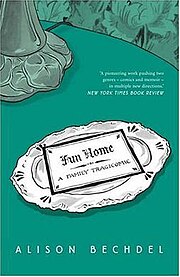
BPL Book Discussion: Fun Home

On Monday, our group tried something new-- we read a graphic novel.  For many of my "mature" ladies, this was a new experience, one that they were a bit nervous about.  But I am happy to say not only did we all survive, but also we had had a great discussion.

Yes, I led a book discussion on Fun Home by Alison Bechdel with a group of mostly senior citizen women.  It was a great experience and really tested my skills as a facilitator.  I often can coast when I lead the group, but making them move out of their comfort zone, pushed me to leave mine too.  In the end I think we all appreciated it.

For the record, I love this book.  It made my best of the year reads in the first year I did one of those posts.  I also read the sequel in 2012, Are You My Mother?, and although I did not like it as much as Fun Home, when you read the sequel, you learn quite a bit about what went into the creation of Fun Home.  That made me appreciate Fun Home even more when I re-read it last week.

But enough intro, let's get to the normal book discussion report format which begins with the publisher summary:
In this groundbreaking, bestselling graphic memoir, Alison Bechdel charts her fraught relationship with her late father. In her hands, personal history becomes a work of amazing subtlety and power, written with controlled force and enlivened with humor, rich literary allusion, and heartbreaking detail. 
Distant and exacting, Bruce Bechdel was an English teacher and director of the town funeral home, which Alison and her family referred to as the "Fun Home." It was not until college that Alison, who had recently come out as a lesbian, discovered that her father was also gay. A few weeks after this revelation, he was dead, leaving a legacy of mystery for his daughter to resolve.
I have been asked recently why I always use the publisher's summary for my book discussion reports whereas in my reviews, I use my own words.  I do have a reason, and since I was asked, I will share the answer.  It is two-fold.  First, Kathy and I try to use the publisher's summary when we create our ballot for the groups to vote on the titles we will do for the 6 month planned period.  We do this so that we are not unconsciously swaying the vote by including an opinion, either our own or from a review.  I think it keeps the list more objective when it is presented for voting.  Stemming from that, second, I use the same words here so as not to color to insert too much of my opinion into these reports.  They are different from my What I Am Reading reviews.  Those are about my experience with a book.  These BPL Book Discussion reports are about the group, not me, so I use the publisher's description to emphasize that.

Now on to the discussion:
  • Come on, you know what is first.  We voted and I got 5 liked, 3 disliked, and 6 so-so.  As we discussed more, it turns out many of the so-sos were because they could not connect with Bechdel as a narrator.  Interestingly, this is a complaint I have heard about this book before.  I also want to note that one of the likes was a participant who is a fan of Bechdel's comic strip, Dykes to Watch Out For, and she loved seeing Bechdel's personal story.  She said it helped her to appreciate the strip even more.  If you are interested in the strip, we do carry the collections at the BPL.
  • Of course, since this was our first experience reading a graphic novel as a group, I started by asking about the pictures.  Here are some of the comments:
    • I wasn't sure I would enjoy reading a memoir with pictures but it helped the story.
    • The pictures were memorable, detailed, and enhanced the story.  I especially liked how the pictures of the father working on the home and the garden showed how distant he really was.
    • The art is so powerful it magnifies the feeling of the story.  It really showed us how unhappy the family was.
    • It got me into the story more.
    • Bechdel's journals and her OCD tics that began appearing in them were more moving to see on the page rather than just have them described.
    • These were just the initial comments, they got more used to using the text and pictures in tandem to talk about the book as the discussion went on.  Keep reading for more on that.
  • I do want to mention that fairly early on in the conversation one lady raised her hand and wanted to ask about homosexuality in general.  She wanted to know "if they were born this way." First, I want to say I think she really wanted to know more, she was not trying to judge, but second, I also knew this was not the place or time to get into a conversation like this. Personally, I am an out spoken proponent of gay rights, but that was also not the point of the book.  I was on guard for this question coming up and said to that person, "We can have that discussion privately later and I can suggest some books for you on the topic, but since that is not what this book is about, I don't think it is appropriate for our discussion."
  • Which led to my next question: Why did Bechdel write this book?
    • To forgive herself. To forgive her dad
    • To come to terms with his death by understanding his life
    • It is about her assessing all of her losses in her life and trying to get down to a larger truth about herself and her dad.
    • It is memoir so it is the perception of her past from a perspective in the future.
    • Memoirs are spearheaded by emotion or something that is eating you up alive.  You have to get it out.  (A member who has written, but not published, a memoir)
    • I was troubled by the fact that she does all this soul searching but there is no huge cathartic moment.  However, another person added that she felt that was the point; Bechdel could try all she wanted, but she would never know if her coming out to her dad finally pushed him over the edge. She will never know if he killed himself or if it was an accident.  It is impossible.  So the book is more about the coming to terms process.
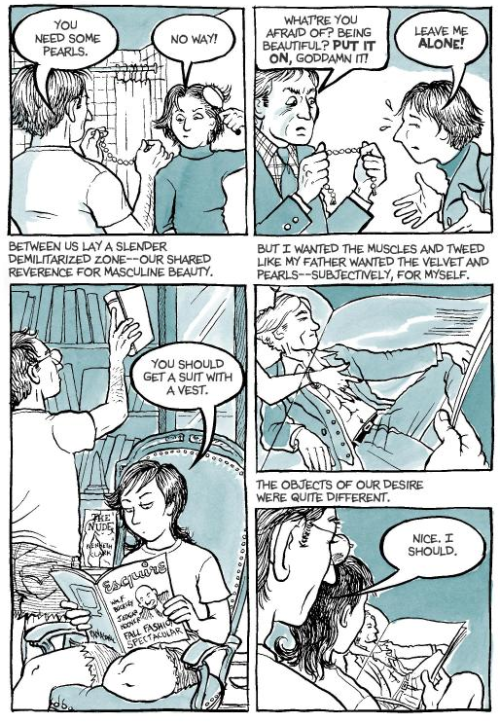
  • We talked about the fact that each family member was a talented artist and that as artists they were all self absorbed.  This made them more unhappy and alienated from each other.  One person had us all turn to the picture on page 134 (seen right above this text) and how it drove this point home more than pages of written words could.  The house becomes a reflection of the inner soul of the family life in this picture.
  • We talked about how the mom and dad in particular were self absorbed as a coping mechanism to deny the truth.  The dad focused on the house and making it perfect to hide his secret of being gay and to keep himself from cruising for young boys.  While the mom knew what was going on, but had her music and acting to distract and consume her.
  • While we are talking about specific drawings.  Another person pointed us to page 99 (seen above) because for her it illustrated the inner turmoil Allison and Bruce had with each other and with the true selves they were denying. This intricate layering is the crux of the entire memoir, yet it is hard to explain in words.  We talked about this page and how in 5 panels, she boils down the entire theme of the book.
  • Someone shared that she was amazed at how every single panel in the book connects in some way with her relationship with her father.  This was an amazing feat and held her in awe of Bechdel's talent.
  • As a book group, we loved the focus on books and reading throughout this work.  There are so many literary illusions.  Allison and her father's largest connection to each other was through their shared love of reading and analyzing literature. Books were also a way they could be honest with each other, and send each other messages they were not able to voice out loud.
  • We did tackle the question at the heart of why Bechdel started writing this book-- did her father die in an accident or did he kill himself?  We took turns sharing our opinions.  We went back and forth for awhile.  What I can share here is that like Bechdel, we have no idea.  I guess we came to the consensus that it was probably not a planned suicide for that moment, but with the divorce pending and Allison coming out, Bruce was probably tired of all the lies and might have slipped on purpose.  But again, who knows. The reason I had us talk about it was for us to see how frustrating it was for us to not know.  Then I said, "Imagine what it was like for her."  Again, this brought us back to a better understanding of the "why" Bechdel bared her soul in this book.
  • I moved us to talk about the color palate since it is so distinctive. Fun Home is done in what is called a single color technique.  She used black, white, and then shades of blue.  Here are comments about the color palate:
    • It underscored the somber tone
    • It made it easier to follow
    • The 1 color unified the work for me and made it flow better
    • The simplicity of using only carefully chosen words paired with intensely complex pictures added to the complexity of the emotions portrayed.  The 1 color enhanced that.  More would have been distracting and taken away from the beauty of the complexly detailed pictures.
    • It was like she, Bechdel, was living in a world that was all grey after the death of her father.  The book was written as she is waiting for the sunshine.  She is looking for the sunshine with the book, the bluish-gray tones underscored that.
  • We talked about the parents' marriage.  This came up throughout, but I combined it all here:
    • Why did the mother marry him? We felt like as an artistic, independent woman in the 1950s and 60s, Bruce presented freedom to her.  She knew he was gay, but she also knew he wouldn't come out.  She could have a family and an artistic life and still be free to do her own thing as long as she let him do his own thing too.
    • Why did Bruce not come out?  Bechdel struggles with this.  She does mention maybe he was not easily tagged as "gay." maybe he was bisexual, maybe he didn't know what he was.  It was a different time It was troubling that he might have been a pedophile though. Some thought the divorce stemmed from this.
    • Why stay in such a small town.  The mother seemed confined by it.  She thought they would stay in Europe, but the family business, The Fun Home (Funeral Home), brought them back.  We thought we learned more about Bruce by seeing how he lived the part of his life as a funeral director.
    • Why did the mom finally file for divorce? She was sick of him getting caught with young boys.  Allison coming out gave her the courage to take her life back.  She felt confined and couldn't take it anymore. 
  • I did ask about Bechdel as a narrator since it had come up earlier.  While no one found her warm and fuzzy, most thought she was very authentic.  Even those who did not "like" her as a narrator felt she was effective and reliable.  We appreciated her willingness to open up to the reader and let us in to her healing process.  
  • We were emotionally drained after this discussion but I pressed the group to give me words or phrases to sum up the book:
    • somber
    • cathartic
    • raw truth (I liked this one)
    • sad
    • healing
    • well written
    • drek (she did not like it and would not elaborate as to why) 
    • literary
    • literate
    • composite of emotions
    • expressive
    • confessional
  • For the record, I did use the questions in the right gutter of this blog as a guide for the discussion, but much of what we talked about came up organically as we discussed the book.
Readalikes:  Back when I first read Fun Home, I had readlaikes here.  And then last year when I read Bechdel's follow-up Are You My Mother?, I had more suggestions here, including The Glass Castle which is another memoir of a dysfunctional family that we also read in book club.

Two newer graphic novel memoirs that have a similar somber, raw truth, confessional tone that have also received intense critical acclaim are My Friend Dahmer by Derf Backderf and Stitches by David Small.  My Friend Dahmer is an interesting parallel because while Fun Home is all about Bechdel coming to terms with her possible role in father's death while Dahmer is the recollections of a childhood friend of the serial killer coming to terms with his own guilt.

Bechdel mentions the book And the Band Played On in Fun Home also. I would highly recommned this groupdbreaking work on the origins of the AIDS epidemic.

If you are looking for another critically acclaimed LGBT themed title, go to the Lambda Literary Foundation's website.  I personally really enjoy the work of David Leavitt. On NoveList, I wrote this about him and his style:
David Leavitt writes award-winning literary fiction, short stories, and nonfiction from the gay perspective. His empathetic characterizations make Leavitt's books popular with all audiences. Leavitt also edits collections by gay writers. He uses all his works to illustrate the daily difficulties of being gay in a dominantly homosexual world. Whether it is a fictional writer struggling to live openly, the biography of a brilliant mathematician, persecuted for his sexual orientation, or his own travels through Italy, Leavitt's work goes beyond the sensationalism of gay sex (although it is there), focusing more on the humanity of individuals and their relationships with the world. Start with: The Lost Language of Cranes (fiction) or The Man Who Knew Too Much: Alan Turing and the Invention of the Computer (nonfiction).
I think Leavitt and Bechdel have a similar feel, although it is important to note that some fans of Bechdel enjoy her work for its strong feminism, and they would not get this from Leavitt.

Tuesday, March 19, 2013

Final Say on All The Best Books of 2012

While yesterday I asked you to talk about the books on the horizon that you are most anticipating, today, I want to take one last look back at 2012.

Williamsburg Regional Library’s Blogging for a Good Book and specifically, chief compiler, [and all around good guy] Neil Hollands creates an annual compilation of "All the Best Books" from 120 sources.

Click here for access to the final spreadsheet on Blogging for a Good Book. The post also has links to Neil's in depth break downs for each genre.

I have been following the ABBC over the last few months, but waited for this final post to make it easier to link everything all in one place.

Here is why you need to click through and pay attention to it too:
  1.  In the rush for everyone to get out their "Best" lists at the end of the year, we lose perspective.  Too many best books are thrown at us all at once, during what is already a busy time of year.  Now, in mid-March, we can have perspective and distance to appreciate the list.
  2. It includes over 2200 books that someone considered the best.  This gives you, the RA librarian, a wider range of titles to suggest to patrons.  And as we know, our patrons have a wide range of tastes, so the widest possible range of suggestions is appreciated.
  3. Neil's genre breakdowns serve as a good collection development tool.  You can assess the state of your holdings based on these genre best lists as well as use them as a reading list for yourself if you need to brush up on a genre.
  4. Finally, they want to share this with you. Take them up on this generous offer.
There will be one more final spreadsheet coming out at the end of March, but RA for All will be on vacation then, so I didn't want to wait.