RA FOR ALL...THE ROAD SHOW!

I can come to your library, book club meeting, or conference to talk about how to help your readers find their next good read. Click here for more information including RA for All's EDI Statement and info about WHY I LOVE HORROR.
Showing posts sorted by relevance for query invention of nature. Sort by date Show all posts

Tuesday, March 14, 2017

RA for All Roadshow Visits The Chicago Botanic Garden

As I mentioned in this post, tonight I am leading the first One Book One Garden book discussion at the Chicago Botanic Garden. Click through for all of the details.

Today I have the original readalike document I created for this event, a few resources I consulted in preparation for the discussion tonight, and the discussion questions I created. Next week I will follow up with a detailed report of our discussion.

Let’s get started.

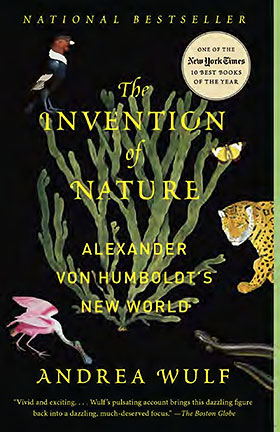
Our book is The Invention of Nature: Alexander Von Humboldt’s New World by Andrea Wulf.  From Goodreads:
The acclaimed author of Founding Gardeners reveals the forgotten life of Alexander von Humboldt, the visionary German naturalist whose ideas changed the way we see the natural world—and in the process created modern environmentalism. Alexander von Humboldt (1769–1859) was an intrepid explorer and the most famous scientist of his age. In North America, his name still graces four counties, thirteen towns, a river, parks, bays, lakes, and mountains. His restless life was packed with adventure and discovery, whether he was climbing the highest volcanoes in the world or racing through anthrax-infected Siberia or translating his research into bestselling publications that changed science and thinking. Among Humboldt’s most revolutionary ideas was a radical vision of nature, that it is a complex and interconnected global force that does not exist for the use of humankind alone. 
Now Andrea Wulf brings the man and his achievements back into focus: his daring expeditions and investigation of wild environments around the world and his discoveries of similarities between climate and vegetation zones on different continents. She also discusses his prediction of human-induced climate change, his remarkable ability to fashion poetic narrative out of scientific observation, and his relationships with iconic figures such as Simón Bolívar and Thomas Jefferson. Wulf examines how Humboldt’s writings inspired other naturalists and poets such as Darwin, Wordsworth, and Goethe, and she makes the compelling case that it was Humboldt’s influence that led John Muir to his ideas of natural preservation and that shaped Thoreau’s Walden.
With this brilliantly researched and compellingly written book, Andrea Wulf shows the myriad fundamental ways in which Humboldt created our understanding of the natural world, and she champions a renewed interest in this vital and lost player in environmental history and science.
The Invention of Nature was universally adored when it was published [much like Humboldt was in his own time]. Here are some of its accolades:
  • NATIONAL BEST SELLER
  • Shortlist -- Costa Biography Award
  • Finalist -- Carnegie Medal for Excellence in Nonfiction
  • Finalist -- Kirkus Reviews Prize for Nonfiction
  • A Publishers Weekly Best Book of the Year
  • New York Times 10 Best Books (2015)
Wulf gave many interviews when the book came out. Here are some of the best:
Click here for the readalike handout I created for this specific discussion.

And finally, here are the questions I have created to facilitate this discussion. If you chose the use this book for your group, feel free to use these but please credit this post on RA for All as your source.

Discussion Questions for The Invention of Nature by Andrea Wulf
Questions created by Becky Spratford
  1. Alexander Von Humboldt has more places named after him than anyone who ever lived on earth. He was the second most popular person in Europe behind Napoleon during his lifetime. Why is he mostly forgotten in the English speaking world? Can you think of an equivalently, ubiquitously famous person now who like Humboldt is famous, not for inventing something or discovering something but just because of who they are and how they lived their life? Will they still be remembered in 200 years? Does it matter since his spirit and ideas live on?
  2. The Invention of Nature is marketed as a biography of Humboldt, but is it more than that? 
  3. What did you think about Humboldt the guy? He was unique even in his own time. Does it matter for his legacy, for anyone's legacy.
  4. Wulf has a very distinct writing style and made specific choices in how she was going to tell Humboldt's story. What are your thoughts on how the book was organized and how the "story unfolded?"
  5. We get a few mini-biographies in this book. Do you want to talk about any of the following "characters" in more detail: Darwin, Thoreau, Goethe, Bolivar, Marsh, Muir, Wilhelm [his brother]? Others?
  6. Political situations throughout the world played a huge part in this book. Did that surprise you? How did politics, both Humboldt's own and the politics of the countries and people he deals with, effect his work, travels, and discoveries? 
  7. Humboldt was a genius "polymath," one of the last scientists who did not specialize. Why did science turn toward specialization after him? What are the positives and negatives of this move toward specialization? How does this effect all higher education today-- not just science?
  8. What would Humboldt think about our world today? What would be his reaction? How would he express his beliefs today? Blog? Twitter? Talk Show? Books?
  9. Where would Humboldt want to travel today? What would he most want to study?
  10. Who is carrying Humboldt's legacy today? Ideas: Neil deGrasse Tyson? Michael Pollan? Ira Flatow? How important is it for science to have a popular voice?
  11. What is Wulf's aim in writing this book? Do you agree with her thesis? Who would you suggest this book to? How would you entice them to read it?

Tuesday, February 21, 2017

Great Idea: One Book One Garden

Last year I was approached by The Chicago Botanic Garden’s Lenhardt Library to help them start a brand new program entitled, One Book One Garden. The Lenhardt Library is international known for their rare book collection. They are very generous with how they share these materials both digitally and in person. 
However, the staff of this wonderful treasure of a library want to expand their reach and not only share their old, rare books, but also, start current conversations surrounding books about nature. To that end they have begun One Book One Garden.
They knew that people are always interested in seeing their unique collections, but often could not make their daytime open hours. They also knew that there were many popular science books focused on nature that fit with the Botanic Garden’s mission. They also already knew the Garden hosted many special events at all hours. So, why not have a series of evening book discussions at their special library? 
Way to think outside the box. Also, way to think about how to serve the entire community better. Science based conversations are obviously lacking out in the lay world, and we are now seeing the negative consequences of that in the political sphere. And without public funds, science suffers. They know this at the Chicago Botanic Garden. They have a successful outreach program which gives discounted visits to all Chicagoland residents through their public library cards. They understand that if the public cannot come to see what science is in their real life, how can we expect them to support it, let alone understand it.
The only thing they were missing to make this all happen was book discussion leadership experience. That’s where I come in. They contacted me and we set dates for March and November 2017. But the ultimate goal is for this to be a self sustaining program for them. So, staff from their library came to my RAILS book discussion leadership training. I will help them get this program off the ground. I am so excited for them.
I applaud the Lenhardt for starting a larger community conversation about natural science through book discussions. They want to invite anyone and everyone to participate and I am proud to be associated with these programs. 
I am also happily surprised at how quickly it is already filling up. As I have already mentioned, I really believe that 2017 is going to be a comeback year for the book discussion. So far, I appear to be correct in that prediction. Book discussions may be our only hope to start having conversations as a country- conversations where we actually listen to each other and don’t just have knee jerk responses to everything. Learning and change requires a two way conversation.
Today, I am posting the details on the specific discussion I will be leading next month in case you are able to sign up. [November’s details are not ready yet.] The Lenhardt has actively reached out to local public libraries. They really want these conversations to include as many different people from different experiences and places as possible. 
This is also commendable and one of the other reasons I am posting this today. All of you out there reading this, somewhere near you there is a special library that you could contact to work with. As a public library you are uniquely situated to help start conversations in the community. As a special library they bring something specialized to the conversation. Working together you can start a community conversation be it through a book discussion like this or just a program.
Use the Botanic Garden’s example to inspire you to reach out and work together too. All it takes is one phone call or email. That’s how we started. And what your community will gain is immesaurable. 
Here [and below] is all the info from their website. I hope to see some of you there. And if you live somewhere else and are doing a similar type program, please let me know.
___________________________________________
Join us for a discussion of Andrea Wulf’s most recent book, The Invention of Nature: Alexander von Humboldt’s New World.
One Book One Garden

One Book One Garden

Tuesday, March 14, 2017
6:30 – 8:30 p.m.
Lenhardt Library
Free; pre-registration required
Join us for our new program, One Book One Garden—a book discussion at the Lenhardt Library.
One of the New York Times' Top 10 Books of 2015, our featured book is acclaimed author Andrea Wulf’s most recent journey of discovery, The Invention of Nature: Alexander von Humboldt’s New World.
Wulf brings to life Alexander von Humboldt (1769-1859), an intrepid explorer and the most famous scientist of his age. Humboldt’s life was filled with adventure and discovery and he translated his research into bestselling publications that changed science and thinking. Called “the Shakespeare of the sciences” by his contemporaries, he inspired scientists, thinkers and writers including Darwin, Wordsworth and Jules Verne. Largely forgotten—despite his name gracing numerous towns, counties, bays, lakes, mountains, animals and more—Andrea Wulf’s in-depth research and compelling writing shows the myriad fundamental ways in which Humboldt created our understanding of the world.
Selections from the Lenhardt Library’s Rare Book Collection related to Alexander von Humboldt will be available for viewing during the program.
The Invention of Nature Book CoverOur discussion will be led by reader’s advisor, Becky Spratford, who trains library staff all over the world to match books with readers and lead book discussions. Please register early as space is limited.
The Invention of Nature won the Costa Biography Award 2015, the 2016 LA Times Book Prize for Science and Technology, and was selected by New York Times “10 Best Books of 2015.” Read the Times review here. 
Andrea Wulf is the author of five books, including The Brother Gardeners and Founding Gardeners. She has written for The New York Times, the Financial Times, The Wall Street Journal and the Los Angeles Times. Wulf is also the winner of the prestigious Royal Society Insight Investment Science Book Prize 2016 for The Invention of Nature.

Tuesday, April 14, 2020

Virtual Book Discussion Books and Resources: The Invention of Nature

I have been asked by a few libraries to help them find good titles to use for their Zoom book discussion meetings. Not only are regular book discussion attendees eager to get back to their book clubs, but many new people are interested in joining. One library worker told me they had double the number of participants sign up in the first day when they announced the virtual discussion!

The obvious key right now is to pick books that are easy to procure digitally [text or audio] through our streaming services and find ways to add them for multiple views at one time through OverDrive or Hoopla. Looking for older, award winning, extremely popular titles [again from a few years ago] is a great bet.

But one other important consideration that many are forgetting is to also find titles that can be discussed without someone having finished it.

[insert awkward silence]

Ahem....Yes, I did just say to pick books that can still be discussed by patrons who haven't read them.

Why? Well, in our current situation not only will we have newbies signup-- patrons who meant to finish the book but bit off more than they can chew-- but we will also have people for whom the idea of a virtual, live discussion with new people is just what they need in their quarantine life. They may not even try to get a copy of the book.

But guess what, if you choose the right book, that is okay.

Today I have a suggestion that I have used with success in a nontraditional book discussion setting AND lead a discussion where some people did not read the book and yet, still contributed positively to the discussion because they had knowledge on the topic.

The book I am talking about is the nonfiction title, The Invention of Nature: Alexander Von Humboldt's New World by Andrea Wulf. You can click here to read a series of posts I did about this book and the discussion I led of it at the Chicago Botanic Garden. There is even a post with the questions I created for this discussion and a long recap post of what happened during the discussion.

I discussed this book with a non-traditional book discussion audience. These were regulars at the Chicago Botanic Garden and volunteers for their library. These were fans of Humboldt and/or nature, no regular book club attendees. Most read the book, all had opinions about nature. We had plenty to discuss both from the book and through topics which the book touched on,

[FYI, I also did Lab Girl by Hope Jehren with this group. Click here for those posts and details.]

Feel free to use this book, my questions, and even my summary of our discussion as a guide. Or pick your own title. At the very least, consider that the book club participants right now are not all going to be those who are even familiar with how a book discussion works these days. It will be different, and not just because you are on Zoom.

In general, choose older titles, both so you can get multiple e-copies and because some people might have read the book previously. In fact, if you have a potential participant who doesn't want to re-read, provide links to in-depth reviews, interviews with the authors, Goodreads entry, and more; places people can go to "jog" their memories.

Also, nonfiction and/or books based on real event will also work well in an environment where not everyone reads the book because participants can discuss the situation, they can look up details, or they might have a connection to the source material outside of the book you are reading [that is what happened at my Botanic Garden discussion of Wulf's book; we had a published Humboldt scholar show up who didn't even try to read this book].

If you need more help running a Zoom book discussion or you need crash course training for new book club leaders, contact me. In the meantime, you should also check out the ARRT Book Club Study [which I helped to reboot a few years ago] or my "book discussion books" tag where I have archived hundreds of summaries of book discussions I have moderated over the years.

Wednesday, March 22, 2017

Book Discussion: The Invention of Nature

As I mentioned here, last week I led a book discussion for the Chicago Botanic Garden on The Invention of Nature by Andrea Wulf. If you are unfamiliar with this book, please click here and read the summary I posted as well as supplementary materials including readalikes and the questions I created.

Now let’s get right into the discussion:

  • The evening began in the rare books room of the library where we were all able to look at Humboldt's original books, maps, etchings, and illustrations. That was amazing and magical. To see the actual items we read about in the book was such a bonus. It got everyone excited to talk about the book.
  • Before we began I also mingled amongst the attendees to see what brought them to this program [a first of its kind for the Botanic Garden]. Many were shocked that I was not “a plant person.” They all were. I think they were a little wary of whether or not I could lead their discussion, but when it was over many people said they loved how I led and were surprised how well I did not being a “plant person.” I reminded them, “I am a book club person,” so together we all made a great team.
  • I also want to note that due to the fact that the Botanic Garden often has educational programs and lectures, there were a few people who came to learn more about Humboldt but didn’t read the book. Another person was there because he was an international Humboldt expert and really wanted a stage to share all of his knowledge. I did have to go into full control the discussion mode though to keep him in check. Afterward both staff and participants thank me for being firm with him and keeping him from dominating the discussion without angering him. 
  • We did have 15 attendees who read the book though. [We had around 25 total] That did mean that there were a handful of people who didn’t talk at all, but I let that go because they were really there to listen.
  • I knew this might happen, so as you can see in my questions, I did have a few that could be answered whether or not you read this book. That helped a lot.
  • I started off with a question that played off of the perception people had of me not being a “plant person” by admitting that I had never heard of Humboldt before this. What about all of you?
    • Right away people were agreeing. I have studied science and botany my whole life and I didn’t know about him.
    • I hadn’t heard of him and I was reading this book at a daffodil festival where people kept coming up to me wanting to talk about how much they loved Humboldt. It was a great conversation starter.
    • I found out there were a lot of Humboldt fans all over the place when I mentioned I was reading this book.
    • I had read another book that featured him and wanted to know more. When I saw this book discussion advertised I realized I had this book on my shelf and had been meaning to read it. 
  • Question: Humboldt was a genius “polymath,” one of the last scientists who did not specialize. Why did science turn toward specialization after him? What are the positives and negatives of this change?
    • We have so much access to so much knowledge now. No one can know it all anymore.
    • Humboldt could hold all the science we knew in his head. No one can do that now. There is too much knowledge. 
    • But we need more Humboldt’s now. People who take a broader view. Sometimes things are too specific.
    • The nature of how we integrate knowledge and learn things has changed so much since his time. He had to go experience something to know it.
    • You no longer have to “traipse over mountains” to see the top. You can view things on the Internet.
    • But touching things, experiencing them is still very important.
    • He not only knew a lot, but he could also explain complex topics to regular people. That is an amazing skill.
  • People listed some of their “A-Ha” moments from the book:
    • Learning that climate change as a result of human interference was discovered as a scientific fact by Humboldt in the 1700s! Why are people still fighting it.
    • All the people he influenced. People who we can’t imagine modern life without. People who certainly weren’t forgotten like Darwin, Thoreau, Muir.
    • Darwin said that Humboldt gave me eyes to see.
    • Humboldt said Goethe was that person for him. Goethe taught Humboldt to be poetic.
    • My “A-Ha” moment was that so much of science during his time was at the mercy of world politics. I learned so much about the complexity of European politics and wars during this time.
      • I knew these wars and conflicts were all going on, but seeing them in relation to scientific discovery and how they could help or hinder science was fascinating in and of itself.
  • Let’s talk more about how Wulf wrote this book because it is not a typical biography:
    • This book is written in a way to inspire us to be more like Humboldt’ to learn like him- using all of the sciences and all of our senses at once.
    • She wrote this book in a holistic way; it was a reflection on who he was as a man.
    • For me, it was slow at the start. Too much story and not enough science. I got into it when the science got more serious.
    • This comment led to others saying the opposite. [Becky included]. That difference was fun to explore for a few minutes.
    • The paragraphs were LONG. Once you got used to the rhythm of her writing style then it was fine.
    • The interconnectedness of his discoveries meant that the book ebbed and flowed too. You cannot create a straight narrative of his life.
    • The book leaves an impression of who he was, what he did, and the world he helped to create because of how she writes.
    • You get into Humboldt brain. She put you in his mind.
    • I enjoyed how the last few chapters were like mini-biographies of other scientists that he directly influenced. Not only were those interesting on their own, but they put Humboldt’s place in the history of science into perspective immediately.
    • It was like little bonus books.
    • I felt like this book was a little too in sync with today’s world. Did Wulf do that? Or is that Humboldt? Probably Wulf’s 21st Century life view influenced the version of Humboldt we got.
      • One person in the group who had read another book on Humboldt said that he got a slightly different picture of the man from that book.
  • Someone wanted to talk about the adventure in this book.
    • How did they not die!?! Many times they could have died. They climbed huge mountains with no equipment and tattered shoes. They drove into anthrax ravaged towns-- knowingly!
    • The adventure was a surprise. I loved it!
    • One person would have preferred more science in place of the adventure. 
    • Just the “economy of the endeavor” was adventurous. He wanted to know everything about everything. That spirit was exciting and invigorating.
  • Where/What would Humboldt most want to explore today?:
    • DNA
    • Antarctica
    • Bottom of the ocean
    • Space
      • But how could he leave earth to explore space without knowing everything about everything on Earth. I don’t think he would/could leave Earth behind.
    • I think he would be working on computers. Exploring all they could do.
    • Or improving the Internet. 
    • Today I think he would be a blogger. He could write all he wanted and use computer illustrating software.
    • He could hold court one the Internet. Have his lectures there. Talk and expound 24/7.
    • What about a radio or TV talk show?
    • He was very visual. I could see him making films
    • Giving Ted Talks.
    • Humboldt would be everywhere, on every medium today. Why wouldn’t he? He was during his time. There were just fewer options.
  • Let’s talk about Humboldt the guy because he was definitely different.
    • He probably had ADHD
    • And a bit of autism because he had trouble showing emotion and interacting with people. Even those he loved dearly.
    • Lots of great people throughout history were eccentrics.
    • I would have loved to listen to his lectures but hang out with him as a friend...probably not.
    • I would have loved to hang out with him, but I would have to be prepared to be with him.  You would learn a lot, but you wouldn’t necessarily become friends.
  • Who is carrying Humboldt’s legacy today? Sharing science with the masses:
    • Science Friday--Ira Flatow
    • Neil deGrasse Tyson
    • Michael Pollan
    • NOVA
    • National Geographic
    • Emily Graslie- Brain Scoop
    • Myth Busters
    • E. O. Wilson
  • Last minute thoughts or comments:
    • Because this biography was so three dimensional, now I want to know more!
      • A good author gets you interested enough to lean more about what you just read.
    • The scene with the horses being thrown into the water with the electric eels was very disturbing. I am still not over it.
    • This book made me realize that no matter how much we think we know, we are really just on the edge of knowledge. We need to keep challenging ourselves.
Readalikes: I created this document for the Botanic Garden full of readalikes.

My next book discussion is one where I get to be a participant only! Well, I do still have to take notes. But still, I get to be a book clubber. Yay! It’s the next ARRT Book Club Study on May 3rd. Details are here.

Tuesday, September 26, 2017

One Book One Garden-- The Sequel

Back in March, I led the first ever One Book One Garden book discussion at the Chicago Botanic Garden. We read The Invention of Nature by Andrea Wulf. Click here for all of the details on that book and our discussion.
Well, I will be back to reprise my role as the moderator of this awesome series with a discussion of Lab Girl by Hope Jahren in November.
While you have to be able to physically get to the Chicago Botanic Garden in order to participate, this  event is open to anyone and it is free.  
If you are not a regular visitor to the garden but you love discussing books, now is your chance to visit for free.
For those of you who live far away, don’t worry, I will post my handouts and the discussion report soon after the event. 
But also, for every reader of my blog, no matter where you may reside, I hope you look at this series as an inspiration to help you to rethink your own book discussions. I was  energized by leading a discussion of people who don’t normally participate in book discussions. They brought a different energy and focus that made me rethink the purpose of book discussions-- in a good way.
Working with the dedicated and enthusiastic staff for the Lenhardt Library also has made me more aware of the wide range of partnership opportunities that are out there which we do not take proper advantage of. For example, does your town have a small, niche museum or even a historical society? What about a senior center? Most have at least one of these things. But are you partnering with them to have book discussions? Have you reached out to work with them on programming? Why not? You have two unique groups of users who may not use the other's services, but both of you can benefit from bringing these groups together for a shared event. A book discussion is an easy bridge. It’s something everyone can relate to. 
So join us if you can, but if not, use this post to rethink how and where you offer book discussions. Reach out to other groups who might love to have this opportunity to have a book discussion with their patrons but don’t even know where to begin to make it happen. Be that bridge and they will remember you helped them get started. No one says you have to lead them forever, just let them know you are there to help and see what happens.
Join us for a discussion of Fulbright Award-winning geobiologist Hope Jahren's book, Lab Girl.
Hope Jahren

One Book One Garden

Tuesday, November 14, 2017
6:30 – 8:30 p.m.
Lenhardt Library
Free; preregistration required
Join us for the second installment of our new program, One Book One Garden—a book discussion at the Lenhardt Library.
Our featured book is Fulbright Award-winning geobiologist Hope Jahren's Lab Girl.
In her widely-acclaimed debut memoir, published in 2016, Jahren traces her life through stories from her childhood days growing up in rural Minnesota to her years of college, graduate school, and building three laboratories for studying trees, flowers, seeds, and soil. Growing up, Jahren found a sense of sanctuary and purpose in her father’s lab at the local community college where he taught physics and earth science. Her passion is plants and she intersperses her own stories with a fresh look at plants that will forever change how you see the natural world.
Author Cheryl Strayed notes, “Lab Girl made me look at trees differently. It compelled me to ponder the astonishing grace and gumption of a seed. Perhaps most important, it introduced me to an inspiring woman—a scientist so passionate about her work I felt myself vividly with her on every page. This is a smart, enthralling, and winning debut.”
Selections from the Lenhardt Library’s Rare Book Collection will be available for viewing during the program.
Our discussion will be led by reader’s advisor, Becky Spratford, who trains library staff all over the world to match books with readers and lead book discussions. Please register early as space is limited.
Copies of Lab Girl are available for purchase in the Garden Shop. Members may also check out a copy of Lab Girl from Lenhardt Library.

Friday, December 22, 2017

What I’m Reading: Becky’ Favorite Reads of 2017

Its my annual list of the best books I read this year, regardless of what year they were published. But, I am changing it up this year and putting my“best” books into categories. Why? Because as I was going through everything I read this year, I kept identifying favorites with caveats like, “that was the best historical fiction I read” or “that was my favorite audio.” Also I realized that grouping them in this way didn’t only make it easier for me to make choices, but it also made the list more useful to you as you help readers.

For example, knowing that I have River of Teeth on my list because it is the “Most fun I had reading a book this year,” means much more than simply listing it as a favorite.

Plus, after 10 years of “best” lists, it’s time to do something a little different. Even I am getting bored of myself.

On a side note, I am very proud of myself that there was almost 50% diversity in my favorite book choices. I actually made myself pick my favorites first and then went back and audited my results. Here are the results:

  • I have 4 straight up POC titles
  • 1 LGBTQ
  • 1 has a non binary protagonist

That’s 6 out of 13 titles listed here.

Enough intro. Here is the list with links to my full reviews either from the blog or on Goodreads.

Speaking of categories, my colleagues over at the Booklist Readers also made a fun year end list based on highly specific categories. Check it out here.

Finally, a reminder that I am starting 2018 with Sing Unburied Sing and The Changeling-- In this post I said that The Leavers would be one of those books, but it looks like I will be reading it for a book club later in 2018, so I am pushing that one back. I never got to The Changeling when I got the ARC and it is the one best speculative book I didn’t read this year.

This is my last post of the year. After a short break, I will return with some catch up reviews before beginning the regular blogging schedule again on 1.8.18.